zenpundit.com » 21st century

Archive for the ‘21st century’ Category

Strategy, Power and Diffusion

Monday, November 19th, 2012
“….and therefore, two kinds of reactions are possible on the defending side, depending whether the attacker is to perish by the sword or by his own exertions.

                                                               – Carl von Clausewitz,  On War

 “Again, if the campaign is protracted, the resources of the State will not be equal to the strain.”

                                                                 – Sun Tzu,  The Art of War 

A recent estimate for the cost of the war in Afghanistan by the Congressional Research Office is $443 billion dollars to occupy and fight a Pakistani-supported insurgency in a primitive country whose annual GDP is a mere $ 27 billion. A  figure that itself inflated by $ 3-4 billion is remittances, $ 4 billion in NGO aid and $14 billion in direct US aid (2010 figure); when you then subtract opium smuggling ($ 4 billion), Afghanistan’s legitimate economic activity may only be a miniscule GDP of  $ 2 – 3 billion.

This does not, of course, include the cost of ten years of lavish bribes for Pakistan, a portion of which was used by the ISI to support the Taliban  killing American and ISAF  soldiers  and Afghan civilians.

This is not a cost-effective or strategic way to run a war. In fact, even for a nation as wealthy as the United States there is nothing in Afghanistan worth such an expenditure of blood and treasure, especially when the bulk of our enemies appear to be based in Pakistan, not Afghanistan. You can approach a strategic problem directly or indirectly but to do so indirectly in the most expensive way logistically possible makes little sense. For example:

….Since the ‘war to end all wars’, however, war has not exactly stood still.  Although the US Defense Logistics Agency rather quaintly describes its mission in terms of a supply chain extending ‘from factory to foxhole’, it is, above all, the mobility of military violence that is central to the conduct of late modern war.  But Creveld is adamant that since 1945 the operational freedom of modern ground forces has not markedly increased, not least because their prized mobility is absolutely dependent on supplies of petrol and gasoline.  Since the end of the Second World War the use of petroleum-based fuels by the US military has soared, and as its stripped-down forces have been expected to do more with less (through technological change and outsourcing) so the fuel expended per soldier has increased by 175 per cent to an average of 22 gallons (83 litres) per day. [viii]  As Obama had US forces ‘surge’ into Afghanistan in 2009 so ISAF’s daily fuel consumption rocketed from two million to over four million litres a day. Given these volumes, it is scarcely surprising that the death-dealing capacities of the US military and its allies should have been tied in knots by ‘umbilical cords’ far more convoluted than Creveld could ever have imagined.

There are three main supply networks to be disentangled in turn.  All of them are ground lines of communication.  Air transportation is extremely, usually prohibitively expensive, and only four airports in Afghanistan are accessible to non-military aircraft, so that until 2011 only 20 per cent of cargo was flown in.  Similarly, onward delivery to combat outposts and forward operating bases has usually only involved airdrops if other options are too dangerous. Still, by the start of 2010 around 30-40 per cent of bases were being supplied by air because the Taliban controlled much of Highway 1, the ring road that loops between Afghanistan’s major cities, and its IED attacks on NATO and Afghan forces were increasingly effective.  The high cost of airdropping pallets of fuel, ammunition, water and supplies has imposed all sorts of fuel economies on the military as it attempts to reduce its carbon footprint – ‘troops have learned to sip, not guzzle’ – but it is still the case that, as one US pilot put it, ‘we’re going to burn a lot of gas to drop a lot of gas’.  According to some estimates it can cost up to $400 a gallon to deliver fuel by air. [ix] 

Neither war nor strategy are a hard science like physics. That said, there are fields of study and investigation that while not being a science are, like physics, inherently about systems or systemic relationships. Economics  and engineering are two such examples, strategy is another.  Because of this similarity, it is often profitable to employ metaphors or analogies from physics to illustrate strategic problems, as Clausewitz famously did in On War with “friction” and “center of gravity“.

Diffusion” might be another analogy for statesmen and soldiers to keep in mind.

Military force, or more broadly, national power marshaled and employed toward a vital objective represents a potent concentration of energy like a red hot iron bar. Thrust deeply into a trough of ice water, the surface of the water yields to the mass and heat of the iron bar in a furious burst of steam and boiling turbulence. Keep the bar submerged and every erg of heat will be sapped out of it by the water and the iron will emerge cold, tempered by the experience and inert. Keep the bar submerged long enough and the water will begin to rust the iron away until nothing is left.

Vast spaces, hostile populaces and deeply impoverished environments are like ice water to the molten heat of an invading power, as we have discovered in Afghanistan.

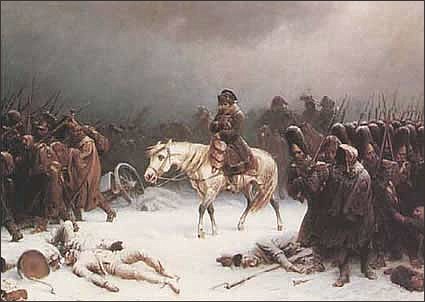
There are already old military maxims that express a warning about the risks of diffusion, notably “Don’t get into a land war in Asia” or “Don’t invade Russia in winter”.  Napoleon Bonaparte marched his vast and fabled Grand Armee of 600,000 men into the endless steppes of Tsar Alexander’s Russia. Everything gave way before Napoleon’s legions, but the Russians were not the Austrians or Prussians, they retreated, savagely burning and destroying as they went:

….Alexander’s proclamation to his people, issued at the time of the French invasion, appealed to these deep seated feelings: Napoleon had come to destroy Russia; the entire nation must rise against ‘this Moloch’ and his ‘legions of slaves’. ‘Let us drive this plague of locusts out! Let us carry the Cross in our hearts and steel in our hands!’ The proclamation was read in all the churches, and the priests supplemented it with embellishments of their own. The Comte de Segur, at this time an aide-de-camp to Napoleon, wrote: ‘They convinced these peasants we were a legion of devils commanded by the Antichrist, infernal spirits, horrible to look upon, and whose very touch defiled”

In Moscow, the city in flames, even Napoleon the Conqueror, the master of Europe, did not have enough men, or material or speed of movement to either digest and rule the immense spaces of Russia or compel Alexander to come to terms:

….Throughout the fall of 1812, Napoleon waited in vain for Alexander’s peace proposals to arrive in the Kremlin. When none came, he made overtures of his own, but Alexander sent no reply. As the days stretched into weeks, Napoleon came to see that he, not Alexander, faced a truly desperate situation, for Russia’s armies grew stronger by the day while his own dwindled from desertions and the ravages of disease. He faced the hopeless prospect of wintering in Russia without adequate food, shelter, or supplies, surrounded by a people so hostile that they burned their grain rather than sell it for French gold. As winter approached, and as the Russian partisans stepped up their attacks on his rear, Napoleon saw that his line of communications, which relied upon a perilously vulnerable corps of couriers who raced from Paris to Moscow in fourteen days, must soon collapse.

Of the Grand Armee, only five thousand returned home from the snowy wastes of Russia alive.

The Wehrmacht did little better. Hitler’s imagined drive to the Urals without a surrender and territorial concession by Stalin was a fantastical ambition. The far-flung distance, roadless mud and icy snow alone were too much for panzer armies and Luftwaffe air wings that proceeded to break down with statistical certainty. Supply lines were too long; gasoline and replacement parts were too few, as were replacements for the men for whom the Eastern Front was a grave. To the dogged resistance of the Red Army, the Germans needlessly added the people’s rage of the Russian partisans by demonstrating to the peasantry that the NKVD held no monopoly on atrocity.  Imperial Japan’s coterminous war in China tells exactly the same unhappy tale.

William Lind and the 4GW school used to like to make the point, regarding your moral and political legitimacy, that ” If you fight the weak, you become weak”. The corollary to that is economic: “If you fight the poor, you become poor”.

Grinding poverty itself  is a tax upon the invading force. There are no resources for your army to comandeer or buy, no skilled manpower to requisition or hire, no infrastructure for them to use. All of that must be imported and built at great expense by the invader whose troops are accustomed to far less spartan environs. The local population is usually malnourished, illiterate, ignorant, suspicious of outsiders and  rife with disease; their living habits and water sources unsanitary and endanger the troops. Caring for the locals, even minimal administration of humanitarian aid, becomes a bureaucratic and logistical burden consuming time and diverting resources away from urgent military needs.

The United States under George Bush the Elder, entered into Somalia, a land beset by violent anarchy and it’s people in the grip of a terrible famine and was driven out shortly thereafter under Bill Clinton. The last scenes there being the emaciated Somali followers of  a two-bit warlord,Mohammed Farah Aidid, gleefully swarming over and looting our military’s former…. garbage dump.

When the enemy has a land so poor that he treasures and makes use of the crap you throw away, the economic spillover of your logistical supply lines will fund his war against you. Used to surviving on bare subsistence, the invader’s presence becomes an economic bonanza for resistance and collaborator alike. Sort of a highly kinetic form of military Keynesianism. The war itself and the occupation become an irreplaceable cornerstone of their economy. They hate you being there, but can’t afford to defeat you and drive you out either – making a “quagmire” irregular conflict their ideal economic equilibrium to maintain.

What lessons can we draw here?

  • Keep your national power concentrated – don’t diffuse it with unmanageable, ill-defined, tasks of unlimited scope
  • Military power is to be used for a clear and articulated policy end with a defined political settlement in mind
  • If a political settlement is impossible because the problem is intractable, avoid involvement.
  • If you cannot avoid getting involved (i.e. -you were attacked) your best option is to engage in a punitive expedition to destroy the war-making capacity of the enemy and impose  ruinous costs and then immediately leave.
  • Keep campaigns short. In operation, military power is a terrible, swift sword and you should sheathe it just as quickly. 
  • Ruling over enemy population is a wasteful, thankless, burden not to be undertaken except in extremis (Reconstruction and occupation of Germany and Japan were in extremis cases).
  • Maximum gains accrue from the most effective use of the smallest possible force in the shortest period of time.
  • Make an army large enough and the enemy will become a secondary or tertiary concern of its leaders.

 

New Book: The Rise of Siri by Shlok Vaidya

Tuesday, November 13th, 2012

The Rise of Siri by Shlok Vaidya 

Shlok Vaidya has launched his first novel,  dystopian techno-thriller in e-Book format entitled The Rise of Siri.  Having been the recipient of a late draft/early review copy, I can say Shlok on his first time out as a writer of sci-fi has crafted a genuine page turner.

Companion site to the book can be found here –  The Rise of Siri.com

Blending military-security action, politics, emerging tech and high-stakes business enterprise, the plot in The Rise of Siri moves at a rapid pace. I read the novel in two sittings and would have read it straight through in one except I began the book at close to midnight.  Set in a near-future America facing global economic meltdown and societal disintegration,  Apple led by CEO Tim Cook  and ex-operator Aaron Ridgeway, now head of  Apple Security Division, engages in a multi-leveled darwinian struggle of survival in the business, political and even paramilitary realms, racing against geopolitical crisis and market collapse , seeking corporate salvation but becoming in the process, a beacon of hope.

Vaidya’s writing style is sharp and spare and in The Rise of Siri he is blending in the real, the potential with the fictional. Public figures and emerging trends populate the novel; readers of this corner of the blogosphere will recognize themes and ideas that have been and are being debated by futurists and security specialists playing out in the Rise of Siri as Shlok delivers in an action packed format.

Strongly recommended and….fun!

A Tale of Two Victories and Two Falls

Sunday, November 11th, 2012

My co-blogger Charles Cameron is fond of his “DoubleQuotes” postings that feature frequently uncomfortable juxtapositions designed to prod thinking. Here’s a wordier one from me:

….Planning for a second term has been under way for months, with Lew and Pete Rouse, the counselor to the president and Obama’s internal management guru, preparing lists of possible promotions and nominations. The staff process has been gossiped about by the staff, but details have been kept secret, even from insiders.

“They haven’t even made calls. People haven’t been asked,” said a Democrat familiar with the situation. “They’re more targets than they are potential nominees.”

Now, officials will start to cement their departure dates, and aides will sound out colleagues about possible new roles. Among the top current officials expected to go: Treasury Secretary Timothy Geithner, Secretary of State Hillary Clinton, Defense Secretary Leon Panetta, Energy Secretary Steven Chu, Interior Secretary Ken Salazar and Lisa Jackson, administrator of the Environmental Protection Agency.

Attorney General Eric Holder and Transportation Secretary Ray LaHood might not be far behind — or may even beat them out the door.

There’s also a growing list of people the administration is looking to find spots for: Massachusetts Gov. Deval Patrick most of all, as well as former Michigan Gov. Jennifer Granholm and outgoing North Dakota Sen. Kent Conrad.

Obama has overseen one of the most stable cabinets in history — the only departures have been Defense Secretary Robert Gates, and Gary Locke and John Bryson from Commerce. But what’s about to happen amounts to an almost full-scale second transition: 


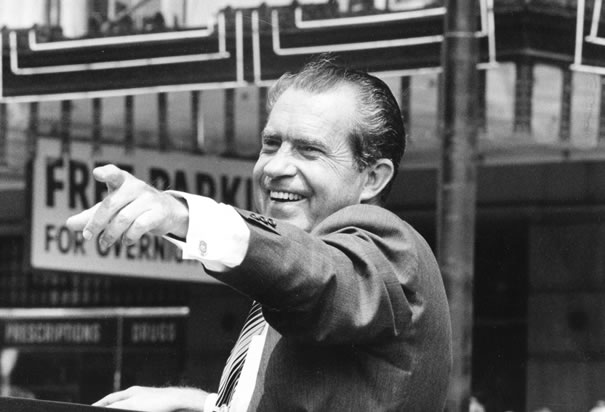
….At eleven o’clock in the morning, Nixon met with his staff in the Roosevelt Room. To many in the room he seemed oddly cool and quietly angry as he thanked them all for their loyalty and said something few of them understood. He said that he had been reading Robert Blake’s Disraeli and was struck by his description a century ago of William Gladstone’s ministers as “exhausted volcanoes” – and then mumbled something about embers that once shot sparks into the sky.

“I believe men exhaust themselves in government without realizing it” the president said “You are my first team, but today we start fresh for the next four years. We need new blood, fresh ideas. Change is important…..Bob, you take over.”

Nixon left then, turning the meeting over to Haldeman. The men and women of the White House stood to applaud his exit, then sat down. The chief explained what Nixon’s words meant: a reorganization of the administration. He told them that they were expected to deliver letters of resignation before the end of the day, then passed out photocopied forms requiring them to list all official documents in their possession. “These must be in by November 10,” he said. “This should accompany your pro forma letter of resignation to be effective at the pleasure of the President”. They were stunned. Speechless. Were they being fired? Haldeman said they would know within a month whether or not they could remain. At noon, the same drama was played out with the entire Cabinet, with Haldeman again passing out the forms.

Ironically, one of the many Cabinet secretaries Nixon ignominiously fired in his bid to centralize power in his White House staff was his former 1968 primary rival, HUD Secretary George Romney, father of 2012 Republican nominee, Governor Mitt Romney.  A blow from which George Romney’s political career never recovered. Nixon’s relationship with Romney had been an acrimonious one, formally polite on the surface with public shows of confidence by Nixon and machiavellian intrigues behind the scenes to undermine Romney and reverse the policies he had been advancing in Nixon’s name.

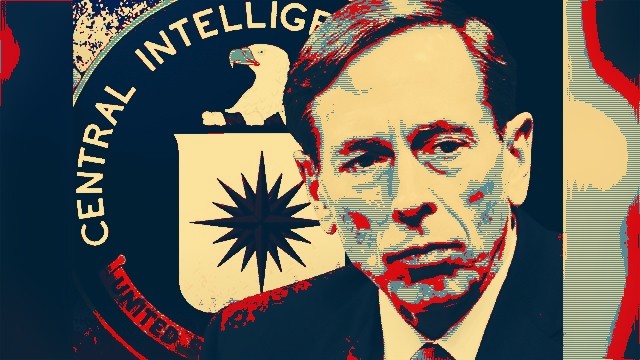
This latest Cabinet reshuffle to build a “Team without Rivals”, comes in the context of an explosive story, the abrupt resignation Friday of CIA Director General David Petraeus, citing an extramarital affair and accepting responsibility for “extremely poor judgment” and “unacceptable conduct”. The affair, allegedly conducted with his official biographer, came to light during a still not fully explained FBI investigation into unauthorized accessing of Petraeus’ private email account. The resignation of the highly regarded General Petraeus comes just before he was expected to testify before Congress regarding discrepancies and questions in the administrations handling of the terrorist attack in Benghazi that killed Ambassador Chris Stevens and other Americans. It also coincides with the Secretary of State Hillary Clinton, declining to testify.

It is difficult to say if General Petraeus public career will survive this scandal that he has brought upon himself, an action which stands in jarring contrast to his sterling, some might say superhuman, record of service to America, or if he will, like George Romney, fade away. Certainly, the CIA badly needed to stop the revolving door on the Director’s office and have a strong, visionary, hands-on leader who could reform and invigorate the Agency not merely in terms of covert action but in terms of rebuilding of capacity in deep cover clandestinity and the acquisition of strategic intel. I do not often find myself in agreement with Senator Feinstein but she is correct, this resignation hurts because it is also a significant institutional opportunity cost for the IC. I too wish it had not been accepted  – at one time it wouldn’t have been – but that is the President’s prerogative.

What however are the real issues? What should we be looking for?

Two things: As with Richard Nixon’s second term machinations, with such sweeping changes personnel changes in the offing for the Obama administration, ask yourself as events unfold: “Where is power flowing? And Why?”

If you do you will be in a better position to game out the direction of the next four years, especially in foreign policy and national security.

The White House has attempted to sell a story that the FBI doing a low-level harassment investigation  stumbled upon a security breach and – on their own authority, mind you – tapped the email account of the Director of the CIA and kept him under surveillance and investigated his mistress and, oh, yeah, the President was only informed of this business after the election on Thursday. Wait! And the DNI ( a three star general whose career was primarily intel administration) on his own initiative called the CIA Director ( a four star general and former theater and combatant commander) in on the carpet and fired him told him to resign. Right.

No, what most likely happened was that the minute the special agents realized who was involved in their investigation and the magnitude of the implications, they stopped and informed their superiors and the matter went up the chain to the FBI Director’s desk. The FBI Director, a former prosecutor with a political antennae circumspect enough to be appointed by George W. Bush and have his term be extended by Barack Obama, would have duly informed the Attorney-General of the United States before proceeding further and – I expect – the National Security Adviser, White House Chief of Staff and the DNI. Worst case scenario thinking in terms of national security would have been one driver. Another would be the fear of an all too juicy story leaking and the media catching an unbriefed POTUS unaware on the campaign trail with a blockbuster scandal before the election. How would that have gone over?

I would further expect that we will in the next few days and weeks hear the most salacious contents of the emails between Petraeus and his biographer, leaked by anonymous officials, timed to coincide with difficult days of testimony regarding Benghazi or new appointments to the administration that could, on a slow media day, prove controversial.

Instead of being distracted by prurient nonsense unrelated to the stewardship of the Republic, time would be better spent scrutinizing the host of nominations to come, not as individuals but as “teams” for particular areas of national security and foreign affairs cutting across bureaucracies – ex. arms control, Russian relations, Mideast etc. What commonalities or congruencies emerge?

I suggest this because back when the Obama administration decided on their “pivot” to Asia, the people they selected for second to third tier workday management related to the Asia-Pacific region were all accomplished, decent, honorable public servants, but their greatest common characteristic was a lack of any professional expertise with China. We saw the same personnel gambit with the Bush administration in the run-up to the war with Iraq where the greatest disqualifier for a job with the CPA was familiarity with the Arab world, Islam or Iraq. When you want careful stratagems, you solicit the advice of experts; when you want grand and revolutionary gestures, the wheels of policy are better greased with bold ignorance. There’s a reason Nixon appointed William Rogers Secretary of State – he knew the State Department bureaucracy would largely oppose his foreign policy initiatives and he wanted someone ill-suited and uninformed in charge there who he could more easily manipulate and keep in the dark.

The sixties radicals used to assert “the personal is the political”; in the eighties, Ronald Reagan in staffing his first administration understood that “the personnel are the political” and picked people culled from Heritage and Cato. My intuition is that in the second decade of the 21st century, the inside circle of the Obama administration have discovered that ” the political are the patterns”.

The story unfolding is no longer the “smoking gun” or the compromising jigsaw piece but the entirety of the puzzle.

The Republican Party: A Strategic View

Thursday, November 8th, 2012

Generally, I eschew writing about partisan politics, but like everyone else in America – and possibly a plurality of the planet – today the election was a topic of discussion, deconstruction and debate for me.  President Obama and his supporters are reveling in their victory, Republicans and conservatives are organizing circular firing squads, but the good news for America is that the election was fair, free and unmarred by the kind of bitter partisan dispute we saw in 2000. The country has sufficient serious problems and is deeply divided enough without having that cross to bear again.

Some Democrats seem to believe the President has won, if not a “landslide’, at least a crushing victory in squeaking by Governor Mitt Romney. While that belief may be delusional, it is the GOP that is clearly in trouble despite winning nearly half the popular vote and is positioning itself to implode in an ideological civil war.

Some of the more intelligent or interesting reactions I read came from historian Ron Radosh, political scientist Dan Nexon,  conservative wonk Bruno Behrend,  blogger Dave Schuler and the NRO Corner, which had a mixture of teeth-gnashing and cold-eyed realism.

What should the once great Republican Party do?

Admit they have a problem – that a majority of Americans find the GOP to be angry, scary and a little bit nuts:

Chris Christie is not why Romney lost. MSM liberal bias, though real enough and sometimes nasty, did not stop the elections of Richard Nixon, Ronald Reagan, George H.W. Bush or George W. Bush (including the two greatest electoral landslides in American history). Even Romney, though he carries his share of blame as standard bearer for an unsuccessful campaign, is not the whole reason millions of Hispanics and women who previously voted for George W. Bush and John McCain, voted to re-elect Barack Obama.

It wasn’t Mitt Romney (who incidentally, I am no fan of) who decided to spout off  in the midst of a national campaign season about idiocies like “legitimate rape”, the Big Bang theory being from ” the pit of Hell”, that Obama is secretly a Muslim or advocating laws where the government can forcibly ram an ultrasound wand into a woman’s vagina. Really, where did that last bright idea come from – Communist China?

The problem is the Republican Party and mainstream conservatives tolerate and support the presence of angry, misogynistic, ignorant crackpots who scare away normal people. The GOP needs to recall  a lesson from Bill Buckley instead of letting the nuts set themselves up as the arbiters of what is “conservative”.

Focus on the key numbers of American democracy – 51%, 60 % and 270:

Sectarian purity is something best left for Church – at the polling booth you need a majority.

While it is the duty of the opposition party to oppose and Obama is going to give Republicans many ideas or actions worth fervent opposition in his second term, being against something is only part of the equation if the goal is to “win”. The other part is offering a positive alternative or constructive vision that diminishes your opponent while advancing your own cause – a “noble philosophy” that attracts the uncommitted, pumps of the resolve of your allies and demoralizes and daunts your adversaries. A philosophy that builds expanding, winning, governing, coalitions
.

An optimistic, inclusive, compelling narrative that makes people proud. Political music for the soul.

.

People want, pretty desperately, to buy into a positive vision that offers a great future for the country and their children that says America’s best days are yet to come. That the United States is the preeminent force for Good in the world and should unreservedly remain so. Obama cannot offer that vision and, with some exceptions, neither will his party. The GOP needs to be not just “a” but “THE” middle-class party – the party of strivers and upward social mobility, personal achievement, rising living standards for everyone and freedom. A Party that is attractive because what Republicans are for and what they do, not just what they are against. Or whom.

.

The GOP should be the natural political home of Latinos, Asians, Jews and Catholics but it isn’t. It should remember small business and entrepreneurs when voting for garbage like Sarbanes-Oxley or Federal bailouts for crony capitalists, not just when they need them at the ballot box. The truth is, given the state of the economy, Obama’s mediocre record and empty campaign, Romney should have crested toward a Reaganesque 1984 electoral landslide but he did not.

.

The Republican Party needs to change it’s current course or lose the game

“Ground Hog Day” Afghanistan Style — Lara Logan Shining Light Where Needed

Wednesday, October 10th, 2012

[by J. Scott Shipman]

This is worth the 20 minutes. Strategy without clarity, isn’t. There is no clarity or strategy to our current problems in Afghanistan.

“We have killed all the slow and stupid ones. But that means the ones that are left are totally dedicated.” Ambassador Ryan Crocker

Cross posted at To Be or To Do.
H/T Feral Jundi at Facebook.


Switch to our mobile site