zenpundit.com » America

Archive for the ‘America’ Category

Hysteria about Afghan schoolgirl hysteria

Sunday, April 28th, 2013

[ by Charles Cameron — Reuters publishes scary stuff, should have checked their facts with WHO epidemiologists first ]
.

Last time, it was the Jerusalem syndrome — this time it’s mass hysteria, not poison.

The Reuters article, Afghan girls’ school feared hit by poison gas by Folad Hamdard (upper frame, above) was posted on April 21, 2013, just one week ago.

Its key paragraphs in terms of etiology and blame are these:

As many as 74 schoolgirls in Afghanistan’s far north fell sick after smelling gas and were being examined for possible poisoning, local officials said on Sunday.

While instances of poisoning are sometimes later found to be false alarms, there have been numerous substantiated cases of mass poisonings of schoolgirls by elements of Afghanistan’s ultra-conservative society that are opposed to female education.

and:

Between May and June last year there were four poisoning attacks on a girls’ school in Takhar, prompting local officials to order principals to stay in school until late and staff to search the grounds for suspicious objects and to test the water for contaminants.

Takhar has been a hotbed of militancy and criminal activity since 2009, with groups such as the Taliban and the Islamic Movement of Uzbekistan active.

One wonders: Does Reuters employ fact checkers?

**

One wonders because…

An Editorial Note on the 2012 article Mass Psychogenic illness in Afghanistan (lower frame, above) in the WHO’s Weekly Epidemiological Monitor (Vol 5 # 22, 27 May) reads in part:

This is the fourth year where episodes of suspected mass poisoning of school girls is reported from Afghanistan. Like in the previous years the events are triggered off with one girl developing symptoms of headache, weakness, dizziness, nausea and fainting. Often these outbreaks were believed to be the work of political elements in the country who oppose girls education. Reports of stench smells preceding the appearance of symptoms have given credit to the theory of mass poisoning (chemical/bioterrorism). However, investigations into the causes of these outbreaks have yielded no such evidence so far. In the last four years over 1634 cases from 22 schools have been treated for Mass Psychogenic Illness (MPI) in Afghanistan. There are no related deaths reported.

Reuters is read by a whole lot more people than some WHO epidemiological weekly, eh?

**

Luckily, the NY Times at least posted a blog post by Matthieu Aikins writing from Kabul, The ‘Poisoned’ Girls of Afghanistan, by way of alerting us to the WHO report:

I’m willing to bet that there was no poison.

Over the past few years, thousands of girls have fallen victim to waves of alleged poisonings in Afghan schools. The government, media and education activists have blamed the Taliban, and the police in a number of provinces have produced the “guilty” parties, with some of them confessing on national television.

But last July when I investigated the subject for Newsweek, I discovered never-released reports showing that the United Nations, the World Health Organization and NATO’s International Security Assistance Force had investigated the incidents for years and had never found, despite extensive laboratory tests, any evidence of toxins or poisoning — a fact that may explain ISAF’s conspicuous silence on the issue.

I’m glad that’s been cleared up.

**

Here’s another DoubleQuote for you:
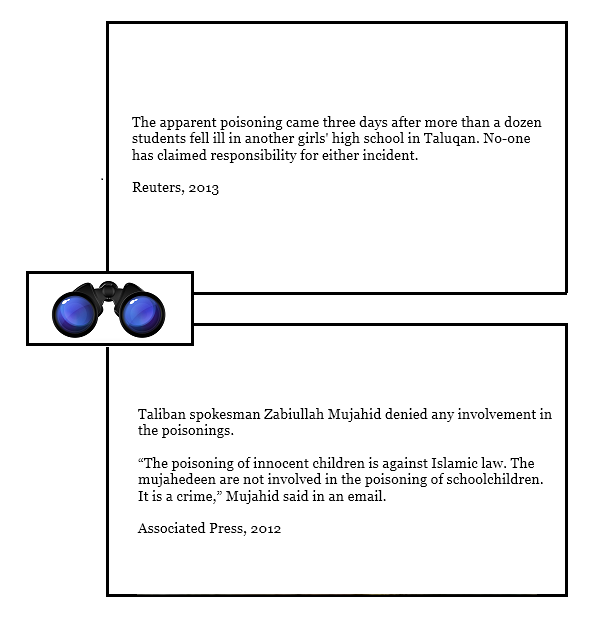
Of course, the Taliban spokesman was addressing a 2012 outbreak of the same hysteria story, and the “no claim of responsibility” report is from one of this year’s versions.

But why would anyone claim responsibility in any case, if the actual cause is mass hysteria rather than poisoning? There’s history to these things — they didn’t begin in Afghanistan:

The cases the Afghanistan incidents most resemble are the Tanganyika laughter epidemic of 1962, in which hundreds of people, mostly schoolgirls, were overcome by fits of mirthless, extended laughter, in what is now known as Tanzania, and the West Bank fainting epidemic of 1983.

The similarities between the heavily studied epidemic in the occupied West Bank and Afghanistan are particularly striking. Both places are in a state of conflict, where political violence is a fact of life, and both have powerful local rumor mills. The incidents follow a similar pattern: First a single report of a bad smell, then a small number of girls come down with symptoms, then it spreads. Local media fueled the rumors and the incidents spread in Afghanistan, just as they did in Israel and Palestine.

Albert Hefez, Israel’s lead psychiatric investigator of the incident, wrote in his 1985 study “The Role of the Press and the Medical Community in the epidemic of ‘Mysterious Gas Poisoning’ in the Jordan West Bank” that Israeli newspaper reports of “poisoning” at the start of the epidemic added fuel to the flames. A front page article in Haaretz on March 28, 1983 even claimed that Israeli military investigators had found traces of nerve gas and quoted “army sources” as saying they suspected Palestinian militants were poisoning their own people in order to blame Israel and provoke an uprising. Palestinian leaders followed up with accusations that Israel had poisoned them in an attempt to drive them from the West Bank.

And such things don’t only happen “abroad” — as detailed in that same NYT blog post I quoted above:

The phenomenon of groups of people falling ill for psychological, rather than physical, reasons is not unknown, nor is it limited to Afghanistan. Moreover, the typical victims are school-age girls. In late 2011, when a group of girls in Le Roy, New York, fell victim to a mysterious twitching illness, medical authorities eventually concluded it was psychogenic.
Only Amateurs Negotiate in Public

Friday, April 26th, 2013

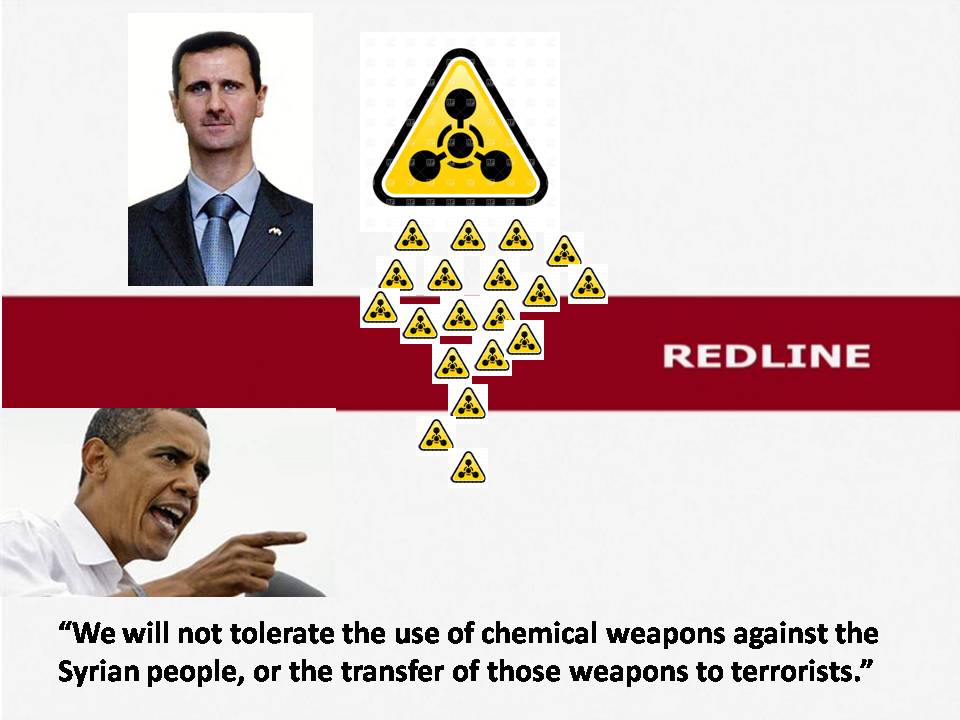
There is much buzz right now about whether the cruel Syrian Baathist-Alawite regime of Bashar Assad, struggling to hold on to power in the midst of civil war against rebel Sunni forces, crossed   President Obama’s “red line” by using Sarin gas, a war crime. That is not really the important point for Americans. There are two things to consider here.

First, specifically how would intervening militarily in Syria’s awful civil war be in American national interest?

It is important to get a clear cut answer here because everyone arguing that Assad has “crossed a red line” that we will “not tolerate” is making a de facto argument for some kind of intervention on our part. Maybe if no one can define such an interest it is because there isn’t any and intervening will bring the US nothing but costs in blood and treasure without gaining anything of strategic value. I’m not against intervention per se but there really ought to be a coherent reason so we can rationally measure it against the potential costs which, from where I sit, look rather large.

Secondly, in important matters of state, you don’t negotiate in public with a potential adversary if you really hope to gain a concession from them and if you reach the point of issuing a public ultimatum, you don’t bluff.

The people who have advised President Obama to make these “red line” statements to Syria through the media instead of quietly through diplomatic channels are either professionally incompetent at statecraft or they were hoping to manipulate the President by getting him to back himself into a corner with tough rhetoric so that if Assad did not blink then Obama would have the choice of looking weak and foolish or of approving some kind of action against Syria. Either way, the President was poorly served by this advice. Maybe he needs some new foreign policy and national security advisers who actually know something more about the world than domestic politics and being lawyer-lobbyists.

As a result that the President never really had any intentions of, say, invading Syria this year, we are now being treated to nervously asserted, lawyerly parsing of what really counts as “red lines” and what technical level of Sarin gas particulates constitutes “use”. It is an embarrassing climb down for the administration but also for the United States that never needed to happen. Empty posturing is not a substitute for a policy. Saying “Do something!” is not a strategy.

This is no brief for Assad’s regime. He’s definitely a bad actor and runs a nasty and now democidal police state he inherited from his mass-murdering father, Hafez Assad. I’m open to hearing why the US should aid in a regime change because the outcome will be in our interests in some concrete and definable way. Oh, yeah, and it might help if the person making the pitch knew something about Syria and regional geopolitics, or was at least consulted about it.

Let’s think long and hard this time.

Jimmy Chen declares DQ on War

Tuesday, April 23rd, 2013

[ by Charles Cameron — juxtaposition offers us a potent way to connect “equal but opposite” dots ]
.

Jimmy Chen at HTMLGiant captures the griefs and joyful reliefs of war by juxtaposing two war photos that had separately become iconic — and their joint impact is precisely the kind I’m reaching for with my DoubleQuotes. I’ve re-framed them accordingly and slipped them into my DQ format, and here they are:

**

In Chen’s own words:

Time may be a sedative, for it’s always harder to know who exactly the bad people were, yet so easy to tell — in the incessant now from which we cannot run — who the bad people are. Either moral clarity diminishes with time, or we simply stop caring, the euphemism being humility. Prisoner of war Lt. Col. Robert L. Stirm is greeted by his family at Travis Air Force Base in Fairfield, California on March 17, 1973, about a year after Phan Thi Kim Phuc, aged 9, was photographed running from a South Vietnamese napalm attack on their own land after it had been occupied by the North.

The specifics of those two photographs may be slowly eroding in memory, as Chen suggests — but I don’t believe their power to evoke joy or grief will fade — and I am grateful to Jimmy Chen for reminding me, once again.

Beautifully.

Like a diamond, Boston

Saturday, April 20th, 2013

[ by Charles Cameron — two quick facets ]
.

Like a diamond, the Boston “event” has many facets — here are two of them to consider:

There are many, many more, and I will be addressing one of them in detail shortly.

Sources:

  • Pundita, at the Pundita blog
  • Rafia Zakaria, at Guernica
  • **

    Boston — the city composed of its people — has been a brilliant gem itself these last few days. I do not often salute a city, but today I salute Boston.

    Aftermath: Caitlin Fitz Gerald

    Friday, April 19th, 2013

    [ Charles Cameron, introducing Caitlin Fitz Gerald ]
    .

    I was among those deeply moved by Caitlin Fitz Gerald‘s post, Boston’s Best Day, which I quoted from two days ago, and today she posted a series of tweets which again struck me. Knowing Caitlin’s love of visual expression, I invited her to take those tweets and make a guest post of them here, with an illustration should she so choose.

    Her post, both text and its illumination, follows:

    **
     
     
    Turns out I hate the theater of this. I don’t want to hear politicians talk about what happened, or about how strong we are, or anything. I just want the professionals to do what they do, find the people who did this, and along the way to keep us as informed as they can without compromising what they’re doing. I want people to grieve in their way, I don’t want this to be a political speech opportunity. Let our local religious leaders offer comfort and our community leaders direction. I’m sure others feel differently, and if it offers comfort to others, that’s wonderful, but I’ve been surprised how very much I don’t want to hear speeches from, e.g. the President on this. And if focus is on anyone, it should be on the medics and doctors and nurses and cops and firefighters and regular old people who helped each other. People keep calling them heroes, which is nice but almost undercuts the absolute gobsmacking amazingness of what they actually are: regular, good people whose instinct in a crisis was to help other people. Isn’t that more incredible than needing some superlative hero in a time like this? Isn’t it more amazing that what looks like heroism is really just what people are? How remarkable, that we all have that capacity in us. It’s not extraordinary, it’s miraculously ordinary.


    Caitlin Fitz Gerald, Aftermath


    Switch to our mobile site

