zenpundit.com » America

Archive for the ‘America’ Category

Form is insight: the funnel, part 2

Thursday, October 11th, 2012

[ by Charles Cameron — a post in my importance of form in intelligence series — following up on part 1 with a series of quotes zeroing in from context via analysis to decision — Pakistan, Afghanistan, OBL ]
.

The 2nd funnel is from Duke's Structural Biology & Biophysics Program "folding funnels" page

.

In Part 1 of this post, I introduced the form of the funnel. I want to use this form, this recognizable and repeating pattern in nature, mathematics, and the transfer of oil into car engines, to illustrate a movement in time, an imperative in intelligence, and a loss in nuance. With regard to Obama and Osama.

I shall do this by offering a series of quotes that, in various voices, take us through the zeroing in process, by which an unimaginably complex world gets sorted into a complex analytic understanding and reduced from there to a yes/no decision and a single, definitive (fatal) command.

**

Let’s start here:

The universe is a complex system in which countless causal chains are acting and interacting independently and simultaneously (the ultimate nature of some of them unknown to science even today). There are in fact so many causal sequences and forces at work, all of them running in parallel, and each of them often affecting the course of the others, that it is hopeless to try to specify in advance what’s going to happen as they jointly work themselves out. In the face of that complexity, it becomes difficult if not impossible to know with any assurance the future state of the system except in those comparatively few cases in which the system is governed by ironclad laws of nature such as those that allow us to predict the phases of the moon, the tides, or the position of Jupiter in tomorrow night’s sky. Otherwise, forget it.

Further, it’s an illusion to think that supercomputer modeling is up to the task of truly reliable crystal-ball gazing. It isn’t. … Certain systems in nature, it seems, are computationally irreducible phenomena, meaning that there is no way of knowing the outcome short of waiting for it to happen.

That’s Ed Regis, responding to the Edge Question for 2008, What Have You Changed Your Mind About?

**

What do we do about it? The great (one might say visionary) biologist Francisco Varela has something important to say about that:

Let me try and be clear in the terminology here: for every system there is an environment which can (if we so decide) be looked at as a larger whole where the initial system participates. Since it would be impractical to do this at all times, we often chop out our system of interest, and put all the rest in the background as “environment.” To do this on purpose is quite useful; to forget that we did so is quite dangerous.

**

Moving on and zooming rapidly in, here’s the state of the FBI’s understanding of Al-Qaida very shortly after 9/11.

…the business of counterterrorism intelligence gathering in the United States is akin to the construction of a mosaic. … At this stage of the investigation, the FBI is gathering and processing thousands of bits and pieces of information that may seem innocuous at first glance. We must analyze all that information, however, to see if it can be fit into a picture that will reveal how the unseen whole operates. … What may seem trivial to some may appear of great moment to those within the FBI or the intelligence community who have a broader context.

**

Michael Taarnby gives us a sense of the various drivers in play in his paper, Profiling Islamic Suicide Terrorists: A Research Report for the Danish Ministry of Justice, 2003 — note that he’s working on suicide bombers, but many of the same drivers are at work more generally among jihadists:

It should be stressed that this study was based on a sceptical view of the exclusively religious nature of Islamic suicide terrorism. The purpose was to look for alternative interpretations with an open mind. The complexity related to the importance of these parameters is not related to a hierarchical dimension since it is the interplay between the parameters that produces a suicide terrorist over a period of time. The profiling of suicide terrorists from an exclusively psychological perspective for instance is no longer valid, reality is much more complex. Nor is it just a question of political disagreements. When existing profiling techniques have failed to understand the complex issues that leads an individual to sacrifice his life, it is because of a habit of using a monocausal approach. This is not to say that psychological studies cannot contribute to terrorist profiling …

Terrorism is not moncausal.

**

The war against the Taliban / AQ is complicated, if for no other reason, then because it is inherently self-referential, contains a paradox, pushes what it pulls against. In Steve Coll‘s words:

This could not be a more complicated war. If you think about it, the United States is essentially waging a war against its own ally. The Taliban are a proxy of the government of Pakistan. We are an ally of the government of Pakistan. We are fighting the Taliban. In the end, the Taliban will be defeated strategically when the government of Pakistan makes a strategic decision that its future does not lie in partnership with Islamic extremists.

**

That’s a fairly simple complexity, something a loop diagram could illustrate nicely. But it’s more multifactorial than that, as National Security Adviser James Jones remarked at the Munich Conference on Security Policy in February 2009:

But to move forward, we must understand the terms “national security” and “international security” are no longer limited to the ministries of defense and foreign ministries; in fact, they encompass the economic aspects of our societies. They encompass energy. They encompass new threats—asymmetric threats involving proliferation, involving the illegal shipment of arms and narcoterrorism, and the like. Borders are no longer recognized, and the simultaneity of the threats that face us are occurring at a more rapid pace …

The challenges that we face are broader and more diverse than we ever imagined, even after the terrible events of 9/11. And our capacity to meet these challenges, in my view, does not yet match the urgency of what is required. To be blunt, the institutions and approaches that we forged together through the twentieth century are still adjusting to meet the realities of the twenty-first century. And the world has definitely changed, but we have not changed with it. But it is not too late, and this is the good news …

**

And so we move from the complicated business of analytic understanding to the relative singularity of an individual making a decision — Steve Coll’s words again:

As with much of modern American national security as a whole, the bin Laden raid came down to a complicated decision made by one person. Only one person is asked to simultaneously weigh the certainties, manage all the various domestic, military, diplomatic, legal, and moral considerations, and make a decision Americans will live with for years to come. It is a remarkable — some might argue impractical — burden.

**

That’s the zoom, that’s my funnel, complete in seven quotes.

Let’s take things a bit further, and examine for a moment what has been said about the man making the decision. From The American Conservative:

To read Niebuhr is to relish these tensions, to grip the fundamental balance of the moral universe. “Man’s capacity for justice makes democracy possible,” he wrote. “But man’s inclination to injustice makes democracy necessary.” The concepts gear together like great cosmic cogs. “Goodness, armed with power, is corrupted,” he wrote. But “pure love without power is destroyed.” Much of Niebuhr’s worldview depends on these balances.

Reading Obama yields a similar effect. In 2009, literary critic Andrew Delbanco pointed out in the New Republic that Obama’s books are populated by counterweighted sentences, for instance: “There’s the middle-aged feminist who still mourns her abortion, and the Christian woman who paid for her teenager’s abortion.” Obama expresses his worldview, Delbanco wrote, in sentences “organized around pairs of sentiments or arguments that exert equal force against each other–a reflection of ongoing thinking rather than a statement of settled thoughts.”

To me, that’s reassuring: the issue can still be complex as it reaches the President’s mind, even if his decision and command has to be given in a single, definitive word.

**

What happens if an impoverished understanding is at work, the wrong answer is given, the wrong decision taken? HL Mencken to the rescue with this dismal truth:

For every complex problem, there is an answer that is clear, simple and wrong.

**

And finally — where are we now?

I’ll take my answer from a series of tweets Aaron Zelin made earlier today:

Al-Qaeda has never been dead, neither have they ever been resurgent. They’ve always just hovered. Nimble, patient, and exploitative. The problem is, we are always one step behind, we were fighting the AQ of 9/11 for yrs, now we are fighting the AQ of 2009-2011. As we have changed our tactics they have changed, too. AQ and its affiliates now are not the same as they once were.
Apocalypse Revisited, not for the last time

Tuesday, October 9th, 2012

[ by Charles Cameron — Tim Tebow and 666, Charlie Fuqua and stoning disobedient children — addenda to two recent posts ]
.

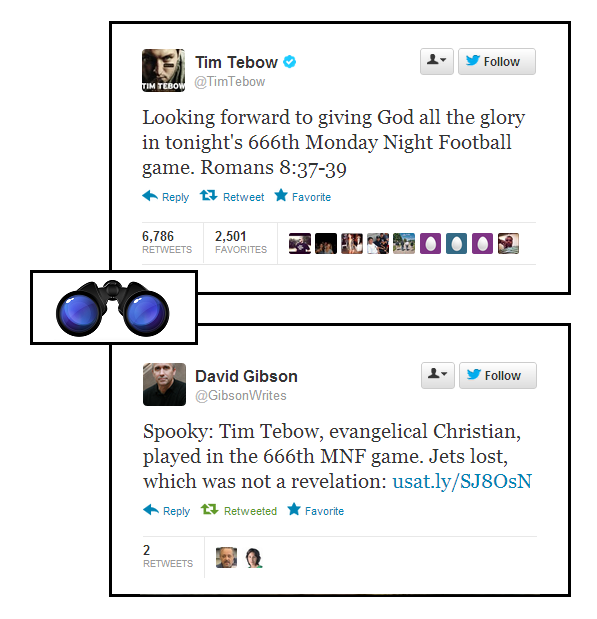
First, the more lighthearted news. Yesterday I featured three footballers prayingTim Tebow was one of them. Today: when prophecy fails on Twitter:

Just look at the retweets for Tebow: his tweet may have been half-tweet, half prediction, half-prayer, all in one forty characters, and his fans were behind it — yet the Jets lost.

At the time of writing, Tebow hasn’t tweeted for 24 hrs.

Permit me an aside, by way of clarification — as someone raised in the UK, I don’t know what “the Jets lost” means, to be honest. My Welsh ex once understood American Football while she was watching a game on hospital TV during a delivery — until the epidural wore off, at which point it went back to being incomprehensible. So that’s as close as I’ve come to understanding it myself — although I played both soccer and rugby in my schooldays.

**

Now onto more serious things. In a comment on another recent post, I mentioned Charlie Fuqua, a Republican candidate for the Arkansas House. I am beginning to think we should have a category to put after the names of such people, as in “candidate Charlie Fuqua (R-Ex)”, to indicate that many on their own team disavow their more extreme pronouncements.

In a post on his Running Chicken blog headed Today in inexplicable religious zealotry, Prof. Ari Kohen quotes the Arkansas Times on Charlie Fuqua, a Republican-side candidate for the Arkansas legislature:

Here’s the key passage from Fuqua’s 2012 book, “God’s Law: The Only Political Solution“:

The maintenance of civil order in society rests on the foundation of family discipline. Therefore, a child who disrespects his parents must be permanently removed from society in a way that gives an example to all other children of the importance of respect for parents. The death penalty for rebellious children is not something to be taken lightly. The guidelines for administering the death penalty to rebellious children are given in Deut 21:18-21:

Deuteronomy 21.18-21 reads:

If a man have a stubborn and rebellious son, which will not obey the voice of his father, or the voice of his mother, and that, when they have chastened him, will not hearken unto them: Then shall his father and his mother lay hold on him, and bring him out unto the elders of his city, and unto the gate of his place; And they shall say unto the elders of his city, This our son is stubborn and rebellious, he will not obey our voice; he is a glutton, and a drunkard. And all the men of his city shall stone him with stones, that he die: so shalt thou put evil away from among you; and all Israel shall hear, and fear.

The Arkansas Times continues:

Fuqua helpfully notes that “This passage does not give parents blanket authority to kill their children.” Rather, parents would have to “follow the proper procedure in order to have the death penalty executed against their children.” Fuqua assures the reader that, in his view, the procedure would “rarely be used.” The threat of death would, however, “be a tremendous incentive for children to give proper respect to their parents.”

**

Here’s where Prof. Kohen, Schlesinger Associate Professor of Political Science and Director of the Forsythe Family Program on Human Rights and Humanitarian Affairs at the University of Nebraska—Lincoln, adds his own informed scholarly input:

The trouble for Fuqua — and anyone else who thinks the Hebrew Bible provides a good template to follow in cases like these — is that he doesn’t actually have any idea what Jewish scholars and religious authorities have been thinking and writing about this particular passage for centuries:

In defining the extent and limitations of the laws of the ben sorer u-moreh, the Talmud (Sanhedrin 71a) states that the child is not considered liable until he has stolen his father’s property in order to acquire a tartimar of meat to eat, and a log of Italian wine to drink. The Halakha places further restrictions upon the ben sorer u-moreh so as to make the application of the law extremely unlikely, if not impossible. The rules only apply with the first three months after the child has reached halakhic manhood; both parents must be living and willing to press charges; neither parent can be deaf, lame, nor missing a limb; they must speak with the same voice and have the same appearance; the boy must steal the meat and wine from his father’s house, yet consume them elsewhere in the company of worthless individuals, in order for him to be convicted. According to the Tosefta Negaim, this law is not in effect in Yerushalayim. (The Meshekh Chokhma suggests that this is due to the continuous eating of so many sacrifices and offerings, as well as ma’aser sheni – the second tithe – within Jerusalem; consumption within the city, since it is performed for mitzva purposes, cannot be considered gluttony.) These are only a few of the numerous restrictions and limitations that apply before a boy can be judged as a ben sorer u-moreh, ensuring that the actual application of the law was extremely rare.

Several Talmudic opinions (Sanhedrin 71), having studied the above limitations, conclude that the case of the ben sorer u-moreh “never occurred and never will occur.” According to them, the sole purpose of having this section in the Torah is to learn the laws and provide a reward for those who do so.

So, in brief, here is my plea to people like Charlie Fuqua:

Stop cherry-picking the Torah to justify all of the terrible things you want people to do to one another; Jews don’t believe that things like this are mandated by the Torah and it’s our book.

**

I very much appreciate Prof. Kohen’s comments, which open a lively window not only on Judaic scripture, interpretation and practice, but also on how scriptures, their literal interpretations by outsiders, and the more skillful and adaptive interpretations of scholars within the traditions can function in the actual shaping of human lives…

When considering the scriptures of any religious tradition, we should bear such examples strongly in mind.

**

Indeed, I have only one qualification to make regarding Prof. Kohen’s post, and offer it as a small gift of thanks.

The one thing I can say that Fuqua is very likely not doing is cherry picking.

It is far more likely that he is a follower of the late RJ Rushdoony, whose massive work The Institutes of Christian Law advocates for the application of what he terms Biblical Law – in its entirety — to American society, and whose Chalcedon Institute published an article in its January 1999 issue on precisely this topic: Rev. William Einwechter‘s Stoning Disobedient Children?:

Deuteronomy 21:18-21 contains what is, perhaps, the most vilified law of the Old Testament. It is widely believed that this law authorizes the stoning of children who disobey their parents. … When this case law, which applies the moral law of the Fifth Commandment to a specific circumstance, is understood it will prove to be “holy, just, and good,” a delight to the heart of God’s true people (Rom. 7:12, 22).

This piece created a bit of a stir, and it was followed shortly thereafter by another Einwechter piece: Stoning Disobedient Children? Revisited.

Both articles seem to have proven unpopular enough that they have been removed from their respective original sites, so I am grateful that the Archive still has them as linked above. I recommend an acquaintance with Rushdoony’s work, and with essays such as these, to anyone interested in the influence of “Biblical Law” on contemporary politics.

**

By way of comparison, the Qur’an, like the Torah, stresses the importance of honoring one’s parents in close conjunction with that of having no god but God. Thus Qur’an 17:23 in the Shakir translation reads:

And your Lord has commanded that you shall not serve (any) but Him, and goodness to your parents. If either or both of them reach old age with you, say not to them (so much as) “Ugh” nor chide them, and speak to them a generous word.

— compare Exodus 20.3-5, 12 — while the hadith reported in Sahih Bukhari, Bk 48, Witness, #822 tells us:

Narrated Abu Bakra:

The Prophet said thrice, “Should I inform you out the greatest of the great sins?” They said, “Yes, O Allah’s Apostle!” He said, “To join others in worship with Allah and to be undutiful to one’s parents.” The Prophet then sat up after he had been reclining (on a pillow) and said, “And I warn you against giving a false witness, and he kept on saying that warning till we thought he would not stop.

To my knowledge, no specific (hudud) punishment for disobedient children is prescribed in the Qur’an.

At Play in the Fields of the Lord

Monday, October 8th, 2012

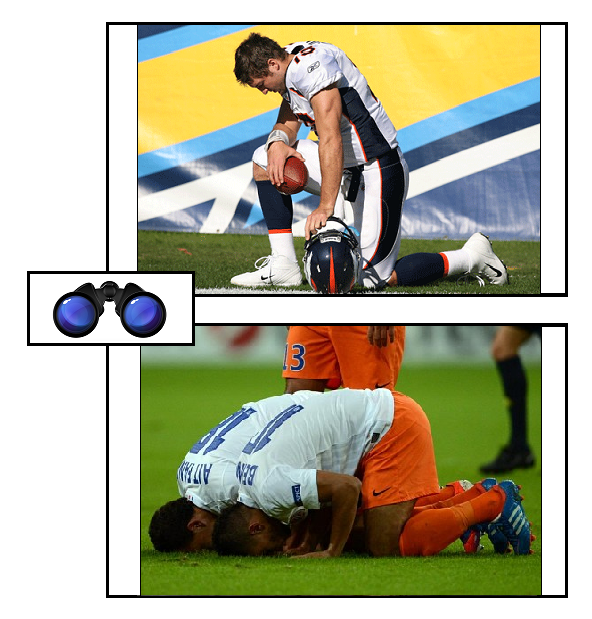
[ by Charles Cameron — two ways of playing football, two faiths ]
.

Image sources:

Tim Tebow: Urban Faith
Karim Ait-Fana and Younes Belhanda: Al Arabiya

Haaretz on the Temple Mount, pt II: axis mundi

Sunday, October 7th, 2012

[ by Charles Cameron — Jerusalem, and the Temple Mount in particular, as the still point in the turning world — Midrash, Haaretz, a map from 1581, M Eliade, TS Eliot, Navaho Night Way ]
.

There is tremendous poetic force to the notion of the axis mundi, the mythic center around which all else revolves.


.

In an earlier post, I quoted this saying, which exemplifies the power of the “center of the world” motif as applied to Israel and the Temple Mount:

As the navel is set in the centre of the human body,
so is the land of Israel the navel of the world…
situated in the centre of the world,
and Jerusalem in the centre of the land of Israel,
and the sanctuary in the centre of Jerusalem,
and the holy place in the centre of the sanctuary,
and the ark in the centre of the holy place,
and the foundation stone before the holy place,
because from it the world was founded.

– Midrash Tanchuma, Qedoshim.

**

Let’s give that room to breathe.

**

There are those who will dismiss all such images and words as irrelevant, impractical, foolish, irrational — Jerusalem is not the center of the earth any more than the earth is the center of the solar system — but to a poet they are words in a familiar language, not of fact but of imagination and love. They are poetry.

Sadly, in my view, the members of the various movements to rebuild the Jerusalem Temple on or near the sites of the Al-Aqsa Mosque and Dome of the Rock on the Noble Sanctuary / Temple Mount take the poetry of the Mount as axis mundi literally and all too politically — as happens not infrequently with authentic poetry.

Phrased as political prose, the idea just isn’t the same, as these words from Shany Littman‘s Haaretz article addressed in the prequel to this post will demonstrate:

Rivka reminded us that over and above the sheer experience and the historical tales, the visit had a purpose: to understand the essence of the Jewish home through the Temple, as the visit revolved around a bride on her wedding day. Holding up a page containing what looks like a satellite image of planet Earth, she showed how, from a certain angle, the Land of Israel and Jerusalem appear to be at the center of the world, in its innermost circle. “I give lessons to women about modesty,” she said. “I show them this image and replace the word ‘modesty’ with the word ‘inwardness.’ The innermost circle, the most hidden, is the Land of Israel, Jerusalem, the Temple, the Holy of Holies. What is modesty, what is a modest, inward place? It is hidden, the place least visible to the eye.”

But the bride was contentious: “You could take that photograph from a different angle and then Jerusalem will not be in the center.” “True,” Rivka replied, “but here we see that the State of Israel is at the heart of the world. If the world knew how much it would gain from us building the Temple, they would heap good stones on us, because they will profit from it. The most prosperous countries in the world are the Western ones; China, Africa and Asia are poor.”

A questioning eyebrow was raised. “Don’t look at the industry,” Rivka said. “Look at the miserable people, who are not allowed to have more than one child and don’t have proper housing and suffer from tsunamis and earthquakes. Look at the suffering they are undergoing. And why? Because the Jewish people resides close to the Temple, the world on this side gains; where we do not reside [i.e., the East] the world loses. This is the place that coordinates and pinpoints all the prayers and the connection with the Master of the Universe. If we are not here, they lose. And we lose, too.”

and, in the words of Prof. Weiss from the same article:

I want to take the movements to a place that is more sensible: a Temple-based state, where the state’s entire content revolves around the Temple.”

**

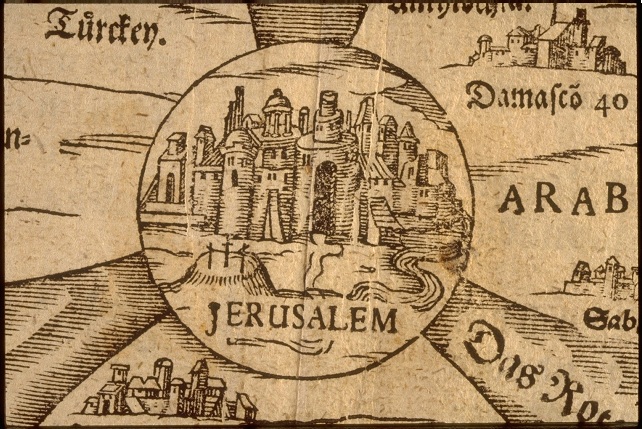
Map (above) by Heinrich Bunting from a copy of Itinerarium Sacrae Scripturae (1581) in the Jerusalem as the center of the world exhibition at the University of Southern Maine’s Osher Map Library, detail below:

**

For more on the symbolism of the axis mundi, see Mircea Eliade‘s essay Symbolism of the Centre in his book Images and Symbols — or consider these lines from TS Eliot‘s poem-series, Four Quartets:

At the still point of the turning world. Neither flesh nor fleshless;
Neither from nor towards; at the still point, there the dance is,
But neither arrest nor movement. And do not call it fixity,
Where past and future are gathered. Neither movement from nor towards,
Neither ascent nor decline. Except for the point, the still point,
There would be no dance, and there is only the dance.
I can only say, there we have been: but I cannot say where.
And I cannot say, how long, for that is to place it in time.
The inner freedom from the practical desire,
The release from action and suffering, release from the inner
And the outer compulsion, yet surrounded
By a grace of sense, a white light still and moving…

**

In many ways, both Eliot’s words and those of the Midrash remind me of the beauty found in the prayers of the Navaho Night Chant:

In beauty may I walk.
All day long may I walk.
Through the returning seasons may I walk.
On the trail marked with pollen may I walk.
With grasshoppers about my feet may I walk.
With dew about my feet may I walk.
With beauty may I walk.
With beauty before me, may I walk.
With beauty behind me, may I walk.
With beauty above me, may I walk.
With beauty below me, may I walk.
With beauty all around me, may I walk.
In old age wandering on a trail of beauty, lively, may I walk.
In old age wandering on a trail of beauty, living again, may I walk.
It is finished in beauty.

To my reading eye as a poet, these are all expressions of the same kind — invocations of the human spirit by rhythm and imagery — true poems, visions. They offer us a form of nourishment and insight not easily found today — nourishment and insight which shrivel and die when reduced to politics or prose.

**

For more on the Navaho chantways, and the balance called “sa’a naghai bik’e hózhó” which this prayer embodies, see John Farella, The Main Stalk: A Synthesis of Navajo Philosophy.

The Person / Position Paradox: once more, with avatars

Saturday, October 6th, 2012

[ by Charles Cameron — a follow up to my previous post — and it’s not religion that’s the alternate reality this time, but games ]
.


.

I just posted a long and potentially contentious post about what I called a person / position paradox: that of the member of the US House Committee on Science, Space and Technology and chairman of the US House Science Subcommittee on Investigations and Oversight, Rep. Paul Broun MD (R-GA), who said recently:

that stuff I was taught about evolution and embryology and the Big Bang Theory, all that is lies straight from the pit of Hell…

And he meant it.

**

Well, while I was writing that post, this little gem (above) crossed my bows (ht Paxsims) — so perhaps you’ll permit me to poke a little fun at a member of the other US political party.

It seems that Colleen Lachowicz, Democratic candidate for the Maine State Semnate, is also Santiaga, Orc Assassination Rogue in the game-world, World of Warcraft.

Questions arising:

Does that make her more representative or less?
what about the fact that she plays at level 68?
is that a representative level to play at?
and an Orc Assassination Rogue? really?
or is she just a candidate who happens to be a gamer?

The image above comes from the Maine GOP, btw.

**

To look at this minor contretemps from another angle: how far are we from religion, here in the land of Orcs?

The great literary critic Northrop Frye in his Anatomy of Criticism writes of:

great art using popular forms, as Shakespeare does in his last period, or as the Bible does when it ends with a fairy tale about a damsel in distress, a hero killing dragons, a wicked witch, and a wonderful city glittering with jewels.

Frye is not knocking Revelation here, though one might at first think he is: he’s assigning it to a literary genre, as one might assign the Psalms to poetry, Kings and Chronicles to history, or the Gospels and Acts of the Apostles to biography. The Epistles, after all, are already classified as epistolary works. And — give the man a break — he’s also placing it in the same realm of great art as Shakespeare.

How far, then, do you suppose CS LewisNarnia — or Tolkien‘s Middle Earth, with its Elven folk Firstborn of the Children of Ilúvatar — might be from the World where Colleen is an Orc?

**

How much room can we concede to imagination in our “real world”?

And Dante‘s voyage took him through the three realms of Inferno, Purgatorio and Paradiso, didn’t it, and according to the Apostles Creed, Christ’s Harrowing of Hell took place between his death and resurrection.

So my next question would be:

When will we build and play the games of Paradise?


Switch to our mobile site