zenpundit.com » America

Archive for the ‘America’ Category

Iconic: compare and contrast

Thursday, December 22nd, 2011

[ by Charles Cameron — iconic images, riot police, compare and contrast, repetition with variation ]
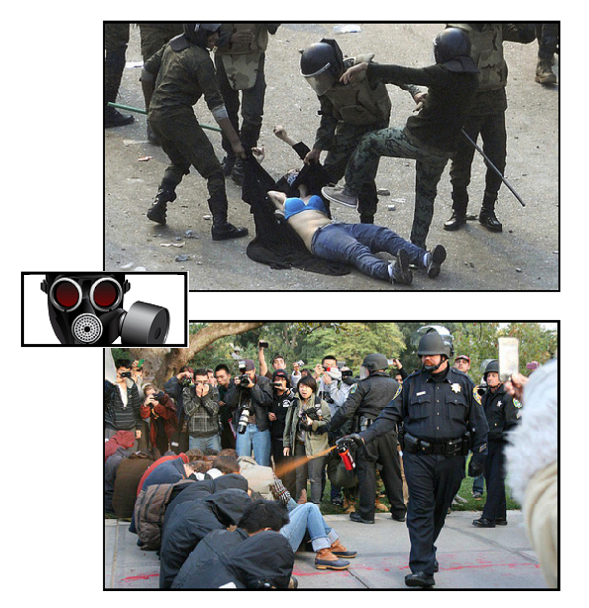
First, let’s be clear that both these images have been widely considered iconic.

Thus NPR reported of the first photo:

There have been countless accounts of violence recorded during the uprisings in Egypt but the image that perhaps has captured the most attention is the most recent. The image has been widely referred to as the “girl in the blue bra.”

While Real Clear Politics quotes Michael Moore on the second:

“The images have resonated around the world in the same way that the lone man standing in front of the tanks at Tiananmen Square resonated. It is an iconic movement in Occupy Wall Street history,” Michael Moore declared on MSNBC’s “Last Word” program.

Moore was referring to police pepper spraying students at an “Occupy” protest at UC Davis.

So we have two similarities between the two images: they both show police in riot gear taking action against demonstrators, and they have both caught the public eye as somehow being representations that can “stand in” for the events they seek to portray.

Beyond that, it’s all compare and contrast territory — or variations on a theme, perhaps — and different people will find different reasons to attack or defend the demonstrators or the police in one, the other, or both cases.

1.

These are, for many of us, “home” and “away” incidents, to borrow from sports terminology, and some of our reactions may reflect our opinions in general of what’s going on in Egypt, or in the United States.

We may or may not know the rules of engagement in effect in either case, on either side.

In a way, then, what the photos tell us about those two events, in Tahrir Square and on the UC Davis campus, may tell us much about ourselves and our inclinations, too.

2.

As I’ve indicated before, I am very interested in the process of comparison and contrast that the juxtaposition of two images — or two quotes — seems to generate. And I’ve quoted my friend Cath Styles, too:

A general principle can be distilled from this. Perhaps: In the very moment we identify a similarity between two objects, we recognise their difference. In other words, the process of drawing two things together creates an equal opposite force that draws attention to their natural distance. So the act of seeking resemblance – consistency, or patterns – simultaneously renders visible the inconsistencies, the structures and textures of our social world. And the greater the conceptual distance between the two likened objects, the more interesting the likening – and the greater the understanding to be found.

I’d like to examine these two particular photographs, then, not as images of behaviors we approve or disapprove of, but as examples of juxtaposition, of similarity and difference — and see what we might learn from reading them in a “neutral” light.

3.

What I am really trying to see is whether we can use analogy — a very powerful mental tool — with something of the same rigor we customarily apply to questions of causality and proof, and thus turn it into a method of insight that draws on our aha! pattern recognition and analogy-finding intuitions, rather than the application of inductive and deductive reason.

And that requires that we should know more about how the mind perceives likenesses — a topic that is often obscured by our strong emotional responses — you’re making a false moral equivalence there! or look, one’s as bad as the oither, and it’s sheer hypocrisy to suggest otherwise!

So among other things, we’re up against the phenomenon I call “sibling pea rivalry” — where two things, places, institutions, whatever, that are about as similar as two peas in a pod, have intense antagonism between them, real or playful — Oxford and Cambridge, say, and I’m thinking here of the Boat Race, or West Point and Annapolis in the US, and the Army-Navy game.

Oxford is far more “like” Cambridge than it is “like” a mechanic’s wrench, more like Cambridge than it is a Volkswagen or even a high school, more like it even than Harvard, Yale, Princeton or Stanford — more like it than any of the so-called “redbrick universities” in the UK — so like it, in fact, that the term “Oxbridge” has been coined to refer to the two of them together, in contrast to any other schools or colleges.

And yet on the day of the Boat Race, feelings run high — and the two places couldn’t seem more different. Or let me put that another way — an individual might be ill-advised to walk into a pub overflowing with partisans of the “dark blue” of Oxford wearing the “light blue” of Cambridge, or vice versa.  Not quite at the level of the Zetas and the Gulf Cartel, perhaps, but getting there…

4.

So one of the things I’ve thought a bunch about is the kind of analogy that says a : A :: b : B.

As in: Egyptian cop is to Egyptian protester as UC Davis cop is to UC Davis protester.

Which you may think is absolutely right — or cause for impeachment — or just plain old kufr!

And I’ve figured out that the reason people often have different “takes” on that kind of analogy — takes so different that they can get extremely steamed about it, and whistle like kettles and bubble over like pots — has to do with the perceptual phenomenon of parallax, whereby some distances get foreshortened in a way that others don’t.

5.

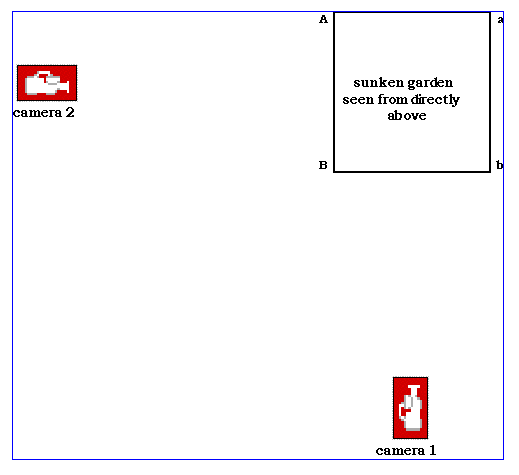
So my thought experiment sets up a sunken garden — always a pleasure, with two video cameras observing it, as in this diagram:
And from the two cameras, the respective views look like this:
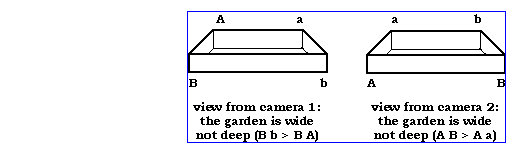
In this scheme of things, Aa (Oxford) seems very close to Bb (Cambridge) seen from the viewpoint of camera 1 — but from camera 2’s standpoint, Aa (Oxford) and Bb (Cambridge) are at opposite ends of the garden, and simply couldn’t be father apart.

6.

Now, my thinking here is either so obvious and simple as to be a platitude verging on tautology — or one of those subtle places where the closer examination of what looks tautological and obvious leads to the emergence of a new insight, a new “difference that makes a difference” in Bateson’s classic phrase.

And clearly, I hope that the latter will prove to be the case here.

7.

What can we learn from juxtapositions? What can we learn from our agreements about specific juxtapositions — and what can we learn from our specific disagreements?

Because it’s my sense that samenesses and differences both jump out at us, as Cath Styles suggested — and that both have a part to play in understanding a given juxtaposition or proposed likeness.

Each juxtaposition will, in my view, suggest both a “sameness” and a “difference” — in much the same way that an arithmetic division of integers, a = qd + r, gives both quotient and dividend.

And then we have two or more observers of the juxtaposition, who may bring their own parallax to the situation, and have their own differences.

8.

Tahrir is to Tienanmen as Qutb is to Mao?

Or is pepper spray just a food additive?

And how do icons become iconic anyway? Are they always juxtapositions, cops against college kids, girl vs napalm, man against line of tanks?  Even in the iconic photo of Kennedy from the Zapruder film, the sudden eruption of violence into the stateliness of a presidential parade is there — a morality play in miniature.

Any thoughts?
Apocalyptic Updates I: Warren Jeffs and a troubled world

Thursday, December 15th, 2011

[ by Charles Cameron — prophecy, Warren Jeffs, FLDS, Zion in the US, the future, mapped ]

.

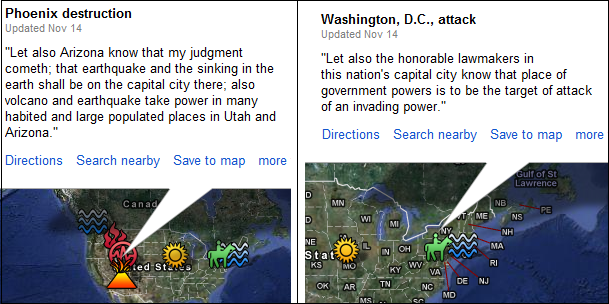
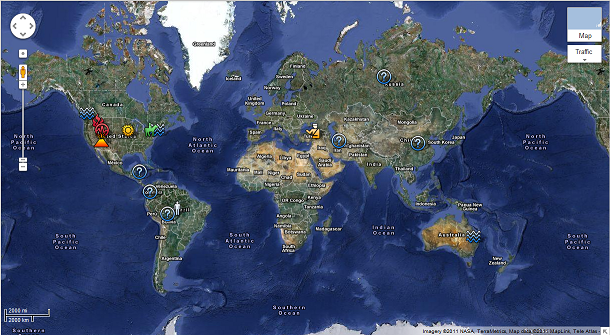
Well, there you have it: a map of where Warren Jeffs, the imprisoned president of the Fundamentalist Church of Jesus Christ of Latter-Day Saints (FLDS), prophesies there will be major problems soon, if his life sentence for child sexual assault isn’t quickly rescinded.

I’ll bet our meteorologists, intel folks and policy-makers wish they had this kind of insight into just where and what will happen next.

*

Let’s take a closer look.

That’s Africa, the Middle East and a good bit of Asia and Australasia, with not a whole lot going on to be honest.  Turkey?

Turkey helps Israel

“Let Turkey aid Israel in day of great attack against my Israel, lest you also fall and become a subject nation. Amen.”

Iran?

Iran warning

“Let the nation of Iran cease all aggressive power against neighboring lands and peoples, lest you become a nation no more; only to be of subjugation to a foreign power, to no longer be of aggression”

And that’s it for the ever-contentious Middle East.

*

And there’s good reason for that.  The Middle East isn’t where Zion is.

Take a look at the US  now, and see how much more dire the prophetic warnings are here…

An earthquake and tidal wave in Seattle, a “melting fire of such powers to cleanse my land of all evil” in Idaho, a tsunami off the East coast (Californians should be relieved) in which “great and noticeable cities on the coast shall be swept off the land ” — and more.

And that’s because the center of gravity shifts to the US when (a) Christ appears here as well as in Israel, according to the Book of Mormon, and (b) Joseph Smith receives his revelations and founds the Mormon church here.

And if that’s not enough, here are two especially significant events to be on the lookout for:

An attack on Washington, the destruction of Phoenix, and volcanoes across Arizona and Utah…

…which points us to the sites especially sacred to the FLDS — and indeed other churches in the tradition of Joseph Smith:

So that’s the hub of this whole thing, what the Temple Mount / Noble Sanctuary is to potent prophetic and apocalyptic influences in the Middle East: New Jerusalem in  Missouri.

*

So that’s your update on our future prospects as Warren Jeffs sees them.

The map was kindly provided by Lindsay Whitehurst on her Salt Lake Tribune blog, and can be found here.  Three of Jeff’s recent prophecies, containing materials used in these maps, have been made public by the Utah Attorney General’s office, and can be downloaded here and here.

Coming up shortly: Apocalyptic Updates II: Iran, the Mahdi and the Vilayat

There’s been some new analysis of the Ahmadinejad / Khamenei split at MEMRI that makes it clear that Ahmadinejad’s Mahdist claims are very much at the root of the issue, so that we have what is essentially a Mahdist vs Velayat standoff on the theological level, and a clerical elite vs populist standoff on the political.  Watch this space…

A question for the readership

Saturday, December 10th, 2011

[ by Charles Cameron — terminology of war ]
.
I have a question:

Do we have or need a term for the kind of situation where one nation, while ostensibly at peace with another, fights them by means that are plausibly deniable –- I’m thinking a campaign of sabotage, computer viruses, assassinations -– whose leaders when asked if they would care to deny them, smile like so many Cheshire Cats?

This certainly seems to be one mode of the continuation of politics by other means — and once war is declared, it would fold itself into war itself as covert and info ops — but I was wondering: is there a name for this, or do we perhaps need a name for it, in “peacetime”, as one of the forms of warfare?

I pinged Mark on this, since he’d know better than I, and he replied:

There is no legal term for such a state.

Individually, these actions either constitute “violations of sovereignty” or “criminal acts” depending on how the state chooses to interpret them, until they consider them “an act of war” (i.e. mining harbors, sabotage, assassination) and act diplomatically. Until then it is a state of “peace” under International Law.

Which leaves me wondering: is it about time we had a name for this kind of war, which the United States and / or Israel may plausibly – and deniably – be waging at against Iran as we speak?

Would it be useful to have a term for, and a legal doctrine about, campaigns of this sort?

Announcement: America 3.0

Monday, November 28th, 2011

Hearty congratulations to Lexington Green and James Bennett of Chicago Boyz on their book deal!

America 3.0

James C. Bennett, author of The Anglosphere Challenge (Rowman & Littlefield, 2004), and Michael J. Lotus (who blogs at Chicagoboyz.net as “Lexington Green”), are proud to announce the signing of a contract with Encounter Books of New York to publish their forthcoming book America 3.0.

America 3.0 gives readers the real historical foundations of our liberty, free enterprise, and family life.  Based on a new understanding our of our past, and on little known modern scholarship, America 3.0 offers long-term strategies to restore and strengthen American liberty, prosperity and security in the years ahead.

….America 3.0 shows that our current problems can be and must be transcended with a transition to a new America 3.0, based on modern technology, decentralized communities, and self-reliant families, and a reassertion of fiscal responsibility, Constitutionally limited government and free market economics.   Ironically the future America 3.0 will in many ways be closer to the original vision of the Founders than the fading America 2.0.

America 3.0 gives readers an accurate, and hopeful, assessment of our current crisis.  It also spotlights the powerful forces arrayed in opposition to the needed reform.  These groups include ideological leftists in media and the academy, politically connected businesses, and the public employees unions.  However, as powerful as these groups are, they have become vulnerable as the external conditions change.  A correct understanding of our history and culture, which America 3.0 provides, shows their opposition will be futile.  The new, pro-freedom, mass political movement, which is aligned with the true needs and desires of Americans, is going to succeed….

Read the rest here.

K2: Kissinger on Kennan

Monday, November 14th, 2011


George F. Kennan: An American Life by John Lewis Gaddis

Former SECSTATE and grand old man of the American foreign policy establishment, Dr. Henry Kissinger, had an outstanding NYT review of the new biography of George Kennan, the father of Containment, by eminent diplomatic historian John Lewis Gaddis:

The Age of Kennan

….George Kennan’s thought suffused American foreign policy on both sides of the intellectual and ideological dividing lines for nearly half a century. Yet the highest position he ever held was ambassador to Moscow for five months in 1952 and to Yugoslavia for two years in the early 1960s. In Washington, he never rose above director of policy planning at the State Department, a position he occupied from 1947 to 1950. Yet his precepts helped shape both the foreign policy of the cold war as well as the arguments of its opponents after he renounced – early on – the application of his maxims.

A brilliant analyst of long-term trends and a singularly gifted prose stylist, Kennan, as a relatively junior Foreign Service officer, served in the entourages of Secretaries of State George C. Marshall and Dean Acheson. His fluency in German and Russian, as well as his knowledge of those countries’ histories and literary traditions, combined with a commanding, if contradictory, personality. Kennan was austere yet could also be convivial, playing his guitar at embassy events; pious but given to love affairs (in the management of which he later instructed his son in writing); endlessly introspective and ultimately remote. He was, a critic once charged, “an impressionist, a poet, not an earthling.”

For all these qualities – and perhaps because of them – Kennan was never vouchsafed the opportunity actually to execute his sensitive and farsighted visions at the highest levels of government. And he blighted his career in government by a tendency to recoil from the implications of his own views. The debate in America between idealism and realism, which continues to this day, played itself out inside Kennan’s soul. Though he often expressed doubt about the ability of his fellow Americans to grasp the complexity of his perceptions, he also reflected in his own person a very American ambivalence about the nature and purpose of foreign policy.

John Lewis Gaddis was George Kennan’s official biographer, a relationship that can contradict and complicate the task of a historian to tell us “like it really was” by growing too close and protective of the subject. On the other hand, Kennan’s unusual longevity and undimmed intellectual brilliance into his tenth decade permitted Gaddis a kind of extensive engagement with Kennan that was exceedingly rare among biographers.

I will be reading this book. Incidentally, Kennan’s own writings, notably his memoirs and his analysis of a totalitarian Soviet regime, Russia and the West under Lenin and Stalin are classics in the field of modern American diplomatic history, alongside books like Dean Acheson’s Present at the Creation. They are still very much worth the time to read.

The Gaddis biography will stir renewed interest and wistful nostalgia for Kennan at a time when the American elite’s capacity to construct or articulate persuasive grand strategies have become deeply suspect. Kennan himself would have shared the popular pessimism, having nursed it himself long before such a mood became fashionable.

ADDENDUM:

Cheryl Rofer weighs in on Kennan at Nuclear Diner

….Although the telegram and article did not deal explicitly with nuclear weapons, they were the basis for the strategy of containing, rather than rolling back, the Soviet Union and thus the arguments in the 1950s against attempting to eliminate the Soviet nuclear capability and in the 1960s against the same sort of move against China. Similar arguments continue today with regard to Iran.  

 Kissinger writes a sketch of Kennan himself and adds some of his own thoughts on diplomacy. The historical context of Kennan’s insights that he presents is worth contemplating in relation to today’s situation. How much of Cold War thinking can be carried into today’s thinking on international affairs, and how should it be slowly abandoned for ideas that fit this newer world better?

Addendum II.

Some fisking of Henry the K. by our friends the Meatballs:

Kissinger refers to Dean Acheson as “the greatest secretary of state of the postwar period.”  False modesty or a ghostwriter?  Gotta be one or the other, but we are leaning towards the former because no Kissinger Associates staffer would risk the repercussions from making a call like that.

Kissinger – the great Balance of Power practitioner – admired that Kennan (at least at times) shared his Metternich-influenced approach:

Stable orders require elements of both power and morality. In a world without equilibrium, the stronger will encounter no restraint, and the weak will find no means of vindication.

(…)

It requires constant recalibration; it is as much an artistic and philosophical as a political enterprise. It implies a willingness to manage nuance and to live with ambiguity. The practitioners of the art must learn to put the attainable in the service of the ultimate and accept the element of compromise inherent in the endeavor. Bismarck defined statesmanship as the art of the possible. Kennan, as a public servant, was exalted above most others for a penetrating analysis that treated each element of international order separately, yet his career was stymied by his periodic rebellion against the need for a reconciliation that could incorporate each element only imperfectly


Switch to our mobile site