zenpundit.com » America

Archive for the ‘America’ Category

Breaking the Legions

Tuesday, October 12th, 2010


Fabius Maximus makes waves with a powerful and controversial post:

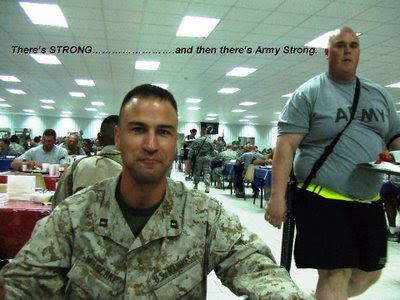
The Army and Marines are breaking, but we don’t care

Summary:  The US Army and Marines are breaking.  It’s a slow inexorable process resulting from fighting 4GWs around the world too long with too few men.  Neocon war-mongers, national leaders, and the general public remain blind to the evidence, so they can express surprise when the results eventually become too severe to ignore.  It took a decade to repair the damage after Vietnam, under more favorable social and economic circumstance than likely in early 21st century America.  Here we see another warning from a senior officer, and revisit data from the lastest Army report about this slow-growth crisis, another in a string of similar reports.  See the links at the end to other articles on this topic.

Update:  The “we” in the title refers (as always on this website) to the American people.  As the shown in previous posts and the report described here, the military quickly recognized these problems and strongly responded with measures to mitigate the damage.  Unfortunately, solutions lie beyond the state of the medical and social sciences.  Perhaps these ills result inexorably result from war.

Before the data, here’s a brief on the situation, from “Dark Hour“, Katherine McIntire Peters, Government Executive, 1 October 2010 (red emphasis added):

“This report literally whistles past the graveyard,” says retired Maj. Gen. Robert Scales, who served as commandant of the Army War College in 2000 and authored a number of books on military strategy and leadership. Suggesting that officers and NCOs or garrison staffs are responsible for a rising suicide rate because of lax leadership, as Scales reads the Army’s report, is “irresponsible,” he says. “This report basically allows people off the hook for the inability to resource these two wars with the people necessary to do it. It’s got nothing to do with politics. It’s got to do with the lack of perception of what land warfare does to a ground force,” he says. “Rarely have I ever read anything that so badly misses the mark. It’s trying to find little nooks and crannies in the Army’s management of these two wars and it absolutely misses the point of what’s been going on.”

Scales says too few troops have been carrying too heavy a burden for too long. “I don’t care if you’ve got an army of Robert E. Lees, the anecdotal evidence clearly shows the ground forces are going through an unprecedented realm of emotional stress,” he says.

Read the rest here.

ADDENDUM:

More at Wings Over Iraq:

Enough complaining, what do we actually do about suicides?

2.) Reduce the Separation Authority.  I think it’s time to admit that we face a mounting discipline problem which will require years to fix.  The instances of misdemeanor activity among soldiers has nearly doubled over the past five years.  In almost a third of those cases, no disciplinary action was taken whatsoever.
Certainly, company commanders need to take action to either rehabilitate or get rid of problem troops.  But this is easier said than done.  For example, the Army has seen a precipitous decline in the number of soldiers chaptered out for obesity in recent years.


Don’t think for a moment it’s because we have fewer obese soldiers, either.?

Part of the problem, in my humble opinion, lies with the fact that separation authority has been taken from battalion commanders and raised to the “special court-martial convening authority” (in many cases, a two-star general)–a full two levels of command. Why?  Because commanders were doing exactly what they should have been doing–kicking sub-par first-term soldiers out of the Army….
Enter Stage Right, Take Two

Wednesday, September 29th, 2010

Another Chicago Boyz colleague, James Bennett, author of The Anglosphere Challenge, had a feature article in National Review, which is now available online:

The Great U-Turn

Admirers and detractors of the United States agree on one point: This country is unusually resistant to the social consensus and set of structures broadly known as “social democracy” or “progressivism.” (Social democracy leans more toward state ownership, progressivism toward state regulation.) Various versions of such schemes have prevailed in Western Europe and Japan, and to a lesser degree in Britain, Canada, and Australia. The characteristics include a wider scope and role for the state, centralization of decision-making in a national bureaucracy, monopolization of power by a set of large institutions, including state-champion corporations and labor unions, and a wide variety of social entitlements for all citizens. This was the classic progressive economic program; since the 1960s, it has also included certain social characteristics, such as official multiculturalism.

Most of these measures were characteristic of some parts of Continental Western Europe from the late 19th century onward, and became generally prevalent there after the Second World War. The English-speaking countries lagged well behind; Britain began to adopt welfarist policies and admit labor unions to the domestic power system before the First World War, but moved to full entitlement systems and substantial state control of the economy only after 1945. Australia and New Zealand adopted entitlement systems early, using their agricultural and mineral export earnings as petro-states now use oil wealth, but remained socially conservative in many other ways. Canada was essentially similar to the U.S. in its domestic systems (despite some greater public ownership, mostly in transportation) until the 1960s. But by the end of the 1970s, America stood virtually alone in a world of seemingly universal consensus for a strong managerial state.

….America had gone some distance down this road by 1980, although not as far as Canada or Britain, and nowhere near as far as Germany or France, which had never been all that laissez-faire in the first place. But 1980 marked the point at which the nation reversed course. Thenceforth it would be headed in the opposite direction, toward a new vision of individualism and decentralism, driven by the computer rather than the plow….

Read the rest here.

Enter Stage Right

Tuesday, September 28th, 2010

Good friend and co-author Michael Lotus, a.k.a. “Lexington Green has a feature article as he debuts at The RIGHTNETWORK. Congrats Mike!

The Insurgency

Mass political movements often begin with a single, striking event. The Insurgency began in the fall of 2008, when President Bush, Senator Obama, and Senator McCain appeared together to endorse the TARP bailout.  At that moment the lights came on for many Americans. It was glaringly obvious that both political parties jointly operated the system, and the system existed to protect the well connected at the expense of everyone else. The public opposed the TARP bailouts; the banks got their money anyway. The Insurgency, long brewing, began.

The Insurgency is a movement of citizens directed against unsustainable government taxation and regulation, and spending, both of which benefit insiders rather than ordinary people. The target of the Insurgency is a leviathan in Washington, D.C. that will ruin us all if it is not dismantled. 

The Insurgency is part of a long tradition of mass political movements in our history. It has the potential to make a fundamental change in American life-for the better.

….2.  What is the Insurgency? Why now?

For now the Tea Party movement, ignited by Rick Santelli’s “Rant Heard Round the World,” is the dominant component of the Insurgency; Glenn Beck‘s gathering of hundreds of thousands of people in Washington, D.C. is another, overlapping one. The people who have gathered around Governor Sarah Palin form yet another part of the Insurgency, as do the libertarian-minded citizens who read blogs like Instapundit. Many of Rush Limbaugh‘s, Sean Hannity‘s, and Mark Levin‘s listeners are part of it. Various long-established conservative groups that have always opposed big government are now parts of the Insurgency.

There are appear to be three factors that have caused the rise of the Insurgency now, and the particular form it is taking: 1) technology, 2) a new, heightened awareness of the problem, and 3) the shock of the current crisis.

First, new technology allows massive, decentralized and horizontal organizations to form quickly. The Tea Party is the best current example: There is coordination, but no central direction. There is no one in charge, giving orders, but rather many people and groups cooperating. This is only possible due to current technology. 

“[Technology] enabled the Insurgency,

but it did not cause it.”

Technology, however, cannot by itself explain the rise of the Insurgency. After all, the political Left actually pioneered in this area: MoveOn was a highly effective internet-based organization, for example. It does seem odd, in retrospect, that a tech-savvy Left would cast its lot with a top-down, government-centric political culture. And there may be some overarching affinity between libertarian-style thinking and the new technology. But that technology is ultimately neutral. It enabled the Insurgency, but it did not cause it.

Read the rest here.

UPDATED:

Michael has published the second part of his essay: 

The Insurgency, Part II

….Mass political movements have come along several times in American history.  Some have transformed the country, and others have fizzled out. 

The movement that elected Andrew Jackson, against the vicious opposition of the existing establishment, swept through all levels of American government, rewriting state constitutions and extending the franchise to all adult White males. Jacksonian democracy caused a permanent and irreversible change in American life.  

The Populist movement looked like it would have a similar impact.  Led by the charismatic outsider William Jennings Bryan, this movement held gigantic rallies and seemed like a revolution in the making. It provoked fear and a hostile response from the establishment of its day, in both political parties. Yet the Populists ultimately failed to make a significant impact on national policy, and were absorbed into the Democratic Party. 

Today’s Insurgency could go either way. Success is not inevitable. 

Summer Series 2010: The Autobiography of Theodore Roosevelt

Tuesday, September 21st, 2010

Summer Series 2010: Reviewing the Books! continues……

The Autobiography of Theodore Roosevelt

This summer I read the autobiography of America’s greatest near-great president. It was partly a memoir but mostly idiosyncratic, stream of consciousness commentary by TR, who seemingly grew bored with attempting a dry recounting of his life within the first few dozen pages and launched into a series of never-ending and generally entertaining digressions. Teddy regales the reader with honest beat cops in New York slums, crooked saloonkeeping politicians, rugged cowboys in the twilight of the Old West, ramrod straight Army officers, genteel Harvard men, desperados, captive madmen, wild animals in locales from the silence of nature to the sound of battle with orders barked over the cries of wounded men. Every story involves a fistfight, a gun, a test of integrity and manly honor where respectable men who are “right square” do their duty without complaint and few concessions, except perhaps to a glass of whiskey “taken for medicinal purposes”.

My God, to have a president like that again!

Theodore Roosevelt was an accomplished historian and polished writer and was capable of scholarly work, such as his first book on The Naval War of 1812, or of focused popular history as in his books on the West or his account of his fabled volunteers in the Spanish-American War, The Rough Riders ( I have a 1920 edition); his autobiography is not that kind of book. While historians regard Ulysses S. Grant’s memoir as the greatest written by an American president, Roosevelt’s has a different quality. His voice comes through on the pages; it is more like he is sitting in a chair in his study at Sagamore Hill, talking to you directly, gesticulating, shouting, laughing, leaping up like a jack-in-the-box, leaning forward, face fierce with emphasis and good humor.

Roosevelt would have been a natural blogger.

The autobiography has it’s weaknesses. Despite his ability to cunningly turn a phrase, TR could have used the services of a stern editor. There are parts of this book, particularly in his recounting of minor legislative battles with creatures of the New York political machines that wander at times into redundancy and tediousness. Roosevelt’s periodic expositions into public morality and social problems of his day have a weird conflation of victorian prudishness and liberal noblesse oblige that can run so contradictory that the modern reader wonders which sentiment represents Roosevelt’s real views and which have been judiciously added for public consumption. Outspoken and impetuous in person, TR’s autobiography bears the imprint of an author who has repeatedly gone back and toned down or qualified original judgments or recollections and excised names to spare others embarrassment. Roosevelt was in many ways, a product of his era and his class.

The Autobiography of Theodore Roosevelt is not a great book but is still a good read after over a hundred years since Teddy Roosevelt last sat in the Oval Office. That’s praise enough.

Chicago Boyz at National Review

Saturday, September 18th, 2010

ChicagoBoyz.net has hit in the last few weeks a) The Glen Beck Program, b)  Rush Limbaugh and now, c) National Review. Jeez, a conservative trifecta if there ever was one.

James Bennett, who is in my experience, an extremely smart man and the author of The Anglosphere Challenge: Why the English-Speaking Nations Will Lead the Way in the Twenty-First Century, collaborated on the featured cover article in the latest edition of National Review.
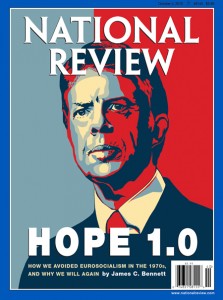

 Lexington Green has the details:

Jim Bennett Article on Cover of National Review

Bennett NR cover

The current issue of National Review features an article by my future co-author Jim Bennett:

For decades, America had been on a course toward a more centralized society. But 1980 – with the arrival of Reagan and the departure of Carter – marked the point at which the nation reversed course. Thenceforth it would be headed in the opposite direction, toward a new vision of individualism and decentralism.

I have read Jim’s piece in draft, and I strongly suggest you read it.

I second.

Congratulations to Mr. Bennett!


Switch to our mobile site
