zenpundit.com » military history

Archive for the ‘military history’ Category

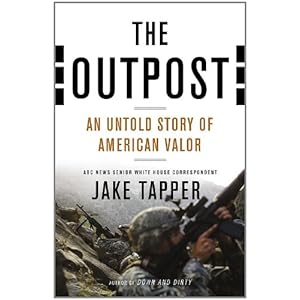
New Book: The Outpost by Jake Tapper

Thursday, October 18th, 2012

The Outpost: An Untold Story of American Valor by Jake Tapper

Influential ABC News Senior White House correspondent Jake Tapper has a new book coming out in November entitled The Outpost, about the battle of Outpost Keating in 2009 that the Taliban lost but inflicted high casualties on American troops and led to an ignominious withdrawal. Tapper’s PR folks have sent me an advance review copy, and at first glance, the book uncomfortably reminded me of Sebastian Junger’s WAR.

Sure enough, the site of Combat Outpost Keating in Nuristan is compared by Tapper to Junger’s deadly Korengal valley by page 6.  The xenophobic and remote Nuristanis were the last Afghans to convert to Islam, only by force, in the 1890’s. Their distant kin, the Kalash, are polytheists still.  Great place for an American outpost.

Looks like a gripping story. Will review in the near future.

Bassford’s Dynamic Trinitarianism, Part II.

Monday, September 24th, 2012

In Part I.  we looked at a working paper by Professor Christopher Bassford that he he has posted at Clausewitz.com entitled  Tiptoe Through the Trinity, or, The Strange Persistence of Trinitarian Warfare.  As I said previously:

At 31 pages of analytic prose, diagrams and footnotes regarding the nature of  Carl von Clausewitz’s“fascinating” trinity; how Bassford thinks Michael Howard and Peter Paret got some important points in their translation of On War wrong ; the real meaning of Politik and on the perfidy of non-trinitarians – Bassford’s paper is not a quick read but a worthwhile one. I learned some important things about On War from reading this paper and had some uncertain speculations strengthened by Bassford’s expertise on Clausewitz and Clausewitzians.  I am not going to attempt a summary of so long and abstruse an argument, but I would instead like to highlight some of Bassford’s more valuable insights. There were also a couple of points where, in stretching to make analogies with other fields, I think Bassford may be going astray, as well as some commentary I might make regarding “non-state war”.

This paper will be more digestible if we blog the topics one at a time, in succession. 

Having previously tackled Bassford’s interpretation of the “fascinating” trinity and his argument for it’s dynamic nature, the time has come to observe how he explains a concept almost as important for understanding On War, what Clausewitz meant by “Politik“. We have all heard the often quoted maxim that Clausewitz said that “War was the continuation of politics by other means”, but what that sentence actually meant has been subject to both misunderstanding and debate. Here is Bassford:

….That leaves us with the problem of Politik. This is a huge subject, for it encompasses the entire issue of the relationship between it and war; perhaps 90% of debates about Clausewitz turn on it. Let us pause for a (long) moment and consider the meaning of those problematic words, Politik, politics, and policy.

Clausewitz seldom overtly defines Politik in any detail, and when he does so the definition is shaped to fit the immediate context. In translating Politik and related words, English-speakers feel compelled to choose between “politics” and “policy.” Some even prefer the much more specialized term “diplomacy,” which limits the discussion to relations among organized states—that is how Jomini’s Politique was usually rendered into English. Our choices can seriously distort Clausewitz’s argument. Clausewitz himself would probably have been very comfortable with the word “statecraft,” the broad zone of concerns and activities within which “statesmen” operate. But that term avails us no greater clarity and might even lock him exclusively into the state, where so many modern writers want to (uselessly) maroon him. We are interested in what Clausewitz meant by Politik, of course, but our focus here is even more on the question of what we mean by policy and politics. The latter two terms are related but far from equivalent. Each captures a part of the meaning of Politik, but even used together they do not cover quite the same ground.

…..1. Politics and policy are both concerned with power. Power comes in many forms. It may be material in nature: the economic power of money or other resources, for example, or possession of the physical means for coercion (weapons and troops or police). Power is just as often psychological in nature: legal, religious, or scientific authority; intellectual or social prestige; a charismatic personality’s ability to excite or persuade; a reputation, accurate or illusory, for diplomatic or military strength. Power provides the means to attack, but it also provides the means to resist attack. Power in itself is therefore neither good nor evil. By its nature, however, power must be distributed unevenly, to an extent that varies greatly from one society to another and within the same society over time.*25

2. “Politics” is the highly variable process by which power is distributed in any society:the family, the office, a religious order, a tribe, the state, an empire, a region, an alliance, the international community. The process of distributing power may be fairly orderly—through consensus, inheritance, election, some time-honored tradition. Or it may be chaotic—through intrigue, assassination, revolution, and warfare. Whatever process may be in place at any given time, politics is inherently dynamic and the process is always under pressures for change. Knowing that war is an expression of politics is of no use in grasping any particular situation unless we understand the political structures, processes, issues, and dynamics of that specific context…..

….The key characteristics of politics, however, are that it is multilateral and interactive—always involving give and take, interaction, competition, struggle. Political events and their outcomes are the product of conflicting, contradictory, sometimes cooperating or compromising, but often antagonistic forces, always modulated by chance…..

….War—like politics—is inherently multilateral, of course, though Clausewitz often uses the term sloppily in the sense of a unilateral resort to organized violence…..

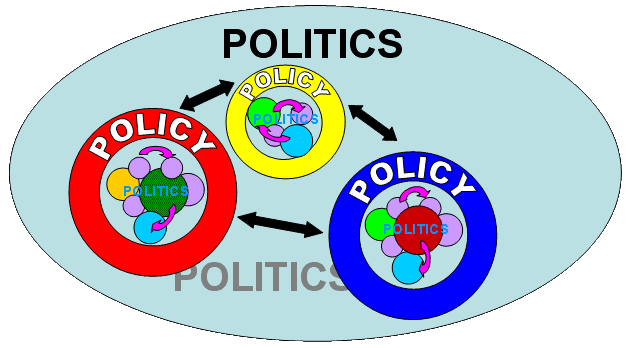
….3. “Policy,” in contrast to politics, is unilateral and rational. Please do not confuse rationality with wisdom, however. As you may already suspect, there is no shortage of unwise policy out there. Policy (like strategy) represents a conscious effort by one entity in the political arena to bend its own power to the accomplishment of some purpose—some positive objective, perhaps, or merely the continuation of its own power or existence. Policy, is the rational and one-sided subcomponent of politics, the reasoned purposes and actions of each of the various individual actors in the political struggle.

….The key distinction between politics and policy lies in interactivity. That is, politics is a multilateral phenomenon, whereas policy is the unilateral subcomponent thereof.

….This makes policy and politics very different things—even though each side’s policy is produced via internal political processes (reflecting the nested, fractal *27 nature of human political organization).*28 This is not of merely semantic importance. The distinction is crucial, and there is a high price for confusion.

….In general, H/P’s word-choice reflects this logic, despite its strong bias towards “policy.” Whenever the context can be construed as unilateral, as in the Trinity discussion, we see “policy.” In Clausewitz’s final and most forcefully articulated version of the concept, however, the context is unarguably multilateral, with so strong an emphasis on intercourse and interactivity that, ultimately, even H/P is forced to use “politics” and “political”:

We maintain, on the contrary, that war is simply a continuation of political intercourse, with the addition of other means. We deliberately use the phrase “with the addition of other means” because we also want to make it clear that war in itself does not suspend political intercourse or change it into something entirely different. In essentials that intercourse continues, irrespective of the means it employs. The main lines along which military events progress, and to which they are restricted, are political lines that continue throughout the war into the subsequent peace. How could it be otherwise? Do political relations between peoples and between their governments stop when diplomatic notes are no longer exchanged?*30

….The clash of two or more rational, opposing, unilateral policies brings us into the realm of multilateral politics. Thus there really is no reason to avoid translating the Trinity’s politischen Werkzeuges literally, i.e., as “political instrument.”
That brings us to the problem of instrumentality. Force or violence is, of course, an instrument, in the sense of a hand-tool or weapon, of unilateral policy. War, however, must be bi- or multilateral in order to exist. Thus, while military force is indeed an instrument of unilateral policy, we should see war as an instrument of politics only in a very different, multilateral sense, as the market is an instrument of trade or the courtroom an instrument of litigation (“which,” as Clausewitz says, “so closely resembles war”)

….Clausewitz seems simply to assume that his readers will distinguish, on the fly, whether he is speaking in the unilateral or the multilateral sense. After all, he has stressed time and again the interactive nature of war, and, of course, his own language’s term Politik encompasses both our multilateral politics and our unilateral policy. But this casual stance results in constant confusion for the translator and the reader.

….We sometimes forget, of course, that Clausewitz’s magnum opus is not about policy or politics, nor about human nature or the nature of reality. It is merely a mark of the book’s profundity that these matters arise immediately in any serious discussion of it. In fact, Clausewitz himself dismisses the political complexities of policy in order to focus on his true subject, the conduct of military operations in war

….On the other hand, he’s offering some good advice here, not necessarily a prediction. It seems rather superfluous to suggest that perhaps Clausewitz actually grasped the facts that there is such a thing as bad policy, that bad policy has military consequences, and that this in turn may have consequences for both the political leadership and the community whose interests it is supposed to represent.

Clausewitz’s analogy to markets and litigation are interesting, partly because they are strained.  Still useful, but strained.

In the case of the former, the relationship is actually the reverse: trading is an instrumentality of economic relationships and economic laws which continue to operate even if their “natural” manifestations are suppressed by political power wielded by the state (i.e. the Soviet Union or North Korea could fix prices or set quotas but then had shortages, surplus goods and black markets instead). However, in CvC’s defense, he was still correct that there was a degree of parallel between economic competition and war and economics was then still in it’s infancy. Some of the classical economists had yet to become regarded as such by wrestling with their own conception of iterative, friction-generating, relationships. Furthermore, in Clausewitz’s day, the heavy hand of the state in economic life was traditional in continental Europe while “liberalism” (allowing freer markets) seemed like a radical innovation rather than an underlying mechanism behind an existing system of distortions.

The same might be said that litigation is the instrument of the courtroom or justice, but I am less sure here. Continental legal traditions and assumptions are sometimes very different from the Anglo-American legal systems based more upon common law and the evolution of judicial independence from the executive. And unfortunately, early 19th century Prussian royal courts are a subject beyond my competence. In any event, the adversarial and zero sum nature of litigation carries through in Clausewitz’s analogy.

In regard to Politik, I think Bassford has done an excellent job teasing out the ambiguities of a German word that does not translate or transliterate precisely into an English equivalent. He offers the reader a method for sensibly discerning when to use “politics” or “policy” in interpreting Clausewitz’s text and reasonably assumes that Clausewitz expected the reader to infer the correct meaning from the surrounding context. That’s how most of us write when dealing with multi-layered, abstract topics – we sacrifice exact clarity for useful brevity and expect (or hope) the audience will intuitively grasp the right nuance in our line of reasoning.

I am also intrigued by Bassford’s diagram. The representation of internal political dynamics is very useful but I am curious how he would weave a visual representation of strategy flowing from policy or (more accurately, policies) and strategy’s relationship with politics, beyond being subsumed. Many a potential strategy is stillborn in the tumult of bureaucratic-military politics, never mind the larger societal kind.
As complex as the text of On War sometimes seems, it really was a brilliant simplification by Clausewitz of the dynamics mediating conflict and war.

New Book: Mission Revolution by Jennifer Morrison Taw

Sunday, September 16th, 2012

Mission Revolution: The US Military and Stability Operations by Jennifer Morrison Taw

Columbia University Press just sent me a review copy of Mission Revolution: The US Military and Stability Operations by Jennifer Morrison Taw, an assistant professor of IR/Security Studies at Claremont McKenna College.  Taw has written a very timely book given the looming threat of sequestration – she has investigated and analyzed the institutional and strategic impact of the US having elevated MOOTW (military operations other than war) in 2005 to a DoD mission on par with war-fighting, terming the change a “Revolution”.

[ Parenthetical aside: I recall well Thomas Barnett loudly and persistently calling for the Pentagon to deal with MOOTW by enacting an institutional division of labor between a heavy-duty Leviathan force to handle winning wars and a constabulary System Administration force to win the peace, manage stability, defend the connectivity. Instead, in Iraq and Afghanistan we had one Leviathan force trying to shoehorn in both missions with a shortage of boots, a river of money and a new COIN doctrine. Soon, if budget cuts and force reduction are handled badly we could have one very expensive, poorly structured, force unable to do either mission.]

Thumbing through Mission Revolution, it is critical and well focused take on the spectrum of problems the US has faced in the past ten years trying to make a “whole of government” approach an effective reality in stability operations and counterinsurgency. Taw covers doctrine, training, bureaucratic politics, procurement, policy, grand strategy, mission creep, counterterrorism and foreign policy visions of the civilian leadership, all with generous footnoting.

I am looking forward to reading Mission Revolution and giving it a detailed, in-depth, review in the near future.

Inventing Grand Strategy and Teaching Command, The Classic Works of Alfred Thayer Mahan Reconsidered, a review

Tuesday, September 4th, 2012

[by J. Scott Shipman]

Inventing Grand Strategy and Teaching Command, by Jon Tetsuro Sumida

As of August 2012 this is the best non-fiction book I’ve read this year. Professor Sumida brings a potentially dry topic to life making Alfred Thayer Mahan relevant in the process; as indeed, he should. At a mere 117 pages of moderately footnoted text, Sumida provides the reader a grand tour of Mahan’s life work, not just The Influence of Sea Power 1660-1983. Sumida includes the major works of Alfred Thayer Mahan’s (ATM) father Dennis Hart Mahan, as he introduces ATM’s major works, lesser works, biographies, essays, and criticisms.

Sumida begins his chapters with quotes, and weaves his recounting of ATM’s work with musical performance, Zen enlightenment, and naval command; which is quite a combination, but convincing. Of ATM’s “approach to naval grand strategy” he writes:

Mahan believed the security of a large and expanding system of international trade in the twentieth century would depend upon the creation of a transnational consortium of naval power. His handling of the art and science of command, on the other hand, was difficult, complex, and elusive. It is helpful, therefore, to achieve an introductory sense of its liminal character by means of analogy.

This is where musical performance and Zen enlightenment become relevant and instructive. Sumida writes on musical performance:

Teaching musical performance…poses three challenges: improving art, developing technique, and attending to their interaction.

Sumida goes on to illustrate the parallels between learning musical performance and naval command/strategy and the common thread is performing or, “doing it.” He writes that most musical instruction is through the understudy watching demonstrations by the master, but the higher purpose of replicating the master’s work is “to gain a sense of the expressive nature of an act that represents authentically a human persona.” In other words, the development of relevant tacit knowledge, or as I have come to refer to this as “tacit insight.”

Sumida continues with six short chapters that pack a powerful punch and a good introduction to the trajectory of Mahan’s work from the beginning to end. My favorite was Chapter Six, The Uses of History and Theory. In this chapter Sumida deals with complexity, contingency, change, and contradiction, naval supremacy in the Twentieth Century, Jomini, Clausewitz, and command and history. Quite a line-up, but a convincing inventory of Mahan’s influences and how his work remains relevant today. Sumida writes:

Mahan’s role as a pioneer and extender of the work of others has been widely misunderstood and thus either ignored or misused. The general failure to engage his thought accurately is in large part attributable to the complexity of his exposition, the difficulties inherent in his methods of dealing with several forms of contingency, changes in his position on certain major issues, and his contradictory predictions about the future and application of strategic principles…His chief goal, however, was to address difficult questions that were not susceptible to convincing elucidation through simple reasoning by analogy. He thus viewed history less as a ready-made instructor than a medium that had to be worked by the appropriate intellectual tools.. Mahan’s analytical instruments of choice were five kinds of argument: political, political-economic, governmental, strategic, and professional.

The first three were used in grand naval strategy, the latter two with the “art and science of command.” The section of Command and History is particularly relevant given two recent posts, one at the USNI Blog, The Wisdom of a King, by CDR Salamander, and the other in a September 2012 Proceedings article by LCDR B.J.Armstrong, Leadership & Command. Here’s why: Sumida quotes Admiral Arleigh Burke, who latter became Chief of Naval Operations, during WWII. Of “Decentraliztion,” Burke wrote:

…means we offer officers the opportunity to rise to positions of responsibility, of decision, of identity and stature—if they want it, and as soon as they can take it.

We believe in command, not staff. We believe we have “real” things to do. The Navy believes in putting a man in a position with a job to do, and let him do it—give him hell if he does not perform—but be a man in his own name. We decentralize and capitalize on the capabilities of our individual people rather than centralize and make automatons of them. This builds that essential element of pride of service and sense of accomplishment.

The U.S. Navy could do worse than return to this “father” of naval strategy and give his ideas more attention; Professor Sumida’s little book would be a good place to start.

Strongest recommendation—particularly to active duty Navy personnel.

Cross-posted at To Be or To Do.

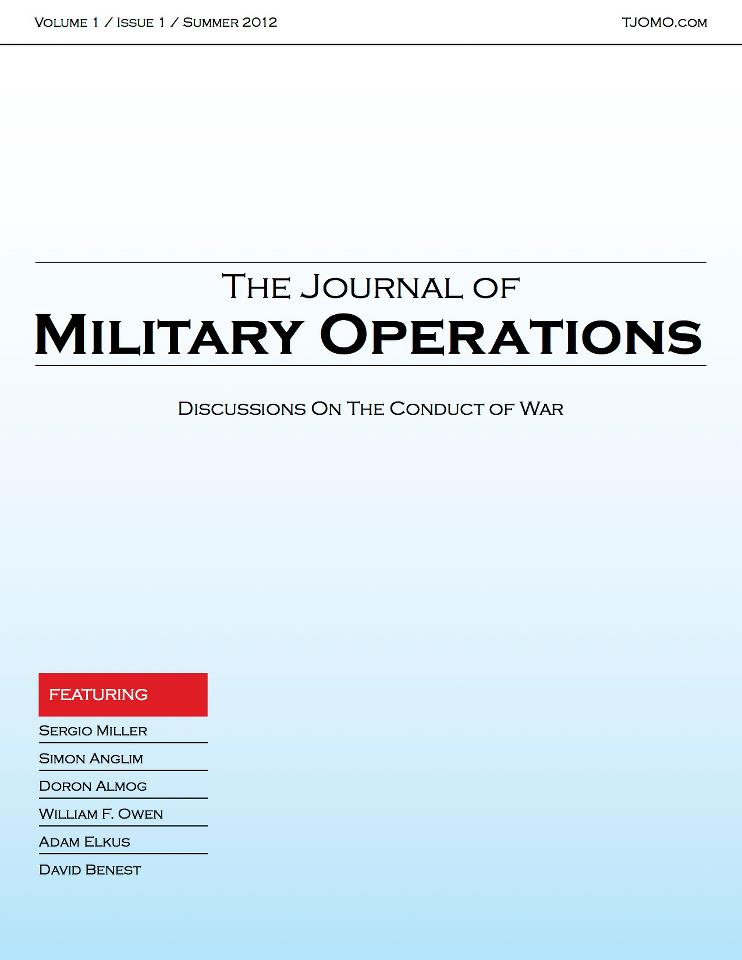
The Journal of Military Operations

Tuesday, August 7th, 2012

The Journal of Military Operations  

A new peer-review “journalzine” from the IJ  Group, which publishes Infinity Journal.  The difference between the two is that Infinity focuses on strategy while the former, as the masthead implies, is dedicated to military operations as well as tactics. If you do not know what the difference between strategy and tactics are….well….reading these should help. The Editor is Dr. Jim Storr, a.k.a  Colonel Storr, author of the well regarded The Human Face of War.  Registration is free.

The maiden issue of JoMO has articles from two friends of ZP, Deputy Editor Wilf Owen and Adam Elkus.

Ironically, Wilf is  arguing against the existence of an operational level of war or the utility of separating operational art from sound understanding of tactics and strategy and criticizes Soviet strategist A.A. Svechin:

“The Operational Level of War Does Not Exist”

….Thus the definitions of strategy and tactics were and are simple, coherent and highly workable. While armies conducted ‘operations’, such activity did not impinge on the delineation of strategy and tactics. Conducting operations did not an operational level of war make!

The operational level of war is strongly associated with Soviet military thought. A.A. Svechin is often seen as the originator of the idea, when he discussed ‘Operational Art’ (operativnoe iskustvo) as conceptual connection between tactics and strategy.[iii] He defined an operation as ‘the effort of troops directed towards the achievement of a certain intermediate goal in a certain theatre of military operations without interruptions.’[iv] In the very next sentence he went on to explain that operations were designed to destroy or encircle a portion of the enemy forces to force a withdrawal of other forces, to capture or hold a ‘certain line or geographical area.’ Destroying a portion of the enemy’s armies is what battles traditionally sought to do. Svechin’s description equates strongly with battle and thus tactics, at least in terms of the outcome described.

Much Soviet and Russian writing (and Western analysis of it) on the Operational Level of War is, once subject to rigour, paper-thin and mostly a sophistry that arbitrarily creates a false and unneeded link between strategy and tactics. The extremely high losses suffered by Soviet Forces in WW2 are not symptomatic of anything other than bad tactics poorly executed. If the acme of operational art is encirclement operations, then at what level of command does this operational level of war take place? A platoon can encircle an enemy section, just as much as an army group can encircle an enemy army.

Svechin’s fundamental intellectual problem was not that he did not understand strategy or tactics, but how to function as a strategist in a society where politics as normally understood no longer existed and adherence to yesterday’s policy could be regarded as today’s evidence of treason. Indeed, this is what ultimately resulted in Svechin’s demise during the Great Terror despite his best effort to the contrary. Whatever the other merits of defining an “operational level of war” or “operational art” Sevechin was looking for an ideological safe harbor, a purely “technical” realm where military officers could do the campaign planning war required without the act of planning or doing strategy itself being ideologically suspect in Stalin’s eyes.  In 1937, this was a hopeless task, but Svechin’s legacy carved out a degree of professional autonomy for Red Army general staff officers in milder times that was unthinkable under Stalin’s rule.

Adam Elkus explains “D&D”:

“The Continuing Relevance of Military Denial and Deception”

….From the end of the Cold War onwards, Western militaries have rightly assumed that military competitors would attempt to disguise their power and deceive to draw attention away from their real capabilities and intentions. Moreover, the West’s enemies also are frequently authoritarian states for whom cheating and deception is basic political behavior. The attractiveness of deception operations and capabilities to opponents ranging from Mao’s China to Saddam Hussein’s Iraq provides empirical support for this prejudice.

But democracies are also capable of information manipulation and deception. The United States was able to exercise remarkable control over information in the 1991 Gulf War, not only shaping the media coverage’s tenor, but also protecting secrets. It is true that America cannot do so today in regards to its remotely piloted vehicle (‘drone’) program and its cyber operations in Iran. But while this demonstrates the difficulty of conducting D&D in democracies, it is not proof that D&D is impossible.

Now that the West has become fiscally weaker and weary of war, denial and deception will be crucial to engaging and destroying both conventional and irregular forces. Currently, the United States is employing special operations forces, paramilitary intelligence capabilities, and regular air and sea military platforms to acquire and target al-Qaeda affiliated groups in Africa, the Middle East, and South Asia. Information denial is key to this campaign, lest press leaks alert al-Qaeda to ongoing operations. The US reliance on human intelligence also presents opportunities for adversary deception operations, like the Jordanian double agent who executed a hit against an American spy base in Khost in 2009.

Future conventional campaigns are likely to also hinge on the employment of denial and deception. Information denial has always been a hallmark of successful Western operations, but deception has been neglected due to the brute fact of Western qualitative and material superiority. If one marches with big battalions and has better troops, platforms, and weapons, why do any extra effort to engage in deception? At times, such as during Operation Moshtarak in Afghanistan and Israeli operations in Lebanon and Gaza, operational objectives have been served by telegraphing the attack in advance in order to allow civilians to leave the target zone and intimidate the enemy.

I think Adam is on the right track here with his analysis. In an age of austerity, as the advanced states field shrinking, increasingly expensive, militaries, this will force a return to the employment of force-multiplying stratagems that are supplementary to and supportive of the employment of military force and coercion.

Scarcity is the mother of strategic invention.


Switch to our mobile site