zenpundit.com » military history

Archive for the ‘military history’ Category

RESTREPO Review II. : Lexington Green

Saturday, July 3rd, 2010

An excellent review at Chicago Boyz by my comrade Lex:

Restrepo

First, the cryptic title. It looks like an acronym, but it is in fact the last name of a young soldier killed in Afghanistan, in the fighting which is recounted in the film. His name was Juan S. Restrepo.. His comrades in arms called him “doc.” His name is pronounced with an accent on the second syllable, reh-STREP-po.

The film was made by the noted author Sebastian Junger, and the photographer Tim Hetherington. (Junger wrote a book entitled simply War about his experiences being embedded with the troops, which Zen reviewed here. James McCormick reviewed Junger’s book on CB, here.)

The movie covers the hard fighting endured by a platoon of American troops in a 15 month deployement to the Korengal Valley in Afghanistan. It intercuts footage of the troops in the Valley with interviews after they left Afghanistan. The overall feel of the film is grim. The sense projected by the movie is that the troops who were not physically wounded have been psychologically damaged by their exposure to combat. The movie makes clear that their goal became survival and leaving Afghanistan alive. Other than the platoon commander, who was making a superhuman effort to carry out a counterinsurgency program, there was no sense that the troops perceived any achievable mission to carry out.   

The movie depicts the troops as facing an insurmountable task, trying to conduct a counter-insurgency campaign where they are bottled up in firebases and cannot come out to provide security for the population. The Taliban rule the countryside. The Americans can foray out, and bring down heavy firepower when they encounter the Taliban, but the fundamental mismatch between what the troops have been asked to do and the means provided to do it is apparent throughout….

Read the rest here.

Movie Review: RESTREPO Screening

Tuesday, June 29th, 2010

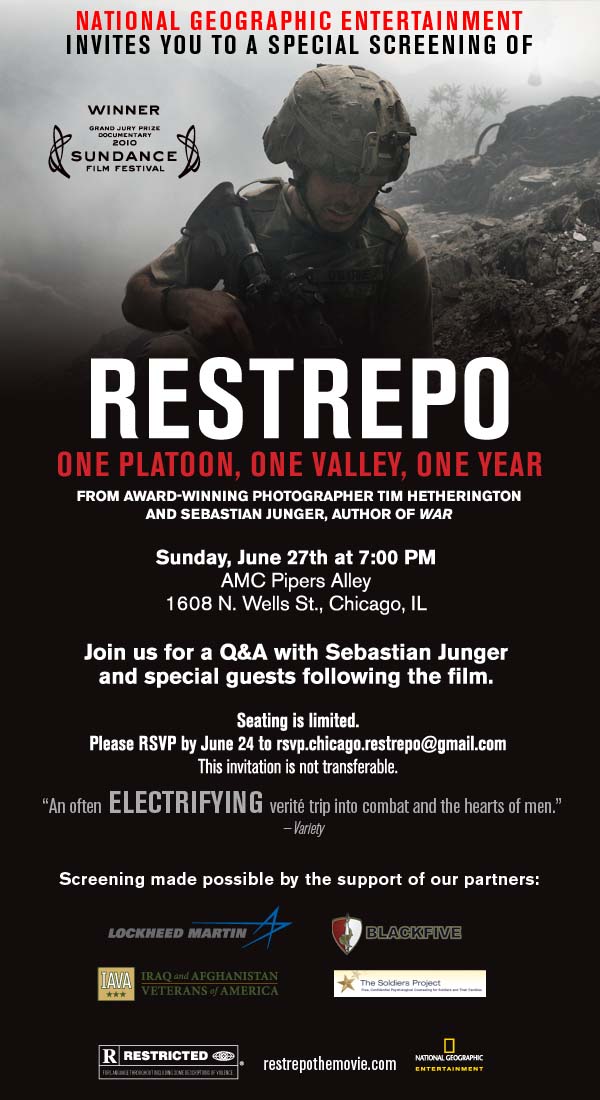
restrepo_evite_chi2.jpg  

RESTREPO 

As I mentioned yesterday, I had the good fortune to receive a courtesy invite to a screening of RESTREPO, a documentary of the experience of the second platoon of Battle Company in the Korengal valley of Afghanistan. The film takes its title from a fallen member of the platoon, a medic Pvt. Juan “Doc” Restrepo, in whose honor the platoon’s new outpost in that ferociously disputed valley is named. The film, largely compiled from footage shot by Tim Hetherington, is the companion to the book WAR by Sebastian Junger on the same subject. There are some substantial differences between the movie experience and reading the book ( which I reviewed here).

First, RESTREPO makes more explicit the harsh terrain in which the war is taking place for the young men of second platoon. If you have ever driven through the mountains of Tennessee or West Virginia, imagine those states as semi-arid, with steeper elevations and go back in time to circa 1900 so that the deeply impoverished residents are struggling to scratch a living out of sand and rocks with little or no comforts of modernity. The valley appears to always be dusty, sunny and very hot. Except up in the hills where it snows – then it looks cloudy and cold. That’s what Korengal looks like.

The Korengalis, it must be said, look like that too. Virtually every Korengali man in the film is hawk-faced gaunt and weathered, fierce faces deeply lined by sun and privation. Korengali elders have the look of determined survivors who built the fortified compounds that cling precariously to the rock wall of the hills, ascending, jerry-built. The village reminded me of what Cabrini-Green might have looked like had it been erected in the 9th century. The warmth of their elders’ feelings toward Americans can be described as “grudging”, well-demonstrated at the shura where the elders asked the Captain for the return of “Yusuf Mohammed” who had been arrested. As it turned out, young “fucking Yusuf Mohammed” had beheaded someone on a jihadi videotape and the clearly disgusted C.O. told the elders that Yusuf would not be coming back.

A second striking difference was that unlike WAR, which is narrated through Sebastian Junger’s perspective, the soldiers are speaking directly themselves, either in candid comments on patrol and in RESTREPO or in de-brief interviews. Junger accurately reflected the views of the soldiers he interviewed but where WAR has one voice, Junger’s, RESTREPO has a multitude of voices with their individual insights, irreverance, agonies, tedium, bitching, regrets and pride. Reading WAR depressed me, but watching RESTREPO, despite scenes of graphic suffering, definitely did not. If you see these young soldiers and do not come away impressed with their mettle and resilience of character, then you have a heart of stone and a head of straw.

A thought that kept coming back to me, which I think was stirred by the imagery of the valley seen in the film in a way the book did not, was that there was nothing of strategic value there whatsoever. Even the Taliban was not particularly welcome and tread very lightly among the Korengalis who are ruled by their elders to a degree that has eroded elsewhere in Afghanistan. It seemed with American operations in the Korengal we were replicating in miniature a Khe Sanh or Dien Bien Phu where the conventional army could draw out the insurgents and that the COIN elements were window dressing, Big Army humoring the party line at CENTCOM while playing a joke on the soldiers ordered to go through the motions of counterinsurgency on the ground. Junger, in his talk after the film hinted as much in saying that 150 men of Battle Company could hold their own there but could not do the COIN objectives in Korengal by themselves that required a full battalion.

After the film was over, Sebastian Junger took questions from the theater audience, which had a strong representation of veterans, including two who had served at RESTREPO and family members who lost sons in Afghanistan. He was a straight shooter in all of his answers, even the difficult moral questions and did not pretend he had all the answers or better answers and tried to testify primarily to what he personally witnessed. A performance that would make me comfortable in relying on Junger’s reporting in the future.

A moving and thought-provoking documentary, RESTREPO opens at Piper’s Alley in Chicago this Friday on July 2nd

For Strategists, Security Scholars and Historians

Friday, June 25th, 2010


A useful tool, much like Zenpundit himself.

National Defense University Library has digitized American National Strategy Documents in a searchable archive.

Cool.

New Roundtable: Defeat in Afghanistan? The View from 2050

Saturday, June 19th, 2010


An important upcoming blogging roundtable this summer at Chicago Boyz. Now a word from our moderator, Lexington Green:

Defeat in Afghanistan? The View from 2050

Voices from many quarters are saying dire things about the American-led campaign in Afghanistan. The prospect of defeat, whatever that may mean in practice, is real. But we are so close to the events, it is hard to know what is and is not critical. And the facts which trickle out allow people who are not insiders to only have a sketchy, pointillist impression of the state of play. There is a lot of noise around a weak signal.

ChicagoBoyz will be convening a group of contributors to look back on the American campaign in Afghanistan from a forty year distance, from 2050.

40 years is the period from Fort Sumter to the Death of Victoria, from the Death of Victoria to Pearl Harbor, from Pearl Harbor to the inauguration of Ronald Reagan. It is a big chunk of history. It is enough time to gain perspective.

This exercise in informed and educated imagination is meant to help us gain intellectual distance from the drumbeat of day to day events, to understand the current situation in Afghanistan more clearly, to think-through the potential outcomes, and to consider the stakes which are in play in the longer run of history for America, for its military, for the region, and for the rest of the world.

The Roundtable contributors will publish their posts and responses during the third and fourth weeks of August, 2010.

The ChicagoBoyz blog is a place where we can think about the unthinkable.

Stand by for further details, including a list of our contributors.

Karaka on WAR at SWJ Blog

Monday, June 7th, 2010

Blogfriend Karaka has a review of WAR by Sebastian Junger up at SWJ Blog today:

Junger’s War , Review by Karaka Pend

….Part of the purpose of Junger’s exercise is to engage as fully in the experience of being at Restrepo, of living with the men of Battle Company, as he can given the constraints of his embed. He mostly succeeds in that, in part because he let himself get swept up in the life-and-death fraternitas of it all, and perhaps more importantly because Battle Company allowed him to become a part of their brotherhood. It would have be a rather different story had he not won his way into the human terrain of that mountaintop.

….Throughout, Junger’s soldiers describe combat, describe firefight, as an addiction or a high; and perhaps that is the only real framework in which their longing for conflict or engagement with the enemy can be understood. If there is no greater high than when you are protecting your brother, how do you return to a world where you need not always watch your brother’s back?

ADDENDUM:

Video interview of Sebastian Junger by NRO.  Hat tip to Lexington Green.


Switch to our mobile site

