The question is whether flavors are “in the wine” or “in the mind”. On the one hand, there are objectively measurable chemical compounds in wine that reliably affect our taste and olfactory mechanisms—pyrazines cause bell pepper aromas in Cabernet Sauvignon, malic acid explains apple aromas in Chardonnay, tannins cause a puckering response, etc. But we know that human beings differ quite substantially in how they perceive wine flavors. Even trained and experienced wine critics disagree about what they are tasting and how to evaluate wine. This disagreement among experts leads many to claim that wine tasting is therefore purely subjective, just a matter of individual opinion. According to subjectivism, each person’s response is utterly unique and there is no reason to think that when I taste something, someone else ought to taste the same thing. Statements about wine flavor are statements about one’s subjective states, not about the wine. Thus, there are no standards for evaluating wine quality.
**
Is each mind inherently closed to every other, much as the bird’s mind is closed to ours in Blake‘s aphorism —
How do you know but every bird that cuts the airy way, is an immense world of delight, closed by your senses five?
— albeit not always so joyful?
In more contemporary terms — Is there encryption of the mind?
**
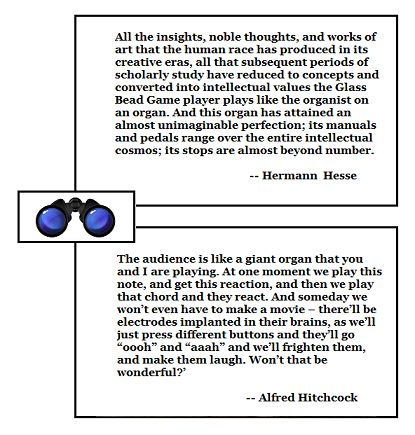
I ask this in light of the DoubleQuote I posted a few days ago comparing Hesse and Hitchcock in terms of their metaphoric uses of “organ” — in, I hasten to add, the Bach sense of the word:
Here’s what I’m thinking. Hesse’s game influences the mind, as does art, but it is non-invasive; Hitchcock applauds the potential for art to move in a more invasive direction, as if by force rather than by enticement.
“”
Humans — or at least the philosophers and philosopher tagalongs among them — can’t even tell if what one human sees as “red” is what another sees as “red” — let alone what a given Burgundy tastes like on another’s palate.
If this means, more generally, that minds are effectively encrypted by virtue of their differences in wiring acquired with parentage, age and experience, then our communications media -– language, the arts, literature, number — would appear to be the available decryption keys, selectively available to the minds in question.
**
Chuang-Tsu has this tale to tell:
Men claim that Mao-ch’iang and Lady Li were beautiful, but if fish saw them they would dive to the bottom of the stream, if birds saw them they would fly away, and if deer saw them they would break into a run. Of these four, which knows how to fix the standard of beauty for the world?
And this..
Chuang Tzu and Hui Tzu were strolling along the dam of the Hao River when Chuang Tzu said, “See how the minnows come out and dart around where they please! That’s what fish really enjoy!”
Hui Tzu said, “You’re not a fish – how do you know what fish enjoy?”
Chuang Tzu said, “You’re not I, so how do you know I don’t know what fish enjoy?”
Hui Tzu said, “I’m not you, so I certainly don’t know what you know. On the other hand, you’re certainly not a fish – so that still proves you don’t know what fish enjoy!”
Chuang Tzu said, “Let’s go back to your original question, please. You asked me how I know what fish enjoy – so you already knew I knew it when you asked the question. I know it by standing here beside the Hao.”
**
Chuang Tzu said, “You’re not I, so how do you know I don’t know what fish enjoy?”
Blake said, “How do you know but every bird that cuts the airy way, is an immense world of delight, closed by your senses five?”
[ by Charles Cameron — a follow up to my post on the Vespers liturgy at Hampton Court Palace ]
.
Boring as hell or blissful as paradise? Religious worship can be either one.
I know that when I was at Wellington College I must have sat through dozens of sermons in which one or another scriptural passage was read in that droning pastoral voice which Alan Bennett so skilfully skewered in his Beyond the Fringe satirical sermon on the text of Genesis 27.11, “Behold, Esau my brother is a hairy man, and I am a smooth man”:
I was a deeply religious kid, but verses like I Samuel 15.3, “Now go and smite Amalek, and utterly destroy all that they have, and spare them not; but slay both man and woman, infant and suckling, ox and sheep, camel and ass” went right past me. I had no qualms back then about Old Testament genocides, pretty much because I didn’t notice them — these were just sacred words, intoned, a strange blend of heaven, lullaby and snooze.
In my piece on the Hampton Court Vespers, I tried to give readers a sense of how things look from a perspective where liturgy and rites and rituals more generally need not be viewed as dry relics of a past best forgotten, but as well-springs of deep personal, interpersonal and transcendent inspiration and communion.
**
Here, I’d like to supplement my attempt with two “cases” that I hope will illustrate the power of liturgy.
When the service began late on Saturday evening the cathedral was dimly lit, all the hangings and the altar cover were black in the color of Good Friday. Then the entire congregation went out into the street and marched slowly around the block. It was very cold. When we returned the cathedral was brilliantly lit and the color of everything was very bright. Easter had arrived.
So — somebody turned the lights on.
But no, it’s more than that, it’s the utter darkness of Christ’s descent from the cross and burial, it is grief physically imposed by that very cold pilgrimage around the block — and it’s the shock, the palpable beauty of the Resurrection dawn.
**
Going back yet a day further, from Good Friday to the Maundy Thursday which in the church’s calendar porecedes it, we can see the similarly profound impact of a simple gesture as my old mentor, Fr. Trevor Huddleston, washes the feet of his students in Sophiatown, the Johannesberg shanty-town where for years he taught and preached. In his own words, drawn from his book Naught for Your Comfort, we read:
On Maundy Thursday, in the Liturgy of the Catholic Church, when the Mass of the day is ended, the priest takes a towel and girds himself with it; he takes a basin in his hands, and kneeling in front of those who have been chosen, he washes their feet and wipes them, kissing them also one by one. So he takes, momentarily, the place of his Master. The centuries are swept away, the Upper Room in the stillness of the night is all around him: “If I, your Lord and Master, have washed your feet, ye ought also to wash one another’s feet.” I have knelt in the sanctuary of our lovely church in Rosettenville and washed the feet of African students, stooping to kiss them. In this also I have known the meaning of identification. The difficulty is to carry the truth out into Johannesberg, into South Africa, into the world.
That world, for Fr Trevor, was the world of South African apartheid. He carried that truth out into Johannesberg and the world in his book, and as President of the Anti-Apartheid Movement — and with what impact! He lived to see apartheid gone.
I say that the consummation of the drama, the perfect and ideal drama, is to be found in the ceremony of the Mass. … And the only dramatic satisfaction that I find now is in a High Mass well performed. Have you not there everything necessary? And indeed, if you consider the ritual of the Church during the cycle of the year, you have the complete drama represented. The Mass is a small drama, having all the unities; but in the Church year you have represented the full drama of creation.
Zenpundit is a blog dedicated to exploring the intersections of foreign policy, history, military theory, national security,strategic thinking, futurism, cognition and a number of other esoteric pursuits.