zenpundit.com » symmetry

Archive for the ‘symmetry’ Category

Inspire #5: between front and back covers

Thursday, March 31st, 2011

[ by Charles Cameron ]

*

Okay. When what goes into the opening paragraphs of an editor’s note at the front of a magazine corresponds pretty exactly to what’s on the back cover, you have a sort of conceptual bracket that’s “holding” the rest of the content, and it pays to pay attention.

Here are the first paras of the “Letter from the Editor” that is featured on page 5 of the latest issue of AQAP’s English language magazine, Inspire, immediately after the front cover and index pages:

The cover of this issue is about the Tsunami of change that is sweeping the Arab world. With the removal of the despots, the ummah will speak its voice, and when it does, it will chant: Here we start and in al-Aqsa we’ll meet.The biggest barrier between the mujahidin and freeing al-Aqsa were the tyrant rulers. Now that the friends of America and Israel are being mopped out one after the other, our aspirations are great that the path between us and al-Aqsa is clearing up.

There could be no freeing of Palestine with the presence of the likes of King Abdullah to the East, Hosni Mubarak to the West and al-Saud to the South. Now that Hosni is gone, we heard the Imam of the Friday prayers praying: “O Allah we ask you to allow us to meet in al-Aqsa,” and the millions in Tahrir square roared with one voice: Amin.

Note that this explicitly ties the front cover (“about the Tsunami of change that is sweeping the Arab world”) with the back (“Here we start and in al-Aqsa we’ll meet”), shown here:
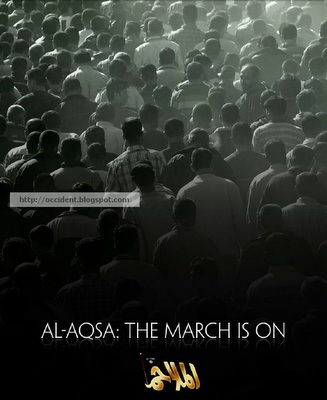
inspire-5-al-aqsa-the-march-is-on.jpg

[ graphic courtesy of Ibn Siqilli ]

As I’ve noted before, al-Aqsa isn’t just the focal point of the Palestinian / Israeli question, nor it is only the place at which the Prophet alighted from his steed, Buraq, and ascended to receive the divine instructions for prayer in the Miraj — it is also the destination of the Mahdi‘s victorious army in the Khorasan strand of ahadith.

Indeed, it has been suggested that the Pierced Rock of the Dome of the Rock in al-Aqsa is closely related to the Black Stone of the Kaaba. Kanan Makiya, in his part-fictional part-documentary book, The Rock, quotes Charles Matthews‘ translation of Burhan al-Din ibn Firka al-Fazari‘s Kitab Ba’ith al-Nufus ila Ziyarat al-Quds al-Mahrus (The Book of Arousing Souls to Visit Jerusalem’s Holy Walls) from Matthews’ Palestine: Mohammedan Holy Land:

Verily, the Kaaba is in an equivalent position to the Frequented House in the Seventh Heaven, to which the angels of Allah make pilgrimage. And if rocks fell from it, they would have fallen on the place of the Rock of the Temple of Mecca [i.e. the Black Stone]. And indeed, Paradise is in the Seventh Heaven in an equivalent position to the Holy Temple (in Jerusalem) and the Rock; and if a rock had fallen from it, it would have fallen upon the place of the Rock there. And for this case the city is called Urushalim, and Paradise is called Dar al-Salam, the House of Peace.

Indeed, David Roxburgh mentions all these matters, writing in Salma Khadra Jayyusi et al., The city in the Islamic world, vol. 1. p 756:

This movement corresponded to other efforts — before, during, and after the Crusades — to establish “geo-theological” connections between Jerusalem and Mecca, whose preeminent sanctity was inviolable up until the end of days. Examples linking Mecca to Jerusalem include the Prophet Muhammad’s nocturnal journey from Mecca to Jerusalem (isra) and his ascension from Jerusalem to the throne of God (miraj); the underground joining of the waters of Zamzam to Silwan (var. Siloam) during the “feast of the sacrifice” (id al-adha); and the transfer of the Kaba and its black stone from Mecca to Jerusalem during the last days. these various traditions linked Jerusalem to Mecca, sometimes by sets of doubled features, in a near symmetry and in a calendar that will culminate during the end of days.

So there’s an eschatological dimension to all these parallelisms, too…

*

And if for no other reason, then because I happen to love doubled features, symmetries and analogies of all sorts (and we were already speaking of graphics and Inspire #5), let me add this:

A tweet from @webradius via @azelin that I saw today noted that “the cover of Inspire 5 is remarkably similar to a wikileaks logo”.

I liked it.  And I’ve translated it here into my own DoubleQuotes format:
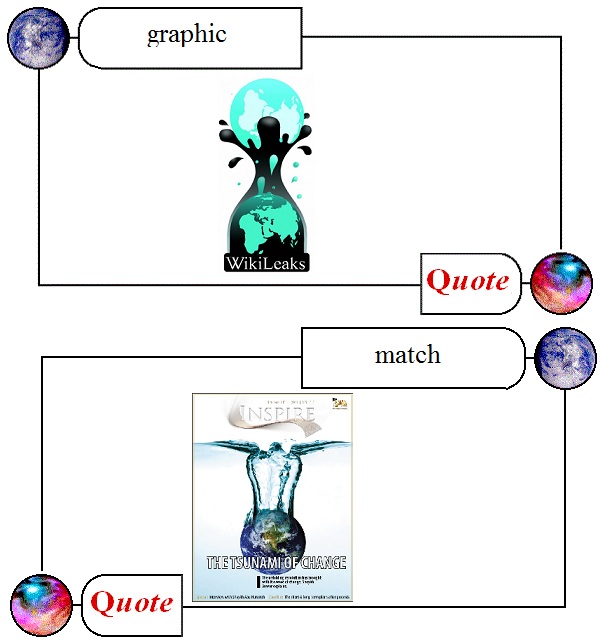
quographic-match.jpg

For those who are unfamiliar with the phrase, graphic match is another term for match cut — the gambit whereby one shot in a movie is directly juxtaposed to another with which it bears a close resemblance – essentially, a film director’s equivalent of rhyme.

Wikipedia gives two classic examples which are of particular interest to me because there is a “rhyme” between them, too, albeit a far more indirect one – the second being an hommage to the first.

Stanley Kubrick‘s 2001: A Space Odyssey contains a famous example of a match cut. After an ape discovers the use of bones as a tool and a weapon, there is a match cut to a spacecraft or satellite in orbit. The match cut helps draw a connection between the two objects as exemplars of primitive and advanced tools respectively.

Michael Powell and Emeric Pressburger‘s A Canterbury Tale contains the influence for the 2001: A Space Odyssey match cut in which a fourteenth century falcon cuts to a World War II aeroplane. The sense of time passing but nothing changing is emphasised by having the same actor, in different costumes, looking at both the falcon and the aeroplane.

*

Conclusion:

Parallelisms really are worth watching — always bearing in mind that one thing is never quite the same as another…
Variations on a theme

Tuesday, March 15th, 2011

[ by Charles Cameron ]

*

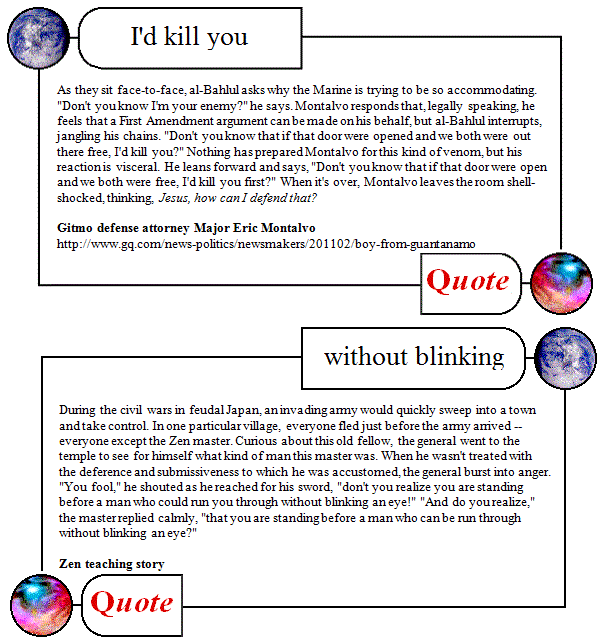
Two stories — continents, centuries and cultures apart — yet as remarkable for their similarities as for their differences. The first concerns a US military defense attorney’s first meeting with a defendant at Gitmo, the second a zen monk…

quokiller-repartee.gif

I already knew the zen story, so the Gitmo version positively flew off the page at me.

I suppose some people will prefer one story, some will prefer the other: for me it’s the almost stereophonic effect of knowing the pair of them that I find more interesting than knowing either one of them separately.

Either one is impressive — together, they dance.

Two courtyards, two hundred camels

Sunday, March 6th, 2011

a light-hearted canon in two voices

[ by Charles Cameron ]

*

I’d been doing some research for a follow-up post on story-telling in Afghanistan to go with Scott‘s account of his day at DARPA’s recent STORyNET conference, and one of the interlocutors on the list we’re both on posted a question about the impact of drug use as a consideration in narrative.

Baudelaire and Cocteau both have writings on drug use — hashish and opium respectively — but it was Afghan or more generally Islamic story-telling that I was after, and it occurred to me that the four stories in Paul Bowles‘ collection, A Hundred Camels in the Courtyard, were easily accessible examples of the kind of story-telling that Moroccans are prone to under the influence of hashish.  Bowles describes their mental processes thus:

Moroccan kif-smokers like to speak of the “two worlds,” the one ruled by inexorable natural laws, and the other, the kif world, in which each person perceives “reality” according to the projections of his own essence, the state of consciousness in which the elements of the physical universe are automatically rearranged by cannabis to suit the requirements of the individual. These distorted variations in themselves generally are of scant interest to anyone but the subject at the time he is experiencing them. An intelligent smoker, nevertheless, can aid in directing the process of deformation in such a way that the results will have value to him in his daily life. If he has faith in the accuracy of his interpretations, he will accept them as decisive, and use them to determine a subsequent plan of action. Thus, for a dedicated smoker, the passage to the “other world” is often a pilgrimage undertaken for the express purpose of oracular consultation.

The title of Bowles’ little collection, by the way, comes from the Moroccan proverb which is gives me the first of my two quotes, two courtyards, two intoxicants and two hundred camels below…

I wasn’t entirely satisfied, though, which a Moroccan account of hash-flavored narrative when DARPA was looking for an understanding of narrative that would apply in Afghanistan, so I thought I’d look up some of Idries Shah‘s writings, and Kara Kush in particular, to see if perhaps I could find an Afghan equivalent of Bowles’ stories there…

I already had Bowles’ one courtyard and one hundred camels in mind, so you’ll understand how pleased I was to stumble upon another slightly obscure but interesting writer — Peter Lamborn Wilson, aka Hakim Bey, who gave use the concept of the TAZ or Temporary Autonomous Zone — writing about Afghanistan rather than Morocco, opium rather than hashish, and a second courtyard, with a second hundred camels:

quo-100-camels.jpg

Two terrific writers: Paul Bowles and Peter Lamborn Wilson.

Sources: BowlesWilson

Courtyards with a hundred camels in them are popping up all over.

The terminal occultation of Muammar Gaddafi

Wednesday, March 2nd, 2011

[by Charles Cameron ]

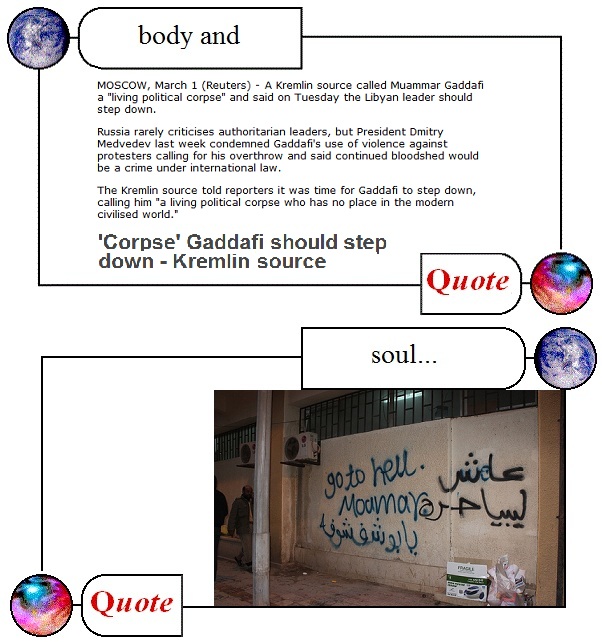
quo-gaddafi.jpg

People want the man out of there — body and soul, it seems.

Sources: body and soul

GMTA?

Tuesday, February 22nd, 2011

[ by Charles Cameron ]

It’s not exactly news —

Napoleon supposedly said “Even in war moral power is to physical as three parts out of four” — and these two quotes say pretty much the same thing, translated and updated, don’t they?

quogmta.gif

Kudos to my blog-friend Christopher Anzalone, who keeps the rest of us current on digital Taliban offerings, AQ graphics and more. His Views from the Occident: Twitter Specials blog is my source for the interview with Abdul Sattar Maiwand, web-master of the official Islamic Emirate [ie “Afghan Taliban “] site, while David Betz blogged on Gaming Social Networks for Influence and Propaganda at Kings of War (Department of War Studies, King’s College London).

The interview with Maiwand gets into detail that will interest students of information operations and/or contemporary uses of technology — here’s a taste of something close to my good (and frequently prophetic) friend Howard Rheingold‘s notion of wireless quilts:

The news that is posted on the website is converted to SMS messages and sent to a number of people, who send it to other people. Each of them sends it to his acquaintances inside and outside Afghanistan and so a chain of dissemination begins. Each ones tries to spread the news more and more. We have seen many people requesting their friends and relatives to forward the news they receive to at least 20 other people, etc…and so this news becomes widely circulated in popular circles. Through the grace of Allah, we have seen many among the general populace rejoice when news reaches them of the victories of the Mujahideen over their enemies.

But you might like to read the whole thing…


Switch to our mobile site