zenpundit.com » art

Archive for the ‘art’ Category

Of a non-comparative use of the DoubleQuotes method

Tuesday, August 25th, 2015

[ by Charles Cameron — further thoughts on the advantages of seeing double ]
.

I’ve said before that when I was at The Arlington Institute, my boss used to ask me to watch out for “early indicators”, and joked that in my book, two is the first number — I don’t see an “indicator” until I see a pattern emerging.

Putting it bluntly, one point is pointless — things could go anywhere from there. Two points suggest a line, a link, a connection — a possible, maybe even plausible, trend.

And so it is with the two photos above. Here the point is not to compare and contrast the two images of surveillance cameras wearing party hats, but to see that they represent a class — the presence of two concrete instances strongly implies the higher level abstraction: hah! they’re watching us!

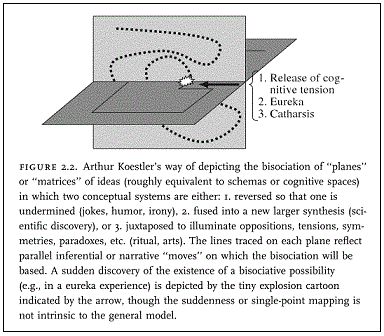
It’s that sense I have of two being the beginning of thought that makes me so fond of the DoubleQuotes format — and of Arthur Koestler‘s insight, which I’m always quoting, about creation occurring at the intersection of two spheres..

koestler-model

If I’m a fundamentalist about anything, it’s the notion that it takes two to tango!

Christ on a Cathedral, Buddha at the Printshop

Monday, August 17th, 2015

[ by Charles Cameron — art & tech interfacing with religion ]
.

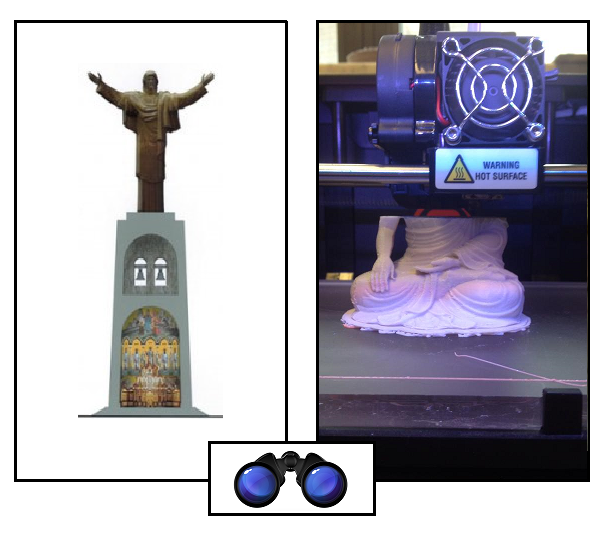
In today’s news, religious statuary:

SPEC statues christ buddha

**

To the left:

Vladivostok ‘to get tallest statue of Jesus Christ in the world’

In Vladivostok, the monument will be composed of two parts: the statue itself and the pedestal housing a cathedral in honour of Archangel Michael.

The monument stands 50 metres taller than the world famous ‘Christ the Redeemer’ in Rio de Janeiro, and two metres higher than ‘The Christ the King’ in Lisbon.

I guess that gives it pride (a deadly siubn, no?) of place.

To the right:

Japanese temples stop theft by replacing priceless statues with 3D-printed copies

The abbot of a Buddhist temple in Jiangjin City was concerned about the potential theft of a valuable statue of Amitabha Buddha. After learning about 3D-printing technology, he made a copy of the statue and gave the original to a local museum for safekeeping.

“There is no way to permanently guard the Buddha statue all of the time,” said the abbot. “Even though this 3D print is just a replica of the original statue, as long as it resides within our temple people can use it as a shrine nonetheless.”

The image of a 3-D Buddha printing is from the Art Program at Seton Hill University.

Great photography? Nah, and then Yah

Sunday, August 9th, 2015

[ by Charles Cameron — captivated by, capturing the light of the moon — a meditattion on art, science ]
.

dscovrepicmoontransitfull

**

According to The Smithsonian:

Great photography often comes down to snapping the right subject from the right vantage point at the right time. This image from NASA is just that. It was taken by the camera onboard the Deep Space Climate Observatory (DSCOVR) satellite, one million miles away from Earth — the perfect spot to capture the Moon passing across the sunlit face of our planet.

Nah, not really. As I said in an earlier post, Don’t you mess with my mother the moon, the great moon photo is Ansel Adams’ Moonrise, Hernandez, New Mexico<:
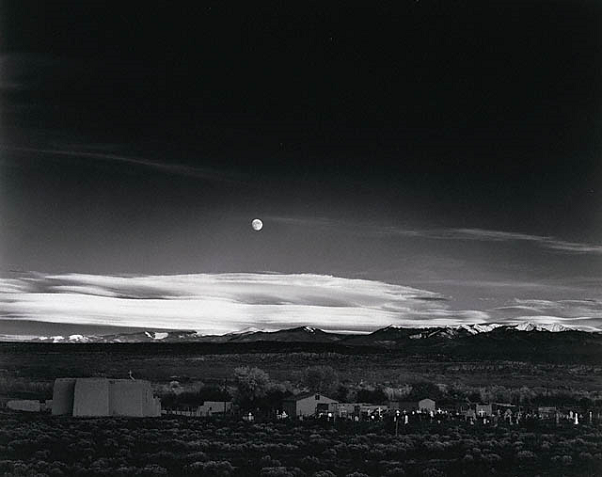
moon-over-hernandez

**

Yes, Adams’ photo captures “the right subject from the right vantage point at the right time” but it does so with a great eye — the eye, experience, vision of an Ansel Adams. The NASA photo of the moon transiting the earth, by contast, is brilliant, stunning, extraordinary — but offers sight, not insight. Once again, I think of Blake:

I question not my Corporeal or Vegetative eye any more than I would Question a window concerning a Sight. I look thro’ it & not with it.

That’s from his A Vision of the Last Judgment — apocalypticx, again — and famnously reads in context:

“What,” it will be Questioned, “When the Sun rises, do you not see a round Disk of fire somewhat like a Guinea?” O no no, I see an Innumerable company of the Heavenly host crying “Holy Holy Holy is the Lord God Almighty.” I question not my Corporeal or Vegetative Eye any more than I would Question a Window concerning a Sight: I look thro it & not with it.

**

Ah, but how easy to quote the Ansel Adams imager — it has long been famous for being a great photograph.

And yet the greatness was in Adams, in the moment, not in popular opinion:

I had been photographing in the Chama Valley, north of Santa Fe. I made a few passable negatives that day and had several exasperating trials with subjects that would not bend to visualization. The most discouraging effort was a rather handsome cottonwood stump near the Chama River. I saw my desired image quite clearly, but due to unmanageable intrusions and mergers of forms in the subject my efforts finally foundered, and I decided it was time to return to Santa Fe. It is hard to accept defeat, especially when a possible fine image is concerned. But defeat comes occasionally to all photographers, as to all politicians, and there is no use moaning about it.

We were sailing southward along the highway not far from Espanola when I glanced to the left and saw an extraordinary situation – an inevitable photograph! I almost ditched the car and russed to set up my 8×10 camera. I was yelling to my companions to bring me things from the car as I struggled to change components on my Cooke Triple-Convertible lens. I had a clear visualization of the image I wanted, but when the Wratten No. 15 (G) filter and the film holder were in place, I could not find my Weston exposure meter! The situation was desperate: the low sun was trailing the edge of the clouds in the west, and shadow would soon dim the white crosses.

I was at a loss with the subject luminance values, and I confess I was thinking about bracketing several exposures, when I suddenly realized that I knew the luminance of the moon – 250 c/ft2. Using the Exposure Formula, I placed this luminance on Zone VII; 60 c/ft2 therefore fell on Zone V, and the exposure with the filter factor o 3x was about 1 second at f/32 with ASA 64 film. I had no idea what the value of the foreground was, but I hoped it barely fell within the exposure scale. Not wanting to take chances, I indicated a water-bath development for the negative.

Realizing as I released the shutter that I had an unusual photograph which deserved a duplicate negative, I swiftly reversed the film holder, but as I pulled the darkslide the sunlight passed from the white crosses; I was a few seconds too late

**

See: science.

Back in the day artists were alchemists — grinding their own colors from exotic shrubs (dragonsblood), insects (crimson lake), stones (lapis lazuli) and so forth — and remain so to this day, as in the case of Jan Valentin Saether:

saether epiphany

Those shadows! The light..

**

Is Moonrise, Hernandez, New Mexico, science, then — or art?

Is “art or science” even a real question?

And that “desired image” of a “cottonwood stump near the Chama River” — isn’t that in some way the negative of Moonrise, Hernandez, New Mexico? The drawn bow that propelled Adams’ arrow to its mark?
Wargame boards, from chess to hexagons

Sunday, August 9th, 2015

[ by Charles Cameron — who can’t even reach the 7 monute mark in a Stallone movie without seeing a DoubleQuote ]
.

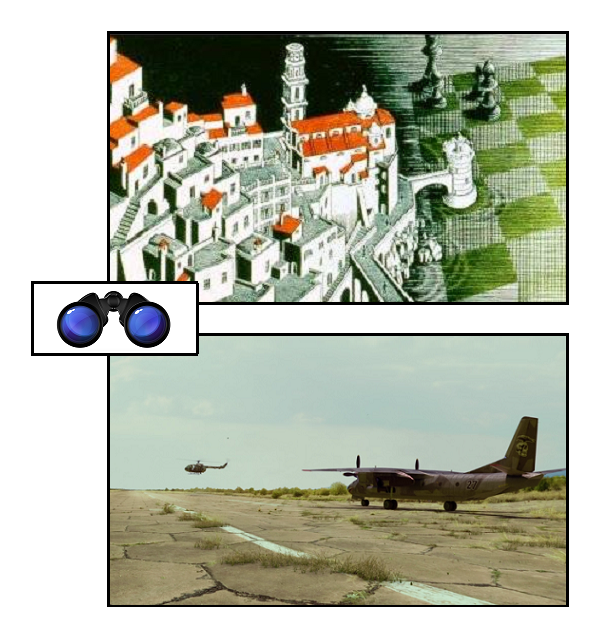
Wargame boards, from chess to hexagons — when the map becomes the territory:

SPEC DQ   hexagons

**

Contemplating..

  • Korzybski: the map is not the territory
  • Lao Tzu: the path that can be mapped is not the pathless path
  • and that second translation is one to set beside my other loose versions after Lao Tzu:

  • The pronounceable name isn’t the unpronounceable name.
  • The flow that can be capped isn’t the overflowing flow.
  • The quantity that can be counted is not the unaccountable quality.
  • The verbal formulation of x is not the x itself.
  • No way the way can be put into words.
  • The problem that can be described isn’t our actual situation.
  • More I grasp you, baby, more you disappear…
  • — which i posted here at Zenpundit in one of the posts that has sadly disappearedc, but which can be found — together with some interesting other commentary — on our emergency site, Zenpunditry.

    **

    At times, the map becxomes the territory, the gameboard becomes the world.

    The upper image in the DoubleQuote above is a teling detail from Maurits Escher‘s great work, Metamorphosis II. The lower image is a screencap of one of the opening shots from The Expendables 3.

    The things I do for science!

    Not everything that counts can be counted

    Monday, July 20th, 2015

    [ by Charles Cameron — not Einstein but a fellow Cameron gave me my title ]
    .

    I’ll admit I was uneasy when I read about the “effective altruism” movement in Peter Singer‘s Boston Review piece, The Logic of Effective Altruism, but I didn’t quite see how to phrase my unease. Here’s Singer’s explanation of the concept:

    Effective altruism is based on a very simple idea: we should do the most good we can. Obeying the usual rules about not stealing, cheating, hurting, and killing is not enough, or at least not enough for those of us who have the good fortune to live in material comfort, who can feed, house, and clothe ourselves and our families and still have money or time to spare. Living a minimally acceptable ethical life involves using a substantial part of our spare resources to make the world a better place. Living a fully ethical life involves doing the most good we can.

    That’s the gist, but there’s a lot of what I can only term “moral cost-effectiveness” in there, as though goodness were a problem in engineering.

    Today I read Michael J. Lewis‘s Commentary piece, How Art Became Irrelevant, and think I found the “why” of my unease, in the writer’s description of the German idea (“ideal”) of an architectural Existenzminimum:

    This was the notion that in the design of housing, one must first precisely calculate the absolute minimum of necessary space (the acceptable clearance between sink and stove, between bed and dresser, etc.), derive a floor plan from those calculations, and then build as many units as possible. One could not add a single inch of grace room, for once that inch was multiplied through a thousand apartments, a family would be deprived of a decent dwelling. So went the moral logic.

    **

  • Not everything that can be counted counts, and not everything that counts can be counted.
  • The heart has reasons Reason knows not of.

  • Switch to our mobile site