zenpundit.com » art

Archive for the ‘art’ Category

Unrenormalizable

Thursday, September 19th, 2013

[ by Charles Cameron — a quick quantum DoubleQuote in music and jewel — humor, edutainment ]
.

Nibbling at the tasseled fringes of science is as close as I get, but these two otherwise unrelated pieces caught my eye…

**

My first entry:
.


.

Pretty cool, pretty popular — and my second?
,


.

Read all about it: A Jewel at the Heart of Quantum Physics

**

A little video music, a little digital art, a little physics — what’s not to like?

And my title, Unrenormalizable? In physics, so I’m told, “Unrenormalizable theories contain infinitely many free parameters”. I’m no theory, but I suspect I’m unrenormalizable too.

Choices: Burning Man or Bali?

Saturday, August 31st, 2013

[ by Charles Cameron — we have as many possible futures as there are eyes in the tails of numberless peacocks — for your consideration, here are two of them ]
.

Sources:

  • Burning Man, live webcast, h/t Scott Hess
  • Bali, Pura Tanah Lot
  • **

    I’ll go for Bali, with wifi and a laptop to watch the live feed from Burning Man. You?

    A Sign of the Times – in today’s Post

    Tuesday, August 6th, 2013

    [ by Charles Cameron — on skilled design, and on choosing to purchase influence, elegance or beauty ]
    .

    There’s something very neat about this front page:

    Okay, okay, Jeff Bezos has bought the Washington Post. But what intrigues me about this front page of today’s digital edition as it appeared on my screen this morning was the way a color photo of Bezos sneaks in (left) below a larger black and while photo of Katharine Graham (center) — while an ad for the China Daily (right) takes up a third of the real estate (right), to be read, mark you, on Bezos’ own Kindle.

    So we have today’s future, to coin a phrase, with the “pivot to Asia” and the “pivot to Bezos” right there together — and the “pivot to digital” pretty much a done deal.

    **

    The price of the Post was $250 million, and plenty of people have talked about what Bezos could have bought instead — and while we’re on the topic of neat design, I couldn’t help but notice that there’s a $250 million penthouse under construction in Monaco, described by HiConsumption as The World’s Most Expensive Penthouse, and that one of the numerous architectural illustrations provided also features a striking lesson on graphics:

    What catches my eye here is the parallelism between the window with its center divider and balcony rail (left) with the geometry of the painting on the wall (right) — that’s a brilliant design choice, as the photographer well knows.

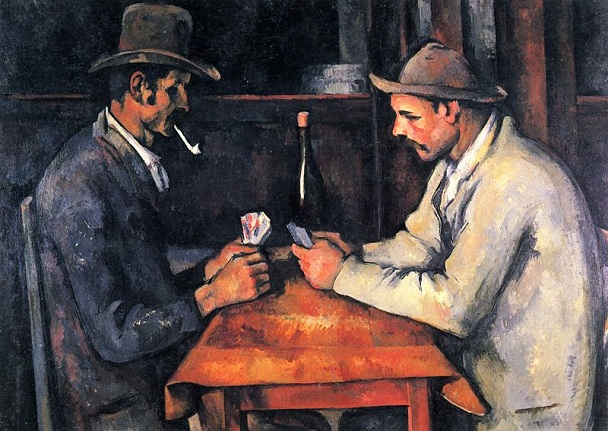
    In my dreams I’d prefer my own choice of art-work, frankly — and if I only had $250 million to play with, I’d go for a small craftsman cottage in Pasadena, perhaps — with that luminous $250 million Cezanne to grace one of my walls…

    **

    That — and the digital Post on Kindle, I suppose.

    On two, one, seven plus or minus, and ten – towards infinity

    Monday, July 29th, 2013

    [ by Charles Cameron — a few quirky thoughts about graphs and analysis ]
    .

    Two eyes (heads, ideas, points of view) are better than one.

    **

    When I worked as senior analyst in a tiny think-shop, my boss would often ask me for an early indicator of some trend. My brain couldn’t handle that — I always needed two data points to see a pattern, and so I coined the mantra for myself, two is the first number. When the American Bankers Association during the Y2K scare wrote and posted a sermon to be delivered in synagogues, churches and mosques counseling trust in the banking system it was a curiosity. When the FBI, in response to the same Y2K scare, put out a manual for chiefs of police in which they provided input on the interpretation of the Book of Revelation, the two together became an indicator: they connected.

    My human brain could see that at once — non-religious authority usurps theological function, times two.

    For what it’s worth, the Starlight data-visualization system we used back then (1999) couldn’t put these two items together: I could and did.

    **

    To wax philosophical, in a manner asymptotic to bullshit:

    One isn’t a number until there are two, because it’s limitless across all spectra and unique, and because it is its own, only context.

    One isn’t a number unless there’s a mind to think of it — in which case it’s already an abstraction within that mind, and thus there are, minimally, two. At which point we are in the numbers game, and there may be many, many more than two — twenty, or plenty, or plenty-three, or the cube root of aleph null, or (ridiculous, I know) infinity-six…

    Go, figure.

    Two is the first number, because the two can mingle or separate, duel or duet: either way, there’s a connection, a link between them.

    Links and connections are where meaning lies — in the edges of our graphs, where two nodes seamlessly integrate, much as two eyes or two ears give us stereoscopic vision or stereophonic sound, not by abstracting one from two by skipping the details that make a difference, but by incorporating the rich fullness of both to present a third which contains them fully via an added dimension of depth.

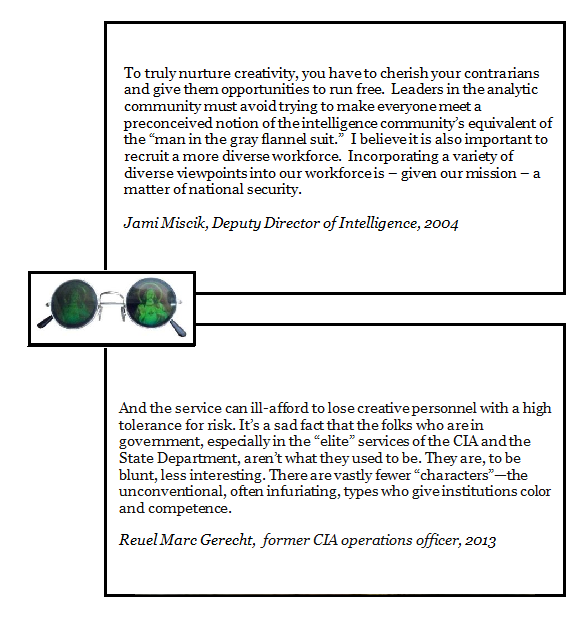
    That’s the fundamental reason that DoubleQuotes are an ideal analytic tool for the human mind to work with: they’re the simplest form of graph — the dyad — populated with rich nodes and optimally rich associations between them.

    **
    **

    Cornelius Castoriades wrote:

    Philosophers almost always start by saying: “I want to see what being is, what reality is. Now, here is a table; what does this table show to me as characteristic of a real being?” No philosopher ever started by saying: “I want to see what being is, what reality is. Now, here is my memory of my dream of last night; what does this show me as characteristic of a real being?” No philosopher ever starts by saying “Let the Requiem of Mozart be a paradigm of being”, and seeing in the physical world a deficient mode of being, instead of looking at things the other way around, instead of seeing in the imaginary, i.e., human mode of existence, a deficient or secondary mode of being.

    When I specified above “the simplest form of graph — the dyad — populated with rich nodes and optimally rich associations between them” I was offering a Castoriades-style reversal of approach, in which our choice of nodes is determined not by their abstraction — as single data points — but by their humanly intuited significance and rich complexity. Hence: anecdotes, quotes, emblems, graphics, snapshots, statistics — leaning to the qualitative side of things, but not omitting the quantitative. And their connection, intuited for the richness of the parallelisms and oppositions between them.

    Often the first rich node will be present in the back of the mind — aviators wanting to learn how to fly a plane, but uninterested in how to land it — when the second falls into place — when a student asks a diving instructor to teach the diving technique, with no interest in learning to avoid the bends while coming back up. And bingo — the thing us understood, the pattern recognized, and an abstraction to “one way tasks” — including “one way tickets” established.

    Let’s call that first node a “fly in the subconscious”. I’d love to have been a fly in the subconscious when SecDef Rumsfeld told a Town hall meeting in Baghdad, April 2003:

    And unlike many armies in the world, you came not to conquer, not to occupy, but to liberate and the Iraqi people know this.

    Because I could have chimed in cheerfully in the very British voice of General Sir Frederick Stanley Maude, in that different yet same Baghdad in 1917:

    Our armies do not come into your cities and lands as conquerors or enemies, but as liberators…

    Oh, the echo — the reverb!

    **

    The ideal number of nodes in the kind of graph I’m thinking of is found in terms of the human capacity to hold “seven plus or minus two” items in mind at the same time — thus, with a slight scanning of the eyes, a graph with eight to twelve nodes and twenty or so edges is about the limit of what can be comprehended.

    The Kabbalistic Tree of Life, infinitely rich in meaning and instruction, has ten nodes and twenty-two edges. Once taken into the mature human mind, there is no end to it.

    The value of a graph composed of such rich nodes and edges lies in the contemplation it affords our human minds and hearts.

    **

    Two, being the simplest number, will probably give you the richest graphs of all…
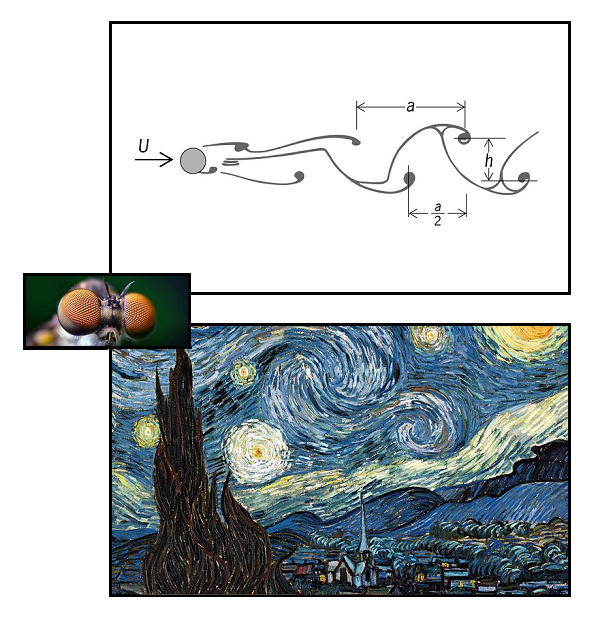
    Art, in the person of Vincent Van Gogh, meet science, in the person of Theodore von Kármán.

    Geometry aka logic as an analytic tool

    Friday, June 28th, 2013

    [ by Charles Cameron — reflections on cognitive empowerment by selective noticing ]
    .


    .

    I just realized that I take notice of details at the level of “geometry aka logic” which I would miss if I were more focused on content. In effect, I treat idiosyncracies and hiccups of expression — such as paradoxes — as indicative of condensed or distilled meaning.

    What triggered this realization was the way my interest was aroused by this phrase:

    The parallel universes may soon become perpendicular.

    I found that today in an FP piece, Will June 30 be midnight for Morsi’s Cinderella story?

    **

    Paradox? Geometry? Contradiction? Figure of speech?

    It’s the irregularity in the pattern used to describe the events in question that catches my eye here, however you care to name it. And something very similar is going on when I flag the weird juxtapositions of imagery and music in Taylor Swift, Sara Mingardo, JS Bach and a quiet WTF, or the koan-like tensions and reconciliations inherent in such inseparable pairs as war-and-peace in Of dualities, contradictions and the nonduality.

    Here’s the full paragraph, discussing the increasing polarization of the Egyptian public, and some ways in which “the current situation differs more in degree than in kind from the recent past”:

    Second, violence is on the table. The parallel universes may soon become perpendicular. Of course, Egyptian politics has had its victims over the past two and a half years, but violence has seemed episodic and almost self-limiting since those who have deployed it have paid a heavy political price. Nobody advocates violence now, but many expect it and it is not uncommon to hear from both sides that they will not shrink from self-defense. And the line between self-defense and offensive action can become thin for each camp for opposite reasons. The opposition is hardly centrally controlled and rogue elements have already been involved in attacks on Brotherhood offices as well as those of its political party. For the Brotherhood, its discipline has led it to prepare for what it sees as defensive action in a manner that understandably appears threatening to outsiders (especially after the events of December 2012 when Brotherhood cadres constituted themselves as a vigilante force to confront those demonstrating at the presidential palace).

    Okay, so I’m already reading the article, ergo I must already have been interested enough in what’s going on in Egypt to click through to it. So why the fuss about paradox and geometry in what is, after all, only one turn of phrase in a piece whpose subject already interests me?

    **

    I’m still feeling my way towards and understanding of how my mind works, how I pick up on things, how I populate my mind with rich and interesting memories, how I make my small and large creative “leaps” — my means of collecting and connecting dots, if you will. Because there’s a cognitive skill there that I haven’t seen taught, and I believe it offers an “outside the box” alternative mode of monitoring topics of interest.

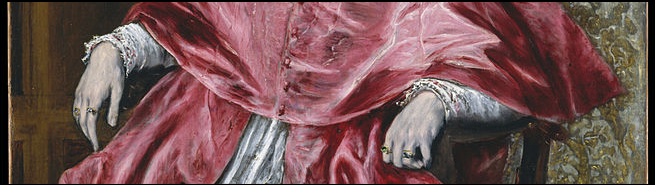
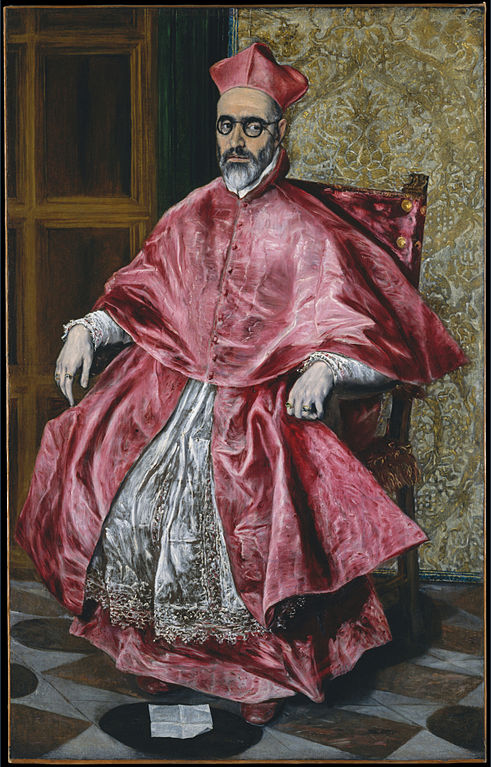
    You know, of course, that most every time you read the words you know, of course, that it’s a dead giveaway that the speaker or writer is skimming quickly past a cherished assumption that he or she wouldn’t want you to examine too carefully? Of course you do. It’s one of those psychological “tells” that should alert you, like a facial tick, a hesitation, or that curious (and paradoxical) tight grip on one arm of the chair with one hand while the other rests almost disdainfully relaxed and gracious on the other, in El Greco’s masterful portrait of a Cardinal, now in the Metropolitan in New York:

    How very telling that sort of detail can be!

    **

    And intersections.

    I talk quite a bit about juxtapositions and parallelisms, because they’re the elements of “creative leaps” (and Sembl / Hipbone moves) and I “practice” noting them for my DoubleQuotes. But one way to clear the xlutter from mind is to concentrate on places where two fields intersect. I’m interested in apocalyptic, for instance, so I take particular note when someone from a Christian apocalyptic POV (Joel Richardson, Joel Rosenberg, eg) writes about Islamic eschatology, or when someone from an Islamic apocalyptic POV (Sh. Safar al-Hawali, eg) writes about Christian eschatology. Reading wherever I notice this kind of overlap means that I learn in two contexts — effectively doubling my knowledge value — where most reading that’s not “targeted” this way only allows me to learn in one…

    Again: parallelisms, overlaps, paradoxes, perpendiculars, contradictions — these are all “formal properties” of a given text rather than “contents” — that’s the level of abstraction at which you can make the details sing.

    **

    Hey, I’m not alone. As I was cleaning this post up, Adam Elkus tweeted a link to a post about the CTO of Intel, Intel Labs: Assuring Corporate Immortality by Rob Enderle, which contains this phrase:

    This is very orthogonal thinking

    There we go! The word orthogonal is so important to me, and is so often on the tip of my tongue but out of reach of immediate memory, that I have a file on my computer consisting solely of the words “opposite oblique orthogonal congruent incongruous antithetical obtuse parallel asymptotic perpendicular right angles” — so if I can remember any one of them, I can easily find “orthogonal”.

    Very orthogonal thinking — terrific!


    Switch to our mobile site