zenpundit.com » art

Archive for the ‘art’ Category

Form is Insight: the project

Monday, October 22nd, 2012

[ by Charles Cameron — about the (not yet titled) book (or post-book project) i seem to be writing, which offers a grand slam intro to an array of box-free contemplative and artistic approaches to creative thinking, and hence opens fresh angles on intelligence ]
.

One thing I can promise: whatever this project turns out to be, it won’t be predictable.
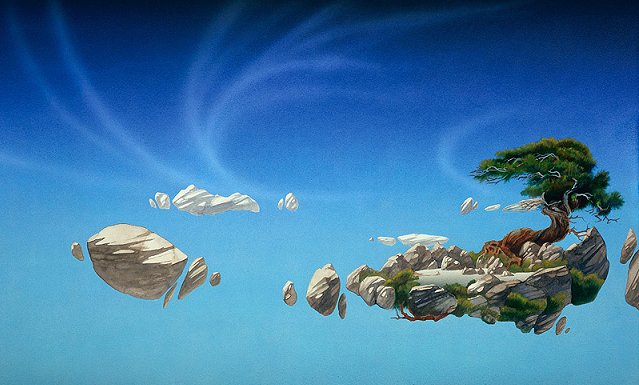
credit for this incredible image: Roger Dean

.

This project won’t take you over familiar territory, congratulating you on holding the same opinions as the author and adding in enough choice details to keep you interested. I’m not aiming to teach you the same thing you already know, only better, more interestingly, more precisely, or in greater detail. I’m aiming to question you, challenge you, and give you a whole new range of optics through which to view the world.

**

So, here we go.

I think I am finally at the point where the book (or whatever it is) I’ve been gathering inside me all these years is ready to be written. Some of it has already emerged in earlier posts here on Zenpundit — you don’t known and couldn’t count how many thanks, Mark — and this is certainly where I’ve been developing the style of integrated visuals and verbals that gives the project its flavor — so I’d also like to use my posts here to discuss the thing with you as I go along.

The project is about intelligence in the widest sense, including heart and mind, and with particular focus on creativity. I’m addressing this from two standpoints that mesh together well, and I’m addressing it to two audiences that I believe also mesh together well.

The standpoints are (i) meditation and (ii) the arts, and the audiences are (i) the “intelligence community” and (ii) bright people in general.

I believe that meditation cultivates a spacious mind-set in which we can hold multiple concerns in mind at the same time – the opposing needs of different people, stakeholders, sections of society, the environment, etc – thus seeing things from multiple angles and in balancing & thus balanced ways. And I think the arts serve as the primary means for expressing these balances with all their nuances and shadings, and that techniques from within the arts such as polyphony, chiaroscuro, formal constraint and pattern can teach us to shape multi-faceted insights like these into rich and complex understandings – complex patterns that respond to complex situations. I’ll go into all this in detail as we move along, with examples.

I also believe that this kind of creatively patterned insight — embodying artistic methodology in the context of complex problems with a “fresh” and open mind – will be of interest beyond the intelligence agencies and policy-makers, to business people, artists, and also — importantly — the bright general public, which I take to be a far larger subset of the population than we commonly think, and always eager for reading that doesn’t talk down to them but appreciates their own intelligence and good will.

For now let me just say that I’m very excited, because this seems (at last) to be a project that ties together my game-work with Sembl, the think-tank side of me which has been monitoring religious violence, jihad and terror and working towards nuance, understanding and peace these last dozen years — and my sense of creativity as a writer and poet.

Ripeness is all: I suspect the time for this venture has arrived.

**

Here’s the single page overview I’ve written, with a working title:

Intelligence is Zen: understanding our complex world with koans in mind

Just a few days ago, the Director of National Intelligence, James Clapper, referenced Pirsig‘s book, Zen and the Art of Motorcycle Maintenance, as key to the Intelligence Community’s work in understanding and adapting to the many, varied, intersecting problems we face in the world today. As I noted, Clapper was focused a bit more on the biker wisdom than the Zen to be found in Pirsig’s book, but he does raise a question I’ve been addressing for some years now:

What does the contemplative mind have to offer in terms of understanding a complex world?

To my mind, the creativity which is all the buzz of the business world, aimed at solving what are called “wicked problems” — problems that feature multiple stakeholders with multiple aims and objectives, aims and objectives which themselves shift over time so the problems are “never the same river twice” – requires a major mental and emotional shift. Reverie and meditation free us up to make the shift: the shift itself is poorly understood.

Our present, mostly linear way of thinking favors either/or side-taking, dubious cause-and-effect expectations which fail to take complex feedback loops into account, followed all too often by a rush to judgment. We need a whole new – old, even ancient – way of thinking.

Our problems are complex because they overlap, they ripple through one another. In Buddhist terms, they are “interdependently arising.” Not surprisingly, the way of thinking that is required to gain a deeper insight into “interdependently arising” problems can be found in explicit form in such contemplative traditions as Madhyamika & Zen, Taoism, Sufism, and their Abrahamic contemplative analogs. At the heart of these systems is fresh thinking – thought refreshed by quiet.

Furthermore, the shaping of insights in an open field of thought is something the world’s artistic traditions have long dealt with, and there are schools of insight not just available but recorded in exquisite detail in the world’s traditions of poetry, music, painting, theater, film… in patterns that are found in nature, in culture, and in the very turbulence we now must learn to flow with.

The project therefore takes a meditation-influenced approach to intelligence, both in the sense in which Clapper would use the word, relating to the intelligence analysis which develops and influences our decision-makers’ understanding of what’s needed, and in the more general sense of those capable folk with bright minds, keen insights, sharp instincts, warm hearts.

I’ll propose a series of ways of looking differently – with application for anyone, whether artist, intel analyst, businessman, policy-maker, or lover – that cut to the essence of creativity: lateral, analogical, holistic thinking, witnessing pattern beneath the surface of things. My examples will be mainly drawn from terrorism, which I have been monitoring for a dozen years: my style is that of a poet and an eccentric Englishman.

My subtext, my subliminal message, will be contemplation and artistry as profound common sense.
When the rivers run red

Sunday, September 9th, 2012

[ by Charles Cameron — science and / or apocalypse, quirky, not analytic ]
.

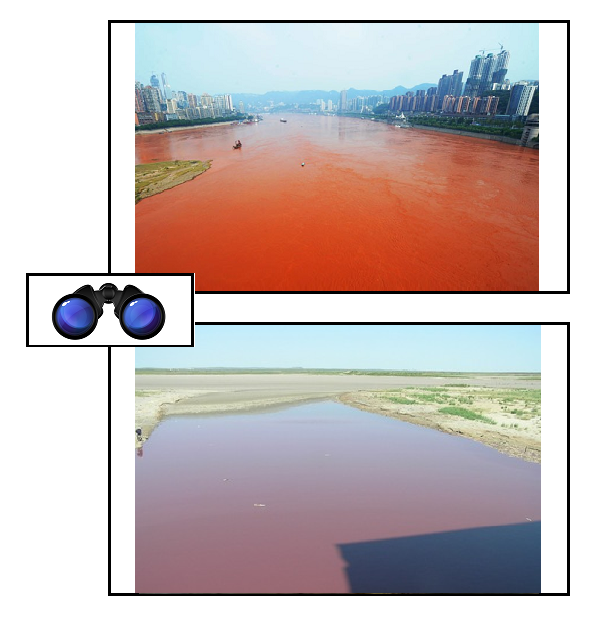
The upper image of this par shows the Yangtze River recently, as reported by the Daily Telegraph under the delightful header, Red China:

I got it from Scence, Space & Robots, which commented:

NDTV reports that Chongqing’s Environmental Protect Bureau is blaming sand for the color change in the river. They claim flooding upstream washed sand downstream which turned the river red.

Okay, so as anyone who has stirred watercolors with their fingers knows, water can be all kinds of colors…

But what it it’s the apocalypse?

That was one possible conclusion Live Science found whehn they asked people about the red color of a lake in Texas (lower image):

The color has some apocalypse believers suggesting that OC Fisher is an early sign of the end of the world, but Texas Parks and Wildlife Inland Fisheries officials say the bloody look is the result of Chromatiaceae bacteria, which thrive in oxygen-deprived water.

So — when you see red water, do you think “aha! daub time” or “ooh, chromatiaceae” — or “OMG, it’s the end, it must be”?

**

Do you prefer to get your explanations for curious events from science, or from religion?

As Caitlin Fitz Gerald — who has an impressive acquaintance with watercolors as the artist behind the Clausewitz for Kids project — kindly tweeted:

John the Revelator puts it this way, in Revelation 16.4:

And the third angel poured out his vial upon the rivers and fountains of waters; and they became blood.

Even the Onion mentions the streets running red, though out of concern for good taste, I won’t quote…

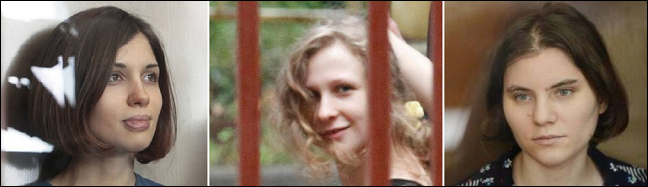
Pussy Riot VII: three “very different” characters

Thursday, August 23rd, 2012

[ by Charles Cameron — a quick look at the dramatis personae ]
.

And let me repeat for the record: I am neither pro nor anti Pussy Riot. I have sympathies on both sides. It comes down to this: I love both liberty and liturgy.

The Washington Post was among the news sources hosting an AP bulletin from August 16, updated August 17 under the header, Art performer, poet, software programmer — three faces behind mask of Russia’s Pussy Riot band.

After pointing out that the group to which they belong strove for anonymity, the writer commented that they “have unwillingly emerged as vivid — and very different — characters.” Here’s the short form version of their differences:

One is a daring performance artist with Angelina Jolie lips and a notorious part in a filmed orgy just days before she gave birth. Another is a poet and environmentalist whose pre-Raphaelite looks project sweetness and sensitivity. Rounding out the trio is a quietly cerebral computer expert, who has applied her skills both to nuclear submarines and experimental art.

In more detail (and I’m still cutting quite a bit here to bring you the gist of the articled, and recommend you read the whole thing):

**

Nadezhda Tolokonnikova:

Tolokonnikova left her home in the frigid oil town of Norilsk at 17 to enroll in Moscow State University’s philosophy department. … “Feminism, art and politics take up all her time,” said David Abramov, who has helped Pussy Riot organize performances. “She devotes all her time to it.”

**

Maria Alyokhina:

Alekhina, an accomplished poet with long curly blonde hair, is quite a different face of Pussy Riot. Alekhina, mother of a five-year-old boy, has a long background in charity work and environmental activism. She organized protest pickets to defend Utrish, a natural reserve in Russia’s south, from developers and worked with Danilovtsy, a Russian Orthodox charity.

**

Yekaterina Samutsevich:

Samutsevich, 30, studied computers at Moscow Energy University and soon got a good job at a top research center. She was promptly hired to a job in a top secret department where she was designing software programs for Russia’s top nuclear submarine Nerpa, her father Stanislav said.

Samutsevich later quit and enrolled at the renowned Rodchenko Photography and Multimedia School to study media art. Her final project at the school was designing a web-browser which intentionally distorted and manipulated search results — an invention that was supposed to highlight society’s dependence on media and helplessness in the uncharted waters of web media.

Alexei Shulgin, a professor at the Rodchenko school … praised her as a talented artist and said that like many young people in Russia she “turned to art for answers about modern times.”

**

What if they had been a classical ensemble playing Stravinsky — might we detect a faint echoes of the Paris première of the Rite of Spring just shy of a century ago? — or, given their interest in the visual arts, Scriabin‘s 102 year old Prometheus: The Poem of Fire with its part for keyboard-for-lights, perhaps?

My own taste runs more to Bach.

A graphic mix and match

Wednesday, August 22nd, 2012

[ by Charles Cameron — the serious-minded can safely ignore this post, which is of mainly aesthetic interest, surely a matter of no importance in its own right ]
.

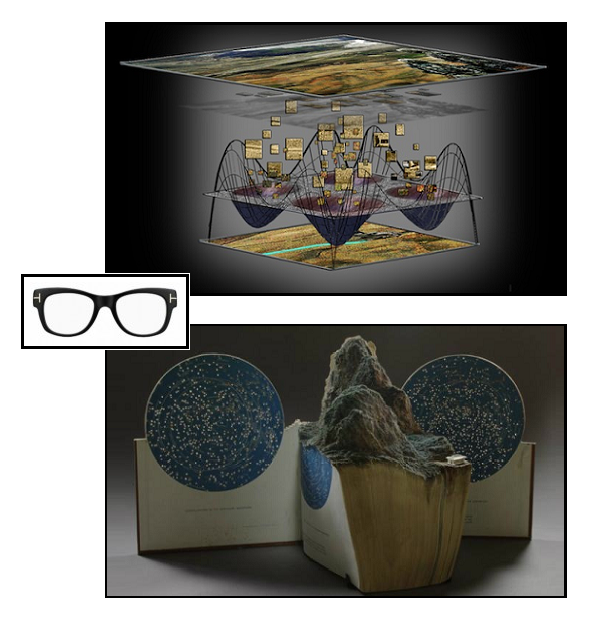
Two graphics caught my eye today, one after another in my RSS feed.


.

The upper image comes from DARPA, and is not really explained in any detail by the otherwise interesting Wired piece that it illustrated — but is easy and intriguing to the eye anyway, and somehow has to do with a return to analog computing:

Through its Defense Advanced Research Projects Agency (Darpa), the DoD is funding a new program called UPSIDE, short for Unconventional Processing of Signals for Intelligent Data Exploitation. Basically, the program will investigate a brand-new way of doing computing without the digital processors that have come to define computing as we know it.

Well, new this time around the block, anyway.

The second (lower image), totally unrelated to the first but almost its twin to my mind’s eye, shows a “literary moonscape” by the artist Guy Laramée, created by sculpting it out of an old book, h/t The Paris Review, Saatchi Gallery and 3quarksdaily.

In my view, Laramée has an impressive understanding of books and how they serve as portals into other worlds:

Book review: Kay Larson on the zen of Cage

Friday, August 10th, 2012

[ by Charles Cameron ]
.

Kay Larson, Where the Heart Beats: John Cage, Zen Buddhism, and the Inner Life of Artists, Penguin, $29.95

.

Dropping silence into a concert turns things upside down: it brings the solo performer or group of performers into the position of audience, makes listeners of them – and makes keener listeners of the audience — perhaps with a touch of unease or self-consciousness, but with an unusual attentiveness, too.

Dropping John Cage‘s piece of silent music into a book right around the beginning… well, it has a similar impact. And that’s what Kay Larson‘s book Where the Heart Beats does, on the page numbered xiii so you’ll know the book hasn’t even started properly yet. Larsen points you, without giving you the URL, to YouTube, where you can find Cage’s most shocking, and thus his most famous piece, 4’33”, performed by the London Symphony at the Barbican, in three movements, all silent as demanded by the composer’s score – with breaks in between the movements for the usual coughing and fidgeting.

And how to say this? During the silence, you could have heard a pin drop? Or you could hear, as Tom Service said on the BBC, the “very distinct high hum” of the Barbican’s electrical system, and the occasional cough too – “you could cut the atmosphere with a knife, and every cough, every tiny noise was absolutely amplified, made into a massive musical event”.

Listen:

You can tell the audience was delighted – self-satisfied perhaps, too? – from the hearty applause, and they had listened, had presumably taken onboard the idea that pauses – silences – are as much a part of music as sounds.

But what if I said that wine was just as much a part of drinking as glasses, and poured wine for my guests with no glasses to contain it?

The thing about John Cage’s 4’33” is that it straddles the line between the emperor having and not having clothes, between group assent and dissent, between “either” and “or” -– if it turns us from self-obsessed self-expressives into attentive listeners, it has reached into us musicically and carried us beyond the limits of music. And if it’s a bunch of boring minutes while an orchestra gets paid to SFU, it’s plain idiotic.

Which means that John Cage composed it right at the tipping point between the stupid and the profound.

I want to express it that way, and not tell you that Cage composes where the mind is fresh and inspiration flows, because it is stupid as well as fresh and profound.

As Hitler might have said, if he’d been asked…

And we haven’t really begun the book yet.

**

There are three stories here:

There’s the rigorous thread of western classical music, from its origins in the mist via Jewish cantillation and Gregorian chant into Polyphony and the Baroque, Classicism proper, Romanticism and the Modern. The music of Cage is the culmination, here, of this theme.

There’s the circling yet nonexistent circle, drawn as it were on glass with an ink brush dipped in water, of Zen, a “rebirth with neither beginning nor end”…

And there’s the world of the contemporary arts, centering in New York, with Cage a leading light.

They comes together when various characters have what Larson calls “life altering moments” — Larson herself, John Cage, Gary Snyder, Allen Ginsberg, Jack Kerouac in the first few pages alone, with the two Suzukis, DT Suzuki and Shunryu Suzuki Roshi and their experiences hovering in the background.

Zen is the pond, the emptiness, the silence, the stillness waiting into which like so many varied pebbles, the themes are character off the book will drop, in which their ripples will intersect…

Or to put that another way: silence, the stillness, is the pond into which Cage’s life and influence is dipped, and music and the arts the shingle on the beach from which the pebbles are dropped.

**

And Cage played in that shingle, sent notes from “prepared piano” and other instruments… formal and informal… skipping across the silence.

Cage not only invited silence into the concert hall, he also theorized it at length. I’d like to quote here a celebrated passage from his book, aptly named Silence: Lectures and Writings:

What happens to a piece of music when it is purposelessly made? What happens, for instance to silence? That is, how does the mind’s perception of it change?… Silence becomes something else — not silence at all, but sounds, the ambient sounds… Where ears are in connection with a mind that has nothing to do, that mind is free to enter into the act of listening, hearing each sound as it is, not as a phenomenon more or less approximating a preconception.

**

Zen is the simplest thing, it’s human nature. It is also the most difficult — it’s what we instinctively shy away from. And it can take all our resources, as those who “sit while going round in circles” well know — to break from the “boredom” of silence into listening, to dip into the sound stream, to hear the stillness.

Somehow, I’m hoping to nudge you into that kind of awareness, so that you can understand from within the taste of silence, the importance of Cage’s life, and of Kay Larson’s book.

Here’s another nudge, from a different angle — the Scottish poet Edwin Morgan‘s poem in homage to one of John Cage’s sayings:

Opening the Cage: 14 Variations on 14 Words
“I have nothing to say and I am saying it and that is poetry.” — John Cage

I have to say poetry and is that nothing and am I saying it
I am and I have poetry to say and is that nothing saying it
I am nothing and I have poetry to say and that is saying it
I that am saying poetry have nothing and it is I and to say
And I say that I am to have poetry and saying it is nothing
I am poetry and nothing and saying it is to say that I have
To have nothing is poetry and I am saying that and I say it
Poetry is saying I have nothing and I am to say that and it
Saying nothing I am poetry and I have to say that and it is
It is and I am and I have poetry saying say that to nothing
It is saying poetry to nothing and I say I have and am that
Poetry is saying I have it and I am nothing and to say that
And that nothing is poetry I am saying and I have to say it
Saying poetry is nothing and to that I say I am and have it

Edwin Morgan, The Second Life
Edinburgh University Press, 1968

**

In a follow up post on Monday or Tuesday, I shall describe Larson’s book in more conventional terms, and offer you some details from Cage’s intricate life and extraordinary network of friends..

For now, I just want to give you again that taste of silence from which this whole endeavor springs. Here is the pianist David Tudor, for whom the piece was written, playing 4’33”:


Switch to our mobile site