zenpundit.com » art

Archive for the ‘art’ Category

Copywrong?

Friday, June 29th, 2012

[ by Charles Cameron — borrowing as the nature of creativity from lichen to origami, copyright ]
.
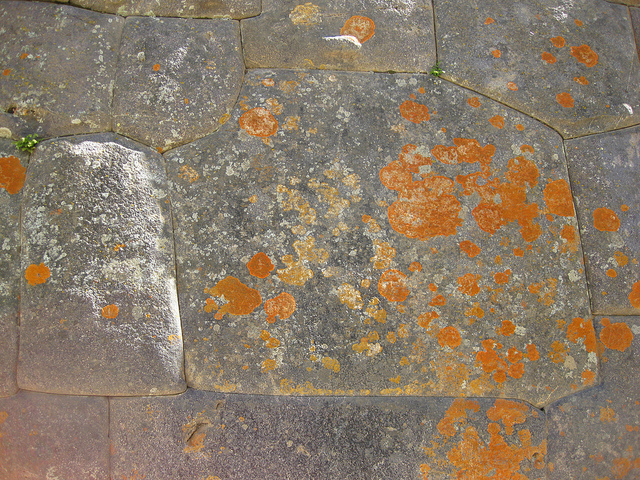
Lichen covered wall, Incan ruins of Ollantaytambo. Cusco, Peru

**

Leonardo in his Treatise on Painting came up with what he called “a new theoretical invention for knowledge’s sake … of great utility in bringing out the creativity in some of these inventions”:

This is the case if you cast your glance on any walls dirty with such stains or walls made up of rock formations of different types. If you have to invent some scenes, you will be able to discover them there in diverse forms, in diverse landscapes, adorned with mountains, rivers, rocks, trees, extensive plains, valleys, and hills. You can even see different battle scenes and movements made up of unusual figures, faces with strange expressions, and myriad things which you can transform into a complete and proper form constituting part of similar walls and rocks. These are like the sound of bells, in whose tolling, you hear names and words that your imagination conjures up.

Borrow, he says, from nature.

Michelangelo, you may recall, used to see statues in chunks of marble, then chip away the excess to reveal what had been there all along…

**

The stone-cutters whose marvelous ingenuity pieced together the stone wall in the Incan ruins of Ollantaytambo, Peru, depicted above in a photo by Teosaurio (under a CC BY-SA 2.0 license) borrowed stone from nature in somewhat the same manner, brilliantly.

Nature repaid the compliment, adding the colors of lichen to the sunlit and shadowed grey of stone.

**

In Paris, the artist Mademoiselle Maurice has been adding her own kind of lichen to the shadowed and sunlit walls of Paris, in an installation she calls spectrum – her lichen being composed entirely of small, colored origami folds, by way of honoring the origami peace cranes of Hiroshima artist Sadako Sasaki.

image: Mlle Maurice, abstract paper rainbow

**

Origami?

Origami is an exquisite art in its own right, demonstrating once again that mathematics belongs as much to the arts and humanities as it does to the sciences and technology.

[Consider this bleeding together of arts and sciences as something of a crusade of mine. Photography is art, and it does not became science just because the photograph is of stars rather than stones: photography is science, and it does not become art simply because the stars are beautiful.]

One genius of the artful mathematics of folding would be Robert Lang, who, as Kevin Kelly just told us, “helped NASA design satellite folding/unfolding solar panels” and “uses computers to devise folding patterns to create impossibly detailed 3D organisms from a single piece of paper…”

One can hardly deny that his work is quite lovely:
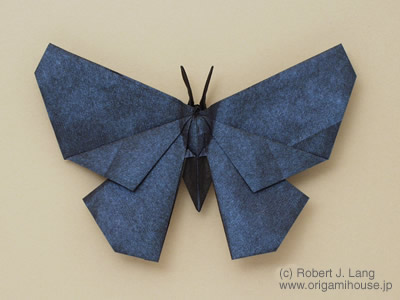
Butterfly image: Robert Lang, Origami Insects Vol 2, ed. Makoto Yamaguchi

**

One might wonder whether Lang is the genius, or mathematics? Does he borrow from God, from some principle immanent in universe?

His diagram depicted, left, below, “will, when folded by him, turn into a convincing Rhinoceros Beetle”

Of the Rhinosceros beetle or of the butterfly one might ask, as William Blake asked of the Tyger:

Did He smile His work to see?
Did He who made the lamb make thee?

Science, naturally, somewhat believes it has the answer…

**

Compare and contrast:

image: Kevin Kelly, from the Technium

**

Inappropriately appropriated? The very concepts battle each other into oxymoron fatigue.

The painter Susan Morris borrowed Robert Lang’s beautiful design, itself a WoA — useful bureaucratese devised by a friend of mine for filing Works of Art in a category of their own – to make the painting, also a WoA, depicted above, right.

Morris, it seems to me, takes Lang in a direction pioneered by Frank Stella:

image: Frank Stella, Harran II

**

It was Kevin Kelly who juxtaposed Lang and Morris in the image above — in what I’d have claimed was a WoA in my DoubleQuotes format if I’d done it myself — so as to discuss copyright.

Or more precisely, copy — right or wrong?

Nature copies, without apology, with beauty – and, in the case of certain poisonous spores, without remorse. And are we not nature?

Here’s Leonardo again:

Don’t underestimate this idea of mine, which calls to mind that it would not be too much of an effort to pause sometimes to look into these stains on walls, the ashes from the fire, the clouds, the mud, or other similar places. If these are well contemplated, you will find fantastic inventions that awaken the genius of the painter to new inventions, such as compositions of battles, animals, and men, as well as diverse composition of landscapes, and monstrous things, as devils and the like. These will do you well because they will awaken genius with this jumble of things.

To study, to copy, to derive: this awakens genius. Who am I to disagree?

Crania Anatomica Filigre

Monday, June 18th, 2012

Crania Anatomica by Josh Harker

Just received a Crania Anatomica skull as a gift for father’s day from the dutiful Mrs. Zenpundit. The skulls come in various sizes and are the creation of sculptor-entrepreneur Joshua Harker; made with 3-D  printing, the polyamide nylon skull is extremely intricate, lightweight, slightly flexible and has the look of delicately carved ivory. Very cool gift.

Harker’s project and sculprures are explained in greater detail at his Kickstarter page.

“No one is really listening, they are just pretending.” – Madhu

Wednesday, May 2nd, 2012

[by J. Scott Shipman]

As mentioned recently, I’m reading Inventing Grand Strategy and Teaching Command, by Jon Tetsuro Sumida. Chapter 2 is complete, however Sumida included one sentence at the end of the Introduction that has been nagging me. Professor Sumida said, speaking of Alfred Thayer Mahan:

“It remains to be seen whether readers exist with the mind and will to accept his guidance on what necessarily is an arduous intellectual and moral voyage into the realm of war and politics.” (emphasis added)

The phrase “whether readers exist with the mind and will” jumped off the page. Over the last few days I’ve seen several articles of warning of the West’s decline, and while many shed light on symptoms that would indicate decline, most are tired old bromides masquerading as “new thought.” For instance, a few days ago, a friend on Twitter (an Army officer) shared a Tweet from The New Atlanticist of an article called, “Why We Need a Smart NATO.” He tweeted, “Call me a cynic, but haven’t we ALWAYS needed a smart NATO?” Good question. In my estimation, “smart NATO” is yet another venture into sloganeering. While it may call into question my judgement, my first thought on reading “smart NATO,” was a line from the cult movie Idiocracy (if you haven’t seen it, get it) and one scene where the time traveling protagonist is attempting to explain the importance of water to plants to people of the future who use a sports drink instead. Here is the clip:

but it’s got electrolytes…

We’re living in a world of unprecedented availability of information, yet our meta-culture seems indifferent to anything that takes more than a few minutes to consume. Among too many military colleagues I know, it is not uncommon to hear the phrase, “I’ve not read Clausewitz through….nobody does…” And I respond, “But if not you, then who will?” If the practitioners of a profession as serious as the profession of arms don’t read and think deeply, who will? And what will become of the timeless principles learned and recorded at the cost of blood and treasure and how those principles translate into how we fight? I have an abiding fear our military, not out of malice but neglect, is cutting the intellectual cord with the past by making it culturally acceptable to be intellectually indifferent and incurious, to sloganeer instead of think, allowing slogans and PowerPoint as woefully inadequate substitutes. There is no app for intellectual development.

We can’t afford to allow the profession of arms to be anything but intellectually robust and challenging. Zen wrote an excellent summation of the recent posts on disruptive thinkers (which may for some have the ring of sloganeering). However these posts are evidence a lot of the young guys “get it” and want more. Good news, but recognition of the problem is not enough; action is required. Action that may damage a career.

I’m a member of the US Naval Institute, and an on-going concern of the Institute is relevance to the young folks. Yep, relevance. Relevance with a mission statement like this:

“To provide an independent forum for those who dare to read, think, speak, and write in order to advance the professional, literary, and scientific understanding of sea power and other issues critical to national defense.”

Reading, thinking, speaking, and writing requires what Sumida referred to as “mind and will.” Leaders create this condition and desire by example, unambiguous expectations, and by listening, adapting, and sharing their knowledge with subordinates and encouraging them to push their intellect. Good leaders will create a space where deep thinking is expected, where curiosity isn’t the exception, but the rule. Many of our folks in uniform compete in the physical fitness arena and do the hard work necessary to be the best physically, but we need more intellectually rigorous competition in both formal schools and at the unit level. Leaders create this environment, for the best leaders want their people to think. Robert Leonhard in his excellent book, The Principles of War for the Information Age said it best:

“The greatest legacy that a leader can leave behind is a subordinate who is not afraid to think for himself.”

While we can’t pretend to be in good condition or physically fit, some may be tempted to pretend on the intellectual front. Which brings me back to Madhu’s quote: “No one is really listening, they are just pretending.” Doc Madhu, a blog friend and frequent commenter at zenpundit, was commenting on an excellent essay by Mike Few at Carl Prine’s Line of Departure. The essay was titled Finding Niebuhr, and Mike reminds us of Niebuhr’s famous Serenity Prayer:

“Lord, grant me the serenity to accept the things that I cannot change, the courage to change the things that I can, and the wisdom to know the difference.”

Courage and wisdom are virtues enabled by a well-developed, well-rounded, curious intellect. “Pretending” in the profession of arms can have deadly consequences, and more often than not, the pretenders are trying to “be someone” instead of “doing something.” More often than not, this is a group effort, enabled by a crippled culture dominated by groupthink.

Boyd’s challenge continues to ring true:

“To be somebody or to do something. In life there is often a roll call. That’s when you will have to make a decision. To be or to do. Which way will you go?”

This is cross-posted at To Be or To Do.

Mountains and Rivers [with or] Without End

Sunday, April 15th, 2012

[ by Charles Cameron — just poetry — Gary Snyder, Han Shan, Dogen, Thoreau, Smokey & MIT ]

Gary Snyder is the fellow in the upper panel with the mountains behind him. Han Shan — whose name means Cold Mountain, which was also the name of the place he lived — is the fellow showing a poem to his friend in the lower panel. Dogen Zenji is the fellow who gave us the Mountains and Rivers Sutra. Thoreau is the fellow who retired for a while to Walden Pond. Smokey the Bear you know. And MIT is where Gary Snyder received the Henry David Thoreau Prize last Tuesday.

All are worthy of your attention, but in combo they’re unbeatable.

 
MIT:

MIT’s an interesting place to crop up in an account of Snyder — a poet, a Californian living high and away in the Sierras, and one of the first westerners to sit Zen and study in a monastery in Japan… And yet it’s curiously appropriate. Snyder is not here to banish science with poetry, but to enhance poetry with science, science with poetry, and both with his keen eye for context and honest detail.

He’s interested in weather. Understanding weather is in all our interests, but Snyder is actively interested. He’s interested in mountains and rivers, which comes to much the same thing — and he would surely have been interested in this exhibit that opened at MIT on Friday, just three days after his award ceremony there:

I dropped this image in here because it shows mountains and glaciers — but not without end. The loss of glaciation would concern Snyder — we know he’s interested in such things both immediately and in the long term, not only from his ecological writings in prose, but also because there’s a section of his epic Mountains and Rivers Without End that opens with these words:

“The 15 billion cubic kilometers of water on the earth are split by photosynthesis and reconstituted by respiration once every two million years or so.”

Even on that time-scale, Snyder’s interest in such things is personal: that section is titled We Wash Our Bowls in This Water.

So that’s the MIT part of the package.

 
Han Shan:

The terrific tale [link includes poems, too] of how a Chinese official learned that Han Shan and Shih-te, his laughing companion pictured above, were in fact great bodhisattvas though they looked like vagabonds could have come straight out of Jack Kerouac‘s Dharma Bums days. The official describes Han Shan:

He looked like a tramp. His body and face were old and beat. Yet in every word he breathed was a meaning in line with the subtle principles of things, if only you thought of it deeply. Everything he said had a feeling of Tao in it, profound and arcane secrets. His hat was made of birch bark, his clothes were ragged and worn out, and his shoes were wood. Thus men who have made it hide their tracks: unifying categories and interpenetrating things.

And here he describes how he arranged for the publication of Han Shan’s poetry:

I ordered Tao-ch’iao and the other monks to find out how they had lived, to hunt up the poems written on bamboo, wood, stones, and cliffs – and also to collect those written on the walls of people’s houses. There were more than three hundred. On the wall of the Earth-shrine Shih-te had written some gatha (Buddhist verse or song). It was all brought together and made into a book.

Gary Snyder it was, by the way, who turned Kerouac and the Beats onto Buddhism, and who features as Japhy Ryder in Kerouac’s Dharma Bums.

 
Gary Snyder:

Here’s Snyder again:

The first question that arises for me when I see photos of Gary Snyder like the ones above, I’ll admit, is whether it’s somehow axiomatic that his face should be as creased and rugged as the mountains he loves.

That’s a question for the intuition, really — but it may be worth noting that Emily Bronte saw a similar yet somewhat different correspondence between face and land and mentioned it in Wuthering Heights:

Catherine’s face was just like the landscape – shadows and sunshine flitting over it in rapid succession; but the shadows rested longer, and the sunshine was more transient; and her poor little heart reproached itself for even that passing forgetfulness of its cares.

People, and their eventual likeness to the places they live?

Let’s take this a little deeper. With respect to mountains, rivers and sages specifically, the great zen master Dogen teaches us in his Mountains and Rivers Sutra:

From time immemorial the mountains have been the dwelling place of the great sages; wise ones and sages have made the mountains their own chambers, their own body and mind. And through these wise ones and sages the mountains have been actualized. However many great sages and wise ones we suppose have assembled in the mountains, ever since they entered the mountains no one has met a single one of them. There is only the actualization of the life of the mountains; not a single trace of their having entered remains.

 
Dogen Zenji:

Dogen composed the Mountains and Rivers Sutra, which as far as I can tell is not available in book form except as a section of his longer work, the Shobogenzo. Snyder worked from 1956 to 1996 on his long poem series, Mountains and Rivers without End. The Cleveland Art Museum houses a scroll painting from the Northern Sung dynasty, Streams and Mountains Without End:

 
Translation — hey, second cousin to reincarnation?

An ancient Han Shan poem that’s also an early Snyder poem, Snyder here translating Han Shan:

I settled at Cold Mountain long ago,
Already it seems like years and years.
Freely drifting, I prowl the woods and streams
And linger watching things themselves.
Men don’t get this far into the mountains,
White clouds gather and billow.
Thin grass does for a mattress,
The blue sky makes a good quilt.
Happy with a stone under head
Let heaven and earth go about their changes.

Of both men you might say: the dwelling place is where the mind dwells.

 
Smokey the Bear:

Snyder has his own sutra. It is called the Smokey the Bear Sutra, and it’s both fierce and hilarious: I have a beautiful copy in storage somewhere, in the beautiful Fudo Trilogy edition, that Snyder kindly inscribed for me, “Well met”.

It contains the following gloss on mountains and rivers:

My obstinate compassion is schist and basalt and granite, to be mountains, to bring down the rain.

Science, mountains, weather patterns, rivers…

The poetry in Synder’s Mountains and Rivers has its rapids and still waters, its simple poetry and dazzling prose:

A day on the ragged North Pacific coast get soaked by whipping mist, rainsqualls tumbling, mountain mirror ponds, snowfield slush, rock-wash creeks, earfuls of falls, sworls of ridge-edge snowflakes, swift gravelly rivers, tidewater crumbly glaciers, high hanging glaciers, shore-side mud pools, icebergs, streams looping through the tideflats, spume of brine, distant soft rain drooping from a cloud,

sea lions lazing under the surface of the sea…

 
HD Thoreau:

Walden Pond is one of the great power centers of America Snyder mentions in the Smokey the Bear Sutra — and Snyder borrowed one of Thoreau’s lines for a poem of his own:

The sun is but a morning-star: each day represents a new opportunity to recover the nobility of life, another chance to turn aside from use to wonder.

Like Han Shan, Thoreau is among the ancestors. And as Thoreau’s own friend Emerson wrote, “The world is young: the former great men call to us affectionately.”

And what’s this about the former great men? Snyder goes way back before Emerson and Thoreau, and even Han Shan — he once said:

As a poet, I hold the most archaic values on earth. They go back to the late Paleolithic; the fertility of the soil, the magic of animals, the power-vision in solitude, the terrifying intuition and rebirth; the love and ecstasy of the dance, the common work of the tribe.

 
Now:

Perhaps that’s what keeps him relevant, fresh. Once again in Mountains and Rivers Without End he writes:

Alive       in the Sea of Information.

As are we all. How’s that for archaic meets MIT?

Going to Try this App

Sunday, April 15th, 2012

Paper for iPad


Switch to our mobile site

