zenpundit.com » innovation

Archive for the ‘innovation’ Category

Recommended Reading: Five Notable Posts

Thursday, June 14th, 2012

[by J. Scott Shipman]

Recently, several notable posts have continued, or amplified the ideas introduced by Lt. Benjamin Kohlman’s post at Small Wars Journal calling on “disruptive thinkers.” I’ll be sharing five posts: three are serialized and offer a historical example of disruptive thinking in the U.S. Navy and the resultant lessons. The fourth is written by LTG Walter F. Ulmer, Jr. (USA, Ret) and defines a major obstacle to the disruptive thinker, namely, “toxic leaders.” The fifth is an current example of a young active duty officer, Richard Allain (USMC) thinking deeply about his profession and offering ideas on adaptability and innovation.

VADM William Sims

Navy Lieutenant Commander Benjamin “BJ” Armstrong wrote a three installment post at the US Naval Institute blog, and his topic was an example of not only disruptive thinking, but of courage, persistence, and what LCDR Armstrong calls (correctly) “grit.” Here is an excerpt from the first installment describing then-Lt. William Sims:

In 1900 he was a Lieutenant, fresh off staff duty in Europe as an intelligence officer.  He had orders to China Station to join the U.S. Navy’s newest and most powerful battleship, the USS KENTUCKY.  He arrived aboard the battleship having studied the early Dreadnaught battleships of Europe and the gunnery practices of both potential allies and potential adversaries alike.

Sims checked onboard and discovered that the Navy’s “newest and most powerful” may have been new, but it certainly wasn’t powerful.  There were a number of problems with the ship.  The hull was armored under the waterline, but the sides and gun turrets were open and un-protected.  The gundecks were so low to the waterline that when the ship was fully loaded and took heavy seas water would pour into the turrets.  And there was no separation of the magazines and the weatherdecks and gundecks, so a hit from an enemy shell could directly access the magazines.

Sims was incensed.  He set about recording the deficiencies.  In a letter to a friend he wrote: “The Kentucky is not a battleship at all.  She is the worst crime in naval construction ever perpetrated by the white race.” 

In the second installment, Lt. Armstrong describes then-Lt. Sims “grit:”

Sims had submitted 13 reports in all, over the span of two years, each one continually improving his method and technique.  When he heard that the Bureau of Ordnance had completed a test and proved that what he claimed was impossible, he finally had enough.  He knew that if the United States Navy went up against a force that was using continuous aim fire it would be decimated.  Destruction of the fleet would open up the U.S. coast to invasion, as the Brits had done in the War of 1812 (a war that was roughly as distant to him as World War I is to us).  He believed that the nation’s security depended on his success.

Lieutenant William Sims did something that he later characterized as “the rankest kind of insubordination.”  He wrote a letter to the President.

Writing the President is is pretty disruptive, and the President read the letter and acted.

LCDR Armstrong, in his final installment called, Voice, Grit, and Listening…A Look at the Possible:

Finally, we all need to learn to listen.  This is especially true as we become more senior.  Today we may be the junior leaders, but that means tomorrow some of us will be the mid-grade leaders, and in the future some of us will be the senior leaders of the Navy.  Sims is proof that when you remember it’s not about you but instead it’s about the idea and about the Service, you can continue to innovate as you are promoted.

These three posts are exceptionally relevant, and highly recommended.

LTG Ulmer’s essay in Army magazine, June 2012 issue, is titled: Toxic Leadership, What Are We Talking About? General Ulmer defines toxic leadership:

Defining toxic leader is the first priority before addressing numbers, impact, cause and solution. Webster’s defines toxic as poisonous, not far from destructive or harmful.

Toxic leaders are a major obstacle, and according to General Ulmer’s essay, make up almost 10% of the Army’s officer corps. General Ulmer goes on to define precisely toxic leaders in the military context, explain how they continue to survive, and offer solutions. His analysis is lucid and spot-on. The other services could learn from the Army’s lesson, and take positive action to separate toxic leaders using indigenous resources—essentially using the personnel system to weed these folks out:

A very good soldier and scientist, LTC Larry Ingraham, now deceased, commented on the dramatic differences among subordinate reputations of senior officers, saying that the personnel system that cannot distinguish between the revered and the despised must have a fundamental flaw.

The final essay comes from today’s Small Wars Journal. The title is Innovation in a Small War, and is truly an exercise in deep thinking on how the Marine Corps plans, adapts, innovates, and fights. On creativity, Allain says:

Current theories of creativity support a process consisting of four key themes.  Creativity results from the invention and bounding of a problem, deconstruction of existing mental concepts, synthesis of these concepts in a new way, and test and development of the novelty to become valuable.

Allain recognizes the institutional obstacles to innovation:

It is clear that we need both innovators and adaptors within the Marine Corps to execute our doctrine.  Without a balance we can stagnate or fluctuate wildly, rapidly finding ourselves unable to cope with structured or unstructured situations.  While Marines are elite, they still have a spread in distribution of natural talents and attributes and exercise a spectrum of adaptive and innovative thought processes.

He concludes:

The field of military innovation studies must expand its orientation and re-examine the interconnectedness of adaptability and innovation, appreciation and leadership, and military effectiveness.  Specific focus should be given to the aforementioned instances of resistance to innovation.  It created stagnation and inhibited learning, a sign of ineffectiveness under this theory, and deserving of analysis.

Allain’s essay, along with the other posts, should be required reading for all are instructive, and all offer examples and solutions—and I would offer, an inspiration to those members on the fence about wading into the debate.

Well done to all!

ADDENDUM to original: Mark Tempest over at EaglesSpeak links to some insightful posts (duplicating a few above), and makes a good point about age (us old guys), illustrating you can teach an old dog new tricks—if the dog is paying attention…

Cross posted at tobeortodo.com

Boyd & Beyond 2012

Saturday, May 19th, 2012

Colonel John Boyd

This is a head’s up early warning so people can get their schedules and plans together.

From J. Scott Shipman at the Disciples of Boyd’s Strategy Group:

Greetings! A gentle reminder that Boyd & Beyond 2012 is scheduled for 12 & 13 October 2012 at Quantico, VA. 

I would encourage those interested in presenting to contact me or Colonel Stan Coerr. As far as I know, Stan doesn’t have a presenters list. As in the last couple of years, we discourage the use of PowerPoint. The last two years have been two compelling days, and I’ve no doubt this year will be no exception.

There is no charge to attend, as the Command & Staff College makes space available. So check you schedules and make plans to attend, and consider submitting an idea for a presentation.

“No one is really listening, they are just pretending.” – Madhu

Wednesday, May 2nd, 2012

[by J. Scott Shipman]

As mentioned recently, I’m reading Inventing Grand Strategy and Teaching Command, by Jon Tetsuro Sumida. Chapter 2 is complete, however Sumida included one sentence at the end of the Introduction that has been nagging me. Professor Sumida said, speaking of Alfred Thayer Mahan:

“It remains to be seen whether readers exist with the mind and will to accept his guidance on what necessarily is an arduous intellectual and moral voyage into the realm of war and politics.” (emphasis added)

The phrase “whether readers exist with the mind and will” jumped off the page. Over the last few days I’ve seen several articles of warning of the West’s decline, and while many shed light on symptoms that would indicate decline, most are tired old bromides masquerading as “new thought.” For instance, a few days ago, a friend on Twitter (an Army officer) shared a Tweet from The New Atlanticist of an article called, “Why We Need a Smart NATO.” He tweeted, “Call me a cynic, but haven’t we ALWAYS needed a smart NATO?” Good question. In my estimation, “smart NATO” is yet another venture into sloganeering. While it may call into question my judgement, my first thought on reading “smart NATO,” was a line from the cult movie Idiocracy (if you haven’t seen it, get it) and one scene where the time traveling protagonist is attempting to explain the importance of water to plants to people of the future who use a sports drink instead. Here is the clip:

but it’s got electrolytes…

We’re living in a world of unprecedented availability of information, yet our meta-culture seems indifferent to anything that takes more than a few minutes to consume. Among too many military colleagues I know, it is not uncommon to hear the phrase, “I’ve not read Clausewitz through….nobody does…” And I respond, “But if not you, then who will?” If the practitioners of a profession as serious as the profession of arms don’t read and think deeply, who will? And what will become of the timeless principles learned and recorded at the cost of blood and treasure and how those principles translate into how we fight? I have an abiding fear our military, not out of malice but neglect, is cutting the intellectual cord with the past by making it culturally acceptable to be intellectually indifferent and incurious, to sloganeer instead of think, allowing slogans and PowerPoint as woefully inadequate substitutes. There is no app for intellectual development.

We can’t afford to allow the profession of arms to be anything but intellectually robust and challenging. Zen wrote an excellent summation of the recent posts on disruptive thinkers (which may for some have the ring of sloganeering). However these posts are evidence a lot of the young guys “get it” and want more. Good news, but recognition of the problem is not enough; action is required. Action that may damage a career.

I’m a member of the US Naval Institute, and an on-going concern of the Institute is relevance to the young folks. Yep, relevance. Relevance with a mission statement like this:

“To provide an independent forum for those who dare to read, think, speak, and write in order to advance the professional, literary, and scientific understanding of sea power and other issues critical to national defense.”

Reading, thinking, speaking, and writing requires what Sumida referred to as “mind and will.” Leaders create this condition and desire by example, unambiguous expectations, and by listening, adapting, and sharing their knowledge with subordinates and encouraging them to push their intellect. Good leaders will create a space where deep thinking is expected, where curiosity isn’t the exception, but the rule. Many of our folks in uniform compete in the physical fitness arena and do the hard work necessary to be the best physically, but we need more intellectually rigorous competition in both formal schools and at the unit level. Leaders create this environment, for the best leaders want their people to think. Robert Leonhard in his excellent book, The Principles of War for the Information Age said it best:

“The greatest legacy that a leader can leave behind is a subordinate who is not afraid to think for himself.”

While we can’t pretend to be in good condition or physically fit, some may be tempted to pretend on the intellectual front. Which brings me back to Madhu’s quote: “No one is really listening, they are just pretending.” Doc Madhu, a blog friend and frequent commenter at zenpundit, was commenting on an excellent essay by Mike Few at Carl Prine’s Line of Departure. The essay was titled Finding Niebuhr, and Mike reminds us of Niebuhr’s famous Serenity Prayer:

“Lord, grant me the serenity to accept the things that I cannot change, the courage to change the things that I can, and the wisdom to know the difference.”

Courage and wisdom are virtues enabled by a well-developed, well-rounded, curious intellect. “Pretending” in the profession of arms can have deadly consequences, and more often than not, the pretenders are trying to “be someone” instead of “doing something.” More often than not, this is a group effort, enabled by a crippled culture dominated by groupthink.

Boyd’s challenge continues to ring true:

“To be somebody or to do something. In life there is often a roll call. That’s when you will have to make a decision. To be or to do. Which way will you go?”

This is cross-posted at To Be or To Do.

“Gamification”

Thursday, April 19th, 2012

Embedding games in education and everyday life.


Of railroad tracks and polyphonic thinking

Thursday, February 23rd, 2012

[ by Charles Cameron — more on the graphical mapping of heresy, radicalization, decision points, multiple ideas and complex issues, and some illustrations from railroad land ]

.
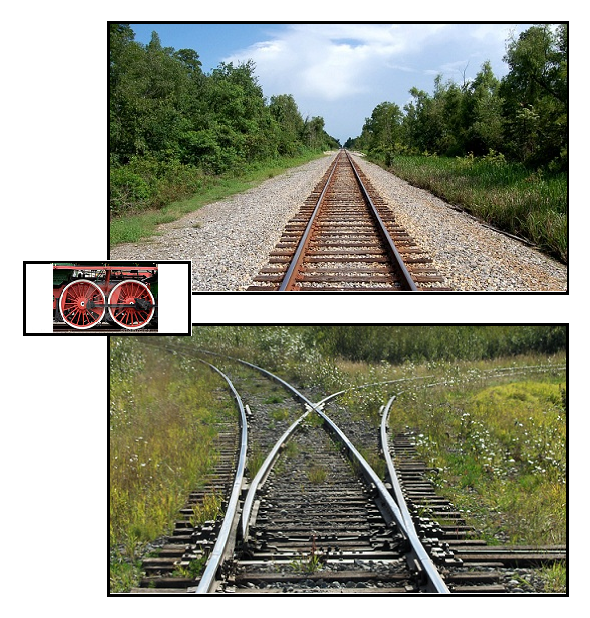
Here’s a railway track illustration of, say, the difference between true Islam (the straight track) and bida (the introduction of new ideas into the religion, deviation, heresy).

This graphic could equally represent the radicalization process, with the “point switching” occurring when the decision is made to switch from sympathizing to active participation, or from participation in the virtual dimension (say by posting on the forums) to the preparation and execution of acts of violence.

Locating the “switching points” would then be a significant part of a successful de-radicalization program, and I’d suggest that the concept of jihad as a matter of obligation (fard ‘ayn) would be one such.

*

What follows is essentially a quick-and-dirty pattern language of train tracks, switching points, marshaling yards, etc — I’ve even included one water-slide — to stir creative insights about linear thinking, multiple voices, multiple lines of thought, elegance and the polyphony of ideas

I’m posting this because any strategic and / or creative thinking that includes the perspectives and voices of multiple stakeholders will require polyphony, as will any approach to the complex dynamics in play in wicked problems…

And much else besides.

*

First, we have linear thinking — and a dilemma:

Then, there’s complication — not the same as complexity, and not nearly so hard to figure out —

— and a wicked problem, where the issues are indeed complex, and the problem itself may shift unexpectedly if, for instance, there’s another bombing run just as you are fixing things up after the last one…

And finally, by way of inspiration, there is always the possibility of elegance —

— and (here’s where I switch to the water-slide) — there’s always the possibility of playfulness…

*

Finding ways to think graphically, elegantly and a bit playfully about wicked problems is what I’m after here…
.

*******************************************************************************

Addendum

Friend JM Berger aka @intelwire sent me a link to this image:

and commented, “I think it’s more like this, no single point of departure, no single destination, loopbacks, dead ends” — nice one, JM!


Switch to our mobile site