zenpundit.com » twitter

Archive for the ‘twitter’ Category

The Hidden Networks of Twitter

Saturday, January 24th, 2009


I am sometimes asked ” What is the point of twitter?” by people who sign up and are bewildered by the flurry of seemingly disconnected “tweets”.  Even Dave Davison, a longtime investor in and enthusiast of media platforms has asked what is the “Return on Attention” with twitter ?

All social networking is not created equal. My usual answer based upon my own usage has been that twitter will make sense for you if you have an established network of people with whom you have a reason to be in frequent contact and a common set of interests. I have that on twitter with a sizable national security/mil/foreign policy/4GW/IC informal “twittersphere”. If you don’t have that kind of network at least in latent form when you sign up on twitter, its going to be very hard to build one from scratch by following strangers based on random tweets.

As it turns out, research has begun to validate my empirical observation. In social networking platforms there is your formal network but inside it is the real, “hidden” network with which you actually interact:

From Complexity Digest – “Social networks that matter: Twitter under the microscope” (PDF) by Bernardo A. Huberman, Daniel M. Romero and Fang Wu

“….This implies the existence of two different networks: a very dense one made up of followers and followees, and a sparser and simpler network of actual friends. The latter proves to be a more inuential network in driving Twitter usage since users with many actual friends tend to post more updates than users with few actual friends. On the other hand, users with many followers or followees post updates more infrequently than those with few followers or followees.”

What does this mean ? 

First, it means that if the IC or military or law enforcement are worried about terrorists or criminals using twitter or Facebook for nefarious purposes, the bad guys will not be able to conceal their cells amidst a large list of nominal “friends” because their manic activity stands out like neon lights against the passivity of the non-members of the network.

Secondly, I’m not certain if this research scales with “celebrity” figures on a platform with huge numbers of followers like Robert Scoble ( Scobleizer  50, 362) or the designer Guy Kawasaki ( guykawasaki  52, 506). These people are deep influencers well outside any realistic circle of actual friends and are followed in part because of their pre-existing status earned in other domains or media.

That said, it’s an interesting concept to think of social media networks having a surface and a hidden or inner network where the real action takes place and what causes transactional movement to occur between the two.

UPDATE:

A related post by Drew – Enabling the Power of Social Networks in the IC
The Twitter Borg Grows

Sunday, December 28th, 2008

Dr. Barnett, no doubt at the behest of his webmaster Sean Meade has joined me, Soob, Shane, John Robb, Shlok Vaidya,  CrittA.E., Michael Tanji, Steve Schippert, Fantomplanet, Selil, Historyguy99, Valdis KrebsMatt Devost, on Twitter.

UPDATE:

Without in intending to slight anyone and not intending to be exhaustive, in my hurry to post earlier today, I was not thorough enough in accounting for everyone in the above intel/national security/cyberwarfare/military/strategy/foreign policy Twittersphere and I would like to add….

mountainrunner, fester986 , SmittenEagle , larrydunbar , jeffreycarr skilluminati  ckras, ganeshpuri89Jimminy, iannarino, PrestoVivace, sandbaggerone, bobgourley, wishtank , ZachTumin, wfzimmerman, OnWar, daxe,   reihansalam, lewisshepherd, jessewilson1,  ChrisAlbon,  marvin_hutchens, PurpleSlog, MB2MB, greatpowers, robpatrob, hipbonegamer, CurtisGaleWeeks,  seanmeade ….

I think I have everyone listed now that I have typed out half of my follow list but I have inadvertantly missed someone please email or DM me and I will add you so others can “follow” you and not miss out on the conversation.

Depth, Breadth and Velocity

Wednesday, August 27th, 2008

I thoroughly enjoyed John Hagel’s post Stupidity and the Internet where he analyzed the implications of the book vs. snippet debate initiated by Nick Carr’s  Atlantic article “Is Google Making Us Stupid?”. Hagel properly broadened the debate away from content format to encompass the social sphere:

But if the concern is about intelligence, thinking and the mind, then isn’t content just one small piece of the puzzle?  Nick and many of the digerati who line up against Nick have one thing in common – they are content junkies.  They consume content voraciously and care deeply about the form that content takes. 

In the heat of debate, they seemed to often lose sight of the fact that most people are not content junkies.  Most people use the Internet as a platform to connect with each other.  Sure, they are exchanging information with each other, but they are doing a lot more than that.  They are learning about each other. They are finding ways to build relationships that expand their understanding of the world and enhance their ability to succeed in their professions and personal lives.

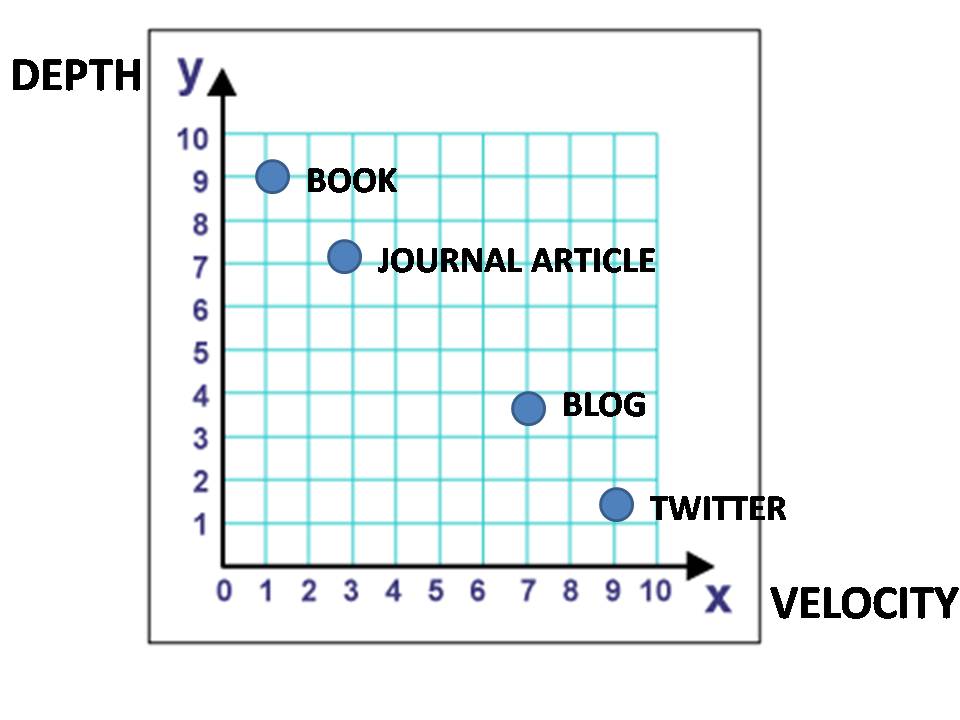
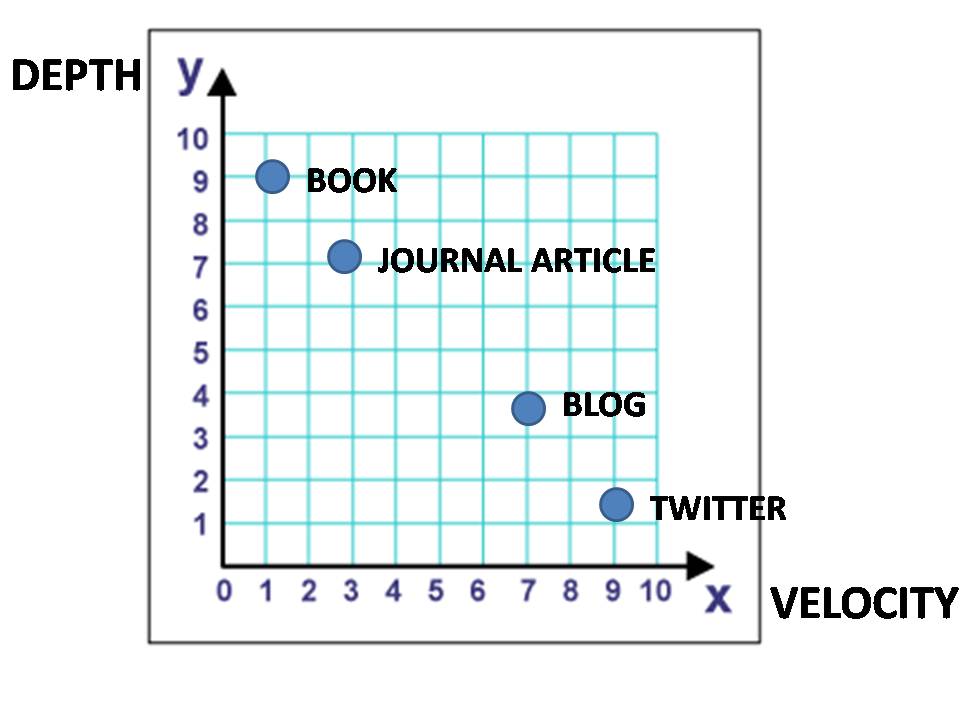
I’m going to back the discussion up a half-step by pointing out that these online relationships are often, initially of a transactional nature. Information is being exchanged and the kind of information used as a “hook” to capture attention may be determinative to the trajectory the social relationship may take and the rate of information exchanged may determine if the social connection can be sustained. To simplify, we are discussing Depth, Breadth and Velocity of information:

graph1.jpg

Books, journal articles, blog posts and Twitter “tweets” ( 140 character microblogging) could have their relative informational and transactional qualities be represented on a simple graph. Books have the greatest potential depth but the least level of timely, qualitatively reciprocal, informational transaction for the author ( primarily gained from the relationship with the editor or a “sounding board” colleague). Peer review journals are next, with a narrow community of experts sanctioning the merit of the article or rejecting it for deficiencies that put the work below or outside the field’s recognized professional standards. Blog posts can potentially generate an enormous volume of feedback, though at the cost of a dramatically inferior “signal to noise ratio“. Microblogging services like Twitter have hyperkinetic transaction rates but unless used strategically ( for example, by Robert Scoble) or within an existing social network, they generate little other than useless noise.

Attention can be attracted by a clever “snippet” – particularly if the concept itself has ambiguity or nuance that would intrigue more people than if it were precisely defined – but the attention will not be held unless the author can sustain the flow of interesting material, something that requires depth of knowledge about a subject.  Even better is to have depth in a subject along with breadth, the ability to think horizontally across many domains to spot emergent patterns, construct powerful analogies and distill a meaningful synthesis. In turn, pulling a willing audience of useful collaborators into a relationship around such intellectual pursuits hinges on first gaining their attention with a comprehensible simplification of complex abstractions and exhibiting a willingness to interact on a reciprocal basis.

It’s not a case here of “Books vs. Google”. Depth, breadth and velocity of information are interdependent and mutually reinforcing.

Is Twitter Dead ?

Saturday, July 26th, 2008

Anyone else having bizarre problems with the log in ?

On a related Web 2.0 note, I just joined Socialmedian where I have just created a news network for “COIN and 4GW” for any readers who are interested in signing up and helping me build that network. Socialmedian needs some time to crawl for potential feeds ( though several obviously come to mind).

Ubiwar on the Value of Social Media Tools

Wednesday, May 21st, 2008

Tim of Ubiwar had a near-simultaneous post on Social Media yesterday that was congruent with mine and expands on aspects that I did not. Highly recommended:

Noise and News

An excerpt:

Alexander van Elsas wrote an excellent piece on mobile phone functionality in which he referenced a recent post by Scoble, Why Google News has no noise. Scoble’s thesis is that he is able to spot trends in news before the main web news carriers, Google News for mainstream news, and TechMeme for tech news, before either they or their readers can. The enabling media for Scoble’s prognostications are social aggregators like FriendFeed and microblogging services like Twitter. I won’t go into the details of exactly what these are but essentially they are services delivered direct to the device of your choice which provide frequent updates of what your friends and acquaintances are doing, thinking, writing, at all hours of the day. With a lot of people in your network these alerts can be relentless.

Scoble likes this, as do many others, because it provides him with a background of noise which allows him to discern patterns in the network of social interaction across these services. Scoble is a journalist by background and inclination and, arguably, he is a new sort of journalist through his work at Scobleizer, and ‘swimming in the noise’ these services provide is food and drink to someone of his bent:

So, how come services like Twitter and FriendFeed have so much noise? Who likes the noise? Who likes the news?

I like the noise. Why? Because I can see patterns before anyone else. I saw the Chinese earthquake happening 45 minutes before Google News reported it. Why? Because I was watching the noise, not the news.

This is an important and valid point. Scoble is watching the new news ‘wires’ to get a jump on the bigger outlets but also to discern the patterning in the information coming from across the globe. This process is aided by aggregative nodes which filter reports of activities into streamlined summaries of many people’s information. Once such example is ‘bridge blogging‘ which enables one bilingual individual to aggregate locally-generated ‘news’ in one language and to disseminate it in another. Scoble likes to avoid these nodes wherever possible but they serve a purpose, as any blogger will tell you.

I’m very curious about the pattern recognition part. Are Scoble and Jason Calacanis and other uber-geek bloggers following tens of thousands mentally upjumping in terms of discriminating patterns or are they gravitating to those signals in the noise that they are already predisposed to “see” anyway?


Switch to our mobile site