zenpundit.com » psychology

Archive for the ‘psychology’ Category

WYSIWYG

Friday, January 18th, 2013

[ by Charles Cameron — what you see is what you get: WYSIWYG — and possibly also TEOTWAWKI ]
.

See buildings, walls, handrails, reflections, rows of windows, and people he’s walking past vanish and reappear as a man dressed for mountain climbing sets out into a blizzard of snow, video snow and special effects…

Hat-tip — Shlok Vaidya.

**

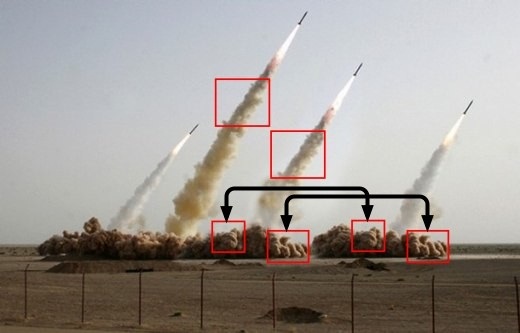
We knew that Iran could photoshop extra rockets into a widely distributed news image –

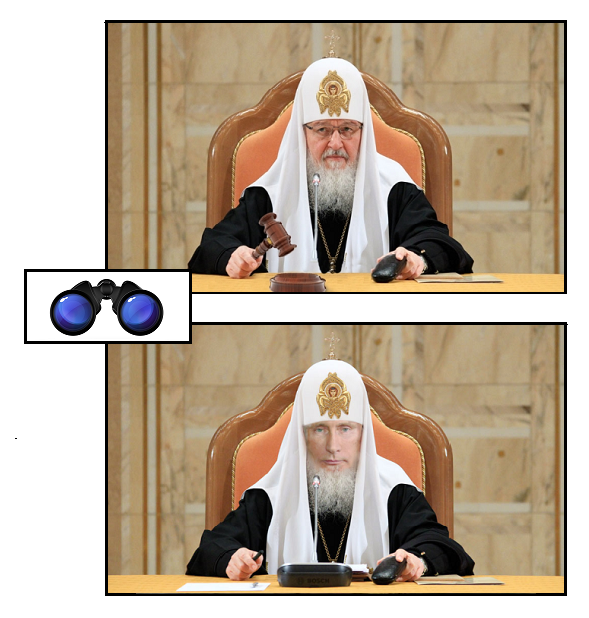
and that Russian dissidents could makeover Kirill as his friend Putin

But the video above, with it’s vanishing and reappearing everythings? Simple — it’s a stunning portrayal of just what patience and skill can manage with video tampering using Photoshop CS5 or the like. Hence — this may also be the time to announce TEOTWAWKI. The end of the world as we know it. As we believe we know it.

You only need one of those effects, remember, to fake out a geopolitical tipping point…

Watcher, beware.

**

But then there’s my friend Howard Rheingold, who points out that our whole world is a constructed reality:

We habitually think of the world we see as “out there,” but what we are seeing is really a mental model, a perceptual simulation that exists only in our brains. …

Cognitive simulation — mental model-making — is what humans do best. We do it so well that we tend to become locked into our own models of the world by a seamless web of unconscious beliefs and subtly molded perceptions. And computers are model-making tools par excellence, although they are only beginning to approach the point where people might confuse simulations with reality.

That’s a quote from his piece in Brenda Laurel‘s 1990 classic Art of Human-Computer Interface Design — and it seems to grow more prescient by the day!

**

Three topics, at least somewhat related, we can maybe talk about later:

  • Who it was that spread the word about the Innocence of Muslims trainer.
  • The disputed Muhammad al-Durrah incident at the Netzarim junction. And
  • Zero Dark Thirty.
  • Madness, Mass Shootings and an Open Society

    Monday, December 17th, 2012


    Everyone in America has seen the latest results of another dangerously mentally ill loner with family members who were in denial about the severity of his condition or disconnected from him. The killer, Adam Lanza, shot shot his own mother in the face before slaughtering twenty elementary school children and the heroic teachers and their principal who had sought to protect them, belonged in an institutional setting. The same can be said for homicidal schizophrenic Jared Loughner who shot Congresswoman Gabby Giffords, James Holmes, the Colorado shooter, has a gag order on his murder trial but his defense lawyers have already disclosed that their client is mentally ill in blocking access to his diaries under physician-client privilege. Seung-Hui Cho, who committed the Virginia Tech massacre, had previously stalked women, made suicidal threats and been ruled “an imminent danger to himself and others” was set free and unwell to be treated on “an outpatient basis” that never happened.

    Predictably, a debate about gun control has erupted in the aftermath of senseless deaths. However, other countries are as heavily armed as the United States (in a few cases, more so). These countries also have severely mentally ill people, yet they don’t have the mass shootings that have become a dark cultural phenomenon we see here in America.  Or when on the rare occasions they do, the shooter is likely not to be insane, but a professional terrorist.

    There have also been calls for improved school security ( the Obama administration and Congress cut school security grant funds in 2010 and 2011), stationing policemen in schools and even arming teachers, citing the example of Israeli schools and the Pearl High School shooter who was stopped by an assistant principal with a .45.  While more security is a reasonable precaution and a good idea, short of turning our schools into windowless, prison-like, fortresses and giving the staff AK-47’s,  anybody utterly willing to die in order to kill someone else stands a pretty good chance of success. If all guns vanished tomorrow, the crazies will use car bombs and IEDs instead; mass shootings are a “motivated crazy person” (or terrorist) problem – criminals with economic motives do not carry out these kinds of attacks.

    There is no perfect answer here, but here are a few suggestions:

    • We need to revise our attitude toward mental illness with greater public education and access to mental health treatment, especially emergency treatment. Most mentally ill people are NOT dangerous but the warning signs of psychotic breakdown should become as widely recognized as the dangers of cigarette smoking.
    • For the very few people who are mentally ill and violent, we need to have public heath authorities accept that some degree of active supervision is required to ensure they receive treatment and take their medication if they are to live independently, and if they refuse, to institutionalize them temporarily until they do so. The key variable here is *violence* not just mental illness and strong due process safeguards must be in place to protect the individual and ensure they receive appropriate treatment with dignity.
    • Schools need much better training and planning for “active shooter” situations. At present, most schools have safety plans that emphasize locking students in enclosed rooms from which there seldom are any escape routes and the staff passively waiting for instructions from higher school authorities or police. While these plans may be good for unarmed intruders of unknown intent, they are dangerously counterproductive for heavily armed active shooters. Schools generally lack  enough secure rooms with doors that can delay such intruders for more than a few seconds and the standard emergency plan emphasis on “sitting tight” discourages the staff from engaging in reasonable risks to quickly evacuate students when the intruder is elsewhere in the building, or if possible, tactics to evade or if need be, resist, the shooter.

    Steven Pinker on Analogy

    Thursday, December 6th, 2012

    [ by Charles Cameron — importance of analogy as an under-developed cognitive skill ]
    .

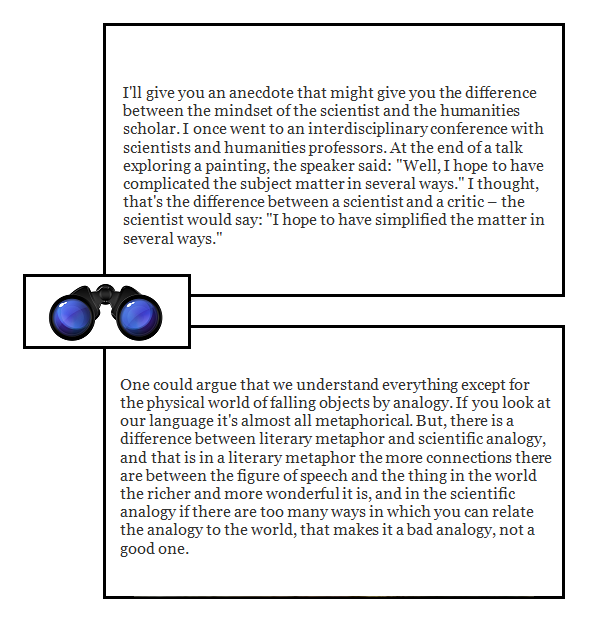
    There was a interview with five prominent “science writers” in the Guardian a few days back, titled Science writing: how do you make complex issues accessible and readable? and one of the writers, Steven Pinker, makes two highly interesting observations:

    **

    There are a couple of things going on here that I’d like to note. One is that without intending to do so specifically, he is in essence formulating a view about a possible, central difference between scientific and religious thinking, since what he says about the humanities in general applies with great specificity to religion and the arts: in both religion and art, the expansive nature of “symbolism” is a key to the experience.

    And that in turn prompts me to suggest that perhaps both the arts and religion are geared towards provoking, evoking or invoking an experience — whereas the sciences are geared towards obtaining an understanding.

    I’ll have to think about that, and come to some sort of understanding of my own — perhaps expressed via symbolic means.

    **

    My second point of interest is that there’s an analogy to be made between Pinker’s two remarks: each of them has a form I could portray thus in terms of cause :: effect

    science : humanities :: simplicity : complexity

    Nobody present — the interviewer, Pinker himself, and four other very bright science writers — picked up on the close correspondence between those two statements at the time. And I find that very interesting.

    I find it very interesting because the six of them were more interested in seeing what they could say (of what they already thought) than in saying what they could see (in light of the ongoing, immediate conversation).

    I think we all tend to do that — which is why David Bohm‘s approach to dialogue is so important: if brings us to speak more into the moment as it surrounds us, not quite so much from the past as it has informed us.

    **

    Then there’s the interesting fact that Pinker’s sense of the difference between modes of thought in the humanities and the sciences as expressed in the top quote translates so directly to the difference between uses of analogy in the second — and his fairly emphatic statement:

    one could argue that we understand everything except for the physical world of falling objects by analogy.

    Analogy is the central device in our mental toolkit, and yet we know far more about trains of logic than we do about analogical leaps. We know so little, in fact, that distinguishing between “literary metaphor” and “scientific analogy” (both of which are based in the recognition of resemblance) on the basis of one looking for multiple, rich connectivity and the other for a single tight connection is something noteworthy enough for Pinker to bother to point it out. It is indeed a provocative and perhaps essential insight. But it is also pretty basic — dividing a field up into significant chunks, the way anthropology got divided into “cultural”, “archaeological”, “linguistic” and “physical anthropology”…

    It’s time we learned to understand and use analogic with the same rigor we’ve applied to learning and using logic — and Sembl is just the tool for this.

    **

    Experience wants to be rich: factual understanding wants to be clear.

    Congratulations!!

    Tuesday, December 4th, 2012

    To Lexington Green and James Bennett, for finishing their new book, America 3.0 – due out (I think) in 2013 published by Encounter Books.

    A political vision for an era desperately short on imagination and needing statecraft of inspiration.

    The Sounds of Silence and Your Own Mind

    Tuesday, November 27th, 2012

    Scott Shipman had an excellent book review post An Unknown Future and a Doubtful Present: Writing the Victory Plan of 1941 — a review-lite and a few questions in which he discussed the intellectual seriousness and evolution of war planner   Major Albert C. Wedemeyer as a military officer and strategist:

    ….Wedemeyer was an honor graduate of the Command and General Staff College, and his performance earned him the opportunity to attended the Kriegsakademie, the German staff college. However, coupled with impressive academic preparations, Kirkpatrick writes that Wedemeyer’s curiosity exposed him to a “kaleidoscope” of ideas and methods. Kirkpatrick summed-up Wedemeyer: “Competence as a planner thus emerged as much from conscientious professional study as from formal military education…” Going on to say:

    In common with many of his peers, much of Wedemeyer’s professional and intellectual education was less the product of military schooling than of personal initiative and experience in the interwar Army.

    Wedemeyer’s intellectual development was purposeful and paid off. In Wedemeyer’s deep study of his profession he used the prescribed paths, but also explored on his own. How common is that today? 

    As often happens, the discussion can take an unexpected turn in the comments section. Lexington Green weighed in with this:

    Think about George Marshall in China, traveling around on horseback.  No cell phone, no email.  The man could actually think.  Or Eisenhower meeting with Fox Connor to talk about the books Connor had him read. Telephone calls were not even common.  The military might do well to have two days once a quarter of silent retreats, only emergency communication permitted, with literally no unnecessary conversation, for groups of officers and non-coms, with some assigned reading and some self-selected on the same theme, then an open discussion after dinner. It would cost virtually nothing and would be an intellectual and mental oasis, and some good ideas might come out of it.  Religious silent retreats which last a couple of days and are truly life-restoring. This would probably be useful as well.

    That in turn provoked this response from Marshall:

    My sense is that many of us live, work, and fraternize in a culture of crisis. Everything is urgent. One response is to just shut off the moment we get some downtime. TV, drinking, schlock fiction, immersion in pop culture, video games, blog reading are some of the ways I’ve coped. I grew out of those as timewasters as I realized that I no longer had time to shut off if I wanted to do something.

    But I still live in a culture of crisis. Almost everybody around me “has no time”. It doesn’t really matter what is being proposed, the sense of urgency kills all ambition toward progress. Defending myself and my space form this is a daily challenge – and some days I lose.

    I’m visiting family this week on a long-scheduled “vacation” that has been interrupted by my office several times already, but always with the promise, “just this thing, Marshall, we don’t want to take you away from your family”. And these are the people I choose as my allies!

    The culture of crisis doesn’t believe in people’s choices. It says that time will only be wasted, so we have to keep our people busy. After all, see how they spend their “free” time? Dissolute wastrels the lot of them. And then the culture of crisis tells us that we need to recharge by shutting off our minds. You need to vege out, man, you’re stressed; turn on the TV and have a beer, mate. Or else fire up your e-mail and write six more. And, hey, sorry about your insomnia, but it lets you get a jump on the day, amirite? [….]

    The discussion moved on, but I have been mulling upon this exchange ever since.

    The first thing that came to mind is that what we mean by “silence” really isn’t silent, what is really meant is that there is an absence of human voice pulling at our limited capacity for attention. Cognitive load is probably a real, if variable, limit on human cognition and the nature of hyperconnected information society is that all too frequently we are -and feel – “overloaded”.

    When human voices are absent the “background” environmental noise comes “forward” , natural (wind through trees, animals etc) or mechanical (various humms and clicks) that we unconsciously tune out as a matter of routine focusing on conversation or distracting hearsay, broadcasts and so on. The processing in the brain is significantly different depending on what kinds of sounds you are listening to, for example:

    1. Listening to Music

    2. Listening to Language
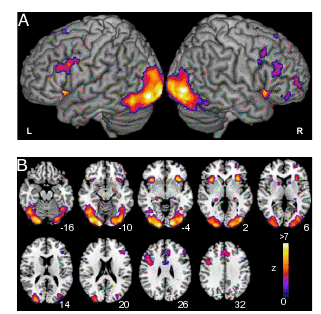
    3. Listening to unpleasant sounds (nails on chalkboard etc.)
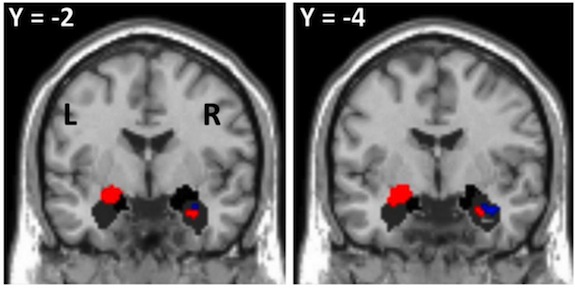
    So eliminating human speech from your environment but not hearing (earplugs) itself allows other regions of your brain to become more active than usual, depending on whatever else you may be doing at the time (walking, chopping wood, smelling a flower, scanning the horizon and so on).  Your brain’s performance and how it varies when thinking under conditions of different combinations and levels of sensory stimuli – “crossmodal processing” – is not yet well understood as research is in early stages of investigation.

    I will speculate here that what is important for enriching your thinking is that taking your brain out a linguistic-saturated environment (let’s include the “soundless noise” of intruding textual symbols as well from smartphones, iPads, laptops)  gives it an opportunity to operate differently for a time and establish new neuronal network patterns of activity. Various forms of meditation – which involves both silence and an intentional modulation of attention – also  alters normal  brain activity.

    I will now go further out on a data-free analytical limb and hypothesize that making a practice of “silence” and/or meditation might improve your thinking by making moments of creative insight more likely. Studies on insight tend to show that as a cognitive event, insight  comes about as a kind of a “pulse” of activity and relaxation in the brain:

    ….Mark Jung-Beeman, a cognitive neuroscientist at Northwestern University, has spent the past fifteen years trying to figure out what happens inside the brain when people have an insight. Jung-Beeman became interested in the nature of insight in the early nineteen-nineties, while researching the right hemisphere of the brain. Mentions Jonathan Schooler. Jung-Beeman decided to compare word puzzles—or Compound Remote Associate Problems (C.R.A. Problems)—solved. He teamed up with John Kounios, a psychologist at Drexler University, and they combined fMRI and EEG (electroencephalography) testing to scan people’s brains while they solved the puzzles. The resulting studies, published in 2004 and 2006, found that people who solved puzzles with insight activated a specific subset of cortical areas. Although the answer seemed to appear out of nowhere, the mind was carefully preparing itself for the breakthrough. The suddenness of the insight is preceded by a burst of brain activity. A small fold of tissue on the surface of the right hemisphere, the anterior superior temporal gyrus (aSTG), becomes unusually active in the second before the insight. Once the brain is sufficiently focused on the problem, the cortex needs to relax, to seek out the more remote association in the right hemisphere that will provide the insight. As Kounios sees it, the insight process is an act of cognitive deliberation transformed by accidental, serendipitous connections. Mentions Joy Bhattacharya and Henri Poincaré. The brain area responsible for recognizing insight is the prefrontal cortex. Earl Miller, a neuroscientist at M.I.T., spent years studying the prefrontal cortex. He was eventually able to show that it wasn’t simply an aggregator of information, but rather it was more like a conductor, waving its baton and directing the players. In 2001, Miller and Princeton neuroscientist Jonathan Cohen published an influential paper laying out their theory of how the prefrontal cortex controls the rest of the brain. It remains unclear how simple cells recognize what the conscious mind cannot. An insight is just a fleeting glimpse of the brain’s huge store of unknown knowledge.

    Another interesting data point to consider re: “silence” and insight is that the mental illness of schizophrenia, where delusions and other mental “noise” exists is significantly negatively correlated with insight.  Researchers are currently investigating if meditation can ease the symptoms of schizophrenia and other mental illnesses.

    For myself, I find my best ideas come via insight when I am doing something primarily physical requiring steady but not all of my concentration and I am alone – working out, walking the dog, a household chore and so on. Relatively useful ideas can happen when I am reading or writing or debating (i.e. interacting with a text or a person), but they tend to be analytic and derivative, sort of an intellectual “tweaking” or “tinkering” but not ones that are fundamentally creative or synthesizing.

    Lexington Green may be right – Silence is golden.


    Switch to our mobile site