zenpundit.com » reading

Archive for the ‘reading’ Category

The Reading List of Colonel Thomas X. Hammes

Sunday, August 3rd, 2008

The Armed Forces Journal cover story features Colonel T.X. Hammes giving an an “outside the box” reading list to change traditional thinking in defense circles:

Read different

Although the wider academic and business communities are coming to grips with the fact that many of these advances are changing the way we understand the world, the defense industry does not seem to see this as an issue. We still tend to view the world as responding to linear approaches applied by bureaucratic entities.

Fortunately, over the past couple of decades, a number of books have provided thought-provoking new theories of how the world works. Unfortunately, these theories do not align with the planning processes we use in the defense industry. The first step in fixing our planning processes is to examine how science’s understanding of reality is changing.The authors of these works highlight aspects of how the world has changed. This forces us to change how we frame problems, how we organize to deal with them and even how to get the best out of our people. For instance, if one still saw the world as a hierarchy, then one looked for the “leadership” of the Iraqi insurgency in 2003. Yet if one saw the world as a network in which emergent intelligence is a key factor, then one quickly saw the networked insurgent entities as they evolved an emergent strategy in Iraq. Our ability to adjust to the rapidly changing future security environment will, to a large degree, depend on our ability to understand the world as it is rather than as we have been taught to understand it. Reading these 12 books should help.

Here is the list, and it is a good one. I’ve read several, have some of the other books in my “antilibrary” and a few are new to me. You can go to the article to get some commentary regarding each book by Dr. Hammes:

Chaos: Making a New Science 

Linked: How Everything Is Connected to Everything Else and What It Means 

Commander’s Appreciation and Campaign Design ( U.S. Army pamphlet)

Emergence: The Connected Lives of Ants, Brains, Cities, and Software

The Innovator’s Dilemma: The Revolutionary Book that Will Change the Way You Do Business (Collins Business Essentials)

The Wisdom of Crowds

The Geography of Thought: How Asians and Westerners Think Differently…and Why

Hidden Order: How Adaptation Builds Complexity (Helix Books)

The Starfish and the Spider: The Unstoppable Power of Leaderless Organizations

Wikinomics: How Mass Collaboration Changes Everything

The Singularity Is Near: When Humans Transcend Biology

An excellent list but one to which I think we need to add a few more. While any comments are welcome, I suggest that readers also chime in and nominate a couple ( 1 or 2) worthy reads that fit the spirit of Col. Hammes’ intent. My nominations are  Global Brain: The Evolution of Mass Mind from the Big Bang to the 21st Century by Howard Bloom and Consilience: The Unity of Knowledge by Edward O. Wilson.

UPDATE:

Great recs are already in the comment section! I will start putting them together as a linked set of ” Reader’s Reading List”. Note also Smitten Eagle has posted up.

The Book Buying Binge Continues Unabated

Thursday, June 5th, 2008

Fortunately, summer is nearly here and I will have time to whittle down the Antilibrary pile. Three More:


Presentation Zen: Simple Ideas on Presentation Design and Delivery (Voices That Matter)

Zhou Enlai: The Last Perfect Revolutionary

The Second World: Empires and Influence in the New Global Order

Adding to my “Antilibrary”

Saturday, May 24th, 2008

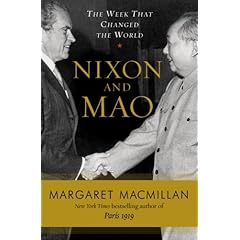
A while back, around these parts we all compared our “antilibraries” of unread books. Well, despite not having any time lately to blog, much less read through the stacks of books that I already have, I went out and bought a few more. LOL!   

Nixon and Mao: The Week That Changed the World

After Tamerlane: The Global History of Empire Since 1405

The Ghost of Freedom: A History of the Caucasus

Journals: 1952-2000

Thumbing through a few of these was interesting. Schlesinger’s partisanship and hagiographic defense of the Kennedy family are of course, well known but his private writings are sprinkled with many sharp observations that the old historian-courtier never let loose in public when he was alive.

Munzenberg’s Viral Post: What is in your Antilibrary?

Thursday, March 27th, 2008

The other day, I was having a conversation in the comments section regarding ancient Chinese philosophers with my learned friend Lexington Green, when I had cause to quote Nassim Nicholas Taleb, from his most recent book The Black Swan: The Impact of the Highly Improbable:

The writer Umberto Eco belongs to that small class of scholars who are encyclopedic, insightful, and nondull. he is the owner of a large personal library ( containing thirty thousand books), and separates vistors into two categories: those who react with ‘Wow! Signore professore dottore Eco, what a library you have! How many of these books have you read?’ and others – a very small minority- who get the point that a private library is not an ego boosting appendage but a research tool. Read books are far less valuable than unread ones. The library should contain as much of what you do not know as your financial means, mortgage rates, and the currently tight real estate market allow you to put there. You wil accumulate more knowledge and more books as you grow older, and the growig number of unread books on the shelves will look at you menacingly. Indeed, the more you know, the larger the rows of unread books. Let us call the collection of unread books an antilibrary.

A passage that immediately made me feel better about having resigned myself to falling further and further behind in reading the books that I keep purchasing ( I’m now also periodically finding myself going to IKEA to buy shelf extensions. I’ve resigned myself to that too).

The obscurely named Munzenberg of Soob, also enjoyed Taleb’s take on the proper function of a book collection and has begun a viral post What is in your Antilibrary?:

I’d like to pose a question to those who read this blog entry: What are three to five books on your shelf that lay unread and what knowledge do you hope to retrieve from them? [ ed.- see Munzenberg’s antilibrary here]

….I suppose I may have to tag people to get a widespread antilibrary booklist going. Feel free if you are reading this blog entry to start your own entry (the more books the better right?). I’ll link to you here if I catch it. I shall tag:

Tdaxp
Ortho
Zenpundit
Adam Elkus
Ymarsakar

As Munzenberg has graciously “tagged” me, here is a fraction of my current antilibrary (the antilibrary appears to be a dynamic state with a definite phase transition to library status) I decided to avoid those recently acquired books at the top of my pile and use some finely-aged examples:

On the Origins of War: And the Preservation of Peace by Donald Kagan

Bought it after I enjoyed reading his revisionist The Peloponnesian War with the intent of getting into Kagan’s head on strategy and military history in general. I was reading a flood other military books at the time and it was lost in the shuffle

HO CHI MINH: A LIFE by William J. Duiker

This is a critically acclaimed biography by a highly respected scholar which I intended to read in tandem with recent biographies of Chiang Kai-Shek and Mao ZeDong, in order to get a feel for the interlocking social networks these leaders shared (Zhou Enlai was a hub for each man for a time). I finished those books but have not begun this one yet.

The Growth of the Mind: And the Endangered Origins of Intelligence by Stanley Greenspan, MD

I actually started this one but it was thrown into a packing box during a year I was building a house, selling another and moving several times. It then spent several years in storage before making it back on to a shelf. The purpose was to learn more about cognitive development in children.

Pillar of Fire : America in the King Years 1963-65 (America in the King Years) by Taylor Branch

Refresher on social, African-American and political history. Like the Kagan book, it was crowded out of the must-read bookpile by the deluge of military history and strategy books that I was reading at the time

The House of Rothschild: Volume 2: The World’s Banker: 1849-1999 by Niall Ferguson

As I am one of those freaks who actually enjoys economic history, I read Ferguson’s first volume years ago and thought it was lucidly written. This book too, fell victim to the packing box

It’s a rare opportunity to be on the ground floor of one of these viral posts and to be able to watch how far afield it travels, so I am selecting my “tags” with great care:

Sean Meade

Pundita

Brad DeLong

Valdis Krebs

Dave Dilegge

Dave Schuler

UPDATE:

Younghusband opines on The Traveller’s Library

123 Meme

Sunday, February 3rd, 2008

Dave Schuler of The Glittering Eye tapped me with the 123 Meme. The Rules of the 123 Meme are as follows:

1. Pick up the nearest book ( of at least 123 pages).
2. Open the book to page 123.
3. Find the fifth sentence.
4. Post the next three sentences.
5. Tag five people.

Dave had a fine selection, a book`that coincidentally sits closely nearby on my own shelf. As a result, I decided to go with what was nearest in terms of the unshelved,” handy”, unread bookpile from which I pick up and read at odd moments or choose from to read seriously from start to finish. At the top of the pile is Robert Dallek’s Nixon and Kissinger:Partners in Power. The anecdote has an eerie timeless quality about it:

When Nixon and Kissinger told Hoover that the May 9 and earlier leaks”were more than damaging, they were potentially dangerous to national security,”  Hoover  began tapping the phones of three national security officials identified by Henry – Henry Davidson, Morton Halperin, and Hal Sonnenfeldt – and one other Defense Department officer, Colonel Robert Pursley, a Laird assistant. Within days, two other NSC staff members came under scrutiny as well: Richard Moose and Richard Sneider. FBI agents also began listening to the phone conversations of four journalists- Beecher and Hedrick Smth of the Times, and an English correspondent based in Washington, Henry Brandon of the Sinday Times of London, and CBS newsman Marvin Kalb.

By the power vested in me by the 123 Meme, I infect the following bloggers:

Shane Deichman of Wizards of Oz

Bruce Kesler of Democracy Project

Dave Davison of Thoughts Illustrated

Cheryl Rofer of Whirledview

Dr. Daniel Nexon of The Duck of Minerva


Switch to our mobile site