zenpundit.com » bin laden

Archive for the ‘bin laden’ Category

Jeff Jonas, Nada Bakos, Cindy Storer and Puzzles

Thursday, September 19th, 2013

[ by Charles Cameron — at the intersection of filmcraft, tradecraft, and gameplay ]
.
**

IBM Fellow Jeff Jones has a powerful insight into puzzles and analytics which I explored in one of my early guest posts here, A Hipbone Approach to Analysis III. I quoted him thus:

The first piece you take out of the box and place on the work surface requires very little computational effort. The second and third pieces require almost equally insignificant mental effort. Then as the number of pieces on the table grows the effort to determine where the next piece goes increases as well. But there is a tipping point where the effort to determine where to place the next piece gets easier and easier … despite the fact the number of puzzle pieces on the table continues to grow.

and — being a theologian and poet, hence interested in creative leaps — I threw this in for bonus points, since in it he talks about epiphanies:

Some pieces produce remarkable epiphanies. You grab the next piece, which appears to be just some chunk of grass – obviously no big deal. But wait … you discover this innocuous piece connects the windmill scene to the alligator scene! This innocent little new piece turned out to be the glue.

**

That, being (at least a little) past — I was quoting Jonas back in 2010 — is prologue.

Yesterday I was listening to Nada Bakos, ex-CIA analyst and targeter, and more recently one of the stars of the HBO documentary Manhunt, which just won an Emmy — and which I have written about twice here on Zenpundit, first in Manhunt: Radicalization, & comprehending the full impact of dreams, and then in Manhunt: religion and the director’s eye.

Chelsea Daymon interviewed Nada Bakos on yesterday’s Loopcast, and I’d just got to the point, one minute and thirteen seconds in, where Bakos said the words that triggered my urgent need to reconnect with Jonas and his puzzle insights. She says:

It’s not unlike what an investigative journalist would do, when you’re piecing together an intelligence picture. You’re looking at disparate bits of information, and you’re trying to form them to make a puzzle. So from our perspective at the Agency, we were looking at it from signal intelligence, to human intelligence, to technical collection, foreign intel services — across the board, we were gathering this information from a variety of different sources. And any one of those pieces of information. in and of itself, may look innocuous, or not representative of what we’re trying to find, but when you add it to the larger puzzle, that’s when you can see if its going to fit. So it’s hard to sift through the chaff to find your actual information that you need to piece together.

I also wrote briefly about Manhunt in A feast of form in my twitter-stream today, quoting Bakos’ colleague Cindy Storer:

Even in the analytical community there’s a relatively smaller percentage of people who are really good at making sense of information that doesn’t appear to be connected. So that’s what we call pattern analysis, trying to figure out what things look like. And those people, you really need those people to work on an issue like terrorism, counternarcotic, international arms trafficking, because you’ve got bits and pieces of scattered information from all over the place, and you have to try to make some sense of it. … That takes this talent, which is also a skill, and people would refer to it as magic — not the analysts doing it, but other people who didn’t have that talent referred to it as magic.

Storer’s “magic” and Jones’ “epiphany” seem to me to have a great deal in common…

**

[ and yes, personal disclosure, I’ve been working for almost 20 years on games that teach that kind of magic, the whole of that kind of magic across all domains, and nothing but that kind of magic. ]

**

Back to Nada Bakos, and a crucial distinction between two types of analytic puzzle-solving:

From a predictive standpoint, if you’re looking at trying to gauge when or if an attack is going to happen, that is really difficult, and you’re going about looking at the data in a very different way. Because if you have a piece of intelligence that said that there will be an attack, but you don’t know the timing or location, your focus is going to be strictly on those two pieces.

That’s narrow focus. Wide focus, by contrast?

When you’re trying to look at an overall picture, you’re not — this is typical of intelligence gathering, when you don’t know what you have in front of you — you’re letting the information tell you what the picture is going to be. And that’s the objective challenge for intelligence analysis, and that’s what the Agency tries to drill into their analysts, to always let the information lead you, rather than you lead the information, so you’re…

**

Wait a moment, though — I’d like to come back to that — but just for the record, here’s what looks to be a parallel use of “leading” from a legal definition…

LEADING QUESTION, evidence, Practice. A question which puts into the witness’ mouth the words to be echoed back, or plainly suggests the answer which the party wishes to get from him. 7 Serg. & Rawle, 171; 4 Wend. Rep. 247. In that case the examiner is said to lead him to the answer. It is not always easy to determine what is or is not a leading question.

I’m hypothesizing that the idea here is, in effect, “to always let the witness lead you, rather than you lead the witness” — in the interests of justice, not of prosecution or defense… And that “justice” in this case parallels “objectivity” in the case of intelligence analysis.

Analysts may yawn and attorneys quietly splutter at this truism — yet when the same pattern crops up in two distinct fields, you can bet it has more general application. From an intel standpoint, it’s a matter of avoiding your own biases and assumptions, and dealt with as such in Heuer. In the arts, it’s this need to avoid painting what one thinks what one knows, rather than what one sees, that’s behind Betty Edwards‘ instruction to her students to draw an upside-down photo of Albert Einstein, as in her book, Drawing on the Right Side of the Brain, see p. 51. In music, it’s what permits the fresh interpretation of the Goldberg Variations by Glenn Gould, 1955 — and then years later in 1981, but Gould again — so very different from all previous interpretations.

It’s the stuff of creativity, and at its highest pitch, the stuff of genius.

**

But let Ms Bakos continue… Here’s another distinction she draws for us:

From a targeting perspective, your focus is, operationalizing the analysis. So you’re taking all that big picture and you’re doing something about it, so that is your intent from the get-go.

When you’re a traditional analyst, you’re actually writing pieces for the policy maker, and you’re adding to the larger picture so they can make decisions based upon that intelligence.

The second of these is clear enough, but I’d have a question for Ms Bakos about the first.

Roughly speaking –and I know the answer is likely to be a bit more complex than my formulation of the question — does this mean t hat the policy maker has by this point signed off on a “do whatever’s needed in your best judgment to achieve the stated goal”? — and if so, where is the threshold where targeting and execution take over from decision-making, in a Clausewitzian extension of the politics by other means?

**

Towards the very end of the interview, and having covered a number of topics that were specific to Iraq and al-Zarqawi and thus not pertinent to my interests here, Ms Bakos asks:

How do we effect change, how do we actually deprogram people to get out of these groups, these regional groups, this ideology, and I think we haven’t effectively tapped into that, yet. I think we’re always fighting yesterday’s war. So, I think we need to start looking forward as well: What’s the way out? Are we working with host governments to figure out how we help people to get out of al-Qaida, how do they get out of the situation that they’re currently in — because once they’re in I think it’s very difficult, for some of these younger followers, if they’ve become disenchanted, to move on.

That’s something I feel passionate about, since Leah Farrall posted a series on Children, jihad, agency, and the state of counter terrorism making much the same point in considerable, painful detail. I invite you to open that link in another window and bookmark it for later reading.

If I’m reading both Ms Bakos and Leah right, this is a serious and underappreciated issue, and one that is both humane and eminently practical.

** ** **

Okay, that’s the gist of what Manhunt tells us about the analytic process, as I see it. So this is where I’d like to take what Nada Bakos, Manhunt, and Cindy Storer tell us, view it through the lens of Jeff Jonas’ insight, and see where else that leads us.

This to me is the crux of the thing.

For myself as a curious mind and game designer, what this boils down to is an investigation of the gameplay involved inp roblem solving, when the game-board extends from the virtual to the real, from thought to action, from the ideal to the practicable…

Indeed, our board also extends from our own models and games via the Great Game (in both its intel and Afghan meanings) to the deep game of life itself, of which Plotinus observed “Men directing their weapons against each other- under doom of death yet neatly lined up to fight as in the pyrrhic sword-dances of their sport- this is enough to tell us that all human intentions are but play…” — and not forgetting Keith Oatley‘s contemporary interpretation of the metaphor in his Shakespeare’s invention of theatre as simulation that runs on minds.

The gameplay of life, then — as is it practiced by the intelligence analyst, by the investigative journalist as Ms Bakos points out — by curious minds, as the phrase goes — and by game designers. Which last consideration is why I’d like to invite Mike Sellers, Brian Moriarty, and Amy Jo and/or Scott Kim and others to add their wisdom to the mix, should they happen to read this post…

**

Alternate Reality Games (ARGs) are the ones I think of most easily whose boards include both virtual and real spaces. Myths, beliefs and hard-nosed realities all impact both the Israeli-Palestinian issue and such games about it as PeaceMaker. The warfare in Mjolnir’s Game is deliciously asymmetrical. Three-dimensional chess has different “levels” to its boards, but no metaphysical distances between them — my own story-telling chess variant (see Playing a double Game) has both competitive and cooperative aspects tied in to every board move…

What other examples should we be thinking about? What other game design rules and heuristics might we apply?

The end game as Jonas describes it, happens quickly — in the context of a puzzle in which the “big picture” was complete for the designer before the pieces were scattered for play to commence, in which all the pieces in play are in fact part of the final picture, with none of them originating in other games and tossed randomly into the box, where none of the pieces are “false” in the sense of false flags, lies, propaganda, dissimulations, and so on.

Compared to the possibilities of deliberately deceptive pieces, duplicative pieces, partially obscured pieces and pieces of unrelated puzzles, the technical issue of pieces arising in different media is relatively easily handled by purely technical means (this I assume, having worked briefly with an early version of Starlight, correct me if I’m wrong).

And it is here — also an assumption of mine — that the analytic, pattern-recognizing mind will have the advantage over the machine.

**

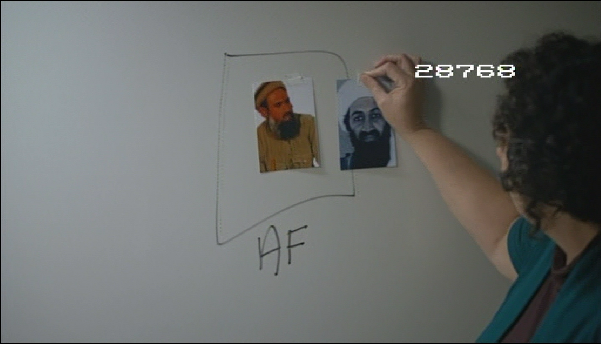
It’s the beginning of the game that interests me most — Jonas says that the moves are quickly made in the beginning, and in Manhunt there’s a moment where Cindy Storer pins the first puzzle piece — a photo of Abdullah Azzam, whose book The signs of Ar-Rahmaan in the Jihad of Afghanistan I’ve discussed before — into the first board space, which she’s labeled AF:
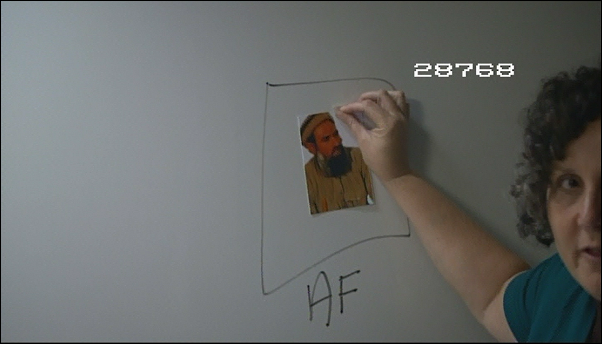
with the words:

Your starting point is Afghanistan. Abdullah Azzam is the Godfather of the Afghan jihad…

That’s a cinematic description of the process, of course, and there must have been a small flotilla of facts floating around in her brain — and the other brains working with her — at the time. Nevertheless, disciplined thought has to have a starting point, and Afghanistan, Azzam and the muj war against the Soviets offer the immediate context for the next face up and central focus of the pursuit, that of Osama bin Laden

whose photo she pins up with the words “and his partner is Osama bin Laden…”

**

For additional context, here are some other quotes from Manhunt about the process:

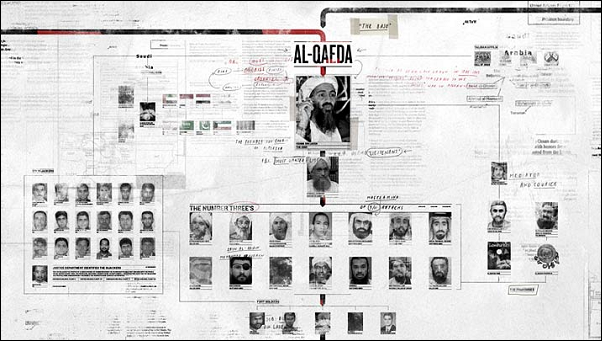
A link chart is the visual representation of a terrorist network and it’s what terrorism analysts spend much of their time building.

and:

My mental image is that, you know, I’m doing Jacob’s Ladder, you’ve got this string where you’re pulling the strings in your fingers, I feel like that’s what I feel I’m doing mentally.

and:

You know, trying to keep track of all the threads of various threats and which ones are real and which ones aren’t real and what connects to what. And, you know, people say, why didn’t you connect the dots? Well, because the whole page is black.

**

A sea of thoughts, then, in more than one mind yet strongly interconnected by whatever intel comes across the transom, conversations, memories, that needs to become physically represented in a way which represents links between the parties and their ideas, stated or surmised. With wild-cards, seepage, and needless duplication. Some oriented to materiel, some to morale: from munitions to Qur’anic meditations. A “semantic network“, with links as vertices, people and ideas as nodes (cf also “conceptual graphs“).

Something very like, in fact, Hermann Hesse‘s Glass Bead Game — only with a focus on threat, rather than conceptual elegance across the full range of human thought…

**

It’s a formidable task, then, moving first from copious scraps of intel to human minds that perform their own evaluative sorting. Here I’d invoke Coleridge‘s “hooks and eyes of memory” and suggest the process, like other forms of combinatorial insight, may require passionate examination, sub-conscious-threshold processing, and some reverie or rest time in which the unanticipated connection can be presented to consciousness… in a highly complex iterative process. And with each new connection or cluster of dots requiring is own drilling down for verification, and weighting adjustment so that salient masses and intriguing outliers are both held in steady remembrance…

— I think this whole process is what Ms Bakos was talking about when earlier she gave us the overall injunction, “you’re letting the information tell you what the picture is going to be” –_

And all this without the benefit of the “red and yellow thumbs” that Jonas talks about in jigsaw puzzles [ see interview here ], or more accurately, with the exact nature of the thumbs ranging from quantifiable links between telephones to near-stochastic leaps from a theological imperative to a tactic…

And with a board that doesn’t have the neat rectangular frame of a picture puzzle, where the frame is in fact the particular analyst’s account — a geographic area, a nation perhaps, or some other area of specific expertise. So there are no “easy corners” to find, just a buzz of data, a murmuration…

It’s magnificently hard. It’s epiphanic, it’s magical. Much of the magic takes place below the threshold of consciousness, but consciousness is not fond of admitting that. And Cindy Storer’s comments, to my ear, convey a whole lot of that magic without “capturing” it.

John Livingstone LowesThe Road to Xanadu: A Study in the Ways of the Imagination, is I’m not mistaken, is a guided tour through the superb analytic puzzle piece and dot connecting mind o Samuel Taylor Coleridge, and a fir bed-time read for analysts. And I could go on, but this is long enough already.

**

My thanks to HBO, the crew and cast of Manhunt — and congratulations on the Emmy.

We’re at the beginning of an understanding of how the mind puts puzzle pieces together, connects dots, spots needles in haystacks, and in general recognizes patterns and irregularities, at this point– and there’s much more to be uncovered.

  • I recommend the Loopcast with Nada Bakos, and the series in general.
  • I recommend the Greg Barker / HBO documentary, Manhunt
  • and you might also like to watch the fascinating mini-docu about the film’s title graphics
  • and read this comprehensive account of the titles
  • **

    Filmcraft, like tradecraft, goes an order of magnitude above and beyond what is easily noticed to achieve its effect…

    And damn, I still want time and attention to give that movie the close review it richly deserves!

    Pie Jesus, dona eis requiem

    Sunday, June 30th, 2013

    [ by Charles Cameron — of Ozymandias, as Shelley’s story-teller friend reminds us, all that remains are “vast and trunkless legs of stone” ]
    .

    I am very fond of the long view, in which each of us becomes (physical) dust and enters (mental) oblivion — not necessarily in that order — see Shelley, Osymandias, best read by the wonderful Eleanor Bron

    I take the video below, with its scenes both of a young girl playing a tribute of flowers to the fallen of 9/11 and of Osama bin Laden, set to Fauré‘s plangent and beautiful Pie Jesus, dona eis requiemBlessed Jesus, grant them peace — as truly comprehensible only in that long view, where oblivion meets forgiveness…
    .


    .

    **

    The notes accompanying the video tell us:

    Uploaded on May 4, 2011
    Pie Jesu (from Requiem by Gabriel Fauré)

    Words : Tommaso da Celano (1200 – 1265)
    Music : Gabriel Fauré (1845 – 1924)

    Conductor : Michel Corboz
    Soprano : Alain Clement
    Organ: Philippe Corboz
    Berne Symphony Orchestra

    Recording on May 1972, in Casino de Berne, Switzerland

    Verse :

    Pie Jesu Domine (Merciful Jesus) ,
    dona eis requiem (grant them rest) ,
    sempiternam requiem (grant them everlasting rest) .

    Notes:

    1) The War in Afghanistan (1979 – 1989)

    was a conflict involving the Soviet Union and her puppet against the indigenous Afghan Mujahideen and foreign “Arab–Afghan” volunteers. The mujahideen found military and financial support from a variety of sources particularly Saudi Arabia and the United States.

    2) September 11 Attack

    The September 11 attacks were a series of coordinated suicide attacks by al-Qaeda led by “Osama bin Laden” upon the United States on September 11, 2001. Nearly 3,000 victims include 343 firefighters and 60 police officers died in the attacks.

    The United States responded to the attacks, invaded Afghanistan. This war is not over yet.

    3) Osama bin Laden (1957 – 2011)

    Osama bin Laden was born in Riyadh, Saudi Arabia. On 1979 he joined the Afghan Mujahideen as a volunteer. After withdrawn USSR, he founded “al-Qaeda” in the war-devastated land and took the decisive action on September 11 2001. U.S. President Barack Obama announced that he had been killed by US armed forces on May 2 2011.

    Fauré’s Requiem is one of the classic works of sacred choral music, and Michel Corboz deservedly one of the pre-eminent conductors of that repertoire.

    This video, as you may have guessed, comes from the same source as the other examples of strange pairings of music and visuals which I discussed recently in Taylor Swift, Sara Mingardo, JS Bach and a quiet WTF, and I hope brings closure to that piece.

    **

    I tracked down the picture of the young girl. it is titled:

    Cazzandra Peterson leaves flowers at Ground Zero in memory of father William Peterson during the 7th annual 9/11 memorial ceremony September 11, 2008 in New York City.

    Family and friends of the victims, heads of government and others gathered at the annual ceremony to remember the attacks that killed more than 2,700 people with the destruction of the World Trade Center on September 11, 2001.

    (September 10, 2008 – Source: PETER FOLEY/Getty Images North America)

    **

    Pie Jesus, dona eis requiem.

    Taylor Swift, Sara Mingardo, JS Bach and a quiet WTF

    Thursday, June 27th, 2013

    [ by Charles Cameron — some very beautiful music accompanied by unexpected visuals ]
    .

    I am in full agreement with this tweet today from our co-blogger here on Zenpundit, Scott Shipman:

    Cantata 63, Christen ätzet diesen Tag, is indeed among the five or so works of Bach to which I find myself constantly turning, though not to this particular movement or performance. It is the work that John Eliot Gardiner performed so movingly, and that wonderfully caught for us on DVD — I’ve spoken of it before.

    Today, though, Scott’s post brings us a mystery I’ve been pondering, and preparing to post about, for a few weeks now. It involves a series of videos, as you can see, and videos take time to watch, I know. I can only say that the music of Cantata 63 itself is wonderful, and the mystery really quite a puzzle. I hope you will find both worth your while.

    **

    Without further comment, then, here is Taylor Swift performing Love Story:

    That seems simple enough.

    Here, though, is the same footage used to present Cantata 63, directed by Karl Richter:

    And here is what I take to be the same exact recording, presented with different visuals:

    Remarkable.

    To my mind, those three videos taken together raise all sorts of interesting questions about the sacred and the profane, eros and agape, aesthetics, mixology, you name it…

    **

    Here is Sara Mingardo singing the recitative O Selger Tag from the same Cantata — in the superlative rendering which I mentioned above — and only recently rediscovered on YouTube, and can thus bring you:

    I have listened to a number of versions of this aria — and to my ear, mind, and heart, Mingardo brings a devotion to this “mere” recitative which far outdistances the others.

    **

    Now for the second part of my puzzle:

    The second of those videos, with the glamorous Ms Swift’s imagery accompanying Herr Bach’s cantata, was posted by one “voiceofshariah” whose 117 videos include more Bach with Taylor Swift imagery:

    — quite a glorious Bach organ piece with which I was not already familiar — but also, under the name “afghanistansomalia”, this version of the B Minor Mass, which I discussed here earlier in a post titled Osama and the flute of the devil:

    — which you’ll note is posted after bin Laden‘s death, and — as if to confuse matters even further — this video, again with OBL visuals, of Maurice Jarre‘s soundtrack for the David Lean / Peter O’Toole film, Lawrence of Arabia!

    Whoa! Osama bin Laden and Lawrence of Arabia?

    What one is to make of all this, I can only guess. I desperately want to get back to the simple appreciation of beauty, however, and will do so, I hope, in an upcoming yet related post.

    Words, words — what’s a bunch of Wordsworth?

    Sunday, May 19th, 2013

    [ by Charles Cameron — bemused again, “jihad” (the word) in the news, “big data” too, plus Google expecting Mahdi ]
    .

    I suppose I should be glad — or should I? — that the word jihad is now in the news.

    It’s about time. Jihad (the word, the concept, the interpretations) should have been in the news at least since 9/11, don’t you think? or since the World Trade Center bombing in February 26, 1993, perhaps? or at least since Osama bin Laden’s Declaration of Jihad Against the Americans Occupying the Land of the Two Holy Mosques of September 2, 1996?

    In any case, the word finally seems to have arrived, if the entry from the National Geographic site last month (upper panel, above) can be trusted:

    And Big Data (lower panel)?

    President Obama launched his Big Data Initiative on March 29, 2012, but I’m not sure how long the term has been in active use. I’m told there’s no “big data” listing in the 2009 Oxford English Dictionary on CD-ROM, I have the sense that three days ago’s Foreign Policy is far more up to date than last month’s National Geographic in any case — and just a month or two ago the CTO of CIA, Ira “Gus” Hunt, situated Big Data somewhere between “the cloud” and right now, telling his audience at GigaOM:

    Big Data was so last year, right, all those breathless articles and all the front page covers — I was expecting BD to be Time’s Man of the Year, right. This year what we’re really talking about is how do we get value out of the stuff?

    That quote, of course, is so “two months ago”…

    **

    So what does National Geographic tell us about jihad?

    The Boston marathon bombing has focused attention on the word “jihad.”

    Vice President Biden characterized the alleged bombers as knockoff jihadis.” The Associated Press reported that the elder brother had “vaguely discussed jihad” with his mother over the phone in 2011.

    Origins

    “Jihad” is derived from the Arabic word juhd (meaning effort, exertion, or power) and literally translates to “struggle” or “resistance” for the sake of a goal. Used 30 times and in multiple contexts in the Koran, jihad most often denotes a struggle against external enemies, the devil, or one’s self. One example from the Koran (49.15) is: “The believers are those who believe in Allah and His Messenger … and jahadu (do jihad) with their properties and selves in the way of Allah.”

    Mark Wilks, an early 19th-century British author, introduced jihad into the English lexicon, defining it as a Muslim “holy war,” in his Historical Sketches of the South of India. It’s retained that meaning in English; the Oxford English Dictionary defines jihad as “a religious war of Muslims against unbelievers.”

    History

    Because of its roots and context in the Koran, jihad has a positive meaning to Muslims. Whatever form jihad may take, the struggle is always noble. When the term is evoked against external enemies, it can be used only during just or defensive wars.

    I’m sorry, but that last para beginning “Because of its roots and context in the Koran, jihad has a positive meaning to Muslims” isn’t terribly clear. When al-Zawahiri talks about jihad, for instance, does the writer imagine all Muslim readers imagine he’s talking about something noble? I fear there are some subtleties being missed her that not everyone who reads National Geographic may understand.

    **

    And what does Foreign Policy want to tell us about Big Data?

    The promoters of big data would like us to believe that behind the lines of code and vast databases lie objective and universal insights into patterns of human behavior, be it consumer spending, criminal or terrorist acts, healthy habits, or employee productivity. But many big-data evangelists avoid taking a hard look at the weaknesses. Numbers can’t speak for themselves, and data sets — no matter their scale — are still objects of human design. The tools of big-data science, such as the Apache Hadoop software framework, do not immunize us from skews, gaps, and faulty assumptions. Those factors are particularly significant when big data tries to reflect the social world we live in, yet we can often be fooled into thinking that the results are somehow more objective than human opinions. Biases and blind spots exist in big data as much as they do in individual perceptions and experiences. Yet there is a problematic belief that bigger data is always better data and that correlation is as good as causation.

    **

    Mr Orange had something to say about the word “jihad” in his War Tracker blog the other day, under the title What’s in the names of terrorist groups (1): Jabhah al-Nusrah li-Ahl al-Shâm min Mujâhidî al-Shâm fi Sahât al Jihâd:

    … they still use a religious term in their name: One that is quite negatively understood in the West but not so in the Arab and Muslim world namely Jihâd.

    They are Mujâhidîn – those who do Jihâd (religious struggle – in this case fighting) – on the fields of Jihâd. Mujâhidîn has a positive, religiously legitimizing ring to it – see here is someone who struggles for the religion – and is furthermore including. Whether you are with the FSA (even one of the rather secular parts of that group mind you) or with an independent Islamist group or with Jabhah al-Nusrah all do use the term Mujâhîd and all may be identified by that term (Granted there was a time when Thuwâr (revolutionaries) was en vogue but no longer so).

    That, IMO, gets us a lot closer to understanding a term that has a range of meanings, a range of users, and a range of audiences — from something along the lines of divinely obligated warfare to something akin to conscience (or what Rilke calls “being defeated, decisively, by constantly greater beings”) , and from those who use it for glorious self-identification to those for whom it is a euphemism for terrorist (irhabi), and from those itching for a fight to those longing, praying and working devotedly for peace…

    **

    So — since we’re talking big data and jihad, here’s a tiny snippet of jihad-related skew from Google, one of the giants of big data…

    I came across it via SelfScholar, who posted a very interesting response re the Iranian nuclear fatwa issue here a few days ago, in a post titled Google Translate’s Khomeini Problem.

    It appears that Google Translate has a distinctly unsecular view when it comes to major figures in Shi’ite theology — specifically, it adds religious honorifics to their names when translating from English into Farsi. As you might imagine, I wanted to know how they dealt with the Mahdi — and behold, my prayer was answered:

    So Google awaits his blessed return?

    It seems pretty clear that SelfScholar would be skeptical about that. He ends his blog post, in fact, with an indication that he neither awaits nor expects it — choosing for his final example “to highlight the inanity of it all, just one for the road…”:

    **

    Prof. Dr. Muhammad-Reza Fakhr-Rohani has an interesting piece titled Rendering Islamic Politeness Markers into English, which he concludes thus:

    There remain some Desiderata to be dealt with. First, the Arabic pre-nominal honorifics as well as post-nominal honorific-cum-optative sentences must be re-translated with a view to remove the items which make the language sound odd, and perhaps ungrammatical. Secondly, appropriate abbreviations must be devised for them. Finally, they must find their ways into English dictionaries, hence registered as part of the language.

    If I could slip a couple of quotes into the water supply

    Thursday, May 9th, 2013

    [ by Charles Cameron — pretty much just thinking out loud about mental processes ]
    .

    The thing is, changing minds is a delicate business, pushing too hard can be counter-productive, and all the more so when the conclusion you want to bring about is clean contrary to the ethos of those you would far rather see thinking — and acting — very differently.

    **

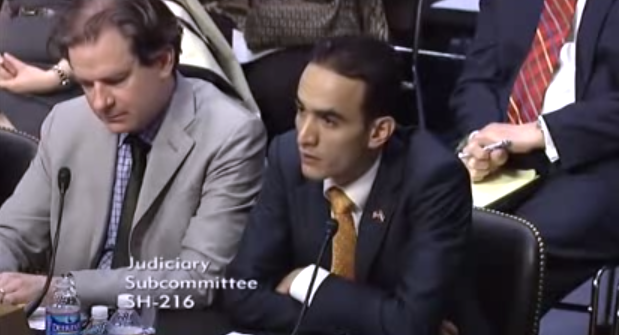
    My first example doesn’t actually need to be dropped into the water supply, it’s there already, in the public discourse. It is taken from Farea Al-Muslimi‘s testimony on Drone Wars: The Constitutional and Counterterrorism Implications of Targeted Killing, April 23, 2013:

    Had the United States built a school or hospital, it would have instantly changed the lives of my fellow villagers for the better and been the most effective counterterrorism tool. Instead of first experiencing America through a school or a hospital, most people in Wessab first experienced America through the terror of a drone strike. What radicals had previously failed to achieve in my village, one drone strike accomplished in an instant: there is now an intense anger and growing hatred of America.

    If that can quietly penetrate thinking in Washington DC, it might alert us to our tendency to act with thought only for direct consequences, never for unanticipated second and second plus order effects…

    And diminish hatred. And thereby also diminish radicalization and recruitment.

    **

    Knowing what words might best counteract pro-jihadist sentiments among potential recruits for purposes of CVE is a far trickier business, and I don’t think it’s my job or the job of government to attempt to influence anyone’s religious belief directly — as I said above, it all too easily backfires.

    Nevertheless, I think that getting a clear picture of how the jihadist mind typically works is a useful exercise, and I’ve suggested before now that accepting the concept of jihad as individual obligation — fard ‘ayn — marks a decisive turning point. That’s why Abd al-Salam Faraj made it a “sixth pillar” of Islam and the centerpiece of his tract The Neglected Duty — see also this article on Faraj in Islamopedia.

    Having said that, these words of bin Laden to Sheikh `Atiyya should at the very least give pause to any who have, like Faisal Shahzad, obtained US citizenship under oath:

    You have perhaps followed the media trial of brother Faisal Shahzad, may God release him, during which the brother was asked to explain his attack [against the United States] in view of having taken an oath [not to harm it] when he was awarded his American citizenship. He responded that he lied [when he took the oath]. It does not escape you [Shaykh `Atiyya] that [Shahzad’s lie] amounts to betrayal (ghadr) and does not fall under permissible lying to [evade] the enemy [during times of war]…please request from our Pakistani Taliban brothers to redress this matter…also draw their attention to the fact that brother Faisal Shahzad appeared in a photograph alongside Commander Mahsud. I would like to verify whether Mahsud knew that when a person acquires an American citizenship, this involves taking an oath, swearing not to harm America. If he is unaware of this matter, he should be informed of it. Unless this matter is addressed, its negative consequences are known to you. [We must therefore act swiftly] to remove the suspicion that jihadis violate their oath and engage in ghadr.

    That’s from Letters from Abbottabad: Bin Ladin Sidelined? by Nelly Lahoud et al, Harmony Program, the Combating Terrorism Center at West Point, 3 May 2012, p. 36.

    For convenience — and here you see the compulsive editor in me helplessly at work — I’d leave out the names and bracketed explanatory phrases, and give the essence of his remarks thus:

    When a person acquires an American citizenship, this involves taking an oath, swearing not to harm America. … The brother was asked to explain his attack in view of having taken an oath when he was awarded his American citizenship. He responded that he lied. It does not escape you that amounts to betrayal (ghadr) and does not fall under permissible lying to the enemy …

    **

    Obviously, that single quote doesn’t accomplish total de-radicalization — but what it might do is give some wannabes pause for further reflection, And as JM Berger has pointed out recently:

    there are hundreds of thousands to millions of people in the world who are radicalized, and only a handful take up violence

    My point here is that if bin Laden himself counseled forms of restraint which young jihadi wannabes acted in ignorance of — how much more would an aspirant need to exercise caution, knowing that divine sanction depends on an accurate theological understanding of what is halal and what haram?

    Because once an individual becomes convinced that jihad is an individual obligation, the fear of being an irhabi terrorist rather than a mujahid fi sabil Allah is about the only restraint left — and that theological distinction, which at the moment of death separates Jannah from Jahannam, paradise from hell, is way above the wannabee’s theological level of competence.

    Something that bears thinking about, no?


    Switch to our mobile site