zenpundit.com » analytic

Archive for the ‘analytic’ Category

R2P is the New COIN

Monday, September 19th, 2011

Introduction: 

The weirdly astrategic NATO campaign in Libya intervening on the side of ill-defined rebels against the tyrannical rule of Libyan strongman Colonel Moammar Gaddafi brought to general public attention the idea of “Responsibility to Protect” as a putative doctrine for US foreign policy and an alleged aspect of international law. The most vocal public face of R2P, an idea that has floated among liberal internationalist IL academics and NGO activists since the 90’s, was Anne-Marie Slaughter, former Policy Planning Director of the US State Department and an advisor to the Obama administration. Slaughter, writing in The Atlantic, was a passionate advocate of R2P as a “redefinition of sovereignty” and debated her position and underlying IR theory assumptions with critics such as Dan Drezner, Joshua Foust, and Dan Trombly.

In all candor, I found Dr. Slaughter’s thesis to be deeply troubling but the debate itself was insightful and stimulating and Slaughter is to be commended for responding at length to the arguments of her critics. Hopefully, there will be greater and wider debate in the future because, in it’s current policy trajectory, R2P is going to become “the new COIN”.

This is not to say that R2P is a military doctrine, but like the rise of pop-centric COIN, it will be an electrifying idea that has the potential fire the imagination of foreign policy intellectuals, make careers for it’s bureaucratic enthusiasts and act as a substitute for the absence of a coherent American grand strategy. The proponents of R2P (R2Peons?) appear to be in the early stages of following a policy advocacy template set down by the COINdinistas, but their ambitions appear to be far, far greater in scope.

It must be said, that unlike R2P, an abstract theory literally going abroad in search of monsters to destroy, COIN was an adaptive operational and policy response to a very real geopolitical debacle in Iraq, in which the United States was already deeply entrenched. A bevy of military officers, academics, think tank intellectuals, journalists and bloggers – some of them genuinely brilliant – including John Nagl, Kalev Sepp, Con Crane, Jack Keane, David Petraeus, Michèle Flournoy, David Kilcullen, Fred and Kim Kagan, James Mattis, Montgomery McFate, Thomas Ricks, Andrew Exum,  the Small Wars Journal and others articulated, proselytized, reported, blogged and institutionalized a version of counterinsurgency warfare now known as “Pop-centric COIN“, selling it to a very reluctant Bush administration, the US Army and USMC, moderate Congressional Democrats and ultimately to President Barack Obama.

The COIN revival and veneration of counterinsurgent icons like Templer and Galula did not really amount a “strategy”; it was an operational methodology that would reduce friction with Iraqis by co-opting local leaders and, for the Bush administration, provide an absolutely critical political “breathing space” with the American public to reinvent an occupation of Iraq that had descended into Hell. For US commanders in Iraq, adopting COIN doctrine provided “the cover” to ally with the conservative and nationalistic Sunni tribes of the “Anbar Awakening” who had turned violently against al Qaida and foreign Salafist extremists. COIN was not even a good theoretical  model for insurgency in the 21st century, never mind a strategy, but adoption of COIN doctrine as an American political process helped, along with the operational benefits, to avert an outright defeat in Iraq. COIN salvaged the American political will to prosecute the war in Iraq to a tolerable conclusion; meaning that COIN, while imperfect, was “good enough”, which in matters of warfare, suffices.

During this period of time and afterward, a fierce COINdinista vs. COINtra debate unfolded, which I will not summarize here, except to mention that one COINtra point was that COINdinistas, especially those in uniform, were engaged in making, or at least advocating policy. For the military officers among the COINdinistas, this was a charge that stung, largely because it was true. Hurt feelings or no, key COINdinistas dispersed from Leavenworth, CENTCOM and military service to occupy important posts in Washington, to write influential books, op-eds and blogs and establish a think tank “home base” in CNAS. Incidentally, I mean this descriptively and not perjoratively; it is simply what happened in the past five years. The COINDinistas are no longer “insurgents” but are the “establishment”.

R2P is following the same COIN pattern of bureaucratic-political proselytization with the accomplished academic theorist Anne-Marie Slaughter as the “Kilcullen of R2P”. As with David Kilcullen’s theory of insurgency, Slaughter’s ideas about sovereignty and R2P, which have gained traction with the Obama administration and in Europe as premises for policy, need to be taken seriously and examined in depth lest we wake up a decade hence with buyer’s remorse. R2P is not simply a cynical fig leaf for great power intervention in the affairs of failed states and mad dictatorships like Gaddafi’s Libya, R2P is also meant to transform the internal character of great powers that invoke it into something else. That may be the most important aspect and primary purpose of the doctrine and the implications are absolutely profound.

Therefore, I am going to devote a series of posts to analyzing the journal article recommended by Dr. Slaughter, “Sovereignty and Power in a Networked World Order“,  which gives a more robust and precise explanation of her ideas regarding international relations, sovereignty, legitimacy, authority and power at greater length than is possible in her op-eds or Atlantic blog. I strongly recommend that you read it and draw your own conclusions, Slaughter’s argument is, after all, about your future.

ADDENDUM – Related Posts:

Slouching Toward Columbia – Guest post: Civilian Protection Policy, R2P, and the Way Forward

Phronesisaical –Dragging History into R2P

Dart-Throwing Chimp – R2P Is Not the New COIN

Committee of Public Safety –With Outstretched Arm | The Committee of Public Safety
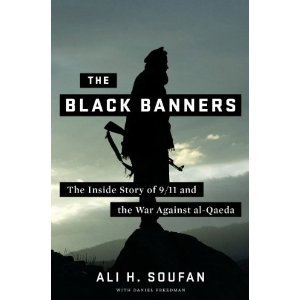
Ali Soufan: AQ, Khorasan and the Black Banners

Saturday, September 17th, 2011

[ by Charles Cameron — yet more black banners, Khorasan, Jerusalem and Armageddon, with the usual strategic implications ]
.
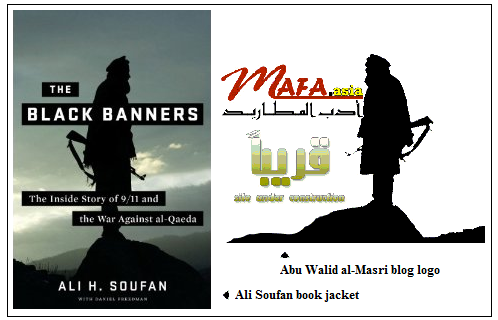
soufan-book-cover.jpg
.

It’s beginning to be embarrassing how obvious the Khorasan / black banner / Mahdism meme is getting these days.  Earlier this week I pointed it out as the basic through-line of Syed Saleem Shahzad‘s Inside Al-Qaeda and the Taliban: Beyond bin Laden and 9/11. Today it’s Ali Soufan‘s turn.

In his book, The Black Banners: The Inside Story of 9/11 and the War Against Al-Qaeda — which I hope to review here — Soufan too makes the apocalyptic significance of AQ’s jihad painfully apparent. Take his title, for instance

Black banners, eh?

Those would presumably be the ones mentioned to Soufan by Abu Jandal, who began to quote the hadith:

If you see the black banners coming from Khurasan, join that army, even if you have to crawl over ice; no power will be able to stop them —

at which point Soufan broke in and completed the hadith for him:

— and they will finally read Baitul Maqdis [Jerusalem], where they will erect their flags.

And in case you missed it, that’s an explicitly end-times, Mahdist hadith, as you can see from (eg) this Hizb-ut-Tahrir-associated site:

Messenger of Allah said: “If you see the Black Banners coming from Khurasan go to them immediately, even if you must crawl over ice, because indeed amongst them is the Caliph, Al Mahdi.” [Narrated on authority of Ibn Majah, Al-Hakim, Ahmad]

Soufan goes on to say:

I was to hear that reputed hadith from many al-Qaeda members I interrogated. It was one of al-Qaeda’s favorites.

Khurasan is a term for a historical region spanning northeastern and eastern Iran and parts of Turkmenistan, Uzbekistan, Tajikistan, Afghanistan, and northwestern Pakistan. Because of the hadith, jihadists believe that this is the region from which they will inflict a major defeat against their enemies — in the Islamic version of Armageddon. Bin Laden’s 1996 declaration of war against the United States – a main text for al-Qaeda members – ends with the dateline “Friday, August 23, 1996, in the Hindu Kush, Afghanistan.” It’s not a coincidence that bin Laden made al-Qaeda’s flag black; he also regularly cited the hadith and referenced Khurasan when recruiting, motivating, and fundraising. Al-Qaeda operatives I interrogated were often convinced that, by joining al-Qaeda, they were fulfilling the words of the Prophet.

It is an indication of how imperfectly we know our enemy that to most people in the West, and even among supposed al-Qaeda experts, the image of the black banners means little…

I could go on, but that’s surely enough.

*

And by the way, who is that man on the cover, anyway?

banners-mafa-juxtaposed.png

“What You Need to Know, Not What You Want to Hear”

Friday, September 16th, 2011


Dr. Robert Bunker testifies before the House Foreign Affairs Subcommittee on the Western Hemisphere on the descent of Mexico into narco-barbarism:

Criminal (Cartel & Gang) Insurgencies in Mexico and the Americas: What you need to know, not what you want to hear.

 ….Something very old historically, and at the same time very new, is thus taking place in Mexico. To use a biological metaphor, we are witnessing ‘cancerous organizational tumors’ forming in Mexico both on its encompassing government and its society at large. These tumors have their roots intertwined throughout that nation and, while initially they were symbiotic in nature (like traditional organized crime organizations), they have mutated to the point that they are slowly killing the host and replacing it with something far different. These criminalized tumors draw their nourishment from an increasingly diverse illicit economy that is growing out of proportion to the limited legitimate revenues sustaining the Mexican state. These tumors do not bode well for the health of Mexico or any of its neighboring states

Hat tip to SWJ Blog.

A bouquet from Breivik

Thursday, September 15th, 2011

[ by Charles Cameron — Breivik, network analysis, graphical presentation, morale and materiel, hard problem in consciousness ]

.

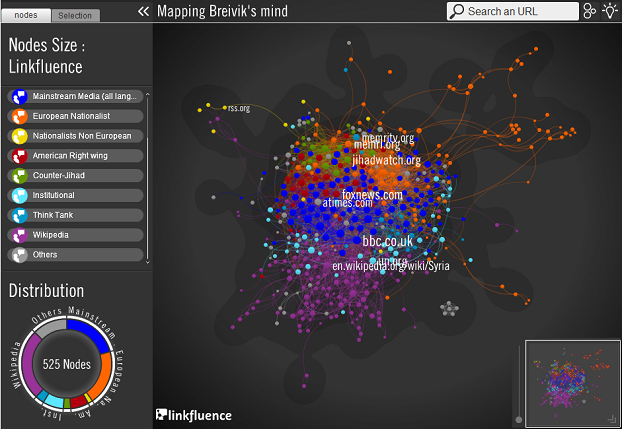
breivik-mind-map.png

If I might wax over-the-top lyrical for just a moment…

Like an early morning bouquet of wildflowers appearing out of the mists —

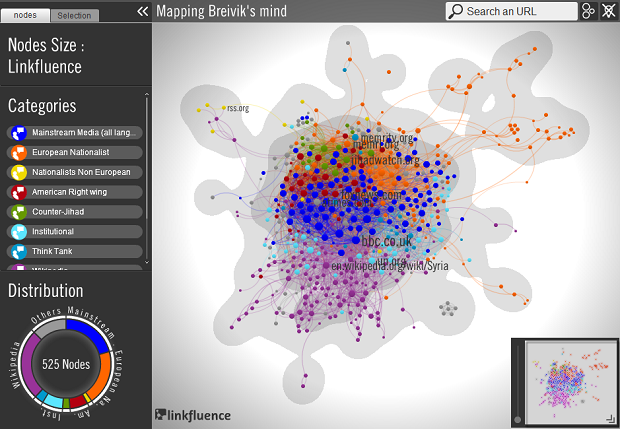
breivik-mind-map-02.png

or like some translucent sea creature perhaps, with galaxies in its veins and tendrils — the mind of Anders Breivik is imaged here by Britain’s Guardian datablog in a graphical mapping of the hyperlinks found in his 1500 page manifesto, and the links between the sites he links to.

Beautiful, no? Like an early morning bouquet?

*

Three things:

  • mapping Breivik’s online links for us is a valuable service.
  • the glamour of high-tech graphical interfaces can be deceptive.
  • there’s no map of the link between concept and act.

That last one, if you ask me, is the real bouquet.

We can know quite a bit about what Breivik read, and even figure out some of how he “connected the dots” – but the move from thinking about to taking action is the one that matters most – and we don’t have much of a handle on it.

It’s not on the map.

*

Such lacunae bother me.

A lot of our maps and models move between one quantity and another, and a lot of our thinking, correspondingly, has to do with materiel rather than morale — but nowhere is there a map or model of how quantity and quality affect each other, or how morale “force multiplies” materiel — even though “real life” moves seamlessly between (subjective, qualitative) mind and (objective, quantifiable) brain.

We have no map to walk us through the hard problem in consciousness — except our own insight.

And x-rays do not an insight make.

Jihad culture: its music, poetry, rituals and dreams

Monday, September 12th, 2011

[  by Charles Cameron – jihadist studies, Hegghammer, culture and influence ]

.

It is the evening of the tenth anniversary: the day is almost over.

*

In an engaging interview with Abu Muqawama posted today, terrorism and violent Islamism expert Thomas Hegghammer discusses his new project about jihad culture, or “the things jihadis do when they don’t fight”.

It is inspired by the observation that militants in the underground spend a lot of time doing things that appear to serve no immediate military purpose, like singing songs, reciting poetry, or discussing dreams. They also do unexpected things like weep on a regular basis, notably when reciting the Qur’an. The infamous Abu Mus‘ab al-Zarqawi, for example, was known among fellow militants as both “the butcher” (al-dhabbah) and “a weeper” (baki). All this “soft matter” of jihadism remains virtually unstudied; one reason, I think, is that it has been considered less consequential than the hard stuff of terror, such as attacks, resources, organizational structures and the like. My hypothesis is that jihad culture is not inconsequential at all; instead I think it may shed important new light on the processes by which jihadi groups recruit, exercise organizational control and make tactical decisions. I am sure that the military men and women reading this blog will find all this rather intuitive, because they have experienced the important role of music and rituals in their own organization.

As a first step in the inquiry, I am currently working with a great team of scholars on an edited volume that will explore various dimensions of jihad culture. I have recruited subject specialists – including a musicologist, an Arabic poetry expert, and an anthropologist of dreams – to help document and decipher al-Qaida’s internal culture.

I hope the book will cover miracle stories and the odor of sanctity, too…

*

Hegghammer is co-author of the forthcoming Meccan Rebellion (Amal 2011), which I very much hope to review here on Zenpundit, and which is likely to be the definitive work on the Mahdist takeover of the Grand Mosque in Mecca in 1979.

Needless to say, I’m delighted at the news of Hegghammer’s upcoming project.


Switch to our mobile site