zenpundit.com » analytic

Archive for the ‘analytic’ Category

Book Review: Grand Strategies by Charles Hill

Monday, March 21st, 2011

Grand Strategies by Charles Hill

Charles Hill, senior Cold War diplomat, Hoover Institution fellow and a co-founder of Yale’s popular Grand Strategy Program that amounts to a crash course in the kind of classical liberal education that universities once imparted to undergraduates but today pride themselves in doing so no longer. The popularity of Hill’s program,  therefore, is with the students moreso than campus activists or the faculty:

…Despite whispers of words like “elitist,” “conservative,” and “cult”-words considered synonyms by many at Yale-The Grand Strategy seminar, only a few years old, has become one of the university’s marquee classes. Grand Strategy, like Professor Hill, has its own myth. The liberals on campus call the class Grand Fascism. They are kidding, but only in part. Many Yale students and faculty are suspicious of the program. Students awed or repelled by Grand Strategy are the same ones who are awed or repelled by Professor Hill, and for the same reasons: the aura of power, the whiff of elitism, the promise of an answer to life’s messiest questions.

If the Grand strategy Course at Yale is a distillation of classical liberal education, Grand Strategies: Literature, Statecraft and World Order is Hill’s reification of the course as an education for the reader on how the evolution of the Western civilizational worldview makes possible grand strategy. The book is an intellectual tour de force by Hill, at some times an idiosyncratic one and at all times an interesting one. I have read many, though very far from all, of the classic texts that Hill critiques and uses to shape his argument but having a large library under your belt is not a prerequisite from understanding Grand Strategies. Far from it, one suspects Hill wrote the book with his seminar students in mind.

Hill examines the protean and mythopoetic relationship between cultural foundations and expressions of power and political wills in conflict represented by diplomacy and war, both navigated by grand strategy constructed from cultural vision. A recurring theme in Grand Strategies is the heroic structure of the epic tale, with the descent into the Underworld and revelation of the heroic destiny by the shades and an ascent (not always successful or as ideally envisioned) to a creative, transformative new order. The reader meets Achilles in many guises, marches upcountry with Xenophon, is cast out of Heaven by Milton, confronts Hobbes‘ Leviathan, defies Rosseau’s general will and exorcises the evil represented in Dostoyevskii’s The Possessed. And this only is a tenth of the narrative.

While I frequently found myself in agreement with Hill’s discernments of the texts, some of them struck me as strained or highly debatable, such as Hill’s reading of Plato as a wry ironist ( Hill borrows from Leo Strauss here but goes further, if I recall correctly, than Strauss did), something that Carroll Quigley, Karl Popper or many classicists would have disputed. Hill’s final chapter, “The Writer and the State” is entertaining and contains a laudatory anecdote about Hill’s former boss, the impressive SECSTATE George Schultz , but it lacked some of the gravity of earlier chapters.

Erudite and visionary, Grand Strategies is a grand synthesis by Charles Hill with lessons to learn on every page.

(Special hat tip to J. Scott Shipman who pushed me to read and review this book)
Happy Birthday, Emlyn, and Applause, xkcd

Sunday, March 20th, 2011

[ by Charles Cameron ]

*

My son, Emlyn, turns sixteen today.

He’s not terribly fond of computers to be honest — but he does follow xkcd with appreciation, as do I from time to time: indeed, I am led to believe I receive some credit for that fact.

So… this is a birthday greeting to Emlyn, among other things. And a round of applause for Randall Munroe, creator of xkcd. And a post comparing more reliable and less reliable statistics, because that’s a singularly important issue — the more reliable ones in this/ case coming from a single individual with an expert friend, the less reliable ones coming from a huge corporation celebrated for its intelligence and creativity… and with a hat-tip to Cheryl Rofer of the Phronesisaical blog.

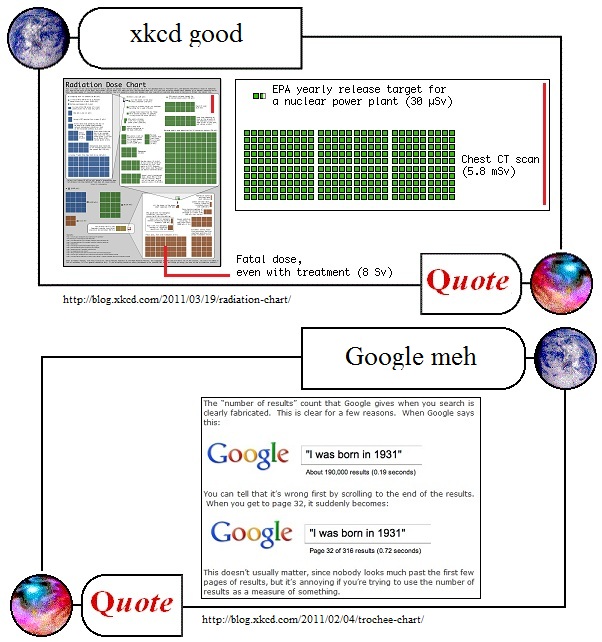
The DoubleQuote:

quoxkcd-01.jpg

Radiation exposure:

Today, xkcd surpassed itself / his Randallself / ourselves, with a graphic showing different levels of radiation exposure from sleeping next to someone (0.05 muSv, represented by one tiny blue square top left) or eating a banana (twice as dangerous, but only a tenth as nice) up through the levels (all the blue squares combined equal three of the tiny green ones, all the green squares combined equal 7.5 of the little brown ones, and the largest patch of brown (8Sv) is the level where immediate treatment doesn’t stand a chance of saving your life)…

The unit is Sieverts, Sv: 1000 muSv = 1 mSv, 1000 mSv= 1 Sv, sleeping next to someone is an acceptable risk at 0.05 muSv, a mammogram (3 mSv) delivers a little over 50,000 times that level of risk and saves countless lives, 250 mSv is the dose limit for emergency workers in life-saving ops — oh, and cell phone use is risk-free, zero muSv, radiation-wise, although dangerous when driving. [I apologize for needing to write “mu” when I intend the Greek letter by that name, btw — software glitch with the ZP version of WordPress.]

The xkcd diagram comes with this disclaimer:

There’s a lot of discussion of radiation from the Fukushima plants, along with comparisons to Three Mile Island and Chernobyl. Radiation levels are often described as “ times the normal level” or “% over the legal limit,” which can be pretty confusing.

Ellen, a friend of mine who’s a student at Reed and Senior Reactor Operator at the Reed Research Reactor, has been spending the last few days answering questions about radiation dosage virtually nonstop (I’ve actually seen her interrupt them with “brb, reactor”). She suggested a chart might help put different amounts of radiation into perspective, and so with her help, I put one together. She also made one of her own; it has fewer colors, but contains more information about what radiation exposure consists of and how it affects the body.

I’m not an expert in radiation and I’m sure I’ve got a lot of mistakes in here, but there’s so much wild misinformation out there that I figured a broad comparison of different types of dosages might be good anyway. I don’t include too much about the Fukushima reactor because the situation seems to be changing by the hour, but I hope the chart provides some helpful context.

Blog-friend Cheryl Rofer, whose work has included remediation of uranium tailings at the Sillamäe site in Estonia (she co-edited the book on it, Turning a Problem Into a Resource: Remediation and Waste Management at the Sillamäe Site, Estonia) links to xkcd’s effort at the top of her post The Latest on Fukushima and Some Great Web Resources and tells us it “seems both accurate and capable of giving some sense of the relative exposures that are relevant to understanding the issues at Fukushima” — contrast her comments on a recent New York Times graphic:

In other radiation news, the New York Times may have maxed out on the potential for causing radiation hysteria. They’ve got a graphic that shows everybody dead within a mile from the Fukushima plant. As I noted yesterday, you need dose rate and time to calculate an exposure. The Times didn’t bother with that second little detail.

In any case, many thanks, Cheryl — WTF, NYT? — and WTG, xkcd!

Google:

Once again, xkcd nails it.

I’ve run into this problem myself, trying to use Google to gauge the relative frequencies of words or phrases that interest me — things like moshiach + soon vs “second coming” + soon vs mahdi + soon, you know the kinds of things that I’m curious about, I forget the specific examples where it finally dawned on me how utterly useless Google’s “About XYZ,000 results (0.21 seconds)” rankings really are — but the word needs to get out.

Feh!

Paging Edward Tufte.

Sixteen today:

Happy Birthday, Emlyn!

Libya Shatters the Partisan Divide

Saturday, March 19th, 2011

Intervention in Libya has shattered the neat little boxes into which the American Left and Right typically divides.

If you favor military intervention against the mad Colonel Gaddafi and his brood of looters, you are aligned with Hillary Clinton. And Paul Wolfowitz. And Joe Biden. And France. And John McCain. And Eliot Cohen. And John Kerry. And John Bolton. And Susan Rice.  And Samantha Power. And Fareed Zakaria. And W. Patrick Lang. And Thomas P.M. Barnett…..

If  you are against intervention in Libya, you stand alongside Robert Gates. And George Will.  And Andrew Bacevich.  And Andrew Sullivan. And Pat Buchanan.  And Ron Paul. And Marc Lynch. And Glenn Greenwald.  And Micheal Cohen. And Mattew Yglesias. And Andrew Exum

Cognitive dissonance reigns. Several generations of American citizens who have been indoctrinated to substitute litmus tests for critical thought are now at sea without a compass or a map. Heh.

My view is pretty straightforward:

1. Libya, in and of itself, is not worth a rusty damn. If Libyans want to be ruled by quasi-demented religious cro-magnons, so be it. Sadly, they represent a moral improvement over Gaddafi. If Gaddafi’s successors sponsor terrorism agaist US interests we can declare war and destroy all of Libya in about three days.

2. I am not in favor of a formal “No fly Zone”. Too expensive. Send some F-16s and and F-18’s to shoot down a few MiG’s. Pilots as a rule are at least reasonably bright; the Libyans know their warplanes are obsolete and the pilots will stop flying ( except to flee Libya). Instead, I recommend giving military and humanitarian aid and professional military advice, if it is desired by the Libyan rebels.

3. Gaddafi has ample American blood between his fingers and he is in a jam. It is a good time for the US give circumstances a push so that he and his miserable clan die in a horrific way, possibly on live TV or youtube. His death will be a salutory lesson for others and also a measure of justice – a thing rare in the world.

4. Whatever happens, he US is not financially obligated to reconstruct Libya. Reconstructing Germany and Japan after WWII was not an act of altruism but of  strategic self-interest. The Libyans have oil. Sell it for a reconstrction fund.

5. Obama was dragged unwillingly to the current policy and personally was ok with Gaddafi’s survival. The US has a lot of options to make life hard right now for Col. Gaddafi and President Obama has delayed taking any of them for as long as he possibly could.

What are your thoughts?

Rationality: Saw this on Facebook

Thursday, March 17th, 2011

Hat Tip to Dan F.

flowchart-to-determine-if-youre-having-a-rational-discussion-e1300206446831-634x882.jpg

If only…..

The Existence of the Operational Level of War, For and Against

Wednesday, March 16th, 2011

I was involved in a discussion elsewhere regarding the excellent and thought provoking article at SWJ by General Huba Wass de Czege on operation art, design and thinking:

Operational Art is Not a Level of War

Strongly recommend you read the article first. My remarks follow, slightly revised:

I have only read a few pieces by General Wass de Czege, those published at SWJ but the caliber of the general’s self-reflective, professional, thinking is something we should strive to emulate.

Here is what seems to be the crtical point in his article, after which I have a comment:

 “We doctrine writers of the 1980’s inserted operational art as a mid-level of war between tactics and strategy – making it the art of translating the governing strategy into the implementing tactics of the “tactical echelons.” And thus, making operational art the province of “campaigning” generals. Because of the way I was conditioned to think then, that strategy was the business of the upper echelons and tactics the business of the lower ones, I miss-translated an idea borrowed from Soviet doctrine about the mediation between strategy and tactics. I was then a product of indoctrination in the US Army’s War and Command and Staff Colleges. These institutions, and the business schools of the time, taught based on the industrial age organizational model of the head (where strategic decisions are made) and the rest of the body (where tactical decisions implement the strategy). I now believe that, without violating the historical meaning of the terms strategy and tactics, this is a much more useful and natural way to think of the relationship between tactics, strategy and operational art.

In fact, this allows one to close the conceptual gap between our bifurcated way of thinking about warfare between nation states and that between states and armed movements of any kind. It also helps do the same for the two tactical operating modes that have recently surfaced in new Army concepts – “combined arms maneuver” and “wide area security.”

Campaigning, another word for operational art, can occur at any scale, and in any milieu, as a close look at what our best company, battalion, and brigade commanders have been doing in Iraq and Afghanistan. “

I think maybe this should be qualified – re; operational art is not a “level”. It is a level of war and it is not at the same time.
 
The difference between the two I think is *how* we are employing the term: “Operational art” as a historical, taxonomic, description of how a military-political command structure has behaved/behaves as a warfighting institutional culture vs. methodologically how they *could* and *should* think about warfare and in turn behave at any “level”.
 
It is not surprising to me, thinking in terms of history, that Wass de Czege, where he wrote that he was in error, was drawing from Soviet examples. If we think about “operational art” as a “level of war” we are led to military powers where powerful ideological constraints systemically interfered with the “natural” clausewitzian connection between Policy and Strategy.
 
The USSR’s Red Army, from the early days of Commissar-Commander relationships in battle, through the Stalinist era to the more modern and restrained (i.e. non-murderous) controls of the Army’s Political Department and vetting security checks for promotion carried out jointly by the military, State Security and Party organs, created an atmosphere where deferral of political implications caused a) a segregation of an officer’s intellectual initiative to organizational and technical military questions and b) constructing military strategy and operational campaigns to at least nominally reflect Marxist-Leninist dogma and the Party line as a matter of necessity, and for a period, in an effort to try and avoid being physically liquidated.
 
Most of the Soviet Union’s most gifted military strategists and tacticians were unsuccessful in this regard and perished (ex. Svechin, Tukhachevskii, Blyukher). Arguably that left an institutional legacy in it’s wake that narrowed the conceptual framework with which Soviet Marshals and generals approached planning for war, including nuclear war.
 
Germany is another example, with the policy-strategy split favoring a professional military focus on operational art emerging as early as 1870 in tensions between Bismarck and Moltke over the war with France, growing worse during the Great War until during the Third Reich, a state of enforced paralysis occurs after 1942 on the Eastern Front. In theory, Hitler, who was his own war minister and commander-in-chief of the Army in addition to being the Supreme Commander, Fuhrer and Reich Chancellor, could (like Stalin) have resolved any contradictions or discordance between Policy and Strategy. Hitler deliberately chose not to do so and his paranoia led him to eventually limit even his field commander’s tactical flexibility (some generals, like Rommel, resisted this more effectively than others).
 
The US military, in my view, suffers a similar fixation. The reasons are very different – proper constitutional deference to civil authority coupled with a limited or absent capacity of most civilian political authorities to think in a complementary strategic fashion that would allow them to best guide their military commanders in jointly constructing a seamless bridge between policy-strategy-operational campaign. Another reason, though I do not want to go into it here, is a cultural reaction to the experience of the Vietnam War that became embedded in the officer corps during the shift to the AVF starting with the Nixon administration.
 
Tom Ricks had a very interesting post at Best Defense while back on the Hew Strachan article in which Ricks argued against the existence of an operational level of war, but as we are not discussing platonic forms, militaries are at whatever “level” of war for which their culture institutionally encourages officers to think about and plan. So in that sense, Wass de Czege is absolutely correct – they can and should be thinking across the whole range and not in “slots”. However, if they don’t do what he suggests and if they do predominantly focus on one “level” as most of their thinking and planning, be it tactics, operations, strategy. Then that level “exists”, it leaves a bureaucratic “trail”, grows a structure to execute it and will be put into practice during a war – at least initially until events force a change of practice from below (the field) or above ( political leaders).


Switch to our mobile site

