zenpundit.com » analytic

Archive for the ‘analytic’ Category

Martyrdom, messianism and Julian Assange

Thursday, December 23rd, 2010

[ by Charles Cameron ]

Martyr and messiah are two of the more intense “roles” in the religious vocabulary, and unlike mystics and saints, both martyrs and messiahs tend to have an impact, not just within their own religious circles but in the wider context of the times.

Martyr and messiah are also words that can be bandied about fairly loosely — so a simple word-search on “messiah” will reveal references to a third-person platform game with some gunplay and the white messiah fable in Avatar, while a search on “martyr” might tell you how to become a martyr for affiliate networks, just as a search on “crusade” will turn up crusades for justice or mental health – my search today even pointed me to a crusade for cloth diapers.

1. Martyrdom and messianism in WikiLeaks

Unsurprisingly, perhaps, both terms crop up occasionally in WikiLeaks, with the Government of Iraq, for instance, banning use of the word “martyr” for soldiers who died in the war with Iran, and US diplomats wiring home a report by an opposition psychiatrist to the effect that “Morally, Chavez [of Venezuela] combines a sense of tragedy and romanticism (a desire for an idyllic world) to project a messianic image.” Indeed, the whole paragraph is choc-a-bloc with that kind of imagery, and worth quoting in full:

Ideologically, Chavez wants to project an image of a “utopian socialist,” which de Vries described as someone who is revolutionary, collectivist, and dogmatic. In reality, de Vries argues, Chavez is an absolute pragmatist when it comes to maintaining power, which makes him a conservative. Coupled with Chavez’ self-love (narcissism), sense of destiny, and obsession with Venezuelan symbolism, this pragmatism makes Chavez look more like fascist, however, rather than a socialist. Morally, Chavez combines a sense of tragedy and romanticism (a desire for an idyllic world) to project a messianic image. De Vries, however, said Chavez is a realist who uses morals and ethics to fit the situation.

PM Netanyahu of Israel was using the term “messianic” with a little more precision when he described the Iranian regime as “crazy, retrograde, and fanatical, with a Messianic desire to speed up a violent ‘end of days.'”

2. Julian Assange in the role of martyr

The words martyr and messiah, then, carry a symbolic freight that is at the very least comparable to that of flags and scriptures – so it is interesting that both terms crop up in the recent BBC interview with Julian Assange.

My reading of the interview suggests that it is Assange himself who introduces the meme of martyrdom, though not the word itself, when he answers a question about the impact of the sexual accusations against him, “What impact so you think that will have on your organisation and what sort of figure do you think you, Julian Assange, cut in the face of all this. How will you be regarded? What will it do to you?” with the response, “I think it will be quite helpful for our organisation.”

In the follow up, interviewer John Humphrys twice uses the word “martyr” explicitly:

Q: Really? You see yourself as a martyr then?

JA: I think it will focus an incredible attention on the details of this case and then when the details of this case come out and people look to see what the actions are compared to the reality of the facts, other than that, it will expose a tremendous abuse of power. And that will, in fact, be helpful to this organisation. And, in fact, the extra focus that has occurred over the last two weeks has been very helpful to this organisation.

and:

Q: Just to answer that question then. You think this will be good for you and good for Wikileaks?

JA: I’ve had to suffer and we’ve had incredible disruptions.

Q: You do see yourself as a martyr here.

JA: Well, you know, in a very beneficial position, if you can be martyred without dying. And we’ve had a little bit of that over the past ten days. And if this case goes on, we will have more.

3. Julian Assange in the role of messiah

If the role of martyr implies, at mimimum, that one suffers for a cause, that of messiah implies that one leads it in a profound transformation of the world. Both terms are now found in association with the word “complex” – which applies whenever a individual views himself or herself as a martyr or messiah – but a “messianic complex” is presumably more worrisome than a “martyr complex” if only for the reason that there are many more martyrs than messiahs, many more willing to suffer for a cause than to lead it.

It is accordingly worth noting that it is the interviewer, John Humphrys, who introduces both the word “messianic” and the concept of a “messianic figure” into the interview, although Assange makes no effort to wave it away…

Q: Just a final thought. Do you see yourself… as some sort of messianic figure?

JA: Everyone would like to be a messianic figure without dying. We bringing some important change about what is perceived to be rights of people who expose abuses by powerful corporations and then to resist censorship attacks after the event. We are also changing the perception of the west.

Q: I’m talking about you personally.

JA: I’m always so focussed on my work, I don’t have time to think about how I perceive myself… I had time to perceive myself a bit more in solitary confinement. I was perfectly happy with myself. I wondered what that process would do. Would I think “my goodness, how have I got into this mess, is it all just too hard?”

The world is a very ungrateful place, why should I continue to suffer simply to try and do some good in the world. If the world is so viciously against it ,why don’t I just go off and do some mathematics or write some books? But no, actually, I felt quite at peace.

Q: You want to change the world?

JA: Absolutely. The world has a lot of problems and they need to be reformed. And we only live once. Every person who has some ability to do something about it, if they are a person of good character, has the duty to try and fix the problems in the environment which they’re in.

That is a value, that, yes, comes partly from my temperament. There is also a value that comes from my father, which is that capable, generous men don’t create victims, they try and save people from becoming victims. That is what they are tasked to do. If they do not do that they are not worthy of respect or they are not capable.

4. Julian Assange, martyr and messiah?

I think it is clear that both Assange and his interviewer are in effect reframing the religious terms “martyr” and “messiah” in non-religious, basically psychological senses — although I don’t suppose Assange is exactly claiming to have the two “complexes” I mentioned above.

Here’s what’s curious about this reframing, from a religious studies point of view:

Assange’s implicit acceptance of a “messianic” role undercuts the specific force of the role of “martyr” – one who gives his life for the cause. “Everyone” he says, “would like to be a messianic figure without dying.” Assange wouldn’t exactly object to being a martyr without dying, too.
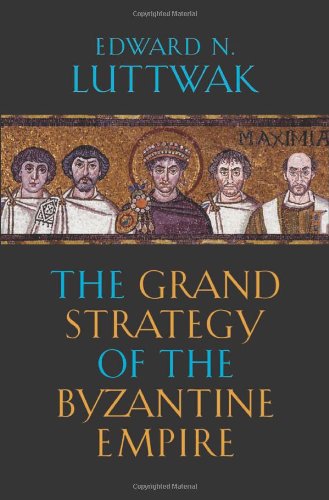
Now Reading Luttwak

Thursday, December 23rd, 2010

The Grand Strategy of the Byzantine Empire by Edward Luttwak

Just starting reading this magnum opus by eminent strategist Edward Luttwak and I am thoroughly enjoying it; particularly, the context-building historical digressions that enrich the text.  Highly recommended.

Google Ngram Viewer

Wednesday, December 22nd, 2010

This amazing visualizing data tool is ready made for analysts, historians and researchers. I just tried Ngoogling “strategy”.

Google Ngram Viewer

Hat tip to T. Greer and Dr. Robert Mackey

Not Getting This….

Friday, December 17th, 2010

Dr. Bernard Finel, explaining his views on COIN theory:

….I am not wholly convinced as a matter of ontology that there exists a coherent phenomena that can be termed “insurgency.” My sense, instead, is that there are various sub-state armed threats that exists to states, several of which we usually lump in together under the rubric of insurgency, but which have very different causes and consequences, and hence require different strategic approaches.  I am not just referring, by the way, to the various motivations for “insurgency” – i.e. religious vs. leftist vs. ethnic – but also that there are at least some groups that have strategic orientations quite at odds from the image of an organized group with ambitions to replace the existing government.

Just a few examples:  Some of what we call insurgency is simple criminality.  There is no desire to replace the state for these groups, but rather  just to weaken the state so that it cannot enforce laws, etc.  There are also other economically motivated groups – those who profit from the existence of conflict and seek to continue it for that reason.  For these groups, promoting conflict is more important than pursuing victory.

Why are submaximum strategic goals (i.e. something < regime change) an indicator of “non-insurgency” ? I think this standard would eliminate most of the popular uprisings in recorded history – for every Taiping Rebellion or Emelian Pugachev, there’s a dozen smaller, hopeless, desperate, peasant revolts.

Why the implicit use of the Maoist model as the defining characteristic of “insurgency”? That is, to the extent Bernard considers insurgency to exist. 

WikiLeaks: Critical Foreign Dependencies

Thursday, December 9th, 2010

[ by Charles Cameron ]

The most interesting part of the WikiLeaks-posted State Department Request for Information: Critical Foreign Dependencies, it seems to me, is the part that ties in with Zen’s recent post Simplification for Strategic Leverage.

Zen referenced Eric Berlow‘s recent TED talk to the effect that sometimes a complex network can be made effectively simple by reducing it to the graph of nodes and links within one, two or three degrees of the node you care about and wish to influence.

“Simplicity often lies on the other side of complexity”, Dr Berlow says, and “The more you step back, embrace complexity, the better chance you have of finding simple answers, and it’s often different than the simple answer that you started with.”

*

This resonates neatly with a few things I’ve been thinking and talking about for some time now.

1. There’s the need for visualization tools that don’t operate with as many nodes as there are data points in a database like Starlight — I’ve been wanting to reduce the conceptual “load” that analysts or journos face from thousands, sometimes tens of thousands of nodes, to the five, seven, maybe ten or twelve nodes that the human mind can comfortably work with:

What I’m aiming for is a way of presenting the conflicting human feelings and understandings present in a single individual, or regarding a given topic in a small group, in a conceptual map format, with few enough nodes that the human mind can fairly easily see the major parallelisms and disjunctions, as an alternative to the linear format, always driving to its conclusion, that the white paper represents. Not as big as a book, therefore, let alone as vast as an enormous database that requires complex software like Starlight to graphically represent it, and not solely quantitative… but something you could sketch out on a napkin, showing nodes and connections, in a way that would be easily grasped and get some of the human and contextual side of an issue across.

2. There’s the fact that the cause is typically non-obvious from the effect. In the words of Jay Forrester, the father of stocks and flows modeling:

From all normal personal experience, one learns that cause and effect are closely related in time and space. A difficulty or failure of the simple system is observed at once. The cause is obvious and immediately precedes the consequence. But in complex systems, all of these facts become fallacies. Cause and effect are not related in either time or space… the complex system is far more devious and diabolical than merely being different from the simple systems with which we have experience. Though it is truly different, it appears to be the same. In a situation where coincident symptoms appear to be causes, a person acts to dispel the symptoms. But the underlying causes remain. The treatment is either ineffective or actually detrimental. With a high degree of confidence we can say that the intuitive solutions to the problems of complex social systems will be wrong most of the time.

3. There’s the need to map the critical dependencies of the world, which became glaringly obvious to me when we were trying to figure out the likely ripple effects that a major Y2K rollover glitch – or panic – might cause.

Don Beck of the National Values Center / Spiral Dynamics Group captured the possibility nicely when he characterized Y2K as “like a lightening bolt: when it strikes and lights up the sky, we will see the contours of our social systems.” Well, the lightning struck and failed to strike, a team from the Mitre Corporation produced a voluminous report on what the material and social connectivity of the world boded in case of significant Y2K computer failures, we got our first major glimpse of the world weave, and very few of the possible cascading effects actually came to pass.

I still think there was a great deal to be gleaned there — as I’m quoted as saying here, I’m of the opinion that: “a Y2K lessons learned might be a very valuable project, and even more that we could benefit from some sort of grand map of global interdependencies” – and agree with Tom Barnett, who wrote in The Pentagon’s New Map:

Whether Y2K turned out to be nothing or a complete disaster was less important, research-wise, than the thinking we pursued as we tried to imagine – in advance – what a terrible shock to the system would do to the United States and the world in this day and age.

4. That such a mapping will necessarily criss-cross back and forth across the so-called cartesian divide between body & mind (materiel and morale, wars and rumors of wars, banks and panics):

You will find I favor quotes and anecdotes as nodes in my personal style of mapping — which lacks the benefits of quantitative modeling, the precision with which feedback loops can be tracked, but more than compensates in my view, since it includes emotion, human identification, tone of voice.

The grand map I envision skitters across the so-styled “Cartesian divide” between mind and brain. It is not and cannot be limited to the “external” world, it is not and cannot be limited to the quantifiable, it locates powerful tugs on behavior within imagination and powerful tugs on vision within hard, solid fact.

Doubts in the mind and runs on the market may correlate closely across the divide, and we ignore the impacts of hope, fear, anger and insight at our peril.

*

Getting back to the now celebrated WikiLeak, which even al-Qaida has noticed, here’s the bit — it’s really just an aside –that fascinates me:

Although they are important issues, Department is not/not seeking information at this time on second-order effects (e.g., public morale and confidence, and interdependency effects that might cascade from a disruption).

It seems to me that the complex models which Starlight provides, and Eric Berlow pillories, overshoot on one side of the problem – but avoiding all second-order effects?

One cause, one effect, no unintended consequences?

What was it that Dr Berlow just said? “if you focus only on that link, and then you black box the rest, it’s actually less predictable than if you step back, consider the entire system”…

Avoid all second-order effects?

If you ask me, that’s overshooting on the other side.


Switch to our mobile site

