Blogfriend Matt Armstrong was recently featured at the USC Center for Public Diplomacy where he had a very thorough and well-considered op-ed on Information Operations and New Media. Pretty much everything Matt had to say were things the USG should be doing in attempting to craft some kind of coherent narrative of it’s national objectives, policies and values:
SYNCHRONIZING INFORMATION: THE IMPORTANCE OF NEW MEDIA IN CONFLICT
Insurgents and terrorists increasingly leverage New Media to shape perceptions around the globe to be attractive to  some and intimidating to others. New Media collapses traditional concepts of time and space as information moves around the world in an instant. Unlike traditional media, search engines and the web in general, enable information, factual or not, to be quickly and easily accessed long after it was created.The result is a shift in the purpose of physical engagement to increasingly incorporate the information effect of words and deeds. Thus, the purpose of improvised explosive devices, for example, is not to kill or maim Americans but to replay images of David sticking it to Goliath.
The U.S. military is actively and aggressively revising its role in shaping its own narrative in cyberspace, but this is falling short. While the U.S. is finally coming to grips with the centrality of information and perceptions, it remains confused as to how to use information effectively. American responses seem to stem from the belief that the message and the messenger we are countering are the same without regard for the target audience, intent, or how the message fits into a larger narrative, which perhaps mirrors our own perception of information as propaganda. ….A famous dead Prussian once said that war is a continuation of politics by other means, but the reality today is that war is not part of political intercourse with foes but an orchestrated, if loosely, effort to gain strategic influence over friends, foes, and neutrals. YouTube, blogs, SMS and traditional media, make every GI Joe and Jihadi a communicator, 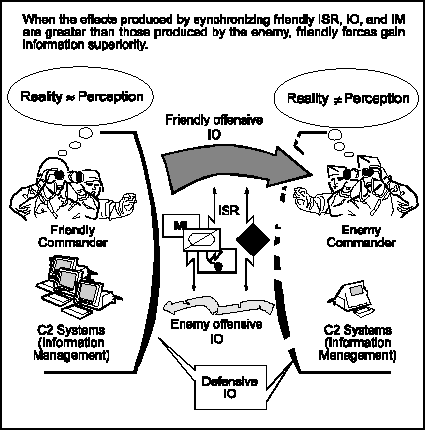 public diplomat, and persuader. Our adversaries understand and exploit this reality. Writing to Abu Musab al-Zarqawi in 2005, Ayman al-Zawahiri stated that “we are in a battle, and that more than half of this battle is taking place in the battlefield of the media [sic].”The U.S. military as reluctant heir to the information throne in an online world has several inherent challenges. First, operating in the environment of New Media requires awareness and agility inconsistent with the current organizational culture of the military. For example, in Iraq the military broke through the bureaucratic red-tape and started posting videos on YouTube. However, this small “victory” was incomplete: the group that uploaded to YouTube was still not permitted to view YouTube. In effect, they were posting information they were not authorized to see.”
Those quotes were snippets. Matt’s post is rich in detail and really requires being read in full.
I have tilted at the IO windmill a few times in the past. It’s a subject that is both easy as wel as difficult to analyze. Easy, because the USG has yet to initiate and/or master the fundamentals of good IO as Matt’s post makes clear ( there are genuine IO experts in the USG, perhaps even a large number of them, but the bureaucracies are not institutionally optimized to conduct IO with consistency or coordination) but difficult because the level of genuine sophistication and effective nuance in strategic communication remains so far off. Even if that level of “play” was achieved by our civil service and soldiers, any IO campaign could be undone in an instant by some clumsy action or statement from a political appointee or elected official concerned primarily with fellating some domestic special interest group.
Matt’s focus on “synchronicity” is apt. It will be a herculean task needing laser beam focus to get all of the USG players on the same message most of the time; even then some dissension and debate being showcased is itself a vital advertisement of the attractive nature of a liberal, open society and a sharp contrast with the dismally intolerant and brutally ignorant alternative our Islamist enemies have to offer. In pursuing that, I’d like to offer a few suggestions:
Credibility is the COIN of the Realm:
Matt touched on this but I want to give this principle added weight. For all our official, overt, communication by any spokesman representing the United States, the best long term strategy is a reputation of credibility. It may hurt to concede errors or enemy  successes in the short run but having the global audience grdugingly concede that “the Americans speak the truth” adds momentum of every word, every idea and every action we undertake. It will not bring us love because oftentimes, our pursuing national interests will come at the expense of others but truth-telling will yield something more valuable, respect. No one cares to be treated as if they were a fool and most of the transparently self-serving gibberish official spokesmen offer up pays dividends only in contempt being added to the anger foreigners already feel at some of our policies. Credibility is to the war of ideas what COIN is to guerilla warfare and it is a valuable and exceedingly rare quality because once your credibility is lost, it is lost.
Without Attention Being Paid All Our efforts Are Useless:
Credibility is not enough. Key messages or memes also have to be interesting. If people are not psychologically engaged in the presentation then they are not hearing it, much less reaching the points of comprehension, sympathy or agreement. American popular culture and commercial advertising is nothing short of an unrelenting global juggernaut that is eroding traditional mores of every society with which it comes into contact, yet our official proclamations remain starkly uninteresting even to most Americans so why should a Yemeni teen-ager or Afghan farmer tune in to what we are selling ? As long as our attempts at capturing attention remain at the level of dull mediocrity we can expect to fail.
Influence is a Long Term Investment:
The 1980’s saw a march toward capitalism and democracy in part because we were reaping the harvest of decades of student visas, cultural and scientific exchanges and consistent public diplomacy outreach. From Mongolia to Czechoslovakia Chile there were reformers taking power who were ” Chicago Boys” who had imbibed free markets at the feet of Nobel laureates. The National Endowment for Democracy, the USIA, VOA, Radio Free Europe and NGO’s like the AFL-CIO whose efforts and programs abroad were robust and self-confident. American society was permitted by the USG to sell itself. These things cost pennies on the dollar compared to having to use hard power options and they lower our transaction costs when sanctions or military intervention is the order of the day.
Deception is Best Left to the Clandestine Operators :
HUMINT based strategic influence efforts, black propaganda and disinformation and various arts of deception will be better left to covert  programs, plausibly deniable third parties and used sparingly and with subtlety. The increasingly “radically transparent” world ensures that too many sophisticated eyes with all sorts of agendas will be analyzing our official spokesmen 24/7. The best will can hope to accomplish is effectively framing our public message to be truthful and compelling. Any meme that is verifiably false, if we believe we must put it out into the global media environment, cannot have a return address.
IO is a secondary area of operations for the United States. Good IO programs cannot remediate incompetent statecraft or poor military leadership or put a “happy face” on obvious disasters but poor or absent IO capabilities can fritter away the capital that successful diplomacy or military action can accrue when our enemies accusations go unanswered.
Crossposted at Chicago Boyz


