zenpundit.com » intelligence

Archive for the ‘intelligence’ Category

On, or Of?

Tuesday, June 11th, 2013

[ by Charles Cameron — always trying to read with care, not always succeeding — NSA ]
.

Dana Milbank in WaPo yesterday:

Sen. Ron Wyden (D-Ore.) asked Clapper at a Senate hearing in March, “Does the NSA collect any type of data at all on millions or hundreds of millions of Americans?”

“No, sir,” Clapper testified.

“It does not?” Wyden pressed.

“Not wittingly. There are cases where they could inadvertently, perhaps, collect, but not wittingly.”

We now know that Clapper was not telling the truth. The National Security Agency is quite wittingly collecting phone records of millions of Americans, and much more

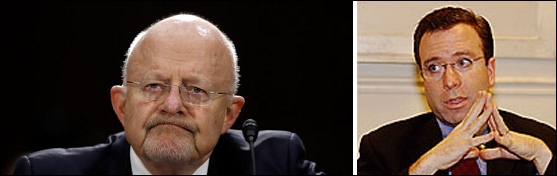
Is there a signikficant distinction to be made between collecting data ON millions of Americans, and collecting phone records OF them?

Does OF mean pertaining to, and ON mean about?

A feast of form in my twitter-stream today

Sunday, June 2nd, 2013

[ by Charles Cameron — forms & patterns, pattern recognition & creative leaps, creative leaps & connecting dots, connecting dots & node-and-edge mapping — node-and-edge mapping, link charts and Sembl-HipBone games ]
.
.

There’s no “actionable intelligence” in that tweet, but it recognizes a pattern, it makes a fine creative leap. And given the chance, that’s something bright minds do naturally, and enjoy doing, and is away more important than we think.

Yestedrday I was watching Manhunt pretty closely for an upcoming Zenpundit review, and noticed that some of the most significant quotes in the film were absent from CNN’s transcript. One gap I noticed had to do with the descriptions of the analytic process, and in particular some of the things Cindy Storer said. I’ll quote this one, which goes to the heart of the matter, but there’s plenty more left for me to chew over with you later. Here she goes:

Even in the analytical community there’s a relatively smaller percentage of people who are really good at making sense of information that doesn’t appear to be connected. So that’s what we call pattern analysis, trying to figure out what things look like. And those people, you really need those people to work on an issue like terrorism, counternarcotic, international arms trafficking, because you’ve got bits and pieces of scattered information from all over the place, and you have to try to make some sense of it. … That takes this talent, which is also a skill, and people would refer to it as magic — not the analysts doing it, but other people who didn’t have that talent referred to it as magic.

That’s a pretty exact description of what the Sembl game will eventually teach people, once it comes out of the museum prototype and onto the web — but let’s back it up with a quick quote from Wittgenstein:

A surveyable representation produces precisely that kind of understanding which consists in ‘seeing connections’ [Zusammenhänge sehen]. Hence the importance of finding and inventing connecting links. Hence the importance of finding and inventing intermediate links.

That’s from Philosophical Investigations, 122, and it’s a higher altitude / more abstract view — but it’s also the very heart of network thinking, seeing processes not just in terms of isolated nodes but of the connections between them.

**

Seeing connections — connecting the dots — happens in lines and leaps. That is to say, it can happen according to the usual linear way of thinking, the dogged 99% of perspiration that people talk about — or according to the far less common lateral move or creative leap, which moves by analogy, which is to say by pattern recognition, by the perception of similarities of form.

That’s the 1% we call inspiration. That’s the magic.

**

So a whole lot of patterning was going on in my twitter-stream today, and I thought I’d show you.

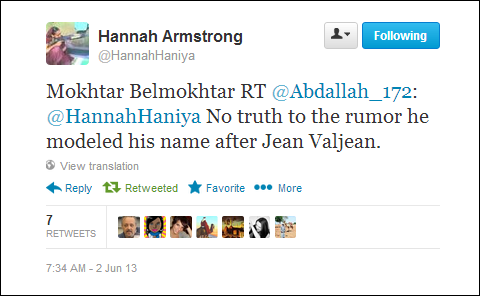
First, there was the parallel between the names Mokhtar Belmokhtar and Jean Valjean (above). If you’re hunting either fellow, the parallelism isn’t going to yield a useful clue — but the mode of recognition is what matters, and the reason its such a rare mode is precisely because it’s playful. It plays with forms — in this case, the forms of the two names — without regard for practicality.

And yet this playful spirit is what brought us Weil‘s conjecture and Pierre Deligne‘s Abel Prize, and the Taniyama-Shimura conjecture and Wiles‘ proof of Fermat’s Last Theorem.

Serious playfulness is key… to serious, magical breakthroughs. In any and all domains.

*

With that in mind, here are the rest of the patterns I recognized in todays feed.

Let’s start with self-reference, which can hardly get more succinct than the hackers hacked:

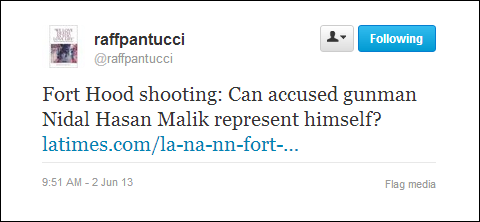
There’s also a self-referential paradox at work in the question of a defendant appearing in his own defense — something that gives judges pause, because they see how tightly the serpent is chasing its own tail. Defendant defends self, From Raff Pantucci:
The saddest self-reference of the morning’s tweets was this one, which could be encapsulated as storm-chaser chased by storm:
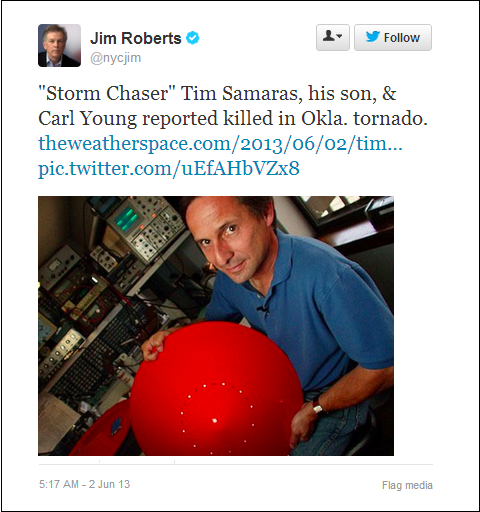
Even tragedy can take self-referential form.

**

But lets move on to Turkey, which provided a rich dividend:

There was this problem:
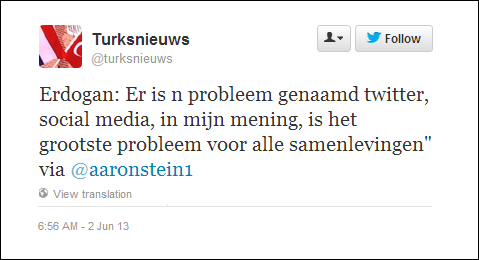
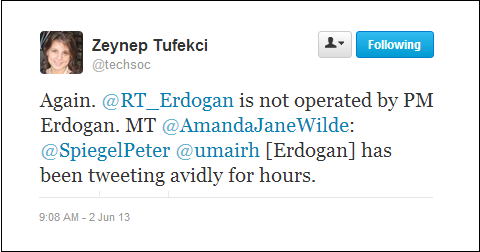
Turkish I couldn’t read, Dutch I can more or less make out — but for an English tweet making the same point let’s go to Zeynep Tufekci, who has expertise in both matters Turkish and matters Internet, and tweets about Erdogan disapproving of tweeting:

Tufekci again, this time catching an even neater self-reference which doesn’t quite pan out — because, as she says, PM Erdogan is not the same as @RT_Erdogan:
**

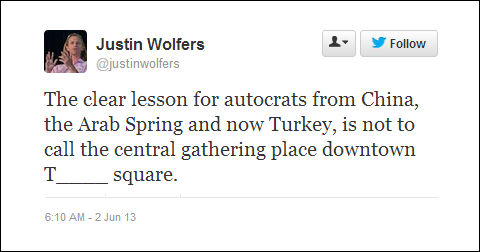
While we’re on Turkey, this tweet about Tienanmen, Tahrir and Taksim Squares gave us another example of a bright mind catching a hint of pattern…
And what a neat rejoinder!
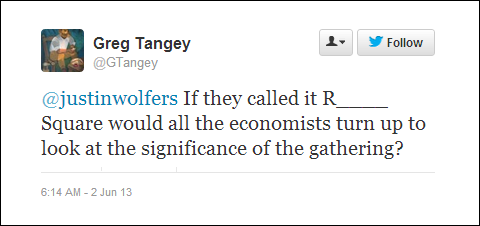
All of the above is quite useless, entirely playful — and of deep interest if creativity and insight matter

**

Finally, I’d like to go someplace quiet and bathe in peace. This tweet, featuring a poem by a Korean zen master, does the trick nicely:
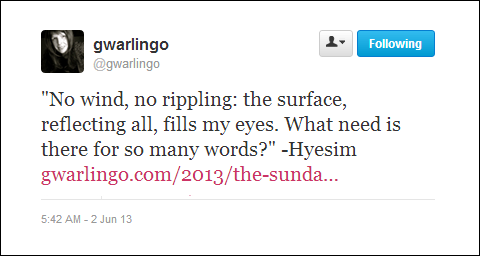
AN appreciative bow to Gwarlingo for that one…
Form is insight: the vesica piscis

Sunday, June 2nd, 2013

[ by Charles Cameron — here’s another post in my importance of form in intelligence series ]
.

Form is pattern, and pattern recognition is insight.

A while back, I started a series of posts [1, 2, 3, 4 and 5] in which I suggested that form is, from an intelligence point of view (and however you may parse “intelligence”) as important to humans as content. I’ll be saying more about this today, but wanted to complete this old and never quite completed post in that series right away, in response to a comment Grurray made today regarding Venn diagrams and the vesica piscis.
.


.

**

If you’ve seen a Venn diagram, you’ve seen overlap. And the simplest form of overlap — between two classes, ideas, or whatever — is the one that’s Venn diagrammed (below, left) as the overlapping of two equal circles — known to artists as the vesica piscis or eye of the fish.

MasterCard uses it for its logo (right) —

— as do Gucci and Chanel:


.

**

But let’s go back to that first pair of images:


.

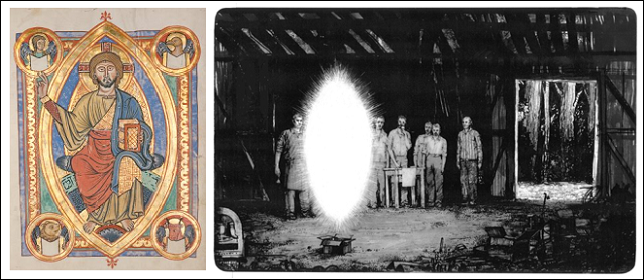
Long before commerce took note of it, the vesica was a sacred image — back in the days when geometry, like nature herself, was sacred.

Like the illuminist of the Codex Bruchsal (ca 1220) with his Christ Pantocrator (above, left), Jan Valentine Saether makes sacred use of the vesica in his book The Viloshin Letters, which I hope to see published shortly — the exquisite suite of prints that accompany the text have already been exhibited to acclaim.

In his text accompanying this particular plate, he writes:

I was not sure. But a new wonder has been moving towards us. That which is… has a new presence. Entering here from elsewhere, the holy spirit manifested again in the vernacular last Wednesday, September 16th.

We were standing around, being together in our own fashion, when suddenly through our common imagination, right there on the floor in the old barn, the donna and the madonna, the loose one and the holy one, merged and became visible.

**

It seems to me there is more to the glory of God than there is to the glory of handbags and perfumes — but your mileage may vary, credit cards are handy little items, and then again, it’s all part of the glory in my opinion.

A neat koan, that.

Thought provoking Tim Weiner quote

Saturday, May 18th, 2013

[ by Charles Cameron — mission statement? perhaps not — but definitely mission critical ]
.

In five words:

Know your enemy: that’s intelligence.

Weiner may not have the whole picture, but he sure puts an interesting spin on things.

Syria, chemicals, Israel: the fast and slow of it

Sunday, May 5th, 2013

[ by Charles Cameron — always we need the rapid response, always we need the slow, thoughtful understanding ]
.

It’s almost axiomatic, isn’t it, we need two brain speeds, two types of intelligence, two modes of analysis, to handle the moment and the times we live in. Both.

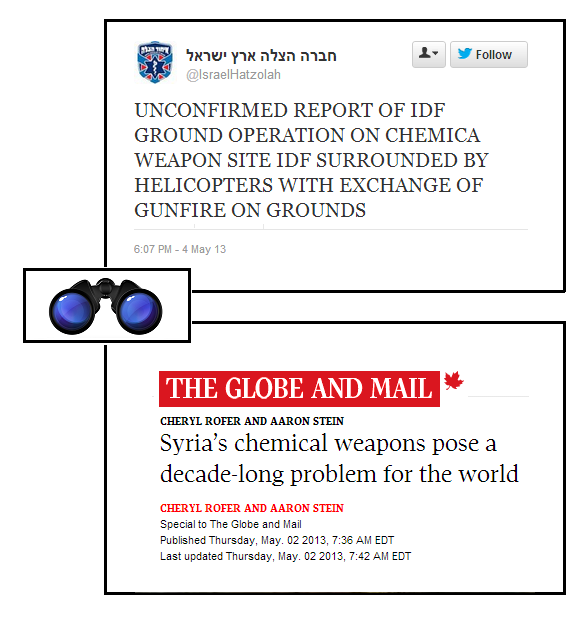
Chevra Hatzolah Israel has the immediacy of Twitter, Cheryl Rofer and Aaron Stein the longer view from the Globe and Mail. Both.

**

Cheryl Rofer, a good friend of this blog, “supervised a team developing supercritical water oxidation for destruction of hazardous wastes, including chemical warfare agents, at the Los Alamos National Laboratory” — bio from the Globe and Mail article. I don’t want to pick and choose excerpts from her piece, I’m certainly no expert on her topic — but as things heat up in Syria, the considerations she describes offer us significant background.

Read her insights as posted two days ago in Syria’s chemical weapons pose a decade-long problem for the world.

**

[ edited 45 mins later to add: ]

Blake Hounshell’s post a few minutes ago for FP, That awkward moment when … Israel launches airstrikes in Syria, begins to bring the two strands of thinking together — Israel attacks, but cautiously…

Syrian state TV is claiming that Israel hit a “research center,” while opposition Facebook pages are saying that several elite units on Mt. Qassioun, overlooking Damascus, were the targets.

Because it’s so difficult, not to mention risky, to destroy chemical-weapons stocks from the air, the next-best thing is to take out Assad’s means of delivering them. And Mt. Qassioun is reportedly where many of the Syrian regime’s best missiles are kept.

That’s a lot less worrisome.

**

As the “fog of war” slowly clears, the longer and slower insights will prove to be the more reliable and enduring.


Switch to our mobile site