zenpundit.com » intelligence

Archive for the ‘intelligence’ Category

Where in the world is Abu Musab al-Suri?

Thursday, September 20th, 2012

[ by Charles Cameron –on the whereabouts of the jihadist thinker, and the importance of careful reading ]
.

For those interested in the question of whether Abu Musab al-Suri has been released by the Syrians, where he is and how he’s doing, this tweet today from Mr. Orangetracker is probably the state of the art:

**

I sat up and took notice of this tweet today, both because I think al-Suri’s whereabouts is and should be a matter of considerable concern and interest — and also because it reminded me of a conversation a day or two back, which began (or at least, those parts that I can see from my own feed began) with a comment from Will McCants on the recently posted Institute for the Study of War report, Jihad in Syria, and led Jane’s analyst Charles Lister to comment that the report “Also concretely claims Al-Suri was released in Feb; that wasn’t confirmed, right?”

The exchange continues:

McCants: i haven’t seen anything credible. but Aaron tracks the story more closely
Aaron Zelin: Credible sources at the forums said al-Suri was released then, but no word on him since.
Raff Pantucci: I wonder if he was ever actually freed tho. maybe a scare story from Syrian intelligence?

I hadn’t particularly noticed the conversation up to this point, but here is where I noticed a tweet from Zelin to Pantucci:

Raff Pantucci is another student of these matters whom I follow. As the discussion continues, he agrees with Zelin’s assessment:

Pantucci: that would make sense. he certainly wouldn’t be on their side if they let him loose at home!
Yassin Musharbash: the thing is that we simply cannot know what kind of state – physically, psychologically and ideologically – he is in
Zelin: Agreed.

**

As a matter of fact, the report did indeed state [p. 15] that Abu Musab al-Suri has been released:

In early February 2012, the Syrian government released Mustafa bin Abdel Qadir Sitt Mariam Nassar, also known as Abu Musab al-Suri. Al-Suri is an important jihadist ideologue and a top al-Qaeda operative, with experience fighting against the Assad regime during the 1979—1982 Islamic Uprising. As the alleged mastermind of the July 2005 London Bombings, Al-Suri had been in Syrian custody since he was allegedly transported there by the CIA six years ago.

But here’s where it gets interesting. In connection with these sentences, the report carries this footnote [# 29]:

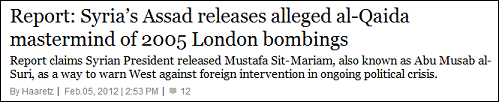
“Syria’s Assad releases alleged al-Qaida mastermind of 2005 London bombings,” Haaretz, February 5, 2012.

Significantly IMO, that footnote omits the first word of the Haaretz headline, which reads:
**

“Report claims Syrian President released” is simply not the same as “Syrian President released”.

On such tiny details are the webs and fogs of misunderstanding often based.

On wearing blinders

Thursday, September 6th, 2012

[ by Charles Cameron — that neither excited hope nor fear nor fixed opinion is a workable basis for sound judgment ]
.

For some reason, this two-year-old tale popped up in my twitter-stream today.

Here’s what Leon Panetta said in response to the CIA report on how the Jordanian AQ operative Dr. Humam al-Balawi managed to get himself invited into the Camp Chapman base in Khost, Afghanistan — despite warning from Jordanian intelligence — where he blew himself up, claiming the lives of seven CIA agents:


.

Isn’t that a bit like saying “The chocolate cake itself may have clouded some of the judgments made here”? You mean, their emotions clouded their judgment, don’t you, Mr Panetta?

On this occasion, the chocolate cake was al-Balawi’s indication that he could lead the CIA to Ayman al-Zawahiri

Links:

Officer Failed to Warn C.I.A. Before Attack
Intelligence: Where Everyone Gets a Trophy

**

And now here’s a companion piece, from today’s publication of a Classified CIA Mea Culpa on Iraq:

Analysts tended to focus on what was most important to us — the hunt for WMD — and less on what would be most important for a paranoid dictatorship to protect. Viewed through an Iraqi prism, their reputation, their security, their overall technological capabilities, and their status needed to be preserved. Deceptions were perpetrated and detected, but the reasons for those deceptions were misread.

**

Intelligence is least intelligent when it’s blindsided by hopes, fears, and unquestioning assumptions.

What are our current blinders?

Inventing Grand Strategy and Teaching Command, The Classic Works of Alfred Thayer Mahan Reconsidered, a review

Tuesday, September 4th, 2012

[by J. Scott Shipman]

Inventing Grand Strategy and Teaching Command, by Jon Tetsuro Sumida

As of August 2012 this is the best non-fiction book I’ve read this year. Professor Sumida brings a potentially dry topic to life making Alfred Thayer Mahan relevant in the process; as indeed, he should. At a mere 117 pages of moderately footnoted text, Sumida provides the reader a grand tour of Mahan’s life work, not just The Influence of Sea Power 1660-1983. Sumida includes the major works of Alfred Thayer Mahan’s (ATM) father Dennis Hart Mahan, as he introduces ATM’s major works, lesser works, biographies, essays, and criticisms.

Sumida begins his chapters with quotes, and weaves his recounting of ATM’s work with musical performance, Zen enlightenment, and naval command; which is quite a combination, but convincing. Of ATM’s “approach to naval grand strategy” he writes:

Mahan believed the security of a large and expanding system of international trade in the twentieth century would depend upon the creation of a transnational consortium of naval power. His handling of the art and science of command, on the other hand, was difficult, complex, and elusive. It is helpful, therefore, to achieve an introductory sense of its liminal character by means of analogy.

This is where musical performance and Zen enlightenment become relevant and instructive. Sumida writes on musical performance:

Teaching musical performance…poses three challenges: improving art, developing technique, and attending to their interaction.

Sumida goes on to illustrate the parallels between learning musical performance and naval command/strategy and the common thread is performing or, “doing it.” He writes that most musical instruction is through the understudy watching demonstrations by the master, but the higher purpose of replicating the master’s work is “to gain a sense of the expressive nature of an act that represents authentically a human persona.” In other words, the development of relevant tacit knowledge, or as I have come to refer to this as “tacit insight.”

Sumida continues with six short chapters that pack a powerful punch and a good introduction to the trajectory of Mahan’s work from the beginning to end. My favorite was Chapter Six, The Uses of History and Theory. In this chapter Sumida deals with complexity, contingency, change, and contradiction, naval supremacy in the Twentieth Century, Jomini, Clausewitz, and command and history. Quite a line-up, but a convincing inventory of Mahan’s influences and how his work remains relevant today. Sumida writes:

Mahan’s role as a pioneer and extender of the work of others has been widely misunderstood and thus either ignored or misused. The general failure to engage his thought accurately is in large part attributable to the complexity of his exposition, the difficulties inherent in his methods of dealing with several forms of contingency, changes in his position on certain major issues, and his contradictory predictions about the future and application of strategic principles…His chief goal, however, was to address difficult questions that were not susceptible to convincing elucidation through simple reasoning by analogy. He thus viewed history less as a ready-made instructor than a medium that had to be worked by the appropriate intellectual tools.. Mahan’s analytical instruments of choice were five kinds of argument: political, political-economic, governmental, strategic, and professional.

The first three were used in grand naval strategy, the latter two with the “art and science of command.” The section of Command and History is particularly relevant given two recent posts, one at the USNI Blog, The Wisdom of a King, by CDR Salamander, and the other in a September 2012 Proceedings article by LCDR B.J.Armstrong, Leadership & Command. Here’s why: Sumida quotes Admiral Arleigh Burke, who latter became Chief of Naval Operations, during WWII. Of “Decentraliztion,” Burke wrote:

…means we offer officers the opportunity to rise to positions of responsibility, of decision, of identity and stature—if they want it, and as soon as they can take it.

We believe in command, not staff. We believe we have “real” things to do. The Navy believes in putting a man in a position with a job to do, and let him do it—give him hell if he does not perform—but be a man in his own name. We decentralize and capitalize on the capabilities of our individual people rather than centralize and make automatons of them. This builds that essential element of pride of service and sense of accomplishment.

The U.S. Navy could do worse than return to this “father” of naval strategy and give his ideas more attention; Professor Sumida’s little book would be a good place to start.

Strongest recommendation—particularly to active duty Navy personnel.

Cross-posted at To Be or To Do.

What eye and mind can reasonably absorb

Friday, August 24th, 2012

[ by Charles Cameron — visual thinking, graphical presentation, the magical number seven plus or minus two, human intelligence ]
.

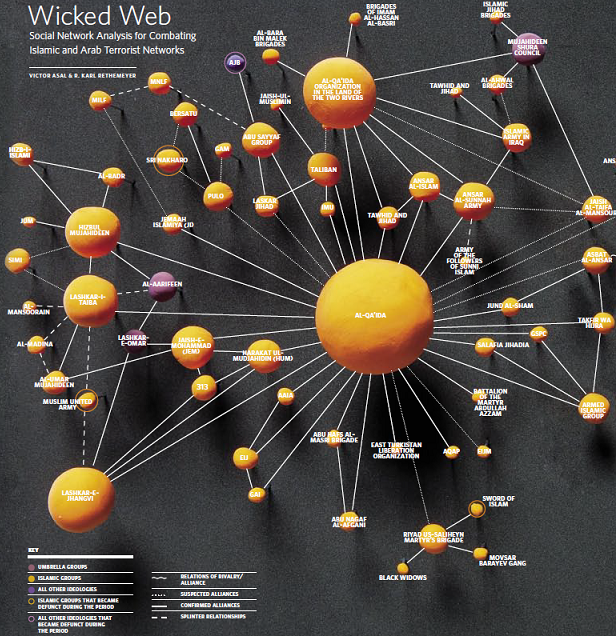
Look:

click image to download pdf & see pp 12-13 for closer, full-size look

Got it? That’s part of a double-page spread from the University of Maryland’s START Program report for 2011:

The National Consortium for the Study of Terrorism and Responses to Terrorism—better known as START – is a university-based research center committed to the scientific study of the causes and human consequences of terrorism in the United States and around the world.

Looking through the rest of the report, I’m tempted to say a snazzier, jazzier magazine I’ve seldom seen!

**

I maintain that’s far nicer to look at, but no more comprehensible than, this gorgeous and justly infamous power point slide:

click image for a closer, full size look

Got that one, too? That was a slide used to help GEN McChrystal understand that war he was fighting.

**

Watson and Crick introduced their 1953 paper in Nature, A Structure for Deoxyribose Nucleic Acid, with these words:

We wish to suggest a structure for the salt of deoxyribose nucleic acid (D.N.A.). This structure has novel features which are of considerable biological interest.

No less witty is the opening of George A. Miller‘s only somewhat less celebrated paper three years later in The Psychological Review, The Magical Number Seven, Plus or Minus Two: Some Limits on Our Capacity for Processing Information:

My problem is that I have been persecuted by an integer. For seven years this number has followed me around, has intruded in my most private data, and has assaulted me from the pages of our most public journals. This number assumes a variety of disguises, being sometimes a little larger and sometimes a little smaller than usual, but never changing so much as to be unrecognizable. The persistence with which this number plagues me is far more than a random accident. There is, to quote a famous senator, a design behind it, some pattern governing its appearances. Either there really is something unusual about the number or else I am suffering from delusions of persecution.

The gist of Miller’s piece (and by gist I explicitly mean the always misleading broad strokes version) is that we can usually manage to hold five to nine chunks of thought in mind at any given time, but that if we want to understand more than that, we need to “chunk” our thoughts in such a way that we think of “seven plus or minus two” items (Miller’s “magical number”) but can peer into any one of them and see it divided into lesser portions which we can also comprehend, in what I’ll call a tree > trunk > limb > branch > twig > leaf arrangement — always remembering that a tree may be part of a forest, and that sometimes ee just can’t see the forest for the trees…

Miller explains chunking succinctly thus:

It seems probable that even memorization can be studied in these terms. The process of memorizing may be simply the formation of chunks, or groups of items that go together, until there are few enough chunks so that we can recall all the items.

Neat, hunh? And he concludes, with another pleasant touch of wit:

And finally, what about the magical number seven? What about the seven wonders of the world, the seven seas, the seven deadly sins, the seven daughters of Atlas in the Pleiades, the seven ages of man, the seven levels of hell, the seven primary colors, the seven notes of the musical scale, and the seven days of the week? What about the seven-point rating scale, the seven categories for absolute judgment, the seven objects in the span of attention, and the seven digits in the span of immediate memory? For the present I propose to withhold judgment. Perhaps there is something deep and profound behind all these sevens, something just calling out for us to discover it. But I suspect that it is only a pernicious, Pythagorean coincidence.

**

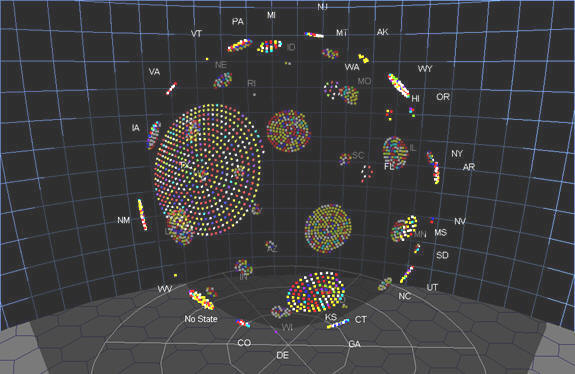
Of course there are high-node graphics programs like Starlight Analytics (from Future Point Systems via Battelle and the Pacific Northwest National Laboratory) which allow you to sample one of a cluster of very similar nodes, or to see where the outliers are and zero in on them…

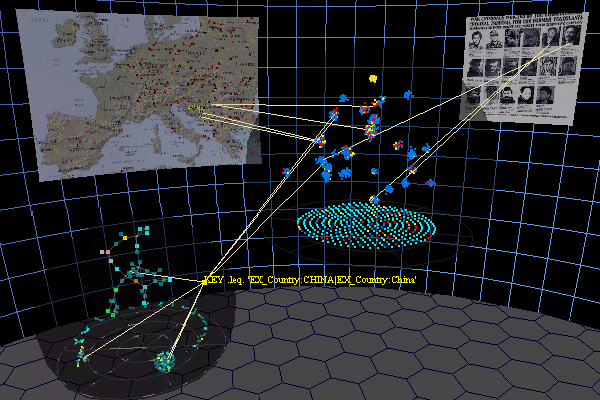
or to focus in on only those nodes connected to one particular name or place on a map:

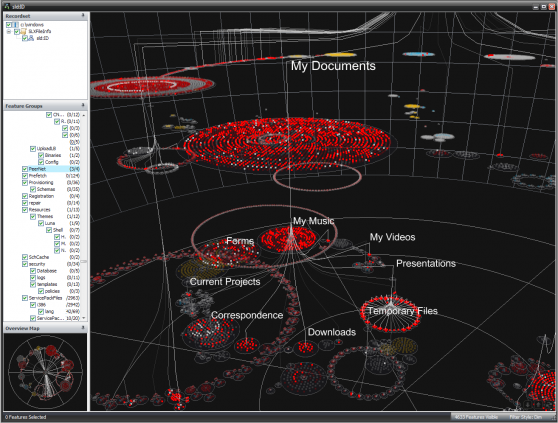
But can you find a file you’re looking for any faster by locating it somewhere in this graphic…

than by using your usual search methods?

So okay, high level analytics like Starlight may be useful for analysts who have the costly software and time to pinpoint and track and zoom and annotate and comprehend, become alarmed or calmed, and respond appropriately.

But people reading that glossy report from the START program? People trying to brief GEN McChrystal from a powerpoint slide?

Seven. Seven plus or minus is your number.

**

Once more, with feeling.

The moral of this tale is that graphical presentations of ideas to explain complexities should generally feature seven plus or minus two nodes, maximum, for eye and mind to consider at any one time, with perhaps an additional three or four that the eye can glide across to, forming a second chunk — thus delivering a maximum of 13 nodes without zooming in.

for the direct communication of major drivers in a complex situation — seven nodes plus or minus two is your optimal number.

**

Ah — but see, I forgot to show you the rest of that first image:

You can handle grasping the import of an image two parts, surely, can’t you?

Okay then — if you can, perhaps you can help me out…

With blinders

Wednesday, August 22nd, 2012

[ by Charles Cameron — light-hearted, but even so, redacted to avoid needless transparency ]
.

No comment.


Switch to our mobile site