zenpundit.com » cultural intelligence

Archive for the ‘cultural intelligence’ Category

One thing leads to an unexpected other

Saturday, August 13th, 2011

[ by Charles Cameron — complex situations, unexpected consequences, analysts’ need for semi-random knowledges ]
.

azelin-tweet.gif

Suppose you’re a Japanese journalist given a news report to write about a tourist who may have contracted an obscure disease on a visit to Zaire. The job seems straightforward enough, you expect your Japanese readers to be sympathetic to the plight of your Japanese tourist subject, you don’t exactly expect your readers to include one Shoko Asahara, guru of Aum Shinrikyo…

But he’s there in the penumbra, reading… as this report from the Center for Counterproliferation Research of the NDU testifies:

In 1992, Aum sent a team of 40 people to Zaire to acquire Ebola. Led by Asahara himself, the team included doctors and nurses. During an outbreak of Ebola in Zaire, a Japanese tourist visiting that country may have contracted the hemorrhagic fever. This report, which received considerable publicity in Japan, apparently inspired Asahara to mount the expedition to Zaire in October 1992. Ostensibly, this trip was intended as a humanitarian mission, called the “African Salvation Tour.” It is not known if Aum actually obtained Ebola cultures. A Japanese magazine quoted a former member of the group, “We were cultivating Ebola, but it needed to be studied more. It can’t be used practically yet.”

One things leads to an unexpected other.

*

Here’s a positive example, one that I heard on the radio yesterday, and nothing to do with terrorism — except perhaps at the cellular level:

You know, the Scottish surgeon George Beatson was walking through the highlands in England, and he heard some shepherds saying, oh, you know, when we remove the ovaries of cows and goats, the pattern — or the breasts of these animals changes; the pattern of milk production changes.

So, Beatson began to wonder, well, what is the — this was a time when no one knew about estrogen. So, Beatson began to wonder, what is the connection between ovaries and breasts? And he said, well, if ovaries are connected to breasts, then maybe they’re connected to breast cancer.

And he took out the ovaries of three or four women with breast cancer and had these spontaneous, had these, not spontaneous, but amazing remissions. And it was — this is the basis for tamoxifen, the drug that actually blocks estrogen, and thereby affects breast cancer.

I mean, who would have thought that walking through and talking to a shepherd in Scotland would affect a billion-dollar drug, which is very, very powerful against breast cancer today?

One thing leads to an unexpected other.  Listen.

*

Back to terror — and what jihadists notice, think about and discuss:

They follow the news.

If the stock-market takes a dive, the folks on the forums know about it — and crow about it.  Because, as bin Laden said, AQ’s policy is one of “bleeding America to the point of bankruptcy, Allah willing, and nothing is too great for Allah.” Inspire magazine calls it “the strategy of a thousand cuts” and claims the “aim is to bleed the enemy to death”.  Daveed Gartenstein-Ross‘ book, Bin Laden’s Legacy, is abundantly clear on that point.

So yes, they follow the news.  So they know about the riots in the UK.

There was an interesting short flurry of tweets on Twitter a couple of days ago, when Will McCants, who monitors such things and runs the Jihadica blog, noted: “Lots of pictures of #londonriots being posted to Ansar jihadi forum” and followed up by quoting a couple of forum comments: “God is burning the ground beneath the feet of the Crusaders” and “We are witnessing this aggressor nation quaking inside and out….collapsing and suffering defeat by the permission of God”.

Jason Burke of the Guardian picked up on McCants’ post and noted, “so now Islamic militants exploiting #londonriots” – and Aaron Zelin of Jihadology chimed in with the tweet I quoted at the top of this post.

The conversation continued for a bit, but it’s Aaron’s comment that I want to focus on, because it makes explicit the kind of seamless weave of knowledge that I’ve been thinking about lately — which makes cross-disciplinary awareness both so necessary and so feasible at this time.  Let’s call it Zelin’s law:

every event and issue will be exploited by every group and ideology on the net.

Here’s my corollary: one thing leads to an unexpected other.

*

So what?

So we need a supersaturated solution of knowledges where decisions are made.

So our analysts need to be speckled specialists — experts with a sufficiently wide and random assortment of additional odd knowledges to be able to frame and reframe and reframe, to shake off any group frame and suggest half a dozen plausible alternatives, to doubt each one of them in turn, to turn to the right people who are themselves specialists in those other framings, to ask, to listen, to hear…

So we also need a supersaturated solution of ignorances — admitted, and inquiring.

*

Here’s Herbert E Meyer on the non-bureaucratic qualities of first-rate analysts:

In normal circumstances people like this would never be willing to take government jobs. Moreover, any agency that hired them would soon be driven nuts by their energy, their drive, their seemingly off-the-wall ideas, their sometimes bizarre work habits, even their tempers.

Sometimes bizarre, eh?  “Embrace the maverick,” Deputy Director for Intelligence Jami Miscik advised.

And by extension, embrace the unexpected — learn to expect it.

Is there a literature of the unexpected? Read it! And I don’t just mean read Nicholas Nassim Taleb‘s Black Swan — I mean, keep tabs on the undertows, read the opposition, read the factional fights within the opposition, read the underclass and upperclass, the radical and the pacific and the merely eccentric and the totally off the wall.  Know that some people believe there is a reptile in Queen Elizabeth II‘s head — and I don’t mean people who hold some variant on Paul MacLean‘s triune brain theory!  Read the ancients as well as the moderns.

Note especially the places where two fields or perspectives or framings overlap — they’re the places where experts can most easily see that each others’ approaches have value.  Cultivate binocular vision — and I mean, vision.

And do all this with a fair amount of randomness, with curiosity.

I happen to study religion, for instance, and splatter myself with other things — epidemiology, for instance, and complexity, and lit crit, and medieval music and plenty more besides — just enough to give a vaguely Jackson Pollock look to my interest in religion.

And Aum Shinrikyo’s attempt to gather samples of the Ebola virus isn’t an epidemiology story, isn’t a new religious movements story — it’s at the intersection, it’s both.

*

How many fields of knowledge can you gossip in for a minute or three? That’s a question with profound implications in terms of networked interactions and collective understanding.

How many languages can you frame your questions in?

Johnston, Gorka and the need for specialist knowledges

Wednesday, August 10th, 2011

[ by Charles Cameron — religious knowledge, foreign policy, military ]

.

Dr. Douglas M. Johnston just posted a piece titled Religion a crucial tool in U.S. foreign policy in the Washington Post’s On Faith blog, and in it he quoted Dr. Sebastian Gorka‘s recent testimony to the HASC Subcommittee on Emerging Threats and Capabilities:

It is very difficult, if not impossible, to provide the contextual knowledge we need to understand and defeat our enemy if we rely solely upon anthropologists and social scientists…. Today our multi-disciplinary analysis of the enemy and his doctrine just as much requires — if not more so — the expertise of the regional historian and theologian, the specialist who knows when and how Sunni Islam split from Shia Islam and what the difference is between the Meccan and Medinan verses of the Koran. We should ask ourselves honestly, how many national security practitioners know the answers to these questions, or at least have somewhere to turn to within government to provide them such essential expertise.

I do appreciate that this was written by Dr Gorka for an audience that needs to keep up to speed on many, many topics.  What dismays me here isn’t the idea that “national security practitioners” should know these things — they should indeed, and should certainly also know specialists who know a great deal more — but that the bar is set so low, “a specialist” being, for that audience, someone “who knows when and how Sunni Islam split from Shia Islam and what the difference is between the Meccan and Medinan verses of the Koran”.

Let’s back up a bit.  Here’s a report on the Senate hearing on the appointment of GEN. Dempsey as Chief of Staff of the U.S. Army.

Gen. Martin Dempsey, tapped by the White House to be the next top military officer, acknowledged Tuesday that he and other senior officers failed to grasp the power dynamics among Islamic-based groups in Iraq.

After the U.S. military toppled the Saddam Hussein-led regime there in 2003, a powder keg erupted that was driven, in large part, by centuries-old power struggles and distrust among Iraq’s various Islamic sects.

It took American civilian and military leaders years to adapt and understand these dynamics, which experts say played a major role in both the length and violent nature of the Iraq war.

Driving the lack of understanding was a tendency of the military to “take five minutes to understand” an issue while immediately spending the next “55 minutes trying to solve it,” Dempsey said during his confirmation hearing before the Senate Armed Services Committee.

Those “five minutes to understand” might get you the basic difference between the Meccan and Medinan suras — but a specialist knows a little more than that, as one can gather from comments Dr Timothy Furnish posted just the other day on his MahdiWatch blog, commenting on Dempsey’s remarks:

One might reasonably wonder whether the US military and intelligence community (not to mention the State Department) truly does, finally, realize the importance of sectarian differences in the Islamic world. For example, the Syrian case pitting the pseudo-Shi`i Alawi rulers against the country’s Sunni majority only recently came to Washington’s attention; neither Libya’s history of Sanusiyah Sufi jihad against occupation, nor Mua`amar al-Qadhafi’s heretical Islamic teachings and rule, has been fully considered or acknowledged by the American government; and there are still commanders deploying to and from Afghanistan who seem blissfully ignorant of the fact that that country is 19% Shi`i (and that a substantial subset of that is not Twelver but Sevener, or Isma’ili, Shi`i).

But that’s one paragraph from a single blog post, and Furnish has written a book — has written, as they say, “the book” on Mahdism.  And that’s just one book, you don’t suppose Furnish’s knowledge is limited to what he managed to compress into a few hundred pages, do you?

Furnish is a specialist — that’s why I read and correspond with him.  I’m a generalist with, I hope, some decent insights into what to watch for and who to read for background — but Furnish is a specialist.

And the solution isn’t to add “specialist” to a checklist, find one on LinkedIn and check it off — the solution is widespread, ongoing conversation among specialists, with the help of generalists, across all silos and disciplinary boundaries, of the sort we try to promote here from time to time… until there are enough people, with enough parts of the puzzle, that we don’t get blindsided by our ignorances.

Ignorances, plural.  Knowledges, plural.

*

This just in…  Dr Furnish’s second book — The Caliphate: Threat or Opportunity? — is now available for pre-order. I hope to review it at some point here on ZP.

Battlefield magic

Tuesday, August 9th, 2011

[ by Charles Cameron — Africa, military, witchcraft, need for analysis ]
.

From a transcript of yesterday’s CNN News Stream: [h/t @Intelwire]

Rebel fighter Mohammed shows me something else he found on the battlefield, what he says are pages of African witchcraft or black magic designed to protect fighters from enemy bullets. Saturday, he says, he got chills when it appeared to work on an armed Gadhafi soldier casually walking in the open.

Mohammed says he and 10 fellow fighters opened fire on the man from 200 meters.

MOHAMMED, REBEL FIGHTER: We tried to shoot him with different guns — Kalashnikov, 14.5 gun, but no one can hit him. And…

HOLMES: He’s out in the open. You’re putting all kinds of weapons at him, including anti-aircraft guns, and you’re not hitting him.

MOHAMMED: We didn’t hit him and he reached the car. He go in the car and go away.

HOLMES: An obviously unnerved Mohammed says he found these writings in another car next to the one the man escaped in.

This isn’t an area that I’ve been tracking in any detail, so I’d welcome further bibliographic suggestions – but two books I ran across recently might be of background interest, Peter Geschiere‘s The Modernity of Witchcraft: Politics and the Occult in Postcolonial Africa and Christopher Taylor‘s Sacrifice as Terror: the Rwandan Genocide of 1994

I’ve mentioned these before, but so might James R Price and Paul Jureidini‘s 1964 Witchcraft, Sorcery, Magic, and Other Psychological Phenomena and their Implications on Military and Paramilitary Operations in the Congo, and Roger D Hughes‘s 1984 Emergency in Kenya: Kikuyu and the Mau Mau Insurrection.

twins.jpg

Magical bullet-proofing as a spiritual theme turns up all over the place. The Ghost Dance shirts of the Lakota were supposed to make their wearers impervious to attack, and similar mythic powers were attributed to Johnny and Luther Htoo [picture credit: BBC], the twins who led God’s Army in Myanmar…

It would be useful to have a cross-cultural study of magical weaponry and protection, no?

2083 — the 36 Stratagems

Wednesday, July 27th, 2011

[ by Charles Cameron — analysis of “deceptive means” in 2083 manifesto / borrowings from Chinese 36 Stratagems ]

.

I don’t know if anyone has commented on this yet, and a quick search proved inconclusive — but section 3.40 of Anders Breivik‘s 2083 manifesto, “Applying deceptive means in urban guerrilla warfare” (pp. 925-930) contains a number of tricks drawn from the Chinese “Thirty-Six Stratagems” – without, I believe, an acknowledgment. These are:

4. Make a sound in the east, then strike in the west
5. Hide a knife behind a smile
6. Sacrifice the plum tree to preserve the peach tree
7. Take the opportunity to pilfer a goat
8. Do not startle the snake by hitting the grass around it
9. Borrow a corpse to resurrect the soul
10. In order to capture, one must let loose
11. Avoid the servant forces and go for the neck of their chiefs
12. Befriend a distant state while attacking a neighbour
13. Replace the beams with rotten timbers
14. Make the host and the guest exchange roles

I imagine there are other readers here more familiar with this material than I, so I’ll just post a few quick notes and express the hope that others will chime in.

*

Breivik doesn’t name it as such, but in fact his first “deceptive means” is the Chinese first stratagem, Deceive the heavens to cross the ocean.  Breivik writes:

Always mask your real goals, by using the ruse of a fake goal that everyone takes for granted, until the real goal is achieved. Tactically, this is known as an ‘open feint’; in front of everyone, you point west, when your goal is actually in the east. By the time everyone realised it, you have already achieved your goal.

Compare the closely similar Wikipedia text accompanying this stratagem:

This stratagem means that you can mask your real goals, by using the ruse of a fake goal that everyone takes for granted, until the real goal is achieved. Tactically, this is known as an ‘open feint’; in front of everyone, you point west, when your goal is actually in the east. By the time everyone realised it, you have already achieved your goal.

Breivik uses the variant Do not startle the snake by hitting the grass around it rather than Stomp the grass to scare the snake which is the primary version in Wikipedia — Wikipedia’s source apparently has both.

Borrow a corpse to resurrect the soul is an interesting stratagem:

Take an institution, a technology, a method, or even an ideology that has been forgotten or discarded and appropriate it for your own purpose. Revive something from the past by giving it a new purpose or bring to life old ideas, customs, or traditions and reinterpret them to fit your purposes.

Isn’t that what Breivik is doing with the Knights Templar?

And lastly, Avoid the servant forces and go for the neck of their chiefs appears to be Breivik’s variant on the Chinese Defeat the enemy by capturing their chief – his wording perhaps influenced by the Qur’an (sura Muhammad) 47.4 “So when you meet in battle those who disbelieve, then smite the necks until when you have overcome them”.  I imagine that’s a verse he’d have encountered often enough.

*

Someone with the appropriate background should do a more thorough job of checking out these particulars, tracking down exactly which text Breivik seems to be borrowing from, etc.  Comments and corrections are welcome.

Plus ça change I

Wednesday, July 20th, 2011

[ by Charles Cameron — backstory of Google+ ]

.

dq-circles.jpg

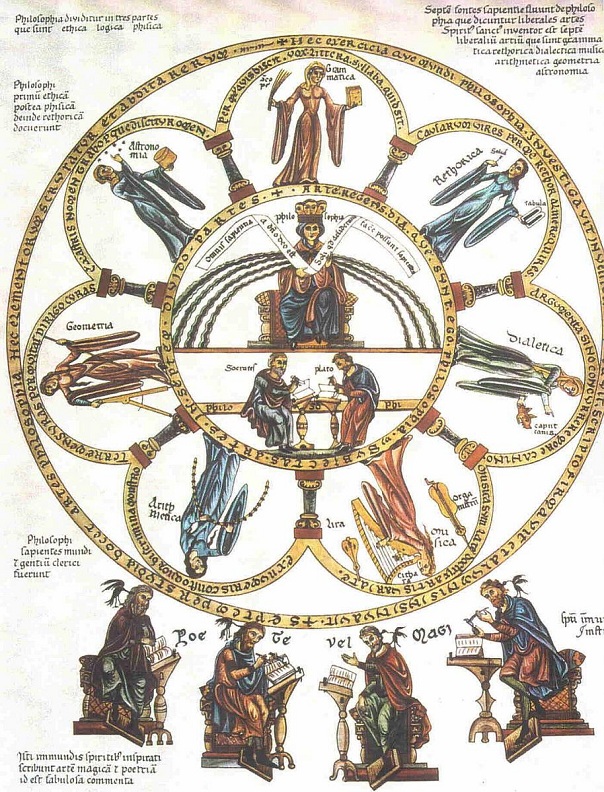
Herrad von Landsberg seems to have corralled seven of his best friends — the Septem Artes Liberales— into his “Hortus deliciarum” on Google+ back in 1180.

Here’s a larger version, for your viewing convenience:liberal-arts-med.jpg


Switch to our mobile site