zenpundit.com » music

Archive for the ‘music’ Category

Of sundry musicians and their moon walks

Sunday, June 12th, 2016

[ by Charles Cameron — a jeu d’esprit, really, because i already have my sunday surprise for this week lined up, and this was too much fun to miss ]
.

I ran across this tweet this morning from Husain Haqqani, former ambassador of Pakistan to the United States and author of Pakistan: Between Mosque and Military and Magnificent Delusions: Pakistan, the United States, and an Epic History of Misunderstanding, currently with the Hudson Institute:

Neil Armstrong? Heard the Islamic Call to Prayer? On the moon?

**

Poets love the moon, almost by definition — the Chinese poet Li Po supposedly drowned while attempting (under the influence) to kiss her face in the Yellow River — so this alleged, though dubious, story was definitely too rich in possibilities for me to ignored. And the Islamic Call to Prayer? According to Nicholas Kristof in the NYT:

Mr. Obama described the call to prayer as “one of the prettiest sounds on Earth at sunset.”

You may or may not agree, but if you want to hear the Call and judge for yourself, you could try listening to one of these videos:

  • https://www.youtube.com/watch?v=mUHDYlJHaOQ
  • https://www.youtube.com/watch?v=otdgbR3yso0
  • https://www.youtube.com/watch?v=T8o6WKTQpMc
  • **

    That’s what led me to my second discovery –one which might be excused by blaming autocorrect, twice, for suggesting that Neil Young — he of the voice, upper panel below — and Louis Arnmstrong — he of the trumpet, lower panel — were each the first man to land on the moon, per (in both cases) NBC.
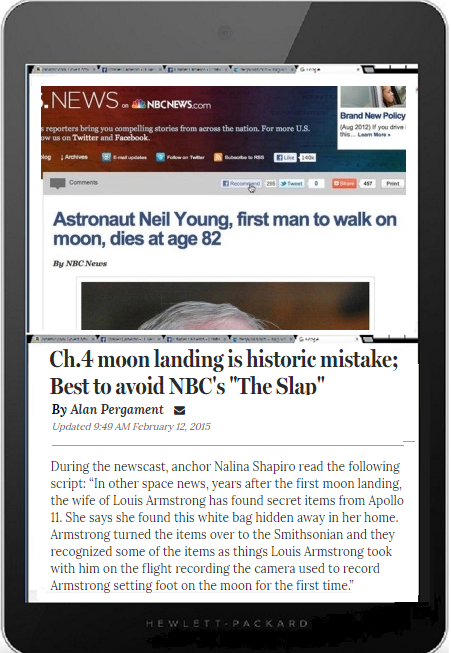
    Tablet DQ 600 at 75 blank Musicians on Moon

    In all fairness, it’s worth noting that other candidates for moon walks include Buzz Lightyear, Lance Armstrong, and Michael Jackson.

    **

    Sources:

  • Mix 104.1, Twitter Confuses Neil Armstrong With Lance and Louis
  • Buffalo News, Ch.4 moon landing is historic mistake; Best to avoid NBC’s “The Slap”
  • **

    None of these mistakes are critical, however, if you believe the late Srila Prabhupada, who introduced Krishna Consciousness to the United States. As someone fascinated by different cosmologies and theologies, I remember reading of Prabhupada’s claim that the moon landing was faked in a California film studio in his magazine some time in the 1970s. No longer having access to the magazine, and looking for confirmation of that memory, I found this page, Srila Prabhupadas statements about the moon landing, of considerable interest:

    Srila Prabhuapda himself said different things at different times. Sometimes he directly said they didn’t go and it was some kind of hoax. And at other times he said they didn’t go to the moon because they didn’t experience the higher dimensional nature of the moon planet, which is a rational way to harmonize the Vedic perspective with the idea of three dimensional space travel. At other times he just said the whole idea was foolish and a waste of money. He saw material space travel as a foolish attempt to reach higher dimensions which can only be reached by yogic practice.

    Bear in mind too that both Joseph Smith and L Ron Hubbard also taught their followers about significant planets that do not form part of the standard astronomical account of deep space — or the heavens, in other words.

    And Charles Williams — the brilliant Dante scholar, Arthurian poet, novelist, theologian of Romantic Love, and friend of JRR Tolkien and CS Lewis — offers a striking near-contemporary Christian example of the genre in the opening paragraph of his book, The Descent of the Dove: A Short History of the Holy Spirit in the Church.

    The beginning of Christendom, is, strictly, at a point out of time. A metphysical trigonometry finds it among the spiritual Secrets, at the meeting of two heavenward lines, one drawn from Bethany along the Ascent of the Messias, the other from Jerusalem against the Descent of the Paraclete. That measurement, the measurement of eternity in operation, of the bright cloud and the rushing wind, is, in effect, theology.

    See also my post, A metaphysical trigonometry.

    Considering Viv, Wolfram Language, Syntience, and the GBG

    Wednesday, June 8th, 2016

    [ by Charles Cameron — expanding the computable to include qualitative ideation ]
    .

    Let’s start with Viv. It looks pretty phenomenal:

    That video is almost exactly a month old, and it’s pitched at “the universe of things” with a marked tilt towards e-commerce. Fair enough.

    **

    It’s instructive to compare it with Wolfram Language, although here I’ve had to go with a video that’s a couple of years old:

    Stephen Wolfram, the creator of both Mathematica and Wolfram Alpha, is focused on the world of numbers — and incidentally, that includes graphs of the sort I’ve been discussing in my series here On the felicities of graph-based game-board design, as you can see in the video above.

    It will be interesting to see how the two of them — Viv and Wolfram — interact over time. After all, one of the purposes of these lines of development is to dissolve the “walled gardens” which serve as procrustean beds for current thinking about the nature and possibilities of the web. Do these two gardens open to each other? If so, why? If not, why not?

    **

    I’ve talked enough for my purposes about AlphaGo and it’s narrowly focused though impressive recent triumph, and the wider picture behind it, as expressed by Monica Anderson — and tying the two together, we have this video from Monica’s timeline, Bob Hearn: AlphaGo and the New Era of Artificial Intelligence:

    Bob Hearn: AlphaGo and the New Era of Artificial Intelligence from Monica Anderson on Vimeo.

    Monica’s Syntience, it seems to be, is a remarkable probing of the possibilities before us.

    **

    But I’m left asking — because Hermann Hesse in his Nobel-winning novel The Glass Bead Game prompts me to ask — what about the universe of concepts — and in particular for my personal tastes, the universe of musical, philosophical, religious and poetic concepts. What of the computational mapping of the imagination?

    My question might well have large financial implications, but I’m asking it in a non-commercially and not only quantitative way. I believe it stands in relationship to these other endeavors, in fact, as pure mathematics stands in relation to physics, and hence also to chemistry, biology and more. And perhaps music stands in that relationship to mathematics? — but I digress.

    If I’m right about the universe of concepts / Glass Bead Game project, it will be the most intellectually demanding, the least commercially obvious, and finally the most revelatory of these grand-sweep ideas..

    From my POV, it’s also the one that can give the most value-add to human thinking in human minds, and to CT analysts, strategists, journos, educators, therapists, bright and playful kids — you name them all!

    Seeing it in terms of counterpoint, as Hesse did — it’s the virtual music of ideas.

    The Cat and the Database

    Saturday, May 28th, 2016

    [ By Charles Cameron — of knotted cords, corporal punishment and external memory ]
    .

    Tablet DQ 600 quipu cat-o'nine-tails 75

    **

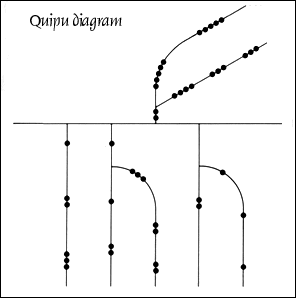
    I have long toyed with the idea of the Quipu as a variant HipBone game-board, as exemplified here:

    QuipuBoard

    I hadn’t until now considered the cat-o’-nine-tails in the same light.

    **

    This particular ramble began when I saw this tweet:

    **

    Reading that tweet set me wondering, not for the first time, what punishments were like in the Royal Navy, say 150 or 200 years ago — not so very many generations in the grand torrent of time.

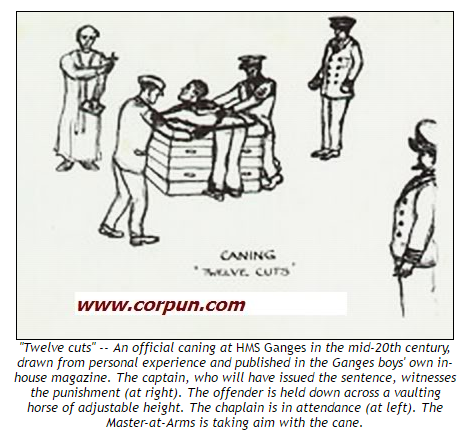
    I hail from a Royal Naval family, and hadn’t until today realized quite how recently fierce corporal punishment had been a part of RN training. This image shows the punishment known as Twelve Cuts administered on HMS Ganges, as recalled from his own early years by the singer Jimmy Lee of the Edge of Chaos Orchestra:

    Corporal Punishment Jimmy Lee HMS Ganges

    A few pertinent details:

    Before receiving his punishment, the young man would be given a medical inspection (“the boy’s buttocks are examined and his general physical condition observed” — Admiralty, 1950). He was then marched to the ship’s tailor to be fitted into a pair of extra-thin tropical-weight white cotton duck trousers, with — at least on HMS Ganges — no underwear allowed. (The Admiralty wrote in 1950 that the latter provision “allows the strokes of the cane to be as painful as need be”. They seem not to have been following their own rules, because the King’s Regulations in 1943 had amended the wording to “Caning on the breech, duck trousers with pants being worn”, but perhaps this was intended to apply only to seagoing ships and not the training ships.)

    Perhaps some idea of the fruits of such training can be found in this impressive video of Ganges

    :

    **

    That image of the “cuts” brings back sore memories.. though my own treatment was far more lenient.

    In my own youth, I was caned as early as age 6 and as late as age 17, the latter beating administered with sincere expressions of regret by my housemaster, the great archaeologist of the Assassins’ castles, Maj. Peter Willey. I’d admitted to doing the (London) Times crossword puzzle in the time allotted for my maths homework, and school regulations left him with no option — I had no option, either.

    Six with a bamboo cane was the worst I suffered, so I can barely imagine what twelve cuts, let alone a hundred lashes with a cat-o’-nine-tails, would be like.

    Discipline, lad: chin up.

    **

    Image sources:

  • Wikimedia, Cat-o’-nine-tails
  • Wikimedia, Quipu
  • I’m no historian, so cannot vouch for the quality of these materials — but my readings today included:

  • Roger Davies, Stringing together a database
  • C. Farrell, Corporal punishment in the Royal Navy
  • Edge of Chaos Orchestra, Jimmy Lee bio
  • Jimmy Lee – The Runaway, Naval Punishment
  • EyeWitness to History, A Flogging at Sea, 1839
  • On the narrative arc

    Monday, May 23rd, 2016

    [ by Charles Cameron — a recent Wapo example of how history gets bent (ever so slightly) out of shape to serve narrative ]
    .

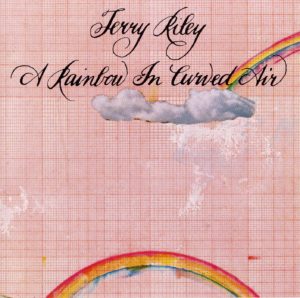
    Riley Rainbow in Curved Air
    One of the universal arcs, and a personal favorite

    **

    Story-telling shapes awareness.

    Yesterday’s Washington Post has an article titled Patriots at the gate: The Americans preparing for battle against their own government. It’s an interesting overview, but I’m not interested in discussing the merits or demerits of the Patriot Movement, Southern Poverty Law Center, Oath Keepers, Waco, Ruby Ridge, Oklahoma City, the Bundy Ranch, or Malheur — what interests me is the way the story is told.

    Here’s the section dealing with one participant:

    Across the family-style table, Alex ­McNeely, 25, a drywaller and “avid YouTuber,” said he became interested in the patriot movement online and joined the group to feel that he was helping to defend the country.

    “There’s this D.C. mentality that if you stand up for your rights, you’re dangerous and anti-government,” said McNeely, who has an AK-47 assault rifle tattooed on his forearm. “But if I’m denied my rights, what else can I do? Am I just going to stand there and take it, or am I going to do something?”

    In the Constitutional Guard, McNeely said: “I feel what we do is stand up for people who don’t have the means to stand up for themselves. I have an overwhelming desire to help people.”

    They have passed out more than 2,000 pocket-size copies of the Constitution that Soper said he bought for $500, sent food and clothes to victims of forest fires in Washington state and Oregon and given Christmas presents to more than three dozen children in need.

    McNeely considered joining the military when he graduated from high school, but he turned 18 the month Obama was elected in 2008, and, because of Obama’s “socialist” policies, “I wasn’t going to accept him as my commander in chief.”

    “I don’t like that he wants to fundamentally change America,” McNeely said.

    **

    The writer is Kevin Sullivan, a WaPo Senior correspondent, and I think we can safely assume he knows his trade. My interest focus on the sentence:

    “There’s this D.C. mentality that if you stand up for your rights, you’re dangerous and anti-government,” said McNeely, who has an AK-47 assault rifle tattooed on his forearm.

    Sullivan has already given his opening identification of McNeely —

    Across the family-style table, Alex ­McNeely, 25, a drywaller and “avid YouTuber,” said he became interested in the patriot movement online and joined the group to feel that he was helping to defend the country

    — that’s fair enough, and the bit about the “AK-47 assault rifle tattooed on his forearm” could have gone in there, or been added to the graph:

    McNeely considered joining the military when he graduated from high school, but he turned 18 the month Obama was elected in 2008, and, because of Obama’s “socialist” policies, “I wasn’t going to accept him as my commander in chief.”

    where the topic is his consideration of “the military” — but no, Sullivan posts it neither where he’s introducing McNeely nor where he’s talking about his thoughts about the military, but in the graph discussing the Patriot Mov ement ideals as McNeely describes them — see, once again:

    “There’s this D.C. mentality that if you stand up for your rights, you’re dangerous and anti-government,” said McNeely, who has an AK-47 assault rifle tattooed on his forearm.

    **

    Sullivan wants the irony. He’s making a juxtaposition-with-purpose — long-time readers here will know that juxtaposition as a rhetorical device is a keen interest of mine — he’s linking the movement’s ideals with the AK-47 tattoo to add an inflection of irony.

    It’s a tiny point — no more than an inflection — but it’s one that I note in the same way I noted the non-appearance of bin Laden‘s Qur’anic epigraph in media versions of a significant speech, in my post Close reading, Synoptic- and Sembl-style, for parallels, patterns. I don’t happen to share McNeely’s worldview, nor that of bin Laden, but I am deeply interested in the ways the media portray matters of substance and nuance. I am interested in “narrative”.

    We’ve all heard MLK’s quote, “somehow the arc of the moral universe is long but it bends toward justice.” The arc of narrative has another aim: it bends towards “good reading” — and if the curve bends fast enough it will spiral ever more lightly and less helpfully in, and we wind up with “click bait”. I know this, because I practice my own version of the dark (and sometimes, brilliantly illuminating) art of writing.

    **

    There’s a lot more to say about narrative, and the various meanings it now has.

    One of my own interests is the way in which we think a narrative can be spun out of words and images (aka “propaganda”), when facts, grounded realities, history may, as they say, tell a different tale — and facts may speak louder than words. In that sense, if we need a new narrative, we may need a new behavior, a new policy, a new strategy implemented, to speak it.

    What interests me here though, getting back to the WaPo piece and McNeely, is how telling a story in a way that makes it a “good read” influences a narrative arc that is, significantly, also the arc of “the first draft of history”.

    That Bach Chaconne

    Sunday, May 8th, 2016

    [ by Charles Cameron — JS Bach in Palmyra, in the DC Metro, and variously on YouTube ]
    .

    I have to applaud Putin and the Russians for bringing the full orchestra of the Mariinsky Theater from St Petersburg to Palmyra now that the Islamic State has departed, with added kudos for choosing Bach‘s towering Chaconne from his Partita No. 2 in D minor, BWV 1004 as one of three works to be played there — by the Tchaikovsky Competition winning soloist Pavel Milyukov:

    As I say, I applaud the gesture. OTOH, British Foreign Secretary Philip Hammond, according to Breitbart, called the event “a tasteless attempt to distract attention from the continued suffering of millions of Syrians” and said it “shows that there are no depths to which the regime will not sink.”

    **

    This may not be the greatest performance of that work musically, but the work itself is extraordinary. Johannes Brahms said of it:

    On one stave, for a small instrument, the man writes a whole world of the deepest thoughts and most powerful feelings. If I imagined that I could have created, even conceived the piece, I am quite certain that the excess of excitement and earth-shattering experience would have driven me out of my mind.

    **

    It was famously this Chaconne that violinist Joshua Bell played — twice — with his violin case open to receive tips, in DC’s L’Enfant Plaza metro station, during a 45 minute anonymous session in which he netted $32. $32 and change, for a man whose upcoming performance with the National Symphony Orchestra at DC’s Kennedy Center (February 11, 2017) is ticketed at $216 or $223, depending on how well seated you wish to be…

    Here’s the poorly recorded, hidden videocam account of the second of those performances, which starts at about the 30’15” mark:

    Gene Weingarten‘s description of the event in the Washington Post, Pearls Before Breakfast, won the Pulitzer..

    **

    For the fullest musical appreciation, here is that same Joshua Bell playing the Chaconne in 2014 in the DeLaMar Theater, Amsterdam:

    Hillary Hahn, also superb:

    The no less beautiful Hélène Grimaud, playing the Busoni transcription for piano:

    And last, violinist Christoph Poppen plays the Chaconne, with added chorale motifs as reconstructed by violinist turned musicologist Helga Thoene sung by the Hilliard Ensemble — the culmination of the group’s celebrated album, Morimur:

    Post-modern adaptation, or quintessential Bach? Either way, I find the entire project enthralling.


    Switch to our mobile site