zenpundit.com » music

Archive for the ‘music’ Category

Sunday surprise, what can happen to music

Monday, May 13th, 2019

[ by Charles Cameron — Aretha to rabbinic wisdom via N’Orleans — five versions of the one great song — with a Mother’s Day greeting to all Marthas and all Marys ]
.

Consider this song as sung by the awesome Aretha Franklin:

Here’s the story of Mary and Martha, as John’s Gospel tells it [John 40: 38-42]:

Now it came to pass, as they went, that he entered into a certain village: and a certain woman named Martha received him into her house. And she had a sister called Mary, which also sat at Jesus’ feet, and heard his word. But Martha was cumbered about much serving, and came to him, and said, Lord, dost thou not care that my sister hath left me to serve alone? bid her therefore that she help me. And Jesus answered and said unto her, Martha, Martha, thou art careful and troubled about many things: But one thing is needful: and Mary hath chosen that good part, which shall not be taken away from her.

You might say that Martha is the mother of service, and Mary the mother of devotion: they are equally celebrated in the church, yet Mary has the better part.

Wonderful, then, to encounter the same song as played and sung by N’Orleans’ own Theresa Andersson:

That’s the extraordinary creative re-creation I was wanting to share with you.

**

The Parting of the Waters [Exodus 14: 21-29]:

And Moses stretched out his hand over the sea; and the Lord caused the sea to go back by a strong east wind all that night, and made the sea dry land, and the waters were divided. And the children of Israel went into the midst of the sea upon the dry ground: and the waters were a wall unto them on their right hand, and on their left.

And the Egyptians pursued, and went in after them to the midst of the sea, even all Pharaoh’s horses, his chariots, and his horsemen. And it came to pass, that in the morning watch the Lord looked unto the host of the Egyptians through the pillar of fire and of the cloud, and troubled the host of the Egyptians, And took off their chariot wheels, that they drave them heavily: so that the Egyptians said, Let us flee from the face of Israel; for the Lord fighteth for them against the Egyptians.

And the Lord said unto Moses, Stretch out thine hand over the sea, that the waters may come again upon the Egyptians, upon their chariots, and upon their horsemen. And Moses stretched forth his hand over the sea, and the sea returned to his strength when the morning appeared; and the Egyptians fled against it; and the Lord overthrew the Egyptians in the midst of the sea.

And the waters returned, and covered the chariots, and the horsemen, and all the host of Pharaoh that came into the sea after them; there remained not so much as one of them. But the children of Israel walked upon dry land in the midst of the sea; and the waters were a wall unto them on their right hand, and on their left.

Wait: there’s a curious — and beautiful — counterpoint to this story in rabbinic lore:

The Talmud teaches us that on the night that the Egyptian army drowned in the Red Sea, the first true moment of freedom for the Jews fleeing Egypt, God refused to hear the angels sing their prayers, and said “my creations are drowning in the sea, and you will sing songs?”

**

Appendix:

We could also take — if you have time to join me — another path through that song.

The Fisk Jubilee Singers:

Mary’s there, but no Martha. That’s the earliest recording of the song that survives.

Then there’s The Swan Silvertones:

Mary don’t you weep — Martha don’t have to moan — it’s been decided that Mary of the song — who might be the sister of Moses — is, or is also, Mary the sister of Martha..

And let’s close with Take-6:

**

Sources:

  • Jerry Zolten, “Oh Mary Don’t You Weep”–The Swan Silvertones (1959)
  • Wikipedia, Mary Don’t You Weep
  • Art & Theology, “Oh Mary, Don’t You Weep”: Death, Resurrection, and the New Exodus
  • Some end in ashes, some wind up in stained glass

    Sunday, May 12th, 2019

    [ by Charles Cameron — and some, high lamas, emanations of Avalokiteshvara, become poets of the erotic.. ]
    .

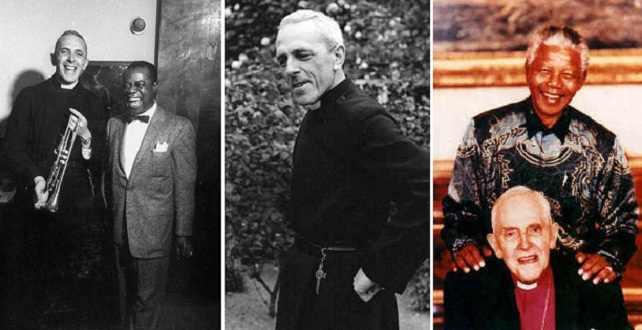
    You know my early mentor Fr Trevor Huddleston CR? I posted three photos of him here, one with Louis Armstrong and a trumpet, one with Nelson Mandela, and one exactly as I knew and now remember and honor him:

    Well, today I saw for the first time an image of the stained glass window dedicated to him in Lancing College chapel:

    For more on Fr Trevor, see The Life of Trevor Huddleston, Makhalipile (the Dauntless One)

    Mandela said of him:

    Father Huddleston was a pillar of wisdom, humility and sacrifice to the legions of freedom fighters in the darkest moments of the struggle against apartheid.

    His fearlessness won him the support of everyone. No one, neither gangster, tsotsi nor pickpocket would touch him. Their respect for him was such that they would have tried – and if they did it could have cost them their lives. His enormous courage gave him a quality that commanded the respect of the place

    and:

    No white person has done more for South Africa than Trevor Huddleston.

    He was a giant.

    **

    All of which got me thinking about stained glass as an alternative destination to ashes..

    Desmond Tutu was another whose life was decisively influenced by Fr Trevor — and he too can be found in stained glass:

    MaryAnn Randolph writes:

    This, in St. Mark’s, Minneapolis, is what is called the Peacemaker’s Window. In this magnificent stained glass you will find: Mother Theresa of Calcutta, Dr. Martin Luther King, Jr., Archbishop Tutu, Mahatma Gandhi, the Dalai Lama and many others.

    Giants, all — and inspirations, inviting us to join them!

    **

    Ah, Gandhi-ji and the Dalai Lama — it delights me to see stained glass extending to peacemakers regardless of their religious affiliations!

    I’ll leave you with an image of Green Tara, female Buddha to whom the “Great Fifth” Dalai Lama — who unified Tibet, established Lhasa as its capital, and worked to bring together the various lineages of Tibetan Buddhism together with the earlier shamanic Bon tradition — was devoted:

    The Dalai Lama himself, in each of his incarnations, is considered an emanation of the Buddha of Compassion, Avalokiteshvara.

    **

    It was the Sixth, beloved successor of the Great Fifth, who was the rascal poet, writer of such gently erotic verses as:

    This white bow in its cloth cover,
    On whom shall I bestow it?
    I will place it gently inside
    My lover’s tiger-skin quiver.

    Ah, but he’d be hard to capture in stained glass —

    I’ll leave you with him and his compassion, and with the Love Songs of the Sixth Dalai Lama.

    Enjoy! Delight!

    Christian, Piano-playing, ISIS-sympathizing terror

    Friday, May 3rd, 2019

    [ by Charles Cameron — it’s a good and bad speckled universe ]
    .

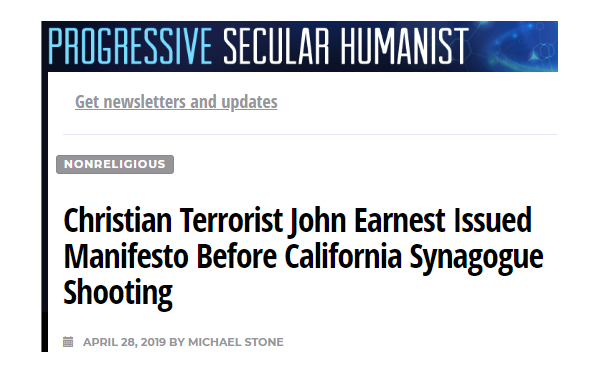
    Christian terrorist?

    Both words, Christian and terrorist, need examining, but they’re not the wrong words, nor the right ones. Also, note (in big print) that this is the view from a Progressive, Secular, Humanist perspective — those three words are also worth pondering.

    Context, context, context, as the realtors would say if they were selling attention-space..

    **

    To give you some context, then, let’s consider these terrorist killings with religious targets:

  • The Gurdwara (Sikh temple), Oak Creek, WI, 2012
  • Emanuel African Methodist Episcopal Church in Charleston, NC, 2015
  • The Tree of Life and New Light synagogues in Pittsburgh, PA, 2018
  • The Al Noor and Linwood Mosques in Christchurch, NZ, 2019
  • and these religions with affiliated terrorists:

  • Jewish religious terrorism
  • Christian terrorism
  • Islamic terrorism<
  • Saffron terror
  • Morals:

  • You can be hated on account of your religion
  • You can hate on account of your religion
  • Your co-religionists may have reason to feel you are outsiders
  • The proportions of violent to other believers varies between times, religions
  • Religions & groups may differ on where injustice requires redress
  • Listening, which involves humility, is a necessary feature of compassion.
  • There’s plenty of room for nuance here — as fractal theorists would say, the world is self-similar at different scales — or at the poet GM Hopkins puts it, “dappled”.

    **

    Let’s peer a little closer:

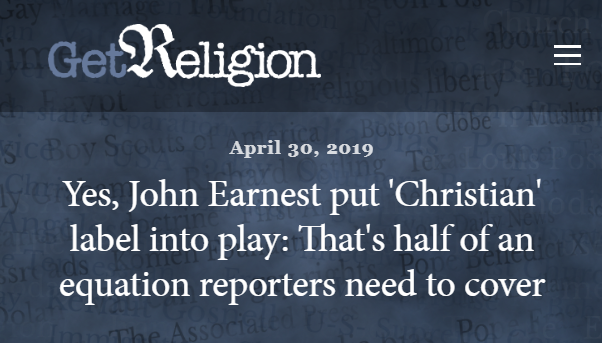
    Half the equation? Presumably terrorist would be the other half?

    Uh-oh: piano-playing and nursing…

    That’s not at all what I was expecting..

    Sources:

  • Prog Sec Hum, Christian Terrorist John Earnest Issued Manifesto
  • GetReligion, Yes, John Earnest put ‘Christian’ label into play
  • Daily Beast, Synagogue Shooting Suspect, a Piano-Playing Nursing Student
  • **

    To repeat the point that it’s not just one religion that’s involved either in violence or as a target, let’s switch religions — these things are simultaneous rather than separate:

    Islamic Terrorist?

    Source:

  • Metro, US Army vet Mark Domingo ‘plotted Isis bomb attack
  • A US army vet turned ISIS-supporter attacking neo-Nazis? That’s just one more curious instance of how these hard-to-imagine cookies crumble..

    **

    To return to our Christian:

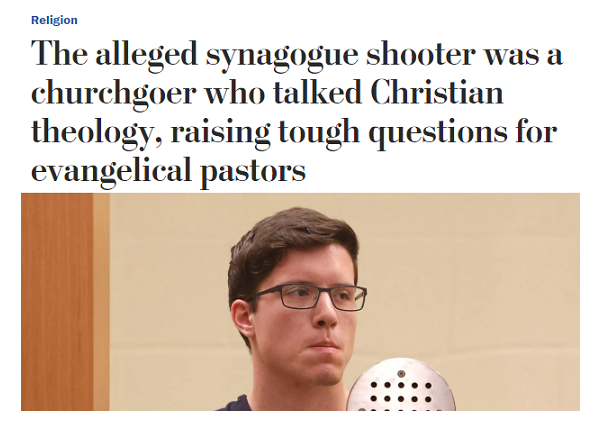
    Before he allegedly walked into a synagogue in Poway, Calif., and opened fire, John Earnest appears to have written a seven-page letter spelling out his core beliefs: that Jewish people, guilty in his view of faults ranging from killing Jesus to controlling the media, deserved to die. That his intention to kill Jews would glorify God.

    Days later, the Rev. Mika Edmondson read those words and was stunned. “It certainly calls for a good amount of soul-searching,” said Edmondson, a pastor in the Orthodox Presbyterian Church, a small evangelical denomination founded to counter liberalism in mainline Presbyterianism. Earnest, 19, was a member of an OPC congregation. His father was an elder. He attended regularly. And in the manifesto, the writer spewed not only invective against Jews and racial minorities but also cogent Christian theology he heard in the pews.

    That’s WaPo‘s opinion, and we don’t know how strong WaPo‘s theological understanding is.

    This pastor, however seems to me to get it right:

    “When there’s an act of ‘radical Islamic terror’ — somebody claiming they’re motivated by their Islamic faith — if we’re going to call upon moderates in Muslim communities to condemn those things, we should do the same. I wholeheartedly, full stop, condemn white nationalism,” said Chad Woolf, an evangelical pastor in Fort Myers, Fla., who was one of the first to join in heated debate online about how the attack reflects on evangelicalism. “We should recognize that somebody could grow up in an evangelical church, whose father was a leader, and could somehow conflate the teachings of Christianity and white nationalism. We should be very concerned about that.”

    Okay, I have now read the complete manifesto, and if WaPo‘s headline writers think it contains theology, WaPo is paying less than ideal attention. The manifesto quotes scriptures — Matthew 27:24-25, John 8:37-45, 1 Thessalonians 2:14-16, Revelation 2:9, Revelation 3:9 and one other verse of which he says “I forget where in the Bible this verse comes from, but it’s definitely in there” — but quoting (cherry-picking) scripture isn’t theology, it’s quoting scripture. And there’s one paragraph that might serve as an intro paragraph in some moderately bright student paper on Protestantism:

    To my brothers in Christ of all races. Be strong. Although the Jew who is inspired by demons and Satan will attempt to corrupt your soul with the sin and perversion he spews—remember that you are secure in Christ. Turn away from your sin. Not because it is required for your salvation—for nobody save Christ can merit heaven based on his own works—but rather out of gratitude for the gift of salvation that your God has given you. Always remember that it is God that is keeping you alive and in faith. All sin stems from the arrogant belief that one does not need God. Satan was so prideful that he actually truly believed (that he, a created being) could overthrow the Ancient of Days—the Creator of all in existence. Satan inspired this rebellion among humanity. Christ alone is the only source of life. Know that you are saved in Christ and nothing—not death, nor torture, nor sin—can steal your soul away from God.

    All else is ugliness, and I won’t quote.

    What’s more lovely? By all accounts, the shooter’s father ..

    Sources:

  • WaPo, The alleged synagogue shooter was a churchgoer who talked Christian theology
  • Reddit, I knew John T. Earnest, the shooter of the Chabad synagogue
  • Some chyrons &c as my chyrons series draws towards a close..

    Wednesday, May 1st, 2019

    [ by Charles Cameron — this post has been lingering while I’ve been slowly adding elements, and with some Bach now firmly in place I think it’s past time to drop it into the slip-stream ]
    .

    This one’s priceless in a Matrioshka, Through the Looking Glass kind of way:

    Can the Actor Who Ruled Ukraine on TV Do It in Real Life?

    File it under life imitates art?

    **

    I’m tired of chasing chyrons. If I see stunners, I may bring them here, but I’ll be concentrating on other things.

    **

    I was surprised to overhear the words “perfect sacrifice” in a baseball commentary my room-mate was attendinmg to, but apparently the phrase fits in the context of bunts – what those are, I still don’t know – as well as they do in the context of the Eucharistic liturgy, often considered, eg by Pope John Paul II , as a perfect sacrifice of praise..

    What can I say? My ears perked up.

    **

    Three levels of beauty for your illumination:

    Lidia Ksiazkiewicz

    Lidia Ksiazkiewicz at her instrument:

    Lidia Ksiazkiewicz plays Bach’s Fantasia in G major, BWV 572, on the great organ of Laon cathedral in 2012:

    **

    This one’s an almost ouroboros — Chris Matthews on Hardball:

    The Democrats don’t know how to play hardball>>

    **

    From the poets — Walt Whitman:

    both in and out of the game, and watching

    Life, the game, yes. And Shakespeare:

    The southern wind
    Doth play the trumpet to his purposes,
    And by his hollow whistling in the leaves
    Foretells a tempest and a blustering day.

    Marvelous. Those unexpected words can break through the strands of conventional thought that spin their deadly shroud about us every day.

    **

    “IT’S GOING TO BE A GUERRILLA WAR”: THE SANDERS LEFT OPENS FIRE ON BIDEN

    Within a few hours of Joe Biden’s official presidential announcement, the Justice Democrats, the progressive group behind Alexandria Ocasio-Cortez’s rise to power, brought out the flamethrower.

    **

    So as you see, this is the sort of amount that would have made the first quarter of a chyrons series post a couple of weeks ago, and today it’s all I’ve collected in a week or so. I’m really cutting back on this game, and will be concentrating on other areas..

    **

    Let’s close here with this trio:

    That’s the rough number.

    That’s just this last week.

    And here’s the exact figure, if there’s no margin of error, which seems unlikely..

    I’m leaving some terrorism screen-grabs for a later post.

    The Mercy, logic, the model digitized, the glass, the music survives

    Sunday, April 21st, 2019

    [ by Charles Cameron — logic, the arts, and technology offer an Easter, resurrection corrective, philosophically speaking, to the ruin of the cathedral of Notre Dame ]
    .

    For the terrible fire that consumed so much of Notre Dame de Paris this week, grief is great. Here, I wish to recall some of the ways in which the essence of the great cathedral has been saved.

    Above, Piero della Francesca‘s Madonna della Misericordia. Our Lady of Mercy, for whom the cathedral was named, continues to shelter us all..

    **

    Perhaps the most extraordinary, as well as the most abstract, form of Notre Dame to survive fire, war, and the French Revolutionary idea — to replace Mary with the goddess Reason enthroned in her place — is the logic embedded in the theology that accompanied its building and — lex orandi, lex credendi — the worship within it, for which purpose it was designed and built

    The American philosopher CS Peirce was among the first to propose a kinship between Gothic architecture and the logic of the Paris schoolmen:

    Art felt the spirit of a new age, and there could hardly be a greater change than from the highly ornate round-arched architecture of the twelfth century to the comparatively simple Gothic of the thirteenth. Indeed, if any one wishes to know what a scholastic commentary is like, and what the tone of thought in it is, he has only to contemplate a Gothic cathedral. The first quality of either is a religious devotion, truly heroic. One feels that the men who did these works did really believe in religion as we believe in nothing. We cannot easily understand how Thomas Aquinas can speculate so much on the nature of angels, and whether ten thousand of them could dance on a needle’s point. But it was simply because he held them for real. If they are real, why are they not more interesting than the bewildering varieties of insects which naturalists study; or why should the orbits of double stars attract more attention than spiritual intelligences?

    Erwin Panofsky‘s work, Gothic Architecture and Scholasticism, is the central presentation of the parallels. Pierre Bourdieu, who translated Panofsky into French, characterizes the work:

    The parallelism between the development of Gothic art and the development of scholastic thought in the period between about 1130–1140 and about 1270 cannot be brought out unless one “brackets off phenomenal appearances” and seeks the hidden analogies between the principles of logical organization of Scholasticism and the principles of construction of Gothic architecture. This methodological choice is dictated by the intention of establishing more than a vague “parallelism” or discontinuous, fragmentary “influences”. Renouncing the semblances of proof which satisfy intuitionists or the reassuring but reductive circumstantial proofs which delight positivists, Panofsky is led to identify the historical convergence which provides the object of his research with a hidden principle, a habitus or “habit-forming force”.

    **

    Rachel Donadio, Witnessing the Fall of Notre-Dame for the Atlantic, depicts the ruin of the cathedral with incredulityn–

    How could Notre-Dame be burning? How could Notre-Dame, which had survived for eight centuries—survived plague and wars of religion, survived the French Revolution, survived the Nazis—be falling? Notre-Dame, the heart of Paris, not only a Catholic site but the preeminent symbol of European cultural consciousness, the heart of France, the kilometer zero from which all its farthest villages are measured—how could this majestic structure collapse so fast

    — Oh, ruin, from the Latin ruere, meaning to fall.. John Milton, Paradise Lost:

                                                              Hell saw
    Heaven ruining from Heaven, and would have fled
    Affrighted

    Viollet-le-Duc‘s 19th century spire, in this archaic sense of the word, ruined.

    Resurrection:

    The competition is already afoot to rebuild it.

    **

    Fortunately, a few years back the entire structure was mapped with ferocious accuracy by Vassar professor Andrew Tallon, using advanced laser photography to capture detail — wear and tear included, to an accuracy of a tenth of an inch:

    Vassar College/AFP Photo / Andrew TALLON

    Alexis Madrigal, in the Atlantic:

    Now, with the building having sustained untold but very substantial damage, the data that Tallon and Blaer created could be an invaluable aid to whoever is charged with rebuilding the structure. Ochsendorf described the data as “essential for capturing [the structure] as built geometry.” (He added, however, that the cathedral, no matter what happens now, “is irreplaceable, of course.”)

    Tallon and Blaer’s laser data consist of 1 billion data points, structured as “point clouds,” which software can render into images of the three-dimensional space. Stitch them together, inside and out, map the photographs onto the precise 3-D models, and you have a full digital re-creation of incredible detail and resolution.

    Professor Tallon died less than six months ago, in November 2018, age 49. If you’re looking for another Easter parallel, Tallon may be metaphysically resurrected with the promised rebuilding of the cathedral he so loved and diligently studied.

    **

    It appears that the great Rosace Nord (north rose window) survived the fire —

    As Incunabula commented:

    By far the greatest blessing – a miracle – is that the Rosace Nord has survived. The South and West windows were very extensively restored in the 18th and 19th century, but the North Rose Window has stood basically unchanged for 800 years, the glass is the 13th century original.

    **

    To close with a blaze..

    In January of this year, Olivier Latry, titular organist of Notre Dame, made what is very likely the final recordings of music on the cathedral’s great organ, for a recording which was released in March, just weeks before the terrible fire. The organ, as built by Aristide Cavaillé-Coll in the nineteenth century, houses some 8,000 pipes; it seems the fire has left it largely intact, though with damage to its electrical systems and wind-chest.

    Olivier Latry plays Johann Sebastian Bach‘s Toccata and Fugue in D minor, BWV 565 on the Cavaillé-Coll organ of Notre-Dame de Paris::


    Switch to our mobile site