zenpundit.com » strategist

Archive for the ‘strategist’ Category

Wikistrat: Barnett on US National Military Strategy

Wednesday, February 23rd, 2011

Dr. Thomas P.M. Barnett on the new US National Military Strategy:

To subscribe to WIKISTRAT for their bulletins, interactive futurist simulation models and client-specific analytical services, go here.

Tom did a very nice job with this piece, particularly his reference to the historically underexamined but diplomatically significant Nixon Doctrine. He’s right. The strategic shift is a radical departure from the previous Bush era and is closely following the mammoth budgetary requests of our high tech services that are gearing up, along with industry lobbyists, to battle for every last dollar of a shrinking defense pie ( one reason I recently asked,  Is COIN Dead?). 

However, the military strategy should be driving acquisitions rather than being a shopping list transformed into a strategy ( see Shape the Future Force section) considering we are in at least two wars, perhaps three depending on how you count, from which we have yet to bring to a satisfactory resolution. That there is a shift here is not bad per se – East Asia is certainly far more significant to American security than is Afghanistan but that shift is so heavily laden with major economic and diplomatic variables, which, frankly, are of much greater longitudinal importance than military operational planning or short term force structure.

Gene Sharp

Monday, February 21st, 2011

[ by Charles Cameron ]

I was impressed by him in London in the early sixties.

Okay, I was young and impressionable. But others have noticed him more recently, too: Hugo Chavez accused him of being a conspirator with the CIA, and the Iranians thought he, George Soros and John McCain were in cahoots.

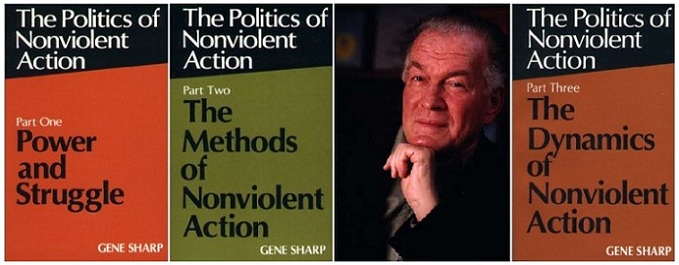
gene-sharp.jpg

Gene Sharp has been in the news quite a bit recently [1, 2, 3, 4], because he pretty literally wrote the book on non-violent resistance.

The young leaders of the Egyptian revolt that toppled Mubarak studied tactics with members of the Serbian Otpor youth resistance who topped Milosevic, Otpor studied tactics in the writings of Gene Sharp, specifically his 90-page pamphlet From Dictatorship to Democracy [download as .pdf]. Sharp wrote that handbook for use in Burma, where it was apparently translated at the request of Aung San Suu Kyi — who once cautioned her readers that that phrase they kept hearing wasn’t “jeans shirt”, it was “Gene Sharp”.

And before that, he’d penned his masterful 900-page, three-volume work, The Politics of Nonviolent Action

I told you he was impressive.

Recommended reading:

From Dictatorship to Democracy is now available in Amharic, Arabic, Azeri, Belarusian, Burmese, Chin (Burma), Jing-paw (Burma), Karen (Burma), Mon (Burma), Chinese (Simplified Mandarin), Chinese (Traditional Mandarin), English, Farsi, French, Indonesian, Khmer (Cambodia), Kyrgyz, Pashto, Russian, Serbian, Spanish, Ukrainian, Tibetan, Tigrigna, and Vietnamese.

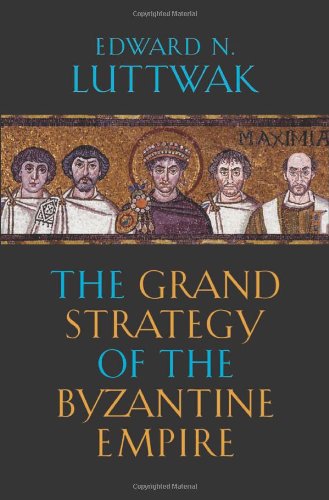
Book Review: The Grand Strategy of the Byzantine Empire by Luttwak

Monday, February 14th, 2011

The Grand Strategy of the Byzantine Empire by Edward Luttwak

A quarter century in the making, eminent and controversial strategist Dr. Edward Luttwak has produced a tour de force work of scholarship that illuminates the little known (to laymen)  military and diplomatic vision of the Byzantine Empire while making a case for adopting some of Byzantium’s strategic posture to adapt to the challenges of today. A book intended to provoke as much as inform the reader, Luttwak’s epilogue, “Conclusion:Grand Strategy and the Byzantine ‘Operational Code”, which synthesizes the best elements of leading schools of strategic thought, is so good that it merits a separate printing of it’s own.

Luttwak’s central idea is that the Hellenic and holy Orthodox Byzantines, who forever saw themselves as “the Romans”, abandoned the grand strategic posture of the Roman Empire whose mighty legions were optimized to smash heavy infantry into the enemy, seeking not just a decisive victory, but the total destruction of the enemy. Facing a sophisticated peer rival in Persia and the endless steppes that vomited up unending waves of invading Huns, Avars, Pechnegs, Slavs, Bulghars, Bulgars, Turks and Mongols, eventually menaced by an ideologically motivated Islamic enemy, the Byzantines sought to conserve their strength by avoiding decisive battle.

As the position of the Empire meant that one destroyed enemy might be replaced by a worse successor, the Byzantines crafted a grand strategy that maximized stratregic alternatives to wars of attrition that the small, highly trained, well-armed, tactically versatile and irreplaceably expensive Byzantine army could ill afford. Diplomacy, espionage, bribery, assassination, recruitment of foreign proxies, strategic raiding, naval supremacy, manuver warfare and cunning strategems were all employed in preference to engaging in decisive battle. Today’s enemy might be tomorrow’s ally was a foremost consideration for the Byzantines, who took great care to lay down hard-won military wisdom in handbooks and manuals like The Strategikon or  De Re Strategica.

Strengths and Weaknesses:

Where you sit in reading The Grand Strategy of the Byzantine Empire is likely to determine where you stand on it. 

Luttwak has written a very interesting book about a historical subfield in which he himself is not an expert but has infused it with distillations of professional insight regarding strategy and warfare that no Byzantinist scholar and only very few military historians could have brought to bear. And importantly, never have tried to do so. Luttwak’s commentary on each of the surviving Byzantine military manuals, some only recently translated, for example, while repetitive for a lay reader is an important service for students of war and military strategy.

The empire lasted an exceedingly long period of time, as the Byzantines themselves reckoned it, from the 8th century BC to 1453 when the last Emperor Constantine died heroically fighting the final onslaught of the Ottoman Turks a mere 39 years before Christopher Columbus discovered the New World.  Luttwak is not a historian and makes no attempt to approach the subject as a historian would – something that might require multiple volumes or a very superficial treatment – and makes selections from Byzantine history to illustrate thematic points regarding strategy or, as with the digressions on the composite recurve bow and training of mounted archers, the complex relationship between technology, economics, military tactics and strategy.  To the reader interested in strategy and military history, Luttwak’s approach is efficient and sensible; for those interested in a comprehensive understanding of the Byzantines it makes for a highly idiosyncratic reading.

Nor does Luttwak make any pretense of bowing to rhetorical academic conventions. He does not soften his language anywhere, referring for example to the later wars between the Empire and Arab potentates as “jihad” and “crusade” and draws clear connections between the wars of Byzantium and the wars today with al Qaida, the Taliban and Iraq or the continuity between old  Persia and Ahmadinejad’s Iran. Luttwak freely injects modern terminology into archaic subjects and generally writes as he pleases, meandering whenever details of a topic interest him. His endnotes though, are a rich source of further commentary and observations and the bibliography runs for an additional seventeen pages.

Strongly recommended.
Ronald Reagan Roundtable: “full of jovial doom” by Charles Cameron

Friday, February 11th, 2011

[ by Charles Cameron ]

Yesterday I made my post on the ChicagoBoyz roundtable about President Reagan’s enthusiasm for prophecies of the end times:

Knowing of my interest in matters apocalyptic, you wouldn’t expect me to pass up President Reagan‘s connection with Ezekiel and the Revelation of John of Patmos on an occasion such as this, would you?
.
Seriously:
.
I’m not entirely comfortable with the idea of people who believe in prophecy having their fingers on the triggers of nuclear weapons. Ronald Reagan was one such, and didn’t press the trigger — a fact for which I am profoundly grateful. Perhaps it was his “jovial” approach to “doom” that made the difference.
.
The story is actually quite fascinating…

and (quoting the Nuclear Age Peace Foundation, a group which advocates for nuclear disarmament):

According to his wife, Nancy, “Ronnie had many hopes for the future, and none were more important to America and to mankind than the effort to create a world free of nuclear weapons.”
.
President Reagan was a nuclear abolitionist…

Since that time, Lex has strongly critiqued my post, I’ve responded, and y’all are cordially invited to chime in…
.
*
.
But I didn’t want to clog that more serious business with what one might term “apocalyptic trivia” – even though such things can be interesting in their own right as samples of humor, conspiracy etc – so I’ll follow that up today with one of my DoubleQuotes here on ZP.

Dr. Barnett Responds on Sino-American Grand Strategy

Tuesday, January 4th, 2011

In response to my previous post A Short Analysis on The Whyte-Barnett Sino-American Grand Strategy Proposal, Dr. Thomas P.M. Barnett wrote in late this morning and I am giving him the floor:

You’re fundamentally right in your analysis.

What we heard from a senior quasi-official (and I’ll leave the description there) was that we should not present the compromises in the form of annexes but to make it a singular sign-it-or-no agreement.  Why? That path would suffer the deaths of a thousand-edits and ruin the desired dynamic. 

I agreed with the notion for this reason:  The American approach to such a document is to carve it up into pieces and to give the Iran piece to the Iran desk and the Taiwan piece to the Taiwan desk and so on, and everybody comes back saying the same thing: “American could never do this one thing!”  But, of course, the whole point of the process is to encourage the horse-trading mindset.

Do you, America, want a different path with China?

Do you, America, want the money to flow from China back into the US economy in a useful manner for all?  Do you want the trade imbalance balanced?

If you want these things, and see the wisdom of the deepened economic connectivity, then what transparency and strategic trust must be created–minimum list?

Once you see all these “demands” expressed from the Chinese side, do you see a path forward or are these things too much for Beijing to ask for?

Me personally, I want Kim’s regime collapsed–pronto.  But I cannot make that argument stand up right now, given the larger tasks at hand and the relationship to be maintained.  I hear the Chinese on that subject and I think their offer of a slow soft-kill path makes sense.  So I accept the bargain because I see a lot of negative pathways curtailed by it and profoundly positive ones created by it.

But I’m not a China expert who’s incredibly vested in the complexity and opacity of this relationship.  It gets better and I still have plenty of opportunity to pursue.  I’m also not a regional expert well versed in telling you how something is “impossible!”  I approach the issue from the long-range perspective, with more of a businessman’s tendency to look for the deal rather than wait on the perfect architecture or all the policy boxes to get checked.  I want progress, and asked the Chinese what it would cost.

I believe that if you put this package in front of the American people, they will not find the costs high at all.  But that would take seriously visionary leadership on our side (like Brzezinski’s suggestion in the NYT yesterday).  The Chinese have enough of it on their side to move forward.  I fear we do not.  We are now the muddle-through people, looking frighteningly like Brezhnevian Russia.  Nobody is creating any Deng or Gorbachev-like clarity about the path ahead.  Where is our 21st-century Alexander Hamilton?  

We argue amongst ourselves over piddling things, fighting each conversation to the death. And we lower ourselves in the eyes of others.

John Milligan-Whyte is convinced Obama is a transformational figure–a lawyer’s mind who will understand the terms and act on it.  I am less optimistic but felt it was crucial to try.

The Chinese response was–to me–stunning in its openness and flexibility of imagination.  Yes, they have their demands and when you look at it from their perspective, they are fairly reasonable, even as I, in my American mindset, find some of them too slow in unfolding.  But they took this thing with immense seriousness–even an eagerness.  They were like somebody who had long waited to eat a decent meal and were determined to gobble it up with relish, and I found all that sad, because it made me realize what a dead dialogue the SED must be, with its 1-2% improvement goal every year.

But Obama’s crew has no real strategists.  They have handlers and politicos and experts, but no strategists or deal-makers.  They are too satisfied with the “keeping all balls in the air” bit, ecstatic when China does the littlest effort to rein NorKo in for some SouKo artillery ex–like that’s some great victory!  It’s really sad, because the moment is so ripe for imaginative approaches.

We knew the package had to start from the Chinese side and I firmly expected the US side to blow it off, for its lack of proper channels.  But it does not stop there–from the Chinese perspective.  So our work continues.


Switch to our mobile site

