zenpundit.com » strategist

Archive for the ‘strategist’ Category

Xi Jinping

Monday, November 26th, 2012

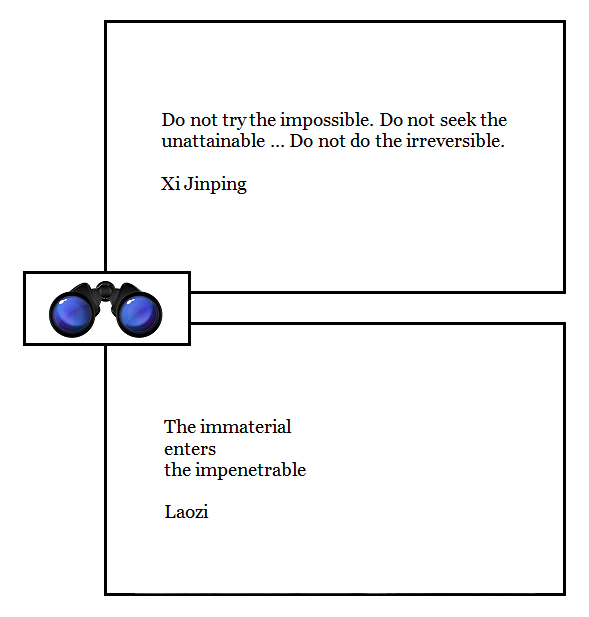
[ by Charles Cameron — Xi Jinping quotes an unnamed “ancient Chinese military strategist” and I respond with Laozi — this one’s for Raff Pantucci ]
.


.

According to Reuters today, Xi used his quote (above, top) in a speech in 2000, while governor of Fujian province. If anyone can identify the “ancient Chinese military strategist” and reference the original source of Xi‘s quote, I’d appreciate a heads up. My version of the Laozi is from Ursula le Guin‘s translation, chapter 43.

An Unknown Future and a Doubtful Present: Writing the Victory Plan of 1941 — a review-lite and a few questions

Tuesday, November 20th, 2012

[by J. Scott Shipman]
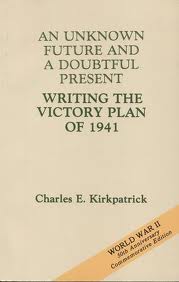
An Unknown Future and a Doubtful Present: Writing the Victory Plan of 1941, by Charles E. Kirkpatrick

Mr. Kirkpatrick’s little book provides an excellent primer to the formulation of the United States’ WWII strategy and a refreshing insight into the education of an master strategist, the focus of this post. At 138 pages (plus bibliography/index), Kirkpatrick provides an overview of the enormous contribution of Major Albert C. Wedemeyer, then attached to the War Plans Division, the Army chief of staff’s strategic planners. In the spring of 1941, General George C. Marshall wanted a “more clear-cut strategic estimate of our situation”. Wedemeyer placed his work in the context of four questions:

1. What is the national objective of the United States?
2. What military strategy will be devised to accommodate the national objective?
3. What military forces must be raised in order to execute that military strategy?
4. How will those forces be constituted, equipped, and trained?

Wedemeyer understood that number 4 was not possible without a clear understanding of 1 through 3. Number 1 did not exist (probably still does not), so Wedemeyer made his best guess. Wedemeyer placed his task in context and produced a plan in the prescribed 90 days (!).

No Ordinary Major

Wedemeyer was no ordinary major. He was a voracious reader and student of history; familiar with Clauzewitz, von der Glotz, Fuller and Sun Tzu. He was fortunate to have a mentor (who happened also to become his father-in-law), MG Stanley Embick. Embick encouraged Wedemeyer to “organize discussion groups of officers during the years on Corregidor. Professional reading served as the context for such social gatherings of Wedemeyer’s peers intelligent and articulate men who met periodically to discuss current events, the books they had been reading, and professional interests.”

Wedemeyer was an honor graduate of the Command and General Staff College, and his performance earned him the opportunity to attended the Kriegsakademie, the German staff college. However, coupled with impressive academic preparations, Kirkpatrick writes that Wedemeyer’s curiosity exposed him to a “kaleidoscope” of ideas and methods. Kirkpatrick summed-up Wedemeyer: “Competence as a planner thus emerged as much from conscientious professional study as from formal military education…” Going on to say:

In common with many of his peers, much of Wedemeyer’s professional and intellectual education was less the product of military schooling than of personal initiative and experience in the interwar Army.

Wedemeyer’s intellectual development was purposeful and paid off. In Wedemeyer’s deep study of his profession he used the prescribed paths, but also explored on his own. How common is that today? What is the real intellectual foundation supporting our professional warriors? Is it the minimum one will glean from the service schools, or we encouraging our people to go a step further.  In an earlier post I wondered aloud, and echoed a remark posed by Jon Sumida with respect to Alfred Thayer Mahan:

“It remains to be seen whether readers exist with the mind and will to accept his guidance on what necessarily is an arduous intellectual and moral voyage into the realm of war and politics.” (emphasis added)

Against this backdrop, Tom Ricks in an interview at the Washington Post said:

The U.S. Army is a great institution. The rebuilding of the U.S. Army after the Vietnam War was an epic struggle and was enormously successful. Today we have great frontline soldiers. They are well equipped, they are well trained and they are in cohesive units.

The problem is at the very top. This magnificent rebuilding of the U.S. military after Vietnam really did recreate the force, but they kept the old head. The one thing they didn’t really change after Vietnam was how they shaped their generals. What we got was a generation of officers who thought tactically and not strategically. It’s the difference between being trained and being educated. You train people for known attacks. You educate people for the unknown, the complex, the ambiguous, the difficult situation. (emphasis added)

No intention of singling out the Army, I would cast the net of this question to include the other services, and ask whether we have Major Wedemeyer Majors/Lieutenant Commanders in the pipeline. If we do, are we nurturing and encouraging them? How many of our professional warriors study independently, and like Wedemeyer host/encourage frequent independent fellowship/discussions around books and ideas independent of the academy? As I mentioned in an earlier post, there is no app for intellectual development. We should at least expose our officers to the Wedemeyer method, if you will, and go deeper than service schools, blogs, and the constant chatter in our information laden world. Colleagues gathering to discuss and debate; educating and enlightening each other.

On strategy, Kirkpatrick quotes Wedemeyer:

…strategy, properly conceived, thus seemed to me to require transcendence of the narrowly military perspectives that the term traditionally implied. Strategy required systematic consideration and use of all the so-called instruments of policy–political, economic, psychological, et cetera, as well as military–in pursuing national objectives. Indeed, the nonmilitary factors deserved unequivocal priority over the military, the latter to be employed only as a last resort.

Wedemeyer’s net was wide and comprehensive and worthy of emulation. While his accomplishment(s) are impressive, so was his preparation.

Wedemeyer went on to a successful Army career, retiring as a 4-star. In 1985, he was presented the Presidential Medal of Freedom by President Reagan. (See the New York Times obituary.)

This is an important and accessible introduction to the nuts-and-bolts of strategic planning and has my strongest recommendation.

A free electronic copy can be found here (pdf).
Gaming Gandhi

Saturday, November 17th, 2012

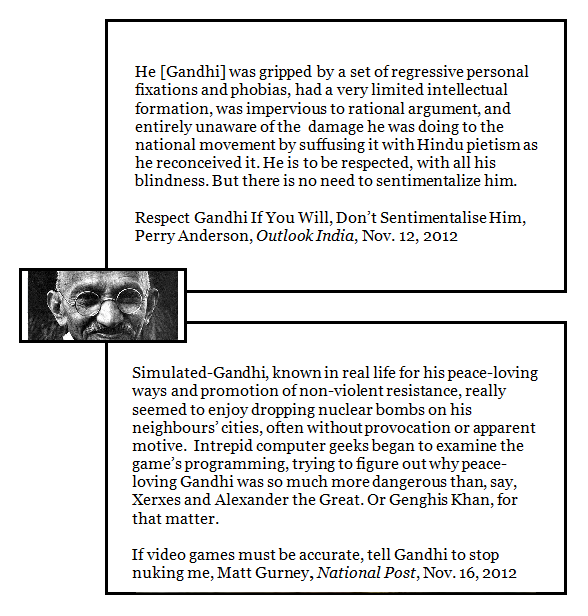
[ by Charles Cameron — two clashing quotes about Gandhi that followed one another in my RSS feed today, funny & strange ]
.


.

Strange, to say the least.

Gandhi was a strategist — as a friend of mine once wrote, “he achieved self determination for the largest number of individuals with the lowest cost in human life” of any rebel known to history —

He managed this feat by holding a position of non-violent non-cooperation, while showing that the ‘civilized’ opponent of the United Kingdom could not live up to its own imposed standards of conduct or law.

And at least some of the time, he was notably unwilling to romanticize himself — he once said:

My nonviolence does not admit of running away from danger and leaving dear ones unprotected. Between violence and cowardly flight, I can only prefer violence to cowardice. I can no more preach nonviolence to a coward than I can tempt a blind man to enjoy healthy scenes. Nonviolence is the summit of bravery. And in my own experience, I have had no difficulty in demonstrating to men trained in the school of violence the superiority of nonviolence. As a coward, which I was for years, I harbored violence. I began to prize nonviolence only when I shed cowardice.

So he’s not the total pacifist he’s sometimes portrayed as.

But nuclear weapons? “Much more dangerous than, say, Xerxes and Alexander the Great. Or Genghis Khan, for that matter”?

Not in India, not back then. In one of Hugh Everett‘s “many worlds”? — perhaps. And in Civ2, the game? — apparently, yes.

**

Quote sources: Outlook India and National Post, with a tip of the hat to Rex Brynen at PAXSims.

Luttwak on the Australian Strategic Pivot

Sunday, September 30th, 2012

Iconoclastic strategist Edward Luttwak has characteristically caustic words on an Australian -American strategic entente to contain an “autistic” rising China:

Australia counters Chinese threat 

AUSTRALIA has been quietly building a regional defence coalition to restrain China’s increasingly ”aggressive” and ”autistic” international behaviour, an influential adviser to the Pentagon says.

Edward Luttwak bluntly contradicts Australian and US denials that they see China as a threat or want to contain its rise. ”Australians view themselves as facing a strategic threat,” he writes in his coming book, The Rise of China v The Logic of Strategy.

The emerging latticework of regional defence arrangements augments ”the overall capacity of the US-Australian alliance to contain China”.

The book praises Australia’s strategic initiative in forging ties with countries such as Malaysia, Indonesia and India that lie beyond America’s natural security orbit, as well as broadening the defence networks of close US allies such as Japan.

”Each of these Australian initiatives derives from a prior and broader decision to take the initiative in building a structure of collective security piece by piece, and not just leave it all to the Americans,” it says.

….The Australian National University’s Hugh White has argued that the US needs to ”share power” with what is going to be ”the most formidable power the US has ever faced”. But for Mr Luttwak, the ”logic of strategy” dictates that neighbours will naturally coalesce against the new rising threat, thus preventing China from realising anything like the relative military power that has been projected.

”The rapid accession to prosperity has been a very common way for countries to lose their sanity,” Mr Luttwak told the Herald. He said China suffered from ancient and new foreign policy weaknesses.

”The Chinese are autistic in dealing with foreigners, they have no sense of the ‘other’,” he said. ”They think they are incredibly brilliant strategists as if they had been conquering other nations, when in fact it’s been the other way around for 1500 years.”

Ouch.

China’s political system is in the midst of a particularly edgy and uncertain generational transition of power, following the succession machinery designed by China’s last “paramount leader”, Deng Xiaoping, to retain harmony among the ruling Communist Party elite.  Deng’s successors are following his script, but their hearts no longer appear to be in it – 15 years after Deng’s death, cracks have appeared in the facade of unity. Not a fatal flaw, but lacking a leader of Deng’s stature who, even in retirement, remained the supreme arbiter of China’s political system, factions of China’s elite have more room to push conflicting agendas.

In foreign policy we see the effects in China’s erratically belligerent, then conciliatory behavior towards it’s East Asian neighbors and the United States. Strategically, it makes little sense for China to repeatedly generate friction over territorial claims to the entire South China Sea with Vietnam, Philippines, Taiwan, Brunei, Malaysia, Indonesia and the United States and push a separate dispute with Japan simultaneously, yet because of intra-elite, domestic politics, Beijing is unable or unwilling to restrain enthusiast Chinese officials from doing so.

Inventing Grand Strategy and Teaching Command, The Classic Works of Alfred Thayer Mahan Reconsidered, a review

Tuesday, September 4th, 2012

[by J. Scott Shipman]

Inventing Grand Strategy and Teaching Command, by Jon Tetsuro Sumida

As of August 2012 this is the best non-fiction book I’ve read this year. Professor Sumida brings a potentially dry topic to life making Alfred Thayer Mahan relevant in the process; as indeed, he should. At a mere 117 pages of moderately footnoted text, Sumida provides the reader a grand tour of Mahan’s life work, not just The Influence of Sea Power 1660-1983. Sumida includes the major works of Alfred Thayer Mahan’s (ATM) father Dennis Hart Mahan, as he introduces ATM’s major works, lesser works, biographies, essays, and criticisms.

Sumida begins his chapters with quotes, and weaves his recounting of ATM’s work with musical performance, Zen enlightenment, and naval command; which is quite a combination, but convincing. Of ATM’s “approach to naval grand strategy” he writes:

Mahan believed the security of a large and expanding system of international trade in the twentieth century would depend upon the creation of a transnational consortium of naval power. His handling of the art and science of command, on the other hand, was difficult, complex, and elusive. It is helpful, therefore, to achieve an introductory sense of its liminal character by means of analogy.

This is where musical performance and Zen enlightenment become relevant and instructive. Sumida writes on musical performance:

Teaching musical performance…poses three challenges: improving art, developing technique, and attending to their interaction.

Sumida goes on to illustrate the parallels between learning musical performance and naval command/strategy and the common thread is performing or, “doing it.” He writes that most musical instruction is through the understudy watching demonstrations by the master, but the higher purpose of replicating the master’s work is “to gain a sense of the expressive nature of an act that represents authentically a human persona.” In other words, the development of relevant tacit knowledge, or as I have come to refer to this as “tacit insight.”

Sumida continues with six short chapters that pack a powerful punch and a good introduction to the trajectory of Mahan’s work from the beginning to end. My favorite was Chapter Six, The Uses of History and Theory. In this chapter Sumida deals with complexity, contingency, change, and contradiction, naval supremacy in the Twentieth Century, Jomini, Clausewitz, and command and history. Quite a line-up, but a convincing inventory of Mahan’s influences and how his work remains relevant today. Sumida writes:

Mahan’s role as a pioneer and extender of the work of others has been widely misunderstood and thus either ignored or misused. The general failure to engage his thought accurately is in large part attributable to the complexity of his exposition, the difficulties inherent in his methods of dealing with several forms of contingency, changes in his position on certain major issues, and his contradictory predictions about the future and application of strategic principles…His chief goal, however, was to address difficult questions that were not susceptible to convincing elucidation through simple reasoning by analogy. He thus viewed history less as a ready-made instructor than a medium that had to be worked by the appropriate intellectual tools.. Mahan’s analytical instruments of choice were five kinds of argument: political, political-economic, governmental, strategic, and professional.

The first three were used in grand naval strategy, the latter two with the “art and science of command.” The section of Command and History is particularly relevant given two recent posts, one at the USNI Blog, The Wisdom of a King, by CDR Salamander, and the other in a September 2012 Proceedings article by LCDR B.J.Armstrong, Leadership & Command. Here’s why: Sumida quotes Admiral Arleigh Burke, who latter became Chief of Naval Operations, during WWII. Of “Decentraliztion,” Burke wrote:

…means we offer officers the opportunity to rise to positions of responsibility, of decision, of identity and stature—if they want it, and as soon as they can take it.

We believe in command, not staff. We believe we have “real” things to do. The Navy believes in putting a man in a position with a job to do, and let him do it—give him hell if he does not perform—but be a man in his own name. We decentralize and capitalize on the capabilities of our individual people rather than centralize and make automatons of them. This builds that essential element of pride of service and sense of accomplishment.

The U.S. Navy could do worse than return to this “father” of naval strategy and give his ideas more attention; Professor Sumida’s little book would be a good place to start.

Strongest recommendation—particularly to active duty Navy personnel.

Cross-posted at To Be or To Do.


Switch to our mobile site