zenpundit.com » extremists

Archive for the ‘extremists’ Category

Kesler on R2P Hypocrisy

Saturday, October 8th, 2011

Nice catch by Bruce Kesler who goes en fuego on the weirdly discordant note Anne-Marie Slaughter strikes in her latest New York Times op-ed:

Majority Rule Over Minorities: Ironic R2P Hypocrisy

The extremism of R2P’s leading proponent is exhibited in Anne-Marie Slaughter’s op-ed in today’s New York Times. Slaughter likens the Wall Street protesters to those demonstrating against oppressive regimes in the Middle East and recommends removal of the US system of checks and balances that protect minority views and avoid poorly developed political stampedes. (Slaughter doesn’t mention or give credence to the more numerous, mature citizenry participating in or supporting the Tea Parties more peaceful protests for more limited government intrusions into Americans’ private lives and earnings.)

R2P’s leading proponent, Anne-Marie Slaughter of Harvard, believes that US foreign policies and military interventions should prioritize the Right To Protect severely repressed peoples through US obeisance to liberal internationalist elites’ sentiments in favor of some they like regardless of the US Constitution or laws or national or security interests.

In today’s New York Times, Slaughter takes her R2P home to the US, advocating that majorities rule regardless of the formal and informal checks and balances of our political system and overriding the rights of political minorities. Again, it is the majorities that liberals like who should be given more powers.

Without any sense of proportionality or of core differences between the US and Middle East satrapies, Slaughter says, “Indeed, the twin drivers of America’s nascent protest movement against the financial sector are injustice and invisibility, the very grievances that drove the Arab Spring.” Slaughter then concludes, “The only effective response is a political response, of a nature and magnitude that convinces protesters on the streets that they can in fact secure the change they seek within, rather than outside, the system.”

Slaughter’s system, however, would reduce the ability of permanent or transitory political minorities to protect their interests. They would, also, further factionalize the US and make compromises more difficult as the power of centrists is reduced….

Read the rest here.

Good grief. Anne Marie Slaughter opining on the need for greater democracy and accountability to the people is somewhat akin to Ayn Rand calling for more welfare programs.

My suspicion here, since this rhetoric runs counter to Slaughter’s most influential ideas, is that Slaughter is just carrying water as part of the current Democratic political strategy of trying to co-opt the Occupy Wall Street movement. Perhaps the Axelrods and Podestas see that open-source protest movement to potentially be “their tea party”. Whatever. I will take her op-ed more seriously when she is marching against the Hedge fundies and Wall Streeters who are top donors to her Party, her administration and her university.

You can put a three corned hat on a Princeton theorist of global governance by transnational “governmental networks” but even if you adjust the hat at a suitably jaunty angle for maximum populist effect, the agenda underneath is still neither democratic nor popular.
Down the rabbit hole: researching the “jikhad”

Thursday, September 22nd, 2011

[ by Charles Cameron — cross-posted from Chicago Boyz – a meander on the perils and promise of research, jihad, typos, books and more ]
.
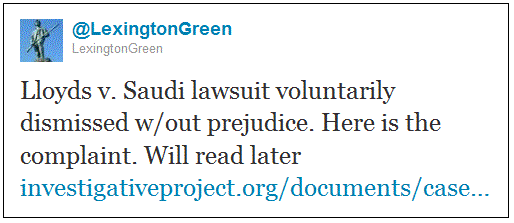
It begins with an email from Lexington Green saying I might be interested in a tweet he had posted earlier this morning:

The Insurance Journal tells us:

Defendants named in the complaint were Kingdom of Saudi Arabia, The Saudi High Commission for Relief of Bosnia & Herzegovina, Saudi Joint Relief Committee for Kosovo and Chechnya, Saudi Red Crescent Society, National Commercial Bank, Al Rajhi Banking and Investment Company. Also included as defendants are three Saudi citizens connected to these organizations, Prince Salman Bin Abdul Aziz Al Saud, Suleiman Abdel Aziz Al Saud and Yassin Al Qadi.

The case is Underwriting Members of Lloyd’s Syndicate 3500 v. Kingdom of Saudi Arabia, 11-00202, U.S. District Court, Western District of Pennsylvania.

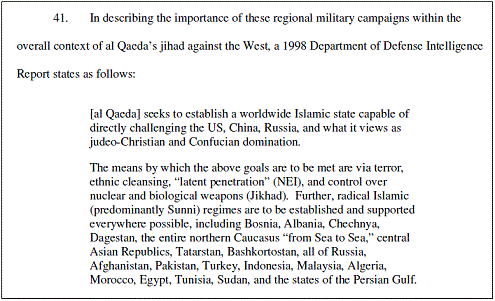
Okay, I’m curious. I go to the complaint [.pdf] and start reading… and on page 9, I find:

That’s interesting. A DIA report, better look that up. But there’s no reference provided…

So I googled for “latent penetration” NEI which sent me back to versions of the court filing, and then for “latent penetration” and found that Robert W. Schaefer on p. 166 of his book, The Insurgency in Chechnya and the North Caucasus: From Gazavat to Jihad, quotes [with minor variations] from what is obviously the same DIA document and in footnote 29, p 165 identifies it as “Declassified DIA intelligence report NC 3095345, October 16, 1998, 3 (obtained through the Freedom of Information Act).”

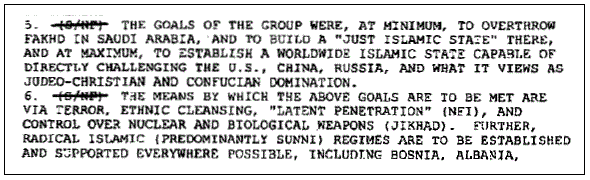
Onwards to locate NC 3095345, which can be found here [.pdf] and contains the following relevant text on p. 3:

So that’s the source of the description of AQ’s overall plan in the Lloyds complaint.

But what’s “latent penetration”? The DIA document even has it in quote marks – does that make it a technical term?

Back to Google.

The FBI uses the term “latent penetration” – maybe I’m onto something! In their Electronic Biometric Transmission Specification (EBTS) [.pdf] on p. 58 they offer the “following list of TOTs is applicable to latent friction ridge searches transmitted to the FBI”:

fbi-latent-prints.gif

I have to admit – a Latent Penetration Query sounds like just the thing I’m after – but the FBI appears to think of “latent penetration” in terms of fingerprints…

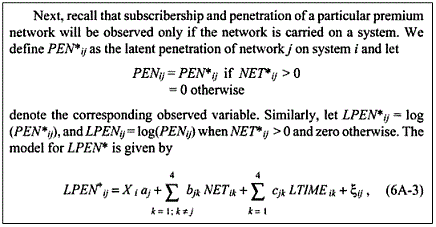
Okay, next up. A quick look at David Waterman and Andrew A. Weiss‘ book, Vertical Integration in Cable Television, (AEI, 1997) tells us:

latent-penetration-in-cable-television.gif

That’s all a bit above my head, and in any case I don’t watch cable TV… and the networks in question aren’t terrorist networks, they’re cable networks…

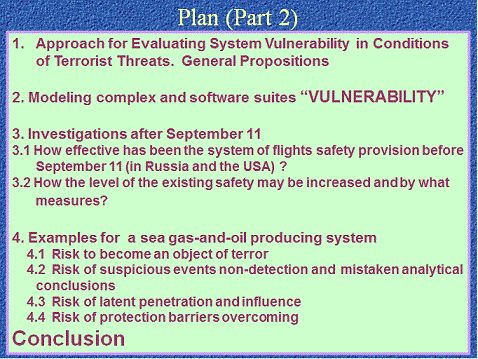
When I add the word “terror” into my search, however, I get directed to Prof. Kostogryzov Andrey‘s paper [.ppt] addressing the question of a “methodical approach for the evaluation of systems vulnerability in conditions of terrorist threats” for a symposium at the University of Texas, Arlington – which sounds promising.

Searching the good professor’s powerpoint for “latent penetration” takes me to slide 36, however, where I read:

symposium-slide-36.gif

To be honest with you, I don’t feel any closer to understanding “latent penetration” beyond a sort of general “potentially getting inside the opposition” kind of sense.

So let’s get back to NEI – which is what the Lloyds transcription has in parens immediately after the quote-marked phrase “latent penetration” – what’s that about?

Well, on closer examination, it looks as though Lloyds got that wrong, and the DIA document — compare their E’s and F’s in the typed excerpt above and I think you’ll agree — actually says NFI…

Phew! NFI.

What’s that?

The DIA probably classifies its acronyms, but this particular document has been declassified and NFI hasn’t been redacted, so perhaps the Free Dictionary acronym finder will be able to help…

I quickly dismiss such possibilities as National Fatherhood Initiative and get down to my three basic possibilities:

NFI … No Further Information (available)
NFI … National Foreign Intelligence
NFI … No Freaking Idea

The last of these describes my own feelings at this point, although “freaking” would be the milder way to put it. So it’s down to guesswork: I’ll go with #2.

Okay: according to this particular DIA report, AQ “seeks to establish a worldwide Islamic state” by means that include “latent penetration” — I still have only the vaguest idea [OTVI] what that means — and “control over nuclear and biological weapons (Jikhad)”.

Jikhad?

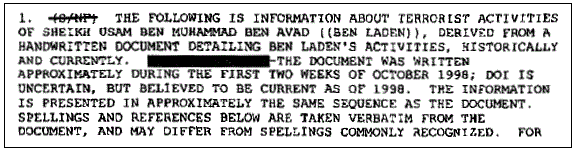
The DIA docu self-describes thus:

dia-self-descript.gif

Variant spellings, okay…

But I’m wondering if “Jikhad” is one of them…

Back to the search engines, where I discover the word does have prior art in a terrorist – indeed, a specifically AQ — context, to wit:

jikhad-book-cover-med.jpg

$149.95, call it $150 on Amazon, and available for free shipping

Well, you can’t judge a book title by its cover, so I have an inquiry in to the good folks at the University of Calgary library, which has a copy – but I’m guessing “Jikhad” is a typo in both cases, aren’t you?

*

And what grand purpose does all this serve?

None, you may think – the complaint has been withdrawn, as Lex tells us, “without prejudice” – so the issue is, if I may use a legal term despite the fact that IANAL, “moot”.

Unless one is interested in the prices of books these days, or the frequency of spelling vagaries on their printed covers, or possible Arabic words bearing on terrorism that one hasn’t run across previously, or fingerprints, or the reliability of a document of which LTC Schaefer notes (p. 165, n 29):

It is important to note that no evaluation of the information detailed in the report is included in the declassified version; and anyone who deals with intelligence will tell you that text without context is pretext. It is entirely possible that this document was passed to U.S. Intelligence by the Russians in order to bolster the evidence linking the Chechens with Al Qaeda.

On second thoughts, we can learn something here about care in reading sources – about the transmission errors that commonly crop up when texts are translated or transmitted – and about the importance of context.

Text without context is pretext.

That whole paragraph of LTC Schaefer’s is worth the price of admission.

Ali Soufan: AQ, Khorasan and the Black Banners

Saturday, September 17th, 2011

[ by Charles Cameron — yet more black banners, Khorasan, Jerusalem and Armageddon, with the usual strategic implications ]
.
soufan-book-cover.jpg
.

It’s beginning to be embarrassing how obvious the Khorasan / black banner / Mahdism meme is getting these days.  Earlier this week I pointed it out as the basic through-line of Syed Saleem Shahzad‘s Inside Al-Qaeda and the Taliban: Beyond bin Laden and 9/11. Today it’s Ali Soufan‘s turn.

In his book, The Black Banners: The Inside Story of 9/11 and the War Against Al-Qaeda — which I hope to review here — Soufan too makes the apocalyptic significance of AQ’s jihad painfully apparent. Take his title, for instance

Black banners, eh?

Those would presumably be the ones mentioned to Soufan by Abu Jandal, who began to quote the hadith:

If you see the black banners coming from Khurasan, join that army, even if you have to crawl over ice; no power will be able to stop them —

at which point Soufan broke in and completed the hadith for him:

— and they will finally read Baitul Maqdis [Jerusalem], where they will erect their flags.

And in case you missed it, that’s an explicitly end-times, Mahdist hadith, as you can see from (eg) this Hizb-ut-Tahrir-associated site:

Messenger of Allah said: “If you see the Black Banners coming from Khurasan go to them immediately, even if you must crawl over ice, because indeed amongst them is the Caliph, Al Mahdi.” [Narrated on authority of Ibn Majah, Al-Hakim, Ahmad]

Soufan goes on to say:

I was to hear that reputed hadith from many al-Qaeda members I interrogated. It was one of al-Qaeda’s favorites.

Khurasan is a term for a historical region spanning northeastern and eastern Iran and parts of Turkmenistan, Uzbekistan, Tajikistan, Afghanistan, and northwestern Pakistan. Because of the hadith, jihadists believe that this is the region from which they will inflict a major defeat against their enemies — in the Islamic version of Armageddon. Bin Laden’s 1996 declaration of war against the United States – a main text for al-Qaeda members – ends with the dateline “Friday, August 23, 1996, in the Hindu Kush, Afghanistan.” It’s not a coincidence that bin Laden made al-Qaeda’s flag black; he also regularly cited the hadith and referenced Khurasan when recruiting, motivating, and fundraising. Al-Qaeda operatives I interrogated were often convinced that, by joining al-Qaeda, they were fulfilling the words of the Prophet.

It is an indication of how imperfectly we know our enemy that to most people in the West, and even among supposed al-Qaeda experts, the image of the black banners means little…

I could go on, but that’s surely enough.

*

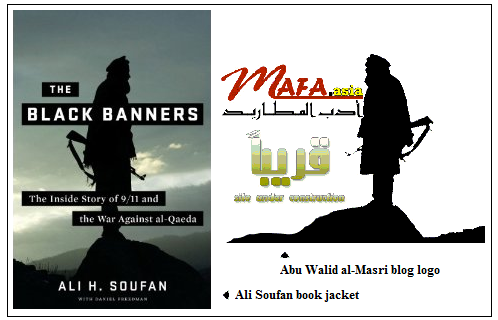
And by the way, who is that man on the cover, anyway?

banners-mafa-juxtaposed.png

A bouquet from Breivik

Thursday, September 15th, 2011

[ by Charles Cameron — Breivik, network analysis, graphical presentation, morale and materiel, hard problem in consciousness ]

.

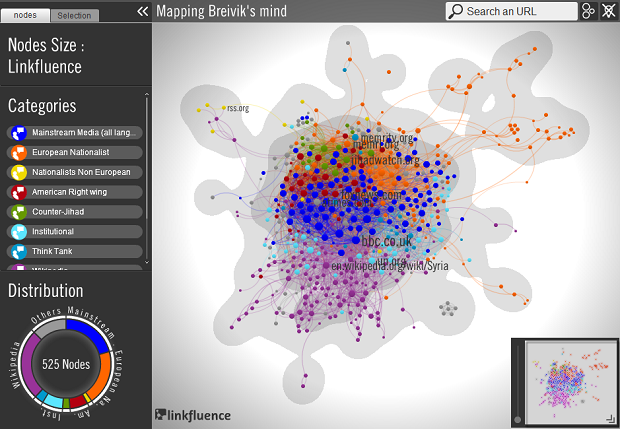
breivik-mind-map.png

If I might wax over-the-top lyrical for just a moment…

Like an early morning bouquet of wildflowers appearing out of the mists —

breivik-mind-map-02.png

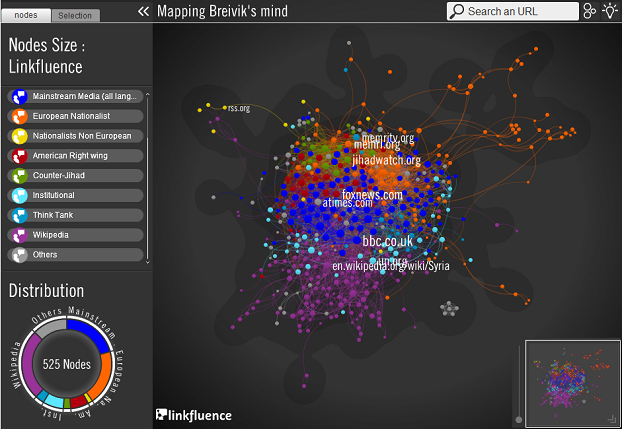
or like some translucent sea creature perhaps, with galaxies in its veins and tendrils — the mind of Anders Breivik is imaged here by Britain’s Guardian datablog in a graphical mapping of the hyperlinks found in his 1500 page manifesto, and the links between the sites he links to.

Beautiful, no? Like an early morning bouquet?

*

Three things:

  • mapping Breivik’s online links for us is a valuable service.
  • the glamour of high-tech graphical interfaces can be deceptive.
  • there’s no map of the link between concept and act.

That last one, if you ask me, is the real bouquet.

We can know quite a bit about what Breivik read, and even figure out some of how he “connected the dots” – but the move from thinking about to taking action is the one that matters most – and we don’t have much of a handle on it.

It’s not on the map.

*

Such lacunae bother me.

A lot of our maps and models move between one quantity and another, and a lot of our thinking, correspondingly, has to do with materiel rather than morale — but nowhere is there a map or model of how quantity and quality affect each other, or how morale “force multiplies” materiel — even though “real life” moves seamlessly between (subjective, qualitative) mind and (objective, quantifiable) brain.

We have no map to walk us through the hard problem in consciousness — except our own insight.

And x-rays do not an insight make.

Jihad culture: its music, poetry, rituals and dreams

Monday, September 12th, 2011

[  by Charles Cameron – jihadist studies, Hegghammer, culture and influence ]

.

It is the evening of the tenth anniversary: the day is almost over.

*

In an engaging interview with Abu Muqawama posted today, terrorism and violent Islamism expert Thomas Hegghammer discusses his new project about jihad culture, or “the things jihadis do when they don’t fight”.

It is inspired by the observation that militants in the underground spend a lot of time doing things that appear to serve no immediate military purpose, like singing songs, reciting poetry, or discussing dreams. They also do unexpected things like weep on a regular basis, notably when reciting the Qur’an. The infamous Abu Mus‘ab al-Zarqawi, for example, was known among fellow militants as both “the butcher” (al-dhabbah) and “a weeper” (baki). All this “soft matter” of jihadism remains virtually unstudied; one reason, I think, is that it has been considered less consequential than the hard stuff of terror, such as attacks, resources, organizational structures and the like. My hypothesis is that jihad culture is not inconsequential at all; instead I think it may shed important new light on the processes by which jihadi groups recruit, exercise organizational control and make tactical decisions. I am sure that the military men and women reading this blog will find all this rather intuitive, because they have experienced the important role of music and rituals in their own organization.

As a first step in the inquiry, I am currently working with a great team of scholars on an edited volume that will explore various dimensions of jihad culture. I have recruited subject specialists – including a musicologist, an Arabic poetry expert, and an anthropologist of dreams – to help document and decipher al-Qaida’s internal culture.

I hope the book will cover miracle stories and the odor of sanctity, too…

*

Hegghammer is co-author of the forthcoming Meccan Rebellion (Amal 2011), which I very much hope to review here on Zenpundit, and which is likely to be the definitive work on the Mahdist takeover of the Grand Mosque in Mecca in 1979.

Needless to say, I’m delighted at the news of Hegghammer’s upcoming project.


Switch to our mobile site