zenpundit.com » christianity

Archive for the ‘christianity’ Category

Kill them all, said the Abbot, and Saddam said much the same

Friday, January 4th, 2019

[ by Charles Cameron — personally, i don’t at all mind the fact that both saddam and the abbot are no longer around, given the brutality of their acts ]
.

Saddam reveals himself {upper panel] to be plausibly mediaeval [lower panel]:

He also puts himself in the judgment seat the Abbot reserves for God…

**

The massacre of Béziers, and the Albigensian Crusade of which it was the opening salvo, came about, I’d suggest, fundamentally because the good people of Languedoc — home of the Troubadours as well as the Cathars or Albigensians — found the leaders of the Cathars, known as the Perfecti, to be humbler, poorer, and less ostentatious than the Abbots and Bishops, leaders of the Catholic Church, who tended to be among the “fat cats” of their day.

Understandably, the Church disliked this almost unavoidable comparison, but was unwilling to relinquish its personal and institutional wealth — hence the Abbot’s instruction, Kill them all, God will sort out his own, which somehow made the massacre tolerable, theologically speaking.

**

Reading, for the Cathars:

  • Le Roy Ladurie, Montaillou: The Promised Land of Error
  • Today’s contest for your listening ear

    Tuesday, December 25th, 2018

    [ by Charles Cameron — sensing the sense of the season, musically, with JS Bach, GF Handel, and a special appearance by Dean Swift ]
    .

    Today’s contest is between Johann Sebastian Bach‘s Christmas Oratorio, here performed by Michel Corboz:

    and Georg Friedrich Händel‘s Messiah, here under the baton of Sir Colin Davis at the Barbican, with the marvelous Sara Mingardo in the alto role..

    Cast your ballots, faites vos jeux — this is a win-win game.

    **

    You knew, perhaps — I didn’t — that Dublin, the place of the first performance of Messiah, was at the time spiritually dominated by Jonathan Swift, Dean of St Patrick’s cathedral, and thus the commander-in-chief under God of that cathedral’s choristers? —

    Jonathan Swift of the Modest Proposal “that a young healthy child well nursed, is, at a year old, a most delicious nourishing and wholesome food, whether stewed, roasted, baked, or boiled” —

    and that the said Dean Swift was at first unwilling to let his choristers sing in what seemed uneasily like an Opera, but later relented?

    **

    The child promised, delivered — despised, rejected — crucified and finally arisen in Handel‘s magnificent music himself became, it would seem, bread broken and shared, thus to be digested spiritually by his followers.

    **

    Dean Swift, Handel (Händel was quite British by now) — the two of them crossed staves (a pun, that, ahem) in Dublin that year, 1742 of the Common Era or Anno Domini, 16th in the reign of George II. The King’s Viceroy for Ireland at that date would have been William Cavendish, 3rd Duke of Devonshire, who was a founding governor of the Foundling Hospital in London, an establishment instituted for the “education and maintenance of exposed and deserted young children” — note the echo of Dean Swift‘s concerns, a DoubleQuote in history if you will.

    George Frederick Handel conducted Messiah to great acclaim in the chapel of Foundling Hospital in 1750, and was elected a Governor the next day.

    **

    Swift‘s children get roasted, God‘s child narrowly escapes death at the hands of Herod the Great, but the children of the Foundling Hospital not only get saved from starvation and the gutter, but are exposed to some of the European world’s most magnificent choral music.

    Hallelujah! — if you don’t mind me saying so.
    *

    Wishing ZP readers a Merry Christmas

    Tuesday, December 25th, 2018

    [ by Charles Cameron — with a poem by Richard Wilbur ]
    .

    TWO VOICES IN A MEADOW
    by Richard Wilbur

    A Milkweed

    Anonymous as cherubs
    Over the crib of God,
    White seeds are floating
    Out of my burst pod.
    What power had I
    Before I learned to yield?
    Shatter me, great wind:
    I shall possess the field.

    A Stone

    As casual as cow-dung
    Under the crib of God,
    I lie where chance would have me,
    Up to the ears in sod.
    Why should I move? To move
    Befits a light desire.
    The sill of Heaven would founder,
    Did such as I aspire.

    **

    I was listening to a podcast with Stephen Mitchell discussing this poem, and then his own translation of the Odyssey, and was struck by these two comments on the music of poetry — echoing my love of Bach and my interest in counterpoint and stereophony:

    You can read a translation by somebody who’s really good and say, Ah, that’s got to be done by so and so, in the same way that you hear a bit of Goldberg Variations and you know that’s Glenn Gould or Murray Perahia..

    The poet of the original poem, whether or not anonymous, is listening to something, and the listening eventually becomes the words, so it’s not something, if a poem is really good, it’s not something in a sense he’s creating, it is creating through him, or her, and that’s what becomes the poem. So in the same way, a really good translator is listening, but it’s stereophonic, so in one ear he has the original poem in the original language, and in the other ear, there’s pure, you could say pure longing, or pure silence, where nothing is happening and he cannot force it and will not force it, and then at a certain point, the English words form by themselves, as that counterpoint to the original language, and then it’s done.

    **

    BTW:

    **

    With this simple, humble poem set in a field — not in a manger, mind you, but in a field, any field pretty much, though there are crib-nativity echoes in each stanza — we at Zenpundit wish all our readers the happiest of holiday seasons, in whatever tradition you each may follow..

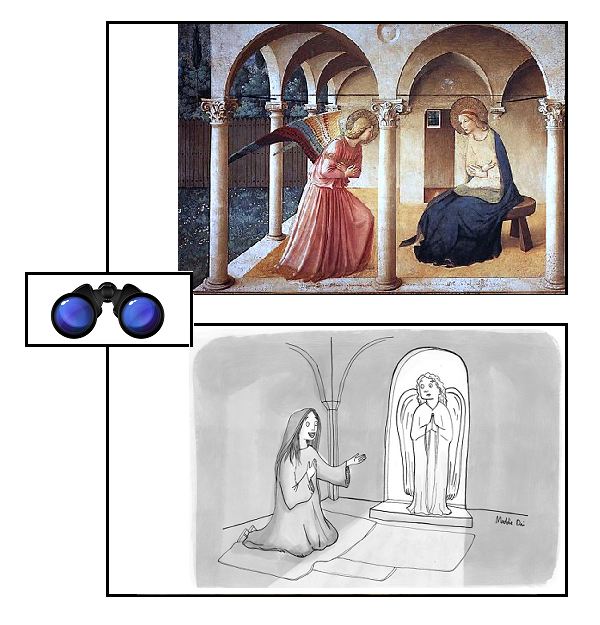
    Slope #2: How’s the Annunciation doing these days?

    Saturday, December 22nd, 2018

    [ by Charles Cameron — art historian manqué ]
    .

    Fra Angelico was a Dominican friar, recently beatified. His Annunciation the San Marco convent in Florence is accordingly a work of devotion, free of irony {upper panel, below]:

    The New Yorker’s current cartoon [lower panel, above] caption reads:

    “I’m really excited about this opportunity, but I’m hoping there’s room to negotiate the title? What about ‘Rises-to-the-Occasion Mary,’ or ‘Cool-Under-Pressure Mary’?”

    **

    That’s it.

    Jews converting to Catholicism, a Dual

    Saturday, December 22nd, 2018

    [ by Charles Cameron — “Conversion is sort of like the untouchable ‘third rail’ of religion” ]
    .

    It’s an ancient, uncomfortable story:

    The Genetic Legacy of the Spanish Inquisition
    As Spain simultaneously persecuted its Jews and expanded its colonies in the Americas, conversos secretly came over to the New World. Their legacy lives on in DNA.

    In 1492, best known as the year Columbus sailed the ocean blue, Spain also decided to expel all practicing Jews from its kingdom. Jews who did not leave—and were not murdered—were forced to become Catholics. Along with those who converted during earlier pogroms, they became known as conversos. As Spain expanded its empire in the Americas, conversos made their way to the colonies too.

    The stories have always persisted—of people across Latin America who didn’t eat pork, of candles lit on Friday nights, of mirrors covered for mourning. A new study examining the DNA of thousands of Latin Americans reveals the extent of their likely Sephardic Jewish ancestry, more widespread than previously thought and more pronounced than in people in Spain and Portugal today. “We were very surprised to find it was the case,” says Juan-Camilo Chaco?n-Duque, a geneticist at the Natural History Museum in London who co-authored the paper. [ .. ]

    In the case of conversos, DNA is helping elucidate a story with few historical records. Spain did not allow converts or their recent descendants to go to its colonies, so they traveled secretly under falsified documents. “For obvious reasons, conversos were not eager to identify as conversos,” says David Graizbord, a professor of Judaic studies at the University of Arizona. The designation applied not just to converts but also to their descendants who were always Catholic. It came with more than a whiff of a stigma. “It was to say you come from Jews and you may not be a genuine Christian,” says Graizbord. Conversos who aspired to high offices in the Church or military often tried to fake their ancestry.

    The genetic record now suggests that conversos—or people who shared ancestry with them—came to the Americas in disproportionate numbers.

    Paper:

  • Nature, Latin Americans show wide-spread Converso ancestry and imprint of local Native ancestry on physical appearance
  • **

    A variant on that story then reappears in the life of Gustav Mahler. My nephew Daniel Hardin explains:

    Two comments on Mahler and conversion:

    On 23-02-1897 (Year 1897) Gustav Mahler walked into the St. Michael’s church in Hamburg and was “received” or baptized into the Roman Catholic faith. The rite of conversion, Mahler believed would clear away a major stumbling block as a prerequisite for being named principal director of the Vienna Hofoper, the Court Opera, today’s Vienna State Opera, and a position for which he and his supporters had been discreetly campaigning for many months.

    and:

    Conversion is sort of like the untouchable “third rail” of religion: switching faiths is frequently the cause of family rupture, personal torment and bitter theological debates. Some parents consider converted children to be dead, both spiritually and physically.

    Sources:

  • National Catholic Reporter, Unconventional converts
  • Gustav-Mahler.eu, Religion
  • See also:

  • Simon Dubnow Institute, Christianity and Conviction: Gustav Mahler and the Meanings of Jewish Conversion in Central Europe
  • Academia.edu, The Conversion of Gustav Mahler
  • **

    Here Daniel Harding conducts the Vienna Philharmonic in Mahler‘s 5th Symphony, in a live recording this year:

    Daniel’s recording of the Mahler 5th with the Swedish Radio Symphony Orchestra,very recently released by Harmonia Mundi, won enthusiastic praise from The Gramophone, the reviewer concluding:

    In a market where modern rivals sound pedestrian or perfumed with finesse by comparison, this Fifth raises high hopes for what the graphic cover artwork implies may become a complete cycle.

    Here’s from another review of the same recording:

    Rarely have I heard the few opening measures of this symphony unleashed with such oppressively inexorable force, and its final minutes infused and driven by such ecstatic euphoria, with everything in between shaping the radical transformations that link the two extremes. After all the Symphony No. 5 in C-sharp minor by Gustav Mahler (1860-1911) is an expansive epic journey ‘per aspera ad astra’ (‘through hardship to the stars’) from fears of oppressive intolerance to great feelings of overwhelming joy.

    Highly, obviously, recommended.


    Switch to our mobile site