[ by Charles Cameron — it’s a good and bad speckled universe ]
.
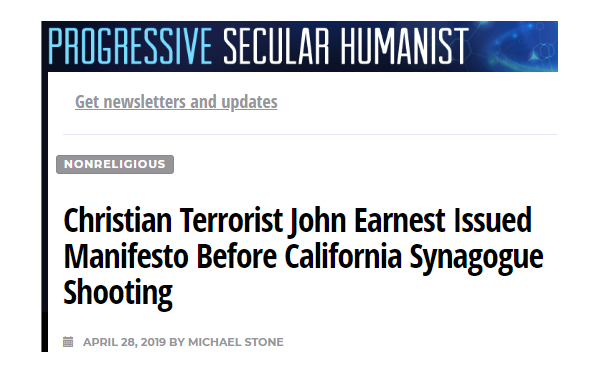
Christian terrorist?
Both words, Christian and terrorist, need examining, but they’re not the wrong words, nor the right ones. Also, note (in big print) that this is the view from a Progressive, Secular, Humanist perspective — those three words are also worth pondering.
Context, context, context, as the realtors would say if they were selling attention-space..
**
To give you some context, then, let’s consider these terrorist killings with religious targets:
The Gurdwara (Sikh temple), Oak Creek, WI, 2012
Emanuel African Methodist Episcopal Church in Charleston, NC, 2015
The Tree of Life and New Light synagogues in Pittsburgh, PA, 2018
The Al Noor and Linwood Mosques in Christchurch, NZ, 2019
Your co-religionists may have reason to feel you are outsiders
The proportions of violent to other believers varies between times, religions
Religions & groups may differ on where injustice requires redress
Listening, which involves humility, is a necessary feature of compassion.
There’s plenty of room for nuance here — as fractal theorists would say, the world is self-similar at different scales — or at the poet GM Hopkins puts it, “dappled”.
**
Let’s peer a little closer:
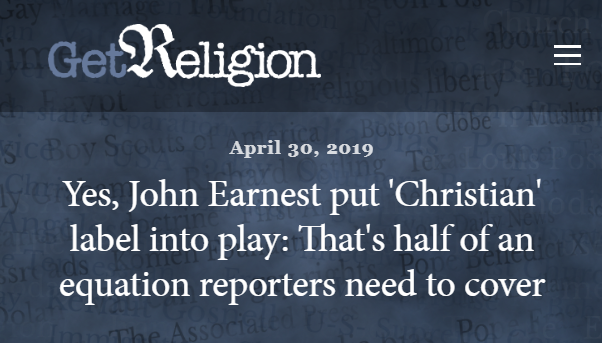
Half the equation? Presumably terrorist would be the other half?
To repeat the point that it’s not just one religion that’s involved either in violence or as a target, let’s switch religions — these things are simultaneous rather than separate:
A US army vet turned ISIS-supporter attacking neo-Nazis? That’s just one more curious instance of how these hard-to-imagine cookies crumble..
**
To return to our Christian:
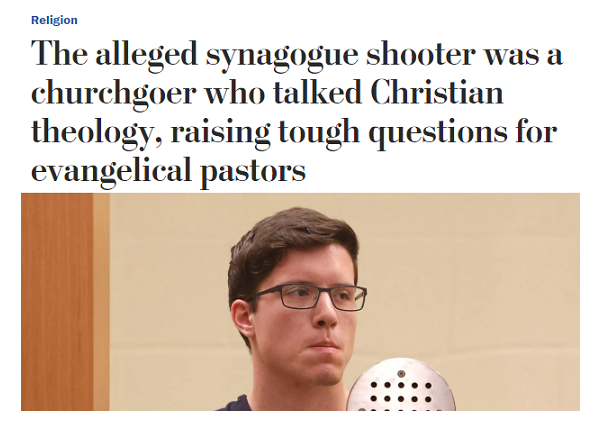
Before he allegedly walked into a synagogue in Poway, Calif., and opened fire, John Earnest appears to have written a seven-page letter spelling out his core beliefs: that Jewish people, guilty in his view of faults ranging from killing Jesus to controlling the media, deserved to die. That his intention to kill Jews would glorify God.
Days later, the Rev. Mika Edmondson read those words and was stunned. “It certainly calls for a good amount of soul-searching,” said Edmondson, a pastor in the Orthodox Presbyterian Church, a small evangelical denomination founded to counter liberalism in mainline Presbyterianism. Earnest, 19, was a member of an OPC congregation. His father was an elder. He attended regularly. And in the manifesto, the writer spewed not only invective against Jews and racial minorities but also cogent Christian theology he heard in the pews.
That’s WaPo‘s opinion, and we don’t know how strong WaPo‘s theological understanding is.
This pastor, however seems to me to get it right:
“When there’s an act of ‘radical Islamic terror’ — somebody claiming they’re motivated by their Islamic faith — if we’re going to call upon moderates in Muslim communities to condemn those things, we should do the same. I wholeheartedly, full stop, condemn white nationalism,” said Chad Woolf, an evangelical pastor in Fort Myers, Fla., who was one of the first to join in heated debate online about how the attack reflects on evangelicalism. “We should recognize that somebody could grow up in an evangelical church, whose father was a leader, and could somehow conflate the teachings of Christianity and white nationalism. We should be very concerned about that.”
Okay, I have now read the complete manifesto, and if WaPo‘s headline writers think it contains theology, WaPo is paying less than ideal attention. The manifesto quotes scriptures — Matthew 27:24-25, John 8:37-45, 1 Thessalonians 2:14-16, Revelation 2:9, Revelation 3:9 and one other verse of which he says “I forget where in the Bible this verse comes from, but it’s definitely in there” — but quoting (cherry-picking) scripture isn’t theology, it’s quoting scripture. And there’s one paragraph that might serve as an intro paragraph in some moderately bright student paper on Protestantism:
To my brothers in Christ of all races. Be strong. Although the Jew who is inspired by demons and Satan will attempt to corrupt your soul with the sin and perversion he spews—remember that you are secure in Christ. Turn away from your sin. Not because it is required for your salvation—for nobody save Christ can merit heaven based on his own works—but rather out of gratitude for the gift of salvation that your God has given you. Always remember that it is God that is keeping you alive and in faith. All sin stems from the arrogant belief that one does not need God. Satan was so prideful that he actually truly believed (that he, a created being) could overthrow the Ancient of Days—the Creator of all in existence. Satan inspired this rebellion among humanity. Christ alone is the only source of life. Know that you are saved in Christ and nothing—not death, nor torture, nor sin—can steal your soul away from God.
All else is ugliness, and I won’t quote.
What’s more lovely? By all accounts, the shooter’s father ..
[ by Charles Cameron — logic, the arts, and technology offer an Easter, resurrection corrective, philosophically speaking, to the ruin of the cathedral of Notre Dame ]
.
For the terrible fire that consumed so much of Notre Dame de Paris this week, grief is great. Here, I wish to recall some of the ways in which the essence of the great cathedral has been saved.
Above, Piero della Francesca‘s Madonna della Misericordia. Our Lady of Mercy, for whom the cathedral was named, continues to shelter us all..
**
Perhaps the most extraordinary, as well as the most abstract, form of Notre Dame to survive fire, war, and the French Revolutionary idea — to replace Mary with the goddess Reason enthroned in her place — is the logic embedded in the theology that accompanied its building and — lex orandi, lex credendi — the worship within it, for which purpose it was designed and built
The American philosopher CS Peirce was among the first to propose a kinship between Gothic architecture and the logic of the Paris schoolmen:
Art felt the spirit of a new age, and there could hardly be a greater change than from the highly ornate round-arched architecture of the twelfth century to the comparatively simple Gothic of the thirteenth. Indeed, if any one wishes to know what a scholastic commentary is like, and what the tone of thought in it is, he has only to contemplate a Gothic cathedral. The first quality of either is a religious devotion, truly heroic. One feels that the men who did these works did really believe in religion as we believe in nothing. We cannot easily understand how Thomas Aquinas can speculate so much on the nature of angels, and whether ten thousand of them could dance on a needle’s point. But it was simply because he held them for real. If they are real, why are they not more interesting than the bewildering varieties of insects which naturalists study; or why should the orbits of double stars attract more attention than spiritual intelligences?
Erwin Panofsky‘s work, Gothic Architecture and Scholasticism, is the central presentation of the parallels. Pierre Bourdieu, who translated Panofsky into French, characterizes the work:
The parallelism between the development of Gothic art and the development of scholastic thought in the period between about 1130–1140 and about 1270 cannot be brought out unless one “brackets off phenomenal appearances” and seeks the hidden analogies between the principles of logical organization of Scholasticism and the principles of construction of Gothic architecture. This methodological choice is dictated by the intention of establishing more than a vague “parallelism” or discontinuous, fragmentary “influences”. Renouncing the semblances of proof which satisfy intuitionists or the reassuring but reductive circumstantial proofs which delight positivists, Panofsky is led to identify the historical convergence which provides the object of his research with a hidden principle, a habitus or “habit-forming force”.
How could Notre-Dame be burning? How could Notre-Dame, which had survived for eight centuries—survived plague and wars of religion, survived the French Revolution, survived the Nazis—be falling? Notre-Dame, the heart of Paris, not only a Catholic site but the preeminent symbol of European cultural consciousness, the heart of France, the kilometer zero from which all its farthest villages are measured—how could this majestic structure collapse so fast
— Oh, ruin, from the Latin ruere, meaning to fall.. John Milton, Paradise Lost:
Hell saw
Heaven ruining from Heaven, and would have fled
Affrighted
Viollet-le-Duc‘s 19th century spire, in this archaic sense of the word, ruined.
Fortunately, a few years back the entire structure was mapped with ferocious accuracy by Vassar professor Andrew Tallon, using advanced laser photography to capture detail — wear and tear included, to an accuracy of a tenth of an inch:
Now, with the building having sustained untold but very substantial damage, the data that Tallon and Blaer created could be an invaluable aid to whoever is charged with rebuilding the structure. Ochsendorf described the data as “essential for capturing [the structure] as built geometry.” (He added, however, that the cathedral, no matter what happens now, “is irreplaceable, of course.”)
Tallon and Blaer’s laser data consist of 1 billion data points, structured as “point clouds,” which software can render into images of the three-dimensional space. Stitch them together, inside and out, map the photographs onto the precise 3-D models, and you have a full digital re-creation of incredible detail and resolution.
Professor Tallon died less than six months ago, in November 2018, age 49. If you’re looking for another Easter parallel, Tallon may be metaphysically resurrected with the promised rebuilding of the cathedral he so loved and diligently studied.
**
It appears that the great Rosace Nord (north rose window) survived the fire —
By far the greatest blessing – a miracle – is that the Rosace Nord has survived. The South and West windows were very extensively restored in the 18th and 19th century, but the North Rose Window has stood basically unchanged for 800 years, the glass is the 13th century original.
**
To close with a blaze..
In January of this year, Olivier Latry, titular organist of Notre Dame, made what is very likely the final recordings of music on the cathedral’s great organ, for a recording which was released in March, just weeks before the terrible fire. The organ, as built by Aristide Cavaillé-Coll in the nineteenth century, houses some 8,000 pipes; it seems the fire has left it largely intact, though with damage to its electrical systems and wind-chest.
Olivier Latry plays Johann Sebastian Bach‘s Toccata and Fugue in D minor, BWV 565 on the Cavaillé-Coll organ of Notre-Dame de Paris::
[ by Charles Cameron — the low down, the vanishing point, and the exaltation ]
.
There is no Christ: he has died, he is not yet resurrected. According to the usual English translation of the most basic of the Church’s three statements of faith, the Apostles’ Creed, he descending into hell: or as Ephesians 4.9-10 has it:
Now that he ascended, what is it but that he also descended first into the lower parts of the earth? He that descended is the same also that ascended up far above all heavens, that he might fill all things.
This worldly world is no place into which such doctrines comfortably fit. Hell? The lower parts of the earth?
No, there is a low doorway by which we may enter such a cosmos, encounter such a Christ. We must shed, in fact, reality and self-importance, twin delusions, and embrace imagination.
Above all heavens?
**
The second to final section of Bach’s St John Passion deals with this intermediate state, the boirderland between life and death, in this melancholy yet resigned chorus, Ruht wohl, ihr heiligen Gebeine:
The lyric addresses the now dead Christ
Rest well, you blessed limbs,
now I will no longer mourn you,
rest well and bring me also to peace!
The grave that is allotted to you
and encloses no further suffering,
opens heaven for me and closes off Hell.
**
The Latin of the Apostles’ Creed does not actually say that Christ descended into hell, but that he descended to those below, and this in turn is interpreted to mean that he came to those of good character who died before his coming, and were thus unable to hear the gospel he preached until this Holy Saturday — his body in the tomb, his presence preaching to them for their salvation. We are thus offered a neat answer to the otherwise tricky question — what happened to those who, through no fault of their own,never heard him.
For Christianity, this is the archetypal liminal moment, this day between crucifixion and resurrection, death and renewed life. How unimportant it seems, how humble, falling between Good Friday and Easter Day — yet there is beauty here, as the whole gospel story is beautiful.
But there is more. It is characteristic of the Passion story that Christ touches the depths of human doubt on the cross — crying My God, my God, why hast thou forsaken me?
**
As I have noted before, the Lakota medicine man Archie Fire Lame Deer told his biographer, Richard Erdoes:
I am no wino or pishko, but I am no saint either. A medicine man shouldn’t be a saint. He should experience and feel all the ups and downs, the despair and joy, the magic and the reality, the courage and the fear, of his people. He should be able to sink as low as a bug, or soar as high as an eagle. Unless he can experience both, he is no good as a medicine man.
Ifb you have not suffered as deeply as those who come to you with their sufferings, you will seem shallow to them, and be unable to console them. If youhave not experienced joy as fully as those who rejoice nearby, you will seem stiff and stilted to the, and cannot join thewir dance, their song/\.
Christ on the cross, Christ in the tomb descending to those below — bith are instances of that same descent which is the natural accompaniment of sacent — just as Chrust’s birth in a stable — no room at the inn — is the descen to vulnerable humanity of Godhead impassible — beyond all suffering.
It is in the descent that the ascent is prepared.
**
Or as Heraclitus says:
The way upward and the way downward
is one and the same
Or St John of the Cross, greatest of Spanish mystics, writing of the Dark Night of the Soul:
Although this happy night brings darkness to the spirit, it does so only to give it light in everything; and that, although it humbles it and makes it miserable, it does so only to exalt it and to raise it up; and, although it impoverishes it and empties it of all natural affection and attachment, it does so only that it may enable it to stretch forward, divinely, and thus to have fruition and experience of all things, both above and below, yet to preserve its unrestricted liberty of spirit in them all.
And again, as TS Eliot has it, who quoted that fragment of Heraclitus as an epigraph to his Four Quartets:
And the way up is the way down, the way forward is the way back.
**
I have written this post, this day, to teach myself these things, to do the necessary research, the discovery and the remembering: and I hope they will be of interest and profit to you too.
But I must post in haste — Easter Day approaches, and with it the joyful cry, Christ is risen! Christos aneste.
For your consideration — this I must listen to myself:
[ by Charles Cameron — switching between my comparative religion and cultural anthropology hats, while reading of Christian and indigenous mass graves in Nigeria — and the fear of a Rwanda-scale genocide ]
.
Villagers stood at a mass grave in Dogon Na Hauwa, Nigeria, in 2010. | (Photo: Reuters/Credit Akintunde Akinleye)
The church leaders said that “over 6,000 persons, mostly children, women and the aged have been maimed and killed in night raids by armed Fulani herdsmen,” which is prompting their cry to the government of Nigeria “to stop this senseless and blood shedding in the land and avoid a state of complete anarchy where the people are forced to defend themselves.”
That last phrase, to “avoid a state of complete anarchy where the people are forced to defend themselves”, is a telling one with an implication of considerable restraint on the part of Christians thus far..
**
Reading the piece carefully, the question arises as to the interwoven influences of tribal, religious, and cultural differences..
Consider the Catholic bishop’s comment as reported:
“Please don’t make the same mistake as was made with the genocide in Rwanda,” he pleaded, referring to the massacre of Tutsi people in Rwanda, where close to 1 million were killed in 1994.
To what extent can this conflict and slaughter be characterized as tribal?
Consider also the clash of religions — indigenous / ancestral tribal religions included — implied by the reference to Boko Haram, and the Intersociety comment:
Nigeria is drifting to [a path of] genocide through killing, maiming, burning and destruction of churches and other sacred places of worship, and forceful seizure and occupation of ancestral, worship, farming and dwelling lands of the indigenous Christians and other indigenous religionists in Northern Nigeria
Or — and this one’s of terrific importance, as implied by the comment:
raids carried out by the herdsmen on local area farmers
To what extent is the conflict one of (mobile) herdsmen vs (settled) farmers?
Fulani vs one or more other tribes
Islam vs Christianity & indigenous religions
herdsmen vs agriculturalists
**
Please note that there are two feared outcomes here, the first of which touches my heart in its implication of Christian non-violence in the face of terrible violence, while the second addresses a significant increase in the scale of that violence:<
to avoid a state of complete anarchy where the people are forced to defend themselves
the same mistake as was made with the genocide in Rwanda
Tragedy is seldom simple. If we are to avoid the worst, we need both to understand the drivers in all their subtle diversity, and to avoid the paralysis that comes from overthinking — not an east task, but a necessary one.
[ by Charles Cameron — hold onto your Stetsons, New Zealand, massacre, tips from JM Berger and Clint Watts, sadness, anger, the 8chan ouroboros, more ]
.
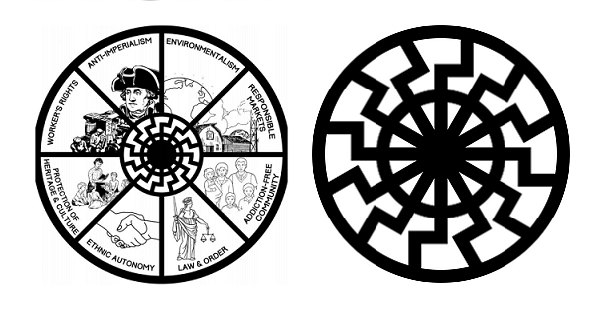
On the left, the symbol which fronts the Christchurch mosques killer’s manifesto, The Great Replacement; note the black sun wheel in the center, and compare: on the right, the Nazi SS black sun or schwartze sonne. The SPLC’s Flags and Other Symbols Used By Far-Right Groups in Charlottesville page notes:
Schwarze Sonne (Black Sun), sometimes called the sonnerad: symbol has become synonymous with myriad far-right groups who traffic in neo-Nazi and/or neo-Volkisch ideologies. The symbol is based on the ancient sun wheel artifacts that were made and used by Norse and Germanic tribes as symbol of their pagan beliefs. Those sun wheels, made centuries upon centuries ago, do not usually resemble the complexity of this particular version. The version above is inlayed into the marble floor of the Castle Wewelsburg, the castle that Himmler made the spiritual and literal home of the SS during the reign of the Third Reich, and has significance within the occult practices of the SS.
The great replacement (French: le grand remplacement) is a right-wing conspiracy theory, which states that the white Catholic French population, and white Christian European population at large, is being systematically replaced with non-European people, specifically Middle Eastern, North and Sub-Saharan African populations, through mass migration and demographic growth. It associates the presence of Muslims in France with potential danger and destruction of French culture and civilization. [ .. ]
News sources will have more details on the shootings, the shooter or shooters, the trial of Brenton Tarrant and so forth. My interest, posting here, will be in this act of cruel terrorism, in Tarrant‘s manifesto and its close relationship to Anders Breivik‘s manifesto, 2083, and whatever else emerges.
Is Islamophobia the issue here? The ideology of Branton Tarrant‘s manifesto is white supremacist, but the attacks themselves, the massacres, take place not on immigration centers, hut on two mosques — clearly identifying the spear-tip of Tarrant‘s rage.
Consider: Hatred, hatred, hatred, and prayer, prayer, prayer:
The Gurdwara (Sikh temple), Oak Creek, WI, 2012
Emanuel African Methodist Episcopal Church in Charleston, NC, 2015
The Tree of Life and New Light synagogues in Pittsburgh, PA, 2018
The Al Noor and Linwood Mosques in Christchurch, NZ, 2019
There’s context there.
**
On this most recent occasion I feel a mix of emotions:
The terrorist massacre of women, men and children in two places of Muslim worship on Friday, the Muslim day of prayer, is heartbreaking: my tears and prayers go out to the victims, their families and friends, and all in New Zealand, a small and notably peaceful country — my friend Walter Logeman, therapist and man of peace, lives in Christchurch, and my heart goes out to him this day, as it does to Marianne Elliott, known on Twitter as @zenpeacekeeper, and Leah Farrall, @allthingsct — see below.
In this moment of rage and hate, it is good to remember and praise the lives of those who untiringly promote peace and love.
So I feel sad, very sad, and grateful for my friends.
Australian Senator Fraser Anning released a statement blaming “the immigration program which allowed Muslim fanatics to migrate to New Zealand in the first place” as “the real cause of bloodshed” following Friday’s shootings.
**
Tarrant’s manifesto :
The first thing to know about Tarrant‘s manifesto is that it is propaganda:
JM: The manifesto is — We treat these often as confessional documents, which are supposed to educate us about the person — but what it really is is a work of propaganda. And this one more than most.
We can tell from the manifesto that he’s a white supremacist, he’s anti-immigrant, he’s anti-Muslim, but when you try to drill down into the details,there’s not a lot of utility in the document. [ ..
One court appearance is probably going to be more illuminating nthan the document itself.
On the mix of immigration, racist and religionist issues:
Immigration and race are closely linked issues. Anti-immigration views allow white supremacists and people who have general right-wing views to incorporate a lot of different forms of hatred under one umbrella. It’s anti-Muslim, obviously, he targeted Muslims. It’s also racist as he describes it. Immigration is a convenient umbrella or fig-leaf for underlying bigotries that are more complex.
**
Having said that, let’s dig into the weeds, and take a look at one particular item in Tarrant‘s agenda, and that of Breivik. I’ll use the example of Constantinople, but Jerusalem and Vienna would have been other candidates..
Tarrant‘s manifesto includes a Q&A in which the imagined questioner asks:
Did/do you have ties to any other partisans/freedom fighters/ethno soldiers?
to which Tarrant responds:
I support many of those that take a stand against ethnic and cultural genocide. Luca Traini, Anders Breivik, Dylan Roof, Anton Lundin Pettersson, Darren Osbourne etc.
But I have only had brief contact with Knight Justiciar Breivik, receiving a blessing for my mission after contacting his brother knights.
That’s of particular since it mentions actual contact of some sort with Breivik , and also suggests there are in fact, as Breivik suggested, more Knights Justiciar besides (the self-proclaimed) Breivik himself.
We’ll return to that. The next question and response also mentions Breivik, and emphasizes his importance to Tarrant, whose 74-page manifesto was no boubt inspired by Breivik’s own manifesto of 1,515 pages:
Were your beliefs influenced by any other attackers?
I have read the writings of Dylan Roof and many others, but only really took true inspiration from Knight Justiciar Breivik.
**
Anders Breivik scans geopolitics and notes such things as Hindu nationalism in India as well as crusades and jihad, and one of his focuses within the latter pair of concerns is Anatolia, now known as Turkey — and within Turkey, Constantinople, now known, with the inclusion of largely residential areas on the Asian side of the Bosphorus, as Istanbul.
Breivik quotes a hadith of the Prophet:
Verily you shall conquer Constantinople. What a wonderful leader will he be, and what a wonderful army will that army be!
He refers to Constantinople as a gem of the Christian world:
Constantinople, the jewel of Eastern Christendom, finally fell in 1453 to the armies of Sultan Mahomet II.
He also terms it “the greatest Christian city in the world” and nites that the First Crusade was called by Pope Urban II “in response to an urgent plea for help from the Byzantine emperor in Constantinople”
Tarrant‘s manifesto is much shrter, though 77 pages is long enough to cram in a fair amount of detail, vitriol, and propaganda, including this section, in which he too writes of the Christian city of Constantinople:
To turks
You can live in peace in your own lands, and may no harm come to you.
On the east side of the Bosphorus.
But if you attempt to live in European lands, anywhere west of the Bosphorus. We will kill you and drive you roaches from our lands.
We are coming for Constantinople and we will destroy every mosque and minaret in the city.
The Hagia Sophia will be free of minarets and Constantinople will be rightfully christian owned once more.
**
Knights Justiciar?
As we have seen, Tarrant suggests there is in fact a community of Templar Knights of the sort that Breivik also claimed:
I have only had brief contact with Knight Justiciar Breivik, receiving a blessing for my mission after contacting his brother knights.
Breivik himself in his manifesto offers an open invitation to all those Europeamns who self-identify as Knights Justiciar:
Normally, any individual who decides he want to choose the road of the PCCTS (ie Knights Templar), a road of strength and honour, courage and martyrdom, should leave any other organisation for practical reasons (first and foremost in order to protect them). He will then spend a predefined time preparing himself mentally (this cannot be emphasised enough) as well as for planning the actual operation (planning, financing and eventually execution of the plan). This may take longer than 36 months depending on the nature of the assault.
Breivik also stated that the Knights Templar had been reconstituted as an order in 2002, with founding members of the following nationalities and observances:
English Protestant, English Christian atheist, French Catholic, German Christian atheist, Dutch Christian agnostic, Greek Orthodox, Russian Christian atheist, Norwegian Protestant, Serbian Orthodox, Swedish, Belgian, and European-American
That white supremacism may be, as Breivik either knew or fantasized and hoped, an international movement is suggested by the breadth of Tarrant‘s travels, financed by his “profits from investing in the cryptocurrency Bitconnect, in such places as North Korea, Poland, Ukraine, Iceland, and Argentina [details].
Breivik‘s own sense of Temoplar membership as he understands it is reported in his manifesto:
varies from 15-80 Justiciar Knights in Western Europe (2008 estimate)
And to the extent that he wishes his manifesto to foment other actions beyond his own assaults on Oslo and Utoya, Breivik has clearly been successful.
The Newtown shooter Adam Lanza reportedly collected news clippings on Breivik’s attack and other incidents of mass violence before he killed 20 children at the Sandy Hook Elementary School. Other young men, such as the British college student Liam Lyburd, have been inspired to plan or carry out mass shootings based on their admiration for Breivik’s lethality, rather than his beliefs.
More recently:
U.S. Coast Guard Lieutenant Christopher Hasson was charged with planning a mass-casualty attack modeled in significant part on Breivik’s strategy, and bearing the marks of his belief system.
And now, courtesy of an Australian, New Zealand.
**
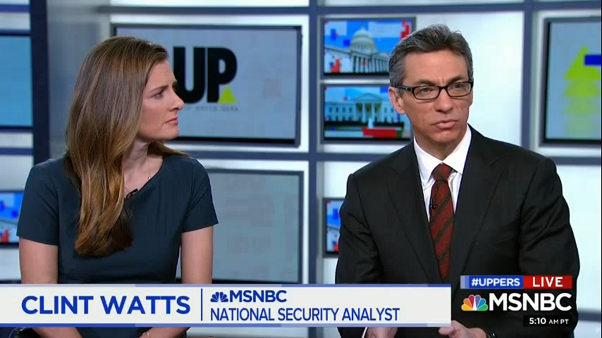
Clint Watts and cascading terrorism:
.
Clint: If you look at Al-Qaida or ISIS, it starts as this central body, this network, and then it expands out and then they inspire their followers.
In the West, it happens in reverse. Inspired followers start to network online, which build into this infrastructure.
We know this is getting more serious because the frequency and pace are picking up. When the pace picks up, that means that the network is tighter [ .. ] They’re citing each other ideologically, they’re playing to reach others’ attacks — and so this often does what I call cascading terrorism. It inspires others to begin acting.
Like a deeper layer of Hell, 8chan is an image board for anyone who is too much of an edgelord for 4chan. Created during the Gamergate fiasco when even the brass of 4chan decided that situation was getting out of hand and became a base of operations of sorts for the GG crowd.
You know, the left plays a tougher game, it?s very funny. I actually think that the people on the right are tougher, but they don?t play it tougher. OK? I can tell you I have the support of the police, the support of the military, the support of the Bikers for Trump ? I have the tough people, but they don?t play it tough ? until they go to a certain point, and then it would be very bad, very bad. But the left plays it cuter and tougher. Like with all the nonsense that they do in Congress ? with all this invest[igations]?that?s all they want to do is ?you know, they do things that are nasty. Republicans never played this.
**
Okay, horrors:
For myself as a poet, one of the great but largely unremarked horros of Brenton Tarrant‘s manifesto is its epigrap=h, spelled out in full immediately after the title, Dylan Thomas‘ great poem Do Not Go Gentle into That Good Night — with emphasis on the final line:
Rage, rage against the dying of the light..
.
Listen to Dylan Thomas himself voice this, his final, trembling plea to his dying father:
God, that’s a breth of fresh air amidst all this hatred.
The poem is one of the finest in the English language: to see it thus dragged through the mire is shocking and saddening in the extreme.
Zenpundit is a blog dedicated to exploring the intersections of foreign policy, history, military theory, national security,strategic thinking, futurism, cognition and a number of other esoteric pursuits.