zenpundit.com » arab world

Archive for the ‘arab world’ Category

Foreign Policy, Tunisia and the Net

Saturday, January 15th, 2011

[ by Charles Cameron ]

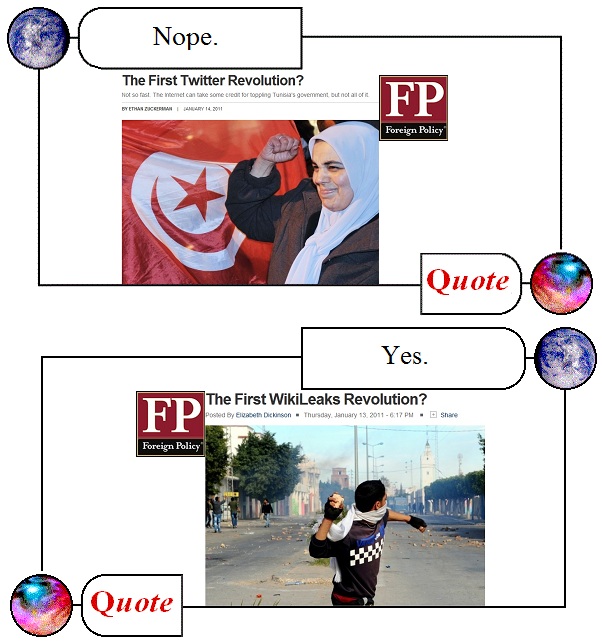
Foreign Policy has had two articles up in the last couple of days with somewhat similar headlines:

Links: TwitterWikiLeaks

The site which specifically tracks WikiLeaks on Tunisia is TuniLeaks:

My rosette for best tweet of the week goes to Galrahn and all those who RT’d him:

What a world, eh?

Ark attack

Tuesday, January 4th, 2011

[ by Charles Cameron ]

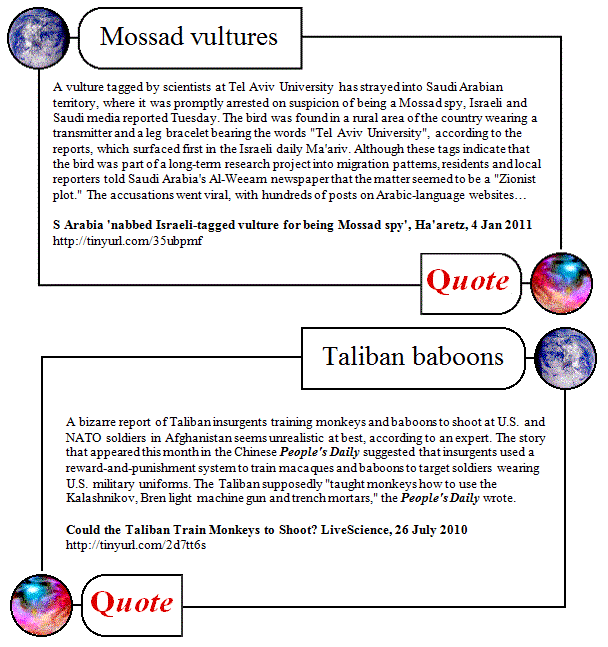
Every article I’ve read about the Mossad vulture makes some mention of another recent story, that of the Shark ‘sent to Egypt by Mossad’ of December — hence my choice to link instead to the Chinese allegation of Taliban-trained baboon platoons…

Links for this piece: vulturesbaboons

For your further edification, here’s LiveScience’s delightful illustrated compendium of the Top 10 Animal Recruits in War.

Warriors of the Spirit

Friday, December 31st, 2010

[ by Charles Cameron ]

It’s a very different approach…

I’ve been preparing to write up some of the episodes that represent how warm and close relations between Muslims and Christians can at times be – the meeting of St Francis with the Sultan Malik al-Kamil, the period of considerable tolerance and artistic flourishing under Umayyad rule in Cordoba – and I have to say I’m getting very impatient to see this film:

film poster for

.
If you would like to understand why the Qur’an (5:82) says:

The nearest to the faithful are those who say “We are Christians. That is because there are priests and monks among them and because they are free of pride.”

May I recommend you either read John Kiser’s The Monks of Tibhirine: Faith. Love and Terror in Algeria — or, when it opens in your part of the world, go see Of Gods and Men. Or both.

Wishing us all peace in the new year, decade, century…

King Abdullah’s health and the Signs of the Times

Sunday, December 19th, 2010

[ by Charles Cameron ]

King Abdullah of Saudi Arabia is currently recovering from two recent surgeries in hospital in the US, may he, may we all be blessed with good health.

1.

Dr. Kamal El-Helbawy of the Centre for the Study of Terrorism in London was quoted yesterday by [Iranian] Press TV as saying that a coup might take place in Saudi Arabia:

“It is possible that a coup could happen, and I see nothing to prevent that from happening,” Dr. Kamal Helbawy of the Center for the Study of Terrorism said in an interview with Press TV aired on Saturday. “Both in Qatar and Oman in the past, the sons of the kings stole the leadership from their fathers, and I think there is a rift in the house of Saud,” he added. [ … ] “With his old age and sickness, there is suspicion about succession. There has been tension in the family for several decades. I believe there is a political and religious crisis,” Helbawy said.

[ h/t Habiba Hamid ]

2.

I have no special insight into the affairs of the Kingdom. I only mention this press report because just today I ran across a reference to the Kuwaiti Shi’ite author Jaber Bolushi and his book [downloadable here in Arabic], Appearance of Imam Mahdi in 2015 — which brings us back to King Abdullah.

We need (IMO) to get used to the idea that every newsworthy event has the potential to spark some kind of reaction in the apocalyptic mind.

I do not wish to suggest that any given event will necessarily spark a Mahdist response — just that it may — and that we should therefore keep tabs on Mahdist and messianic sentiment in general, and note carefully what “signs of the times” might prove persuasive to those who seek such things.

3.

The Sunni site where I found Bolushi’s book mentioned, contained the following among a list of “signs” of the soon-coming of the Mahdi:

Death of King Abdullah of Saudi Arabia (we wish him long life) in 2015: The Shia believe that King Abdullah will be the last king of the House of Saud before the appearance of the Mahdi. Jaber Bolushi cites a Hadith attributed to Prophet Mohammad [saw] (the Shia claim this Hadith used to be reported in Musnad Ahmad, but was later removed) in which the Prophet mentions that the last man who will govern Al-Hijaz (the region that includes Mecca & Medina) before the Mahdi will be called Abdullah and he will be the successor of his brother who is named by the name of an animal. The previous king of Saudi Arabia was King Fahd (Fahd means leopard). It is worth noting that King Abdullah is currently 84 years old. After he dies, a dispute will occur among the royal family as to who should succeed him. There will be a strife and blood shed. Then, people will search for the Mahdi and offer him allegiance between Rukun and Maqam in the Haram Masjid in Mecca.

4.

My point is not to discuss the health of King Abdullah – I wish him well – nor the specifics of this particular prophecy – date-setting seems to me to be a fool’s errand, even according to the scriptures of the various religions where it is practiced.

My point, again, is that today’s news – whatever it is — will be “read” and understood within dozens of conflicting apocalyptic contexts, most of which we are in general unaware of, with possible repercussions on the world stage that may therefore take us by surprise.

5.

Jean-Pierre Filiu in his recently published book, Apocalypse in Islam, writes that:

ambitious militia leaders, such as Muqtada al-Sadr in Iraq and Hasan Nasrallah in Lebanon, consciously exploit popular messianic feeling in order to assert their authority at the expense of the Shi’i clerical establishment, without allowing themselves to fall captive to apocalyptic rhetoric. [ … ] For the moment, only the Iraqi militia known as the Supporters of the Imam Mahdi has actively sought to translate the rise of eschatological anxiety into political action. Yet one day a larger and more resourceful group, eager (like Abu Musab al-Suri) to tap the energy of the “masses” as a way of achieving superiority over rival formations, may be strongly tempted to resort to the messianic gambit. An appeal to the imminence of apocalypse would provide it with an instrument of recruitment, a framework for interpreting future developments, and a way of refashioning and consolidating its own identity. In combination, these things could have far-reaching and deadly consequences.

That’s the point.

Tracking the Mahdi on WikiLeaks

Tuesday, November 30th, 2010

by Charles Cameron

A quick search for “Mahdi” and “Mehdi” and “Twelfth Imam” in the 294 messages so far published in diplomatic Wikileaks reveals some references to individuals with those names, and a couple to Moqtada al-Sadr’s Jaysh al-Mahdi (spelled “Jaysh al-Madhi” in one cable by someone who is perhaps confused by the similarity of the name to that of Mahatma Gandhi), along with three cables in which Mahdism is touched upon.

1

09ASHGABAT1182 of September 16, 2009 reports a comment by an undisclosed source who is “adamant” that the US should not enter into direct talks with Iran’s leadership:

Not only, he insisted, is the Iranian leadership “untrustworthy,” and dominated by a group of “messianics,” who base crucial decisions about domestic and foreign policy on a belief in the imminent return of the “Missing” (Twelfth) Imam.

From my point of view, any foreign policy based on or strongly influenced by belief in the imminent return of a prophesied figure of good or evil, whether that figure be Moshiach or Christ or Mahdi, Antichrist or Dajjal, should be cause for concern: from a religious perspective, because messianic expectations are precisely what Matthew is talking about when he writes that “false Christs and false prophets will rise and show great signs and wonders to deceive, if possible, even the elect” (Matt 24.24) – and from a secular perspective because such identifications have been made again and again across history, often with disastrous results (think Waco, think the 1979 siege of Mecca, think the Taiping Rebellion).

That’s why I’m interested in monitoring the various strands of apocalyptic thinking out and about in the world today.

2

A little over a month earlier, on August 3, 2009, 09RPODUBAI316 under the sub-head “A Benevolent Dictator’s Fall from Grace” discussed the idea that the “Arab street” (both Sunni and Shi’a are mentioned) initially saw some Mahdist qualities in Ahmadinejad:

A Syrian journalist and blogger, who owns a media consultancy firm in Dubai, believes that many in the Arab street initially viewed Ahmadinejad when he came to power in 2005 as a “benevolent dictator.” Citing the tradition of the Mahdi, the media consultant argued that both Shi’a and Sunni Arabs are taught from early childhood to await the arrival of a strong and unimpeachable figure who will lead the Muslim world. The media consultant maintained that even secular Arabs view the world, albeit unintentionally, with this ingrained mindset. Our contact argued that Ahmadinejad played in to this narrative, and when Ahmadinejad arrived on the international stage many Arabs saw him, in contrast to their own flawed leaders, as a humble and pious man who was brave enough to stand up for his people and the greater Muslim world by confronting Israel and the West head on. However, both the intensely competitive campaign period and the forceful reaction by the Iranian people to the official election results have led some moderate Arabs to rethink Ahmadinejad’s true disposition. The election, the media consultant said, led some Arabs to understand that despite his astutely crafted and well-marketed image in the Arab world, Ahmadinejad is resented by many Iranians for domestic mismanagement, incompetence, and corruption. Because of this public fall from grace, so the media consultant told us, Ahmadinejad is no longer the “untouchable, holy figure” in the Arab world he once was — his flaws have brought him down to the level of the Arab world’s own imperfect leaders.

I’m reminded of the way that Steve Davis of Charleston, SC, among others, projected messianic qualities onto then-candidate Obama, when he wrote:

Barack’s appeal is actually messianic, it’s something about his aura, his spirit, his soul, that exudes enlightenment in the making.

I interpret Obama’s Lebanon, NH remarks as making light of that sort of projection (McCain’s video makes light of it, too), whereas Ahmadinejad appears to take his own status within the aura of the Mahdi all too seriously.

3

The last reference allows me to end on a happier note.

The French diplo Jean-Christophe Paucelle is quoted in 09PARIS1046 of July 31, 2009 on the topic of Ahmadinejad’s inauguration.

First he mentions that since non-Muslims had not been invited to previous inaugurations, European members of the diplomatic corps might not know which door to take if they wished to walk out on the ceremony, should such an action be called for… and then he discusses an additional reason why the French would attend the ceremony, despite the contested nature of the election:

Paucelle said that the case of detained French citizen Clothilde Reiss has also influenced the EU decision to attend the inauguration ceremonies. “We think she may be released soon, and we don’t want to create another irritant,” Paucelle said. “There are enough already.” He reported that the French have reason to believe Reiss may form part of a group of detainees likely to be released on the August 7 anniversary of Imam Mahdi. Paucelle noted that a letter released July 29 by Ahmadinejad supported the idea of granting clemency to post-election protesters during Mahdi celebrations. “The Iranians will need to take face-saving measures, and so she will likely transfer to house arrest or some other status,” Paucelle said. He added that, of course, she may not be released at all next week, but the French remain optimistic that she will soon be out of prison.

Clotilde Reiss was indeed not released on that occasion — but she was in fact freed somewhat later, on Sunday, May 16th, 2010.


Switch to our mobile site