zenpundit.com » arab world

Archive for the ‘arab world’ Category

Going out of fashion, fast…

Thursday, June 9th, 2011

[ by Charles Cameron — humor, analytic indicators, fashion, dictators ]
.
It seems likely from the first of these two images [Ben Ali, Saleh, Qaddafi, Mubarak, April] that manner of dress may be a valuable early indicator of how long a given dictator can hold onto power in the Middle East —

quo-vogue.jpg

— but where does that leave the lovely Asma al-Assad [in Vogue this February] today?

Answer:

oops.jpg

Guest Post: David Ronfeldt on Dignity and Democracy

Thursday, May 26th, 2011

 ronfeldt_david.jpg

Blog-friend David Ronfeldt, until recently Senior Social Scientist with the RAND International Policy Dept., is author / co-author of such seminal works as Networks and Netwars; In Athena’s Camp; In Search of How Societies Work: Tribes — the First and Forever Form; and The Zapatista “Social Netwar” in Mexico. Today he offered a detailed comment on Zen‘s post, Skulls & Human Sacrifice — the central portion of which we felt deserved to stand as a post of its own, and attract its own body of discussion. We are accordingly delighted and honored to offer it here as David’s first guest-post on Zenpundit. –CC

______________________________________________________________________________________________

For months, many arab commentators have observed that the uprisings are mainly about “dignity”: e.g., identity and dignity, or dignity and freedom, or some other combination — but always dignity.

In contrast, American observers keep saying the uprisings are mainly about “democracy” — freedom and democracy in particular. some Arabs include a call for democracy with their call for dignity; but Americans only occasionally acknowledge their parallel pursuit of dignity. in fact, Americans rarely think about dignity; we’re raised to assume it. Language about dignity slides right through our modernized minds.

Yet, in many cultures, dignity is a more crucial concept than democracy. Dignity (along with its customary companions: respect, honor, pride) goes to the core of how people want to be treated. it’s an ancient tribal as well as personal principle. indeed, it’s central to the tribal form. tribal and clannish peoples think and talk about dignity far more than do americans and other westerners in advanced liberal democratic societies.

In the Arab spring, what many arabs seem concerned about is thus more primal than democracy. They’re fed up with the indignities inflicted by corrupt, rigged patronage systems, by rulers and functionaries who act in predatory contemptuous ways, by the endless abuse of personal rights and freedoms — in other words, by all the insults to their daily sense of dignity. Of course, many Arabs seek democracy too; and dignity and democracy (not to mention justice, equality, and other values) overlap and can reinforce each other. But dignity and democracy are not identical impulses, nor based on identical grievances. in some situations, the desire for dignity trumps the desire for democracy.

This interplay between “dignity” and “democracy” may have implications for US policy and strategy. I’m not exactly sure what they are, but it seems to me that we ought to be analyzing and operating as much in terms of dignity as democracy. I bring this up not only because americans tend to overlook the significance of the dignity principle, but also because I detect a dignity-democracy fault-line among the Arab-spring’s protagonists — a fault-line that may relate to whether the Arab spring ends up having democratic or re-authoritarian consequences.

My sense is that the younger modernizing protagonists of the Arab spring may well be pursuing democracy (along with dignity) as their strategic goal, but the older, more traditionalist elements operating alongside them are more interested in pursuing dignity, without necessarily favoring democracy. and the latter may be stronger than we have observed. if so, the quest for dignity may be satisfied by outcomes that have little to do with democracy: say, for example, a shift in tribal and clan balances, an enhanced appeal for islamic law (shariah), or a charismatic call for strong government devoid of foreign influence. It may be easier, and more popular, to gratify a quest for dignity than a quest for democracy.

*

I’m led to these observations via the TIMN framework about the four major forms of organization that lie behind social evolution: tribes + hierarchical institutions + markets + info-age networks. the young modernizing protagonists of the arab spring express the nascent +N part of TIMN, while the older traditionalist elements remain steeped in the ancient pro-T part — and therein lies the fault-line I mentioned earlier.

_______________________________________________________________________________________________

For further details of Dr. Ronfeldt’s published work, see his RAND portfolio.His current interests include in particular:

  • Development of a framework (TIMN) about the long-range evolution of societies, based on their capacity to use and combine four major forms of organization: tribes, hierarchical institutions, markets, and networks
  • Development of a framework (STA) for analyzing people’s mind-sets and cultural cosmologies in terms of basic beliefs about the nature of social space, social time, and social action

He blogs recent thinking on both frameworks at Visions from Two Theories.

Rapturous times, neh?

Saturday, May 21st, 2011

[ By Charles Cameron — apocalyptic movements, best readings, budget shortfalls, lack of support for scholarship in crucial natsec areas — and with a h/t to Dan from Madison at ChicagoBoyz for the video that triggered this post ]
.
.
What with rapture parties breaking out all over, billboards in Dubai proclaiming The End and thousands of Hmong tribespeople in Vietnam among the believers, this whole sorry business of Harold Camping‘s latest end times prediction is catching plenty of attention. I thought it might be helpful to recommend some of the more interesting and knowledgeable commentary on Camping’s failed prophecy.

*

First, three friends and colleagues of mine from the Center for Millennial Studies at Boston University, about which I will have a further paragraph later:

Richard Landes of BU has a text interview here, and a TV interview here. His forthcoming book, Heaven on Earth, is a monumental [554 pp.] treatment of millenarian movements ranging “from ancient Egypt to modern-day UFO cults and global Jihad” with a focus on “ten widely different case studies, none of which come from Judaism or Christianity” — and “shows that many events typically regarded as secular–including the French Revolution, Marxism, Bolshevism, Nazism-not only contain key millennialist elements, but follow the apocalyptic curve of enthusiastic launch, disappointment and (often catastrophic) re-entry into ‘normal time'”.

Stephen O’Leary of USC wrote up the Harold Camping prediction a couple of days ago on the WSJ “Speakeasy” blog. He’s the rhetorician and communications scholar who co-wrote the first article on religion on the internet, and his specialty as it applies to apocalyptic thinking is doubly relevant: the timing of the end — and the timing of the announcement of the end. His book, Arguing the Apocalypse, is the classic treatment.

Damian Thompson of the Daily Telegraph is a wicked and witty blogger on all things Catholic and much else beside — the normally staid Church Times (UK) once called him a “blood-crazed ferret” and he wears the quote with pride on his blog, where you can also find his comments on Camping. Damian’s book, Waiting for Antichrist, is a masterful treatment of one “expecting” church in London, and has a lot to tell us about the distance between the orthodoxies of its clergy and the various levels of enthusiasm and eclectic beliefs of their congregants.

Three experts, three highly recommended books.

*

Two quick notes for those whose motto is “follow the money” (I prefer “cherchez la femme” myself, but chacun a son gout):

The LA Times has a piece that examines the “worldwide $100-million campaign of caravans and billboards, financed by the sale and swap of TV and radio stations” behind Camping’s more recent prediction (the 1994 version was less widely known).

Well worth reading.

And for those who suspect the man of living “high on the hog” — this quote from the same piece might cause you to rethink the possibility that the man’s sincere (one can be misguided with one’s integrity intact, I’d suggest):

Though his organization has large financial holdings, he drives a 1993 Camry and lives in a modest house.

*

Now back to the Center for Millennial Studies.

While it existed, it was quite simply the world center of apocalyptic, messianic and millenarian studies. CMS conferences brought together a wide range of scholars of different eras and areas, who could together begin to fathom the commonalities and differences — anthropological, theological, psychological, political, local, global, historical, and contemporary — of movements such as the Essenes, the Falun Gong, the Quakers, Nazism, the Muenster Anabaptists, al-Qaida, the Taiping Rebellion, Branch Davidians, the Y2K scare, classic Marxism, Aum Shinrikyo and Heaven’s Gate.

And then the year 2000 came and went, and those who hadn’t followed the work of the CMS and its associates thought it’s all over, no more millennial expectation, we’ve entered the new millennium with barely a hiccup.

Well, guess what. It was at the CMS that David Cook presented early insights from his definitive work on contemporary millennial movements in Islam — and now we have millennial stirrings both on the Shia side (President Ahmadinejad et al) and among the Sunni (AQ theorist Abu Mus’ab Al-Suri devotes the last hundred pages of his treatise on jihad to “signs of the end times”)…

Apocalyptic expectation continues. But Richard Landes’ and Stephen O’Leary’s fine project, the CMS, is no longer with us to bring scholars together to discuss what remains one of the key topics of our times. When Richard’s book comes out, buy it and read it — and see if you don’t see what I mean.

Or read Jean-Pierre Filiu‘s Apocalypse in Islam.  Please. Or Tim Furnish‘s recent paper.

*

And while it may not see Judgment Day or the beginning of the end of the world as predicted, what this week has seen is the end of funding of Fulbright scholarships for doctoral dissertation research abroad.  But then as Abu Muqawama points out:

hey, it’s probably safe to cut funding for these languages. It’s hard to see Iran, Afghanistan, Pakistan or anywhere in the Arabic-speaking world causing issues in terms of U.S. national security interests anytime soon.

Right?

So the CMS isn’t the only significant scholarly venue we’ve lost to terminal lack of vision.

End times in Dubai?

Wednesday, May 18th, 2011

[ by Charles Cameron — May 21st, Y2K, USS Topeka, Harold Camping ]
.
.

_45474_dubai_billboard_.jpg

I’ve been listening to Harold Camping lately, he’s been on my car radio quite a bit and I like the way he handles callers – he’s a courteous old gentleman, firm when he has to be, and very, very certain that the Bible supports his date-setting for Judgment Day just four days from now on May 21st at 6pm in whichever time-zone you happen to be in – foolish the man who straddles two time-zones on that day!

*

Digression: I say that last bit, remembering that as December 31st 1999 slipped into January 1st 2000, the USS Topeka straddled the dateline, equator, hemispheres, seasons and millennia:

Its bow in one year, its stern in another, the USS Topeka marked the new millennium 400 feet beneath the International Date;line in the Pacific ocean. The Pearl Harbor-based navy submarine straddled the line, meaning that at midnight, one end was in 2000 while the other was still in 1999… The 360-foot-long sub, which was 2,100 miles from Honolulu, Hawaii, straddled the Equator at the same time, meaning it was in both the northern and southern hemispheres. Some of the 130 crewmembers were in Winter in the North, while others were in Summer in the South…

*

In any case: this evening Camping mentioned that his representatives had managed to get permission to post some of his end-times billboards in Dubai of all places – see illustration above — and apparently they’d contacted an Emirate bureaucrat while his boss was away from the office, and received official permission. And although the permission was quickly rescinded, that fact in turn led to Arab news-media carrying the message into half a dozen other countries which might not otherwise have been informed. All this, Camping, age 89, assured his listeners, was the work of God, the CEO — and he spelled out just what those letters stand for: Chief Executive Officer.

What a story — this I had to verify! – and it’s true, Gulf News for April 13th carries a story titled ‘End of days’ billboards in Dubai to be removed, says official.

Dubai: A billboard advertisement claiming that May 21, 2011 will be the “judgment day” according to the Bible, and which shocked many and dismayed others, will be removed, a senior official said on Sunday.
.
The large billboards put up on various busy roads of Dubai such as Al Garhoud and Al Jaffiliya, carries the sentence “the great and terrible day, who shall be able to stand”.
.
Marie Sheahan, Media Representative of Family Radio, who is campaigning to put up this advertisement about judgment day, told Gulf News that she and her husband are in town from the United States to advertise and “warn people about it, regardless of nationality, religion or anything else because this will affect everybody”.

*

So… I was listening to Camping on the radio this evening, fascinated as always by the interplay between Camping himself, the true believers and the doubters, when an awful racket assailed my ears – and Camping’s warning that the entire world was about to end was rudely interrupted by a more local and immediate warning that a tornado watch would be in effect just down the road in half an hour…

Oh, the irony!

Which brings up the question of when is an emergency so urgent that it can interrupt another emergency? I mean, should a tornado watch warning interrupt a warning of the end of the world? Does an ambulance have the right of way over a firetruck if they meet at an intersection?

*

new-camping-1994.jpg

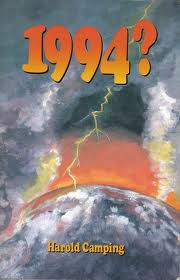
Camping’s book 1994? had a similar theme, but lacked mathematical rigor alas.

This time, he’s double-checked.

The Glenn Beck, Mahdism & Antichrist series

Wednesday, April 27th, 2011

[ by Charles Cameron ]

.

Glenn Beck has a new documentary coming out tonight on Mahdism and the Antichrist.

He calls it “the documentary that you will not see on mainstream television” and to get to see it, you have to be a subscriber to Beck’s Insider Extreme channel on the web. But then that fits with Beck’s emphasis right now — he doesn’t mind crying shame on the media for not carrying the documentary, but he doesn’t want unbelievers to see it either — he told his radio audience today:

Make sure you see it tonight at nine o’clock. And if I may recommend that you watch it with some friends. Invite some friends over, some like-minded people, don’t try to get any converts in. Pull up the nets, man, pull up the nets.

So okay — it won’t be on “mainstream television” but it will be seen in a million “like-minded” homes, and it will influence them, it will influence their perspective on Islam, and on the Middle East.

Here’s a description of what they can expect, drawn from Joel Rosenberg‘s blog today. Joel is the author of the apocalyptic thriller The Twelfth Imam, has seen the rough cut and will be appearing on the video, along with those he lists here:

Tonight on his website, Glenn Beck will premiere his new documentary film, “Rumors of War — Part Two.” As with Part One, I was interviewed for the film…

The documentary examines current events and trends in the Middle East and the Islamic world from various vantage points — Biblical End Times theology, Jewish End Times theology, and Islamic End Times theology. It discusses the latest threats from the Radical Islamic world to Israel, the West and our allies. It features a wide range of Jewish, Muslim and evangelical Christian authors and commentators in a balanced yet provocative and fascinating way. Among them:

  • Dore Gold, former Israeli ambassador to the U.N.
  • Reza Kahlili, former CIA agent inside Iran and author of A Time To Betray
  • Tim LaHaye, author of the Left Behind novel series
  • Brigitte Gabriel, author of They Must Be Stopped: Why We Must Defeat Radical Islam and How We Can Do It
  • Joel Richardson, author of The Islamic Antichrist
  • Dr. Zudi Jasser, president of American Islamic Forum for Democracy

*

The thing is, Beck doesn’t know a whole lot about these things, and his advisers get things wrong — sometimes flat out wrong, sometimes just out of proportion — too.

I aim to review Beck’s documentary along with its predecessor, and the books of Joel Richardson and Joel Rosenberg, and also take a look at some other books and articles that cover the same materials with greater scholarship and less religious special interest — notably the works of David Cook, J-P Filiu and Timothy Furnish — clear up some of this issues in which definitive corrections are in order, suggest areas where the preponderance of evidence and informed commentary leans away from Beck’s position, and raise again those urgent questions which remain.

Because from where I sit, Glenn Beck has hit on one of our blind spots — and is giving us a dangerously distorted mirror in which to view it.

*

Here’s Beck talking about the upcoming documentary this morning on his radio show:

Tonight, you don’t want to miss, on Insider Extreme, something that we have been trying to tell the story for quite some time, and I have told it to you many times before, the story of the Twelfth Imam, well this is not the full story of the Twelfth Imam, this is what people Middle East believe about the Twelfth Imam, or the Mahdi as the… Sunnis? Sunnis are in Egypt, Shias are in, ah, is it Shias in Iran or is it the other way around? I think it’s S.. Shias are in Iran. One believes in the Twelfth Imam, the others believe in the Mahdi, same guy, it is the… the… you would know it as the Antichrist. It is the, it has every earmarking of the Antichrist, every single one, I mean, he makes a peace for seven years with Egypt, he viol… — I mean with Israel, he violates it, he marks people with a number, he beheads people if they don’t submit, I mean it’s all there. It’s all there. And Ahmadinejad says that he is alive and well and orchestrating the things in the Middle East.

Did you get that? He’s not sure: “is it Shias in Iran or is it the other way around?”

If Beck has been working on this documentary for a year now, let’s hope he does in fact know the difference between Sunni and Shi’a, and that he’s using the popular gag technique of pretending not to know, so his audience — who haven’t all been working on a documentary and may well not know — can feel all the more strongly “he’s one of us”. And besides, Sunni, Shia, it’s all the same, Mahdi, Twelfth Imam, no difference at all, right?

So that’s the level of required accuracy that’s tolerated here. Which side was it wanted to keep slavery? I forget now, I think it may have been the South. Belfast — now is that Catholic, or Protestant?

*

And one last quick note from the same post on Joel Rosenberg’s blog:

As far as I can tell, Glenn Beck is leaving the Fox News Channel in part because Fox is opposed to him devoting so much time on his program to End Times issues, Bible prophecy, Iran’s eschatology, and the linkage of these things to left wing efforts to sow seeds of revolution and chaos. It’s too bad, really.

That’s an interesting data point.

*

There will be plenty to talk about, anyway:

the new documentary, Joel Rosenberg’s thriller, which I enjoyed, Joel Richardson, with whom I correspond and whom I like, the new Mahdist video in Iran which is causing quite a stir, and may or may not be an “official” Iranian production, the vexed question — vexed in all three Abrahamic faiths — of whether you can hasten the coming of the Awaited One and if so, how, and the implications of all this both in the United States and in the Middle East, the Iranian nuclear program…

The Glenn Beck, Mahdism & Antichrist blog series, coming up.

Switch to our mobile site