zenpundit.com » chicago boyz

Archive for the ‘chicago boyz’ Category

The Xenophon Roundtable

Tuesday, September 15th, 2009

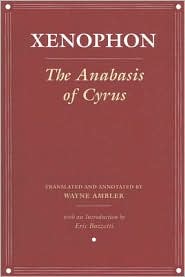
The Anabasis of Cyrus by Xenophon

Translation by Wayne Ambler.

The long awaited Xenophon Roundtable begins today at Chicago Boyz with an introductory post by our host and moderator, Lexington Green, which I reproduce in full, followed by a few comments.

Xenophon Roundtable: List of Contributors

Our Xenophon Roundtable begins this week.

Xenophon‘s Anabasis of Cyrus was written roughly 2,400 years ago. Yet it is still of interest and value today, for many reasons. It is an exciting tale of adventure. It is the first war memoir. It is a firsthand account of a military campaign that goes badly wrong, and of a man taking command and saving himself and his army from destruction. It is a travel book about exotic locales and natives. It depicts leadership under life and death circumstances. It contains remarkable examples of oratory and persuasion, where Xenophon had to convince because he could not compel. It is a portrait of conditions in the era following the victory of Sparta in the Peloponessian War. It is a comparison between the Greek way of political and military organization, and that of the Persians and other “barbarians”.

There is a lot in this very old book. I and the other participants will be putting up several posts in the next three weeks about it. I look forward to what the others will have to say.

Our distinguished roundtable participants are the following:

Disraeli1867 is a graduate of the College and the Business School at the University of Chicago. He works in venture capital and equity research.

“josephfouche” is a software engineer and system administrator slaving away for a technology startup somewhere in flyover country. He’s been reading military history since age nine and talking about it since his fourth grade teacher, asking a pro forma question, inquired if any student in the class knew anything about the Crimean War. (She got more than she bargained for.) He blogs at The Committee of Public Safety, a group blog dedicated to understanding the subtle interplay of human nature, culture, war, and power.

Fringe is a University of Chicago Alum, and is employed as an academic. He has been a student of military history and military affairs since his childhood. He knows strategists, and understands the difference between a strategist and a student of strategy. He has published on many topics and in many venues, including articles about modern warfare.

Lexington Green is a lawyer in Chicago. His common core humanities class freshman year at the University of Chicago was Greek Thought and Literature. It was the only A he got that year. Hblogs at ChicagoBoyz.

HistoryGuy99 is a historian, and U.S. Army veteran of the war in Vietnam. After having a 30 year career in global logistics, he earned an advanced degree in history and began to teach. Currently he is an adjunct history professor with the University of Phoenix and Axia College. He blogs as historyguy99 and hosts HG’s World, a blog devoted to history, connectivity, and commentary. He is a co-author of soon to be published, Activist Women of the American West and contributing author to The John Boyd Roundtable.

Steve Pressfield is the author of “Legend of Bagger Vance,” “Gates of Fire,” “The Afghan Campaign” and other historical fiction set in the Greco-Macedonian era-but nothing about Xenophon! Currently blogging about mil/pol issues in Afghanistan on It’s the Tribes, Stupid

Purpleslog is a Milwaukee-area blogger looking to enjoy and learn from an ancient true-life adventure story. He blogs at PurpleSlog.

Mark Safranski was the editor of The John Boyd Roundtable: Debating Science, Strategy, and War, and a contribution author to Threats in the Age of Obama, both published by Nimble Books. Mark blogs at Zenpundit. Mark can also be found at several well-regarded group blogs including, ChicagoBoyz, Progressive Historians and at a U.K. academic site, The Complex Terrain Laboratory. Mark is a free-lance contributor to Pajamas Media.

Seydlitz89 He is a former Marine Corps officer and US Army intelligence officer who served in a civilian capacity in Berlin during the last decade of the Cold War. He was involved as both an intelligence operations specialist and an operations officer in strategic overt humint collection. This experience sparked his serious interest in strategic theory. He is now involved in education. He participated in the Clausewitz Roundtable on ChicagoBoyz.

Dr Helen Szamuely is a political researcher and writer. She edits the Conservative History Journal and writes its blog. She also blogs on EUReferendum and Your Freedom and Ours, as well as writing occasionally for Chicagoboyz

The list of contributors may not quite be complete as of this writing. Likewise, it is not unknown in previous roundtables for a participant or two to get cold feet once the first stellar post emerges. Two previous roundtables were of a quality where a publisher decided that they merited being turned into books. I can say that I learned a great deal from everyone else who decided to go “into the arena”.

By training my specialty is 20th century diplomatic and economic history, not classical antiquity. I do not have ancient Greek under my belt or a working knowledge of that subfield’s historiography. I have it on authority that Dr. Ambler produced a first rate translation, but I am incapable of evaluating his linguistic skill. In recent years, I have taken to reading ancient history, classic texts as well as secondary sources. This is not the same thing as professional reading or evenreading the classics in the original languages, but it is far more enjoyable a pastime because when I pick up a book I am learning something new – as opposed to re-treading the same well-worn ground from a slightly different angle or sifting it for minutia and minor errors. To an extent, I also can look at The Anabasis of Cyrus with “fresh eyes” because I am not well informed regarding the controversies and implicit dogmas of classicists and historians of antiquity.

Over the summer, I read The Anabasis of Cyrus and enjoyed it, though it struck me as different from the first time, when I read a popular translation entitled “The Persian Expedition”. Ambler’s Xenophon seemed to me to be far more “present” to the reader, perhaps omnipresent, and less a creature of a distant, disinterested, narrator. I took that to be to Ambler’s credit, reconstructing Xenophon’s voice across the gap of twenty four centuries.

The discussion will be good. I hope that the readers, some of whom know a great deal about the Greek world, will join in the comment section at Chicago Boyz.

American Public Schools and History

Friday, September 4th, 2009

My amigo and blogging colleague Lexington Green had an excellent post this week on the anniversary of the invasion of Poland by Nazi Germany, abetted by Joseph Stalin’s Soviet Union, which set off WWII in Europe. Lex laments the state of historical knowlege in public schools and asks readers for their recommendations for books on the Second world War. As of this writing, there are already 47 comments:

September 1, 1939

World War II started (in Europe) 70 years ago today.

There are two sorts of people in the USA today. A tiny minority who are very interested in military history and know a lot about World War II, and a vast majority who can barely even tell you who was in it (“was that the one with Hitler?”), when it occurred (“the Seventies?”), or what it was about, or even who won (“Japan?”). American children whom I talk to are apparently taught two things and two things only about our participation in World War II: (1) The Japanese Americans were imprisoned, and that was racist and wrong, and (2) we dropped atomic bombs on Japan, and that was racist and wrong. Some know about the Holocaust. College age youth are taught that the war was an exercise in American imperialism, meant to spread expoitative capitalism across the world, and that it is a myth that the GIs went to Europe to liberate the conquered countries or to bring democracy and freedom. Even depictions that are not entirely negative, such as Saving Private Ryan, depict the war solely as a personal tragedy and pointless death and destruction, and not about anything, and certainly not about anything good or admirable. Fed exclusively on this diet for over a generation, we now have a population that sees the war in this way.

This is precisely what Pres. Reagan warned us about:

We’ve got to do a better job of getting across that America is freedom-freedom of speech, freedom of religion, freedom of enterprise. And freedom is special and rare. It’s fragile; it needs [protection]. So, we’ve got to teach history based not on what’s in fashion but what’s important-why the Pilgrims came here, who Jimmy Doolittle was, and what those 30 seconds over Tokyo meant. You know, 4 years ago on the 40th anniversary of D-Day, I read a letter from a young woman writing to her late father, who’d fought on Omaha Beach. Her name was Lisa Zanatta Henn, and she said, “We will always remember, we will never forget what the boys of Normandy did.” Well, let’s help her keep her word. If we forget what we did, we won’t know who we are. I’m warning of an eradication of the American memory that could result, ultimately, in an erosion of the American spirit.

Reagan was right. I have gone beyond being distressed about all this to being fatalistically resigned. With historical memory either non-existent or actively corrupted, those of us who care about these things will have to preserve the record as best we can.

At The Corner (updated here) they are asking people to list their favorite books on World War II. This is a good idea, and I solicit your suggestions in the comments. The Boyz readership always suggests something I have not heard of already. Please list two or three favorites, in the comments. I could spend all day doing this, but I will abide by my own rule, and limit myself to three.

Read the rest here:

You should read the rest, as well as the comments, many of which are informative and a few of which qualify as entertaining. While I am very tempted to discuss books and historiography, I will instead address the teaching of history in our public schools.

The ideological Marxoid craziness of which Lex writes does indeed exist, though it is far more common in university courses than in secondary school classrooms ( Oak Park, though, is a pretty liberal UMC burg) and more common in urban school districts on the coasts than in the Midwest or South. In particular, I have seen firsthand at national conferences, teacher-zealots from California who appear to have been kicked out of Trotskyite Collectives for excessive radicalism and who are more like the mentally unsound homeless than someone entrusted with the education of children. They are largely scary exceptions though. The main problem with the teaching of history in our public schools is that as far as subjects go, history is a tertiary concern of government officials, administrators and school boards; as a result, most of history instructors are hard working and well-meaning people who are by education, totally unqualified for the positions they hold.

This is not to say that these history teachers do not have college degrees, They do, usually they are education or English lit majors with a scattering of PE and business majors whose main career concern is becoming varsity football or basketball coach. A few were punitively reassigned to history departments out of fields they are highly qualified to teach because they are good teachers and administrators saw them as capable of filling a gap in the master schedule, credentials be damned.

Nor would I say that these teachers do not care about children or shirk their responsibilities. By and large they are professionals who are dedicated to and care about the welfare of their students. The problem is that they don’t know much history – and it is very difficult to teach something well that you yourself do not even know enough about to be aware of the parameters of your own ignorance.

In 1997, education scholar Diane Ravitch wrote:

…Of those teachers who describe themselves as social studies teachers, that is, those who teach social studies in middle school or secondary school, only 18.5% have either a major or a minor in history. That is, 81.5% of social studies teachers did not study history in college either as a major or as a minor. In case you thinkyou didn’t hear me correctly, let me say it again: 81.5% of social studies teachers did not study history in college either as a major or a minor. This figure helps to explain why history is no longer the center of the social studies, since so few social studies teachers have ever studied history

What? “Well that was twelve years ago!” you say? My friend, the vast majority of that 81 % of unqualified teachers are still teaching today. And most of that remainder are still as unqualified now as they were in 1997. Imagine the state of our buildings and bridges if 81% of the professors of engineering had majored in, say Art Criticism or Women’s Studies.

Aggravating matters, even if a prospective teacher did major in history in college, fewer of their professors were full-time history instructors than ever before, meaning that even the quality of the small minority of teachers who are history majors is going into decline! NCLB scorns history as a subject, so school districts across the nation will continue to starve it. Poorer districts will fire all the social studies teachers in coming years and parcel out the history sections to unwilling English teachers in order to save the jobs that will preserve reading scores (assuming those are making AYP in the first place). After that, the science teachers will start to get the axe.

Students know a few bare minimum things about WWII, what can be gleaned from dumbed-down, turgidly written, textbooks that are long on glossy pictures and short on engaging prose, plus what they might catch on the History Channel which is seldom short of Nazi-related documentaries. It is unsurprising that most high school students are ignorant of their own nation’s history – given the state state of the field, it would actually be surprising if they knew anything at all.

We are deliberately cultivating a level of societal ignorance that is a deadly longitudinal threat to the continuance of democratic governance and individual liberties in this country. Maybe that was always part of the plan.

Ten Books I Want to Read Again

Sunday, June 21st, 2009

My bibliomaniacal co-blogger at Chicago Boyz, Lexington Green, just created a new internet meme, with a post entitled Ten Books I Want To Read Again:

I have too little time to read, let alone re-read. But there are certain books that had an impact on me, that I think about from time to time, and that I have an urge to re-read. I suppose that re-reading, or at least wanting to re-read is a sign that a book is part of a person’s quantum library. I have more, but I will pick ten:

  • Charles Norris Cochrane, Christianity and Classical Culture: A Study of Thought and Action from Augustus to Augustine
  • Eric Rucker Eddison, The Worm Ouroboros
  • Robert A Heinlein, The Moon is a Harsh Mistress
  • Homer, The Iliad
  • George Orwell, 1984
  • Quentin Reynolds, They Fought for the Sky: The Dramatic Story of the First War in the Air
  • Thomas Sowell, Knowledge and Decisions
  • Leo Tolstoy, War and Peace
  • Evelyn Waugh, The Sword of Honor Trilogy

• H.G. Wells, The War of the Worlds

A few years ago I re-read Starship Troopers, which had a huge impact on me when I was 11 years old. It was just about as good as I remembered it. I also re-read 1984 about five years ago. I first read 1984 when I was ten years old. I read it a couple of times afterwards. It is absolutely foundational to my thinking. In the ensuing years, I have read almost everything else by Orwell. I found that 1984 was much better than I remembered it being – So much so that I will certainly to go back to it one more time.

Quantum Library are those books that you read repreatedly because each time you find insights that you had missed or misunderstood previously. While many classics fall into that category, it can be any book with enough pull that you spent the time to read it again. Highbrow literature is not required.

Here are my ten, no particular order:

1. History of the Decline and Fall of the Roman Empire by Edward Gibbon.

Gibbon, along with Clausewitz and Ranke contributed mightily to the development of the historical profession, with Gibbon as a great inspirationfor many others and a daunting intellectual in his time ( Benjamin Franklin unsuccessfully sought a dinner invitation with Gibbon, while a lobbyist for colonial interests in London). I last read The Decline and Fall as an undergraduate.

2. Nonzero: The Logic of Human Destiny by Robert Wright.

Tom Barnett brought up Wright recently, which reminded me how much I liked Wright’s influential explanation of cultural evolution as a force in the Darwinian ratchet in Nonzero.

3. Bell Curve: Intelligence and Class Structure in American Life by Richard J. Herrnstein and Charles Murray.

Probably the most vilified yet least read by critics book of the last thirty years.

The authors staked out an extreme hereditarian position in regard to the “g” factor of IQ, which they took great delight in juxtaposing in one chapter and one appendix section with aggregate mean demographic statistics in such a way as to rub academic PC sensibilities raw. This politically calculated gesture let them ride to the bestseller’s lists on a wave of outrage, a good part of which was self-discreditingly ignorant of psychometric testing, genetics, economics and social science methodology, which drowned out the more perceptive critics. now that the furor is long past, it would be interesting to re-read The Bell Curve in light of subsequent scientific discoveries about neurolearning and intelligence.

4. The Closing of the American Mind by Allan Bloom.

Read it when it first came out and was carrying it into a philo gen ed class which caused my professor, a pompous ass who disliked me for some conservative opinion I once had the temerity to voice, to pause and announce “Well…at least you are reading a serious critic”. He was reading it as well.

5. The Master and Margarita by Mikhail Bulgakov.

Bulgakov was the anti-Soviet novelist who happened to also be Stalin’s favorite playwright ( Bulgakov was the author of The White Turbans, which Stalin delighted in repeatedly watching – a quirk of fate which saved Bulgakov’s life and freedom). An unhappy man of great imaginative powers, Bulgakov’s great novel had something like a quarter of a million or half a million words excised by Soviet censors. I’m curious if more accurate editions have been issued.

6. Battle Cry of Freedom: The Civil War Era by James M. McPherson.

One of the best single volume histories of the Civil War. A “gateway” book to other Civil War histories.

7. The Catcher in the Rye by J.D. Salinger.

For anyone who was ever Holden Caulfield – or who had to teach him.

8. The Great Terror: A Reassessment by Robert Conquest.

This is a hybrid pick because I read The Great Terror and also Conquest’s Reassessment. Conquest is always worth reading, an old school man of letters of whom we will see no more of his like.

9. The Best and the Brightest by David Haberstam.

The seminal, anti-Vietnam War book by a lionized Establishment figure ( lionized now, not during the war), the title of which became a term of cultural literacy. Appropriate because the current administration seems to be too cocksure that they too are best and brghtest.

10. The Possessed (The Devils) by Fyodor Dostoyevskii.

Dostoyevskii’s psychological portrait of faddish radicalism, earnest nihilism, and incipient terrorism in a provincicial backwater in Tsarist Russia, is another classic that fits the spirit of our times. The Possessed is less ponderous and more satirical than Crime and Punishment and more cohesive than The Idiot.

What are your ten ?

The Kilcullen Doctrine

Friday, May 29th, 2009

Dr. John Nagl, president of CNAS, lead author of The U.S. Army/Marine Corps Counterinsurgency Field Manual, retired lieutenant colonel and top COIN expert, has penned an important review of Accidental Guerrilla by Col. David Kilcullen, in the prestigious British journal RUSI. Unfortunately, at present no link is is available, but my co-author Lexington Green is a subscriber and sent me a copy of the review, which I read last night. I now look forward to reading Kilcullen firsthand and have put Accidental Guerrilla near the top of my summer reading List.

I state that Nagl’s review is important because beyond the descriptive element that is inherent in a review, there is a substantive aspect that amounts to an effective act of policy advocacy. First, an example of Nagl’s descriptions of Kilcullen’s arguments:

We do not face a monolithic horde of jihadis moti vated by a rabid desire to destroy us and our way of life (there are some of these, although Kilcullen prefers to call them takfiris); instead, many of those who fight us do so for conventional reasons like nationalism and honour. Kilcullen illustrates the point with the tale of a special forces A-Team that had the fight of its life one May afternoon in 2006. One American was killed and seven more wounded in a fight that drew local fighters from villages five kilometres away who marched to the sound of the guns – not for any ideological reason, but simply because they wanted to be a part of the excitement. ‘It would have shamed them to stand by and wait it out’, Kilcullen reports

Tribal and even “civilized” rural people, often find ways of making social status distinctions that relate to behaviour and character rather than or in addition to the mere accumulation of material possessions (Col. Pat Lang has a great paper on this subject, “How to Work with Tribesmen“). We can shorthand them as “honor” cultures and they provide a different set of motivations and reactions than, say, those possessed by a CPA in San Francisco or an attorney in Washington, DC. People with “honor” are more obviously “territorial” and quick to defend against perceived slights or intrusions by unwelcome outsiders. This is a mentality that is alien to most modern, urbanized, 21st century westerners but it was not unfamiliar all that long ago, even in 19th and early 20th century, Americans had these traits. Shelby Foote, the Civil War historian, quotes a captured Southern rebel, who responded to a Union officer who asked him, why, if he had no slaves, was he was fighting? “Because you are down here” was the answer.

While relatively short and designed, naturally, to help promote a book by a friend and CNAS colleague, Dr. Nagl has also taken a significant step toward influencing policy by distilling and reframing Dr. Klicullen’s lengthy and detailed observations into a reified and crystallized COIN “doctrine”. A digestible set of memes sized exactly right for the journalistic and governmental elite whose eyes glaze over at the mention of military jargon and who approach national security from a distinctly civilian and political perspective:

There is much first-hand reporting in this book, based on Kilcullen’s [Robert] Kaplan-esque habit of visiti ng places where people want to kill him. After chapters detailing his personal experience in Afghanistan and Iraq, he returns to his doctoral fieldwork in Indonesia, discusses the insurgencies in Thailand and Pakistan and evaluates the complicated plight of radical Islam in Europe. While all of these confl icts are related to each other, they are not the same, and cannot be won based on a simplistic conception like the global War on Terror; instead, the enemy in each small war must be disaggregated from the whole, strategy in each based on local conditions, motivations, and desires. One size does not fit all, and there are many grey areas. A ‘with us or against us’ approach is likely to result in far more people than otherwise being ‘against us’ in these conflicts.

John Boyd would have agreed that isolating our enemies and winning over groups as allies is much preferred to needlessly multiplying our enemies. That paragraph is more or less boilerplate in the COIN community but this RUSI review is aimed not at them but at political decision makers, national security bureaucrats, diplomats and elite media and constituted a necessary set up by Nagl for “The Kilcullen Doctrine” [bullet points are my addition to Nagl’s text, for purposes of emphasis]:

….In direct oppositi on to the ideas that drove American interventi on policy two decades ago, Kilcullen suggests ‘the anti -Powell doctrine’ for counter-insurgency campaigns.

  • First, planners should select the lightest, most indirect and least intrusive form of intervention that will achieve the necessary effect.

  • Second, policy-makers should work by, with, and through partnerships with local government administrators, civil society leaders, and local security forces whenever possible.

  • Third, whenever possible, civilian agencies are preferable to military intervention forces, local nati onals to international forces, and long-term, low-profile engagement to short-term, high-profile intervention.

New doctrines emerge because ideas are articulated at the moment in time when they both fit the circumstances and the intended audience is ready to accept their implications. George Kennan, the father of Containment in 1946-1947 had attempted to give the State Department and the Roosevelt administration essentially the same advice about Soviet Russia in the 1930’s and the reaction of the White House was to order the State Department’s Soviet document collection destroyed and exile critics of Stalin like Kennan from handling Eastern European affairs ( Kennan saved the collection by storing it in his attic). Neither Stalin’s nature nor Kennan’s opinion of the USSR changed much in the next decade, but the willingness of American liberal elites to consider them did, making Containment doctrine a reality.

The post-Cold War, Globalization era elite is in the ready state of mind for a “Kilcullen Doctrine”. They are ready to hear it because systemic uncertainties have made them justifiably skeptical of old prescriptions and they are seeking new perspectives the way the Truman White House invited Kennan’s Long Telegram. This situation is both good and bad in about equal measure.

The good comes from the fact that the Kilcullen Doctrine is operationally sound, at least for specifically handling issues of complex insurgencies. It is also politically astute, in that it encourages statesmen and military leaders to first tinker with minimal measures while listening acutely for feedback instead of charging in like a bull in a china shop, to empower locals rather than engaging in the military keynesianism equivalent of enabling welfare dependency, as the U.S. did in South Vietnam and initially in Iraq. Kilcullen is also a reluctant interventionist, a healthy sentiment, albeit one unlikely to survive in doctrinal form.

The bad is multifaceted. None of these are dealbreakers but all should be “handled” by the COIN advocates of a “Kilcullen Doctrine”:

First, Kilcullen’s three principles are an operational and not a genuinely strategic doctrine. In fairness, no major COIN advocate has ever said otherwise and have often emphasized the point. The problem is that a lot of their intended audience – key civilian decision makers and opinion shapers in their 30’s-50’s often do not understand the difference, except for a minority who have learned from bitter experience. Most of those who have, the Kissingers, Brzezinskis, Shultzes etc. are elder statesmen on the far periphery of policy.

Secondly, this operational doctrine requires a sound national strategy and grand strategy if it is to add real value and not merely be a national security fire extinguisher. Kilcullen may say intervention is unwise but that is really of no help. Absent a grand strategy with broad political acceptance, policy makers, even professed isolationists, will find situational (i.e. domestic political reasons) excuses for intervention on an ad hoc basis. That George W. Bush entered office as a sincere opponent of “nation-building” and proponent of national “humility” should be enough to give anyone pause about a president “winging it” by reacting to events without a grand strategy to frame options and provide coherence from one administration to the next.

Thomas P.M. Barnett, a friend of this blog, has been articulating a visionary grand strategy since 2004 in a series of books, the latest of which is Great Powers: America and the World After Bush, where he essentially models for the readers how a grand strategy is constructed from historical trajectories and economic currents to make the case. Barnett’s themes have a great consilience with most of what COIN advocates would like to see happen, but Dr. Barnett’s public example of intellectual proselytizing and briefing to normal people outside of the beltway is even more important. Operational doctrine is not enough. It is untethered. It will float like a balloon in a political wind. It is crisis management without a destination or sufficient justification for expenditure of blood and treasure. If these blanks are not filled in, they will be filled in by others.


COIN advocates will have to bite the bullet of working on national strategy and grand strategy, building political coalitions, speaking to the public and wading into geoeconomics and the deep political waters of the long view. For a some time, they have had the excuse that as uniformed officers, such questions were above their pay grade – and this was the scrupulously, constitutionally, correct position, so long as that was the case.

That era is swiftly passing and most of these brilliant military intellectuals now have (ret.) in their titles and wear business suits rather than fatigues. COIN is not an end in itself. The horizon is much wider now and we should all be ready to pitch in and help.

ALSO POSTING ON THIS TOPIC:

SWJ Blog –  Weekend Reading and Listening Assignment

Thomas P.M. Barnett – Safranski on Nagl on Kilcullen

The Strategist – Sunday reflection: on “The Accidental Guerrilla”

MountainRunner –Recommended Reading: Kilcullen Doctrine

Abu Muqawama – Dogs and cats, living together. Mass hysteria!

HG’s World – A Brief on the Accidental Guerrilla by Zenpundit

Information Dissemination New Doctrines Without Strategic Foundations

Galrahn is right, I have not quite fleshed things out in my post and could use the help. He’s also clarified that the discussion needs to shift to the “why”, the objectives, with which I was not particularly clear by the use of “strategy” which means different things to different people, even those versed in military affairs.

The Anabasis of Cyrus

Thursday, May 21st, 2009

The Anabasis of Cyrus (Agora) by Xenophon. Translator,  Wayne Ambler

Arrived a few days ago. Now I am set for Lexington Green’s Xenophon Roundtable in September 2009.

….They decided, then, to pack up what they had, arm themselves, and proceed forward until they should meet with Cyrus. When they were about to set out, as the sun was rising, there arrived Procles, the ruler of Teuthrania, born of Demaratus the Laconian, and Glus, the son of Tamos. They said “Cyrus is dead” and said that Ariaeus had fled with the other barbarians….”


Switch to our mobile site