zenpundit.com » chicago boyz

Archive for the ‘chicago boyz’ Category

Reagan Roundtable: The Introduction

Sunday, February 6th, 2011

Cross-posted at Chicago Boyz:

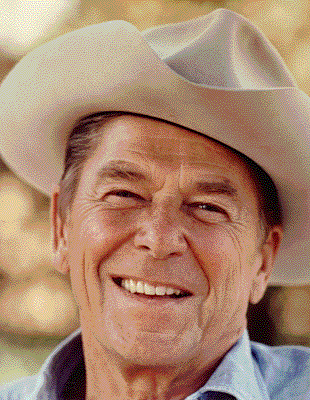
 Ronald Wilson Reagan (1911 – 2004) 40th President of the United States of America

Welcome to the Ronald Reagan Roundtable at Chicago Boyz.

A few presidents have put their stamp on this nation and even fewer have done so on the world. While the top tier historical position is held, by nearly universal accalamation, by Abraham Lincoln and Franklin Delano Roosevelt, a select number of presidents occupy the second tier of greatness, having by their words and deeds changed America and their times, for better and for worse. Among this group,  I believe, is Ronald Wilson Reagan, who entered office as the oldest man ever to be elected to the presidency and left it when a new world was being born.

Ronald Reagan would be 100 years old today, having missed the mark by a mere seven years. It would be too much to say that this has been the century of Ronald Reagan, but we should take time on this anniversary to reflect  on how Reagan impacted his century. What is the legacy of President Reagan? That is the question for this roundtable, one we hope to answer in the next ten days.

All Chicago Boyz bloggers, whose names appear on the margin – including but not limited to Lexington Green, Joseph Fouche, Jonathan, Charles Cameron, Onparkstreet and Dr Helen Szamuely –are free to weigh in on this question, but we are very pleased to also have some special guest bloggers as participants in this roundtable who I would like to take a moment and introduce:

Dr. Steven Metz:  Dr. Steven Metz is Chairman of the Regional Strategy and Planning Department and Research Professor of National Security Affairs at the Strategic Studies Institute. Dr. Metz has a distinguished academic career and has served on numerous government and private sector advisory panels for national security and military affairs. He currently serves on the RAND Corporation Insurgency Board and blogs for The New Republic and National Journal.  Metz. is the author of Iraq and the Evolution of American Strategy and is working on a book entitled “Strategic Shock: Eight Events That Changed American Security.”

Steve Schippert: is a co-Founder of ThreatsWatch and of the Center for Threat Awareness where he serves on the Board of Directors. Steve is the Managing Editor of ThreatsWatch and is the Producer of its FireWatch program. Steve served in the U.S. Marine Corps from June 1985 to June 1993, including service during Operations Desert Shield and Desert Storm to liberate Kuwait.  Steve has also been published in the Washington Times and online at the Weekly Standard and the National Review and is currently a regular contributor at National Review Online’s MilBlog, The Tank. Steve is Crane Durham’s terrorism and national security expert on Durham’s Nothing But Truth daily national radio broadcast on the American Family Radio Network. Steve has also provided terrorism, security and military analysis on The Hugh Hewitt Show, The John Batchelor Show, The Martha Zoller Show and others, and his written work has been featured on MSNBC.

Joseph Guerra: is a former US Marine and Army intelligence officer who served in a civilian capacity in Berlin during the last decade of the Cold War. Guerra was involved as both an intelligence operations specialist and an operations officer in strategic overt humint collection and now blogs and posts on the internet under the moniker “seydlitz89″ and can be contacted at seydlitz89 at web.de. He lives with his family in northern Portugal and works in education.  His latest paper is, “The Clausewitzian Concept of Cohesion as a Theory of Political Development,” which was developed from one of his posts on the Chicagoboyz Clausewitz Roundtable. His writings have appeared at Clausewitz.comDefense and the National Interest and Milpub.

Shane Deichman: has spent nearly two decades in the national security field as both a scientist and a manager. He is a 1994 graduate of the U.S. Naval War College. He spent four years in the Fleet Marine Force as a science and technology advisor. Shane founded his own company in 2008 (EMC2 LLC, a consulting company focused on emergency management and disaster preparedness) and is a consultant at the National Missile Defense Agency. He blogs at Wizards of Oz, Dreaming 5GW, and Antilibrary and was a contributing author to The John Boyd Roundtable.

Historyguy99: is a historian, and U.S. Army veteran of the war in Vietnam. After having a 30 year career in global logistics, he earned an advanced degree in history and began to teach. Currently he is an adjunct history professor with the University of Phoenix and Axia College. He blogs as historyguy99 and hosts HG’s World, a blog devoted to history, connectivity, and commentary. He is a co-author of soon to be published, Activist Women of the American West and contributing author to The John Boyd Roundtable.

James Frayne: James Frayne is a London-based political consultant. Over the last ten years he has worked on a number of high profile political campaigns and has advised many of the world’s best known brands on their communications and strategy. James edits the blog, The Campaign War Room.

[Note: Cheryl Rofer has graced Chicago Boyz on several occasions and may participate in this roundtable as time permits]

Cheryl Rofer: Cheryl’s career has moved from the hard sciences to the social sciences, the hard sciences informing her analysis of international relations. With an A.B. from Ripon College and an M.S. from the University of California at Berkeley, both in chemistry, she has worked on the nuclear fuel cycle, fossil fuels, lasers, technologies for destruction of hazardous wastes and decommissioning of nuclear weapons, and management of environmental cleanups from New Mexico to Estonia and Kazakhstan. Her travels have taken her to both countries, and she is learning Estonian. She blogs at Phronesisaical.

Additional participants and bios TBA.

Let the roundtable begin!
Egypt: the jihad’s receding tide?

Saturday, February 5th, 2011

[ by Charles Cameron — cross-posted from Chicago Boyz ]

Here’s the evidence I’m seeing for one hopeful outcome…

From an Egyptian FaceBook page:

I will NOT accept that religious groups hijack what we have been doing for their own agenda. A large group of the ones organizing them yesterday were people in galabeyas and long beards shouting “Al Jihad fe Sabeel Allah (Jihad in the name of Allah), you have to continue fighting, we will win this war, if you die here today, you will be a martyr and go straight to heaven, don’t stop, fight, fight, fight”. NO! This is NOT why we were in the streets on Friday being tear gassed and dodging rubber bullets and it is not why we have been going to Tahrir everyday to be heard. The reason why this revolt went through and became successful was because it was not religiously or politically charged.

quoted on the The International Centre For The Study Of Radicalisation blog – ICSR is a joint venture between King’s College London, the University of Pennsylvania, Israel’s Interdisciplinary Center, Herzliya, and the Jordan Institute of Diplomacy.

*

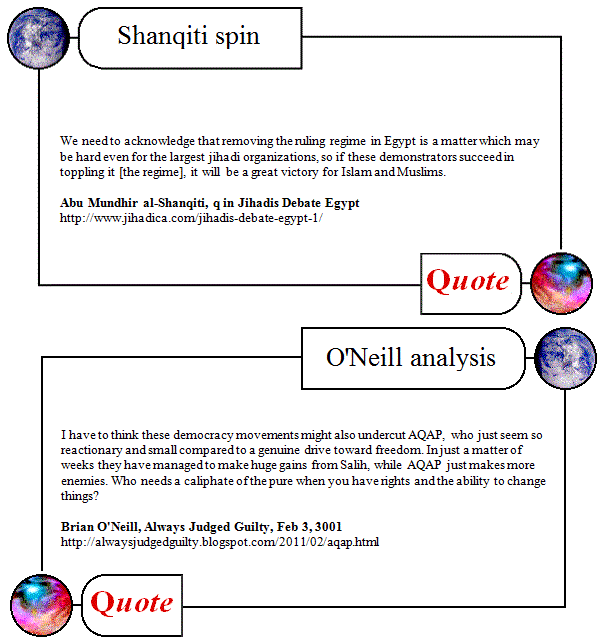
This DoubleQuote first presents a jihadist spin on things, from a legal team member at Minbar al-Tawhid wa’l-Jihad, in Quote #1:

Below that, and lending it both context and irony, is a comment from one of our best analysts of the situation in the Yemen, a former editor for the Yemen Observer.

*

John Robb gives the same general message a little strategic push…

What’s the best way to defuse Islamic radicalism across the ME and beyond? Help make the protest in Egypt work.

.
Sources: ICSRShanqitiO’NeillRobb Feb. 3, 2011.

Ronald Reagan Roundtable Begins Sunday at Chicago Boyz

Saturday, February 5th, 2011

As previously announced, to commemorate the 100th birthday of President Ronald Wilson Reagan, there will be a Roundtable hosted at Chicago Boyz blog starting February 6th featuring the stable of Chicago Boyz contributors and an august panel of invited guest-posters from a range of philosophical perspectives and disciplinary backgrounds.

On Saturday night, I will put up the introductory post, highlighting our guest posters and making some remarks appropriate for the occasion, after which, participants are free to post as often or at whatever length they deem sufficient until February 16th, at which point the roundtable will come to a close.  I will be linking to all posts here at ZP and I encourage my readers to visit Chicago Boyz and comment there directly.

Sunday, is of course, aside from Reagan’s 100th birthday, the Superbowl. I think President Reagan would have liked that coincidence, given his most famous movie role, to have his centennial be associated with America’s hallowed day of football. It also allows me to say that with this Roundtable, regardless of the participants’ take or clash of views, we will accomplish one thing:

” WIN ONE FOR THE GIPPER!”

DQ Egypt: impact on Israel

Wednesday, February 2nd, 2011

[ by Charles Cameron [hoping Zen’s ISP will be back up shortly] — cross-posted from ChicagoBoyz ]

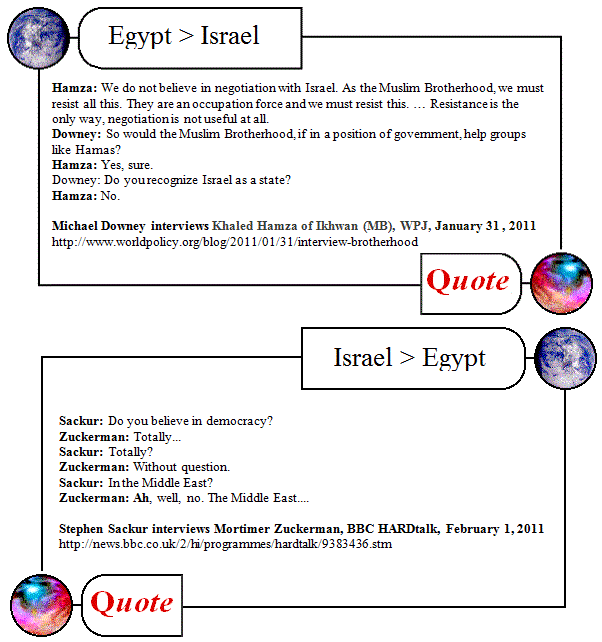
Someone posted an excerpt from an interview with Khaled Hamza, the webmaster of the Muslim Brotherhood, as a comment on an earlier post of mine on ChicagoBoyz, where I also blog, and I was interested enough to track the original interview down, and have presented the key points of the excerpt here in Quote #1.

I am pairing it, in Quote #2, with an excerpt from an interview the BBC recently conducted with Mortimer Zuckerman – because I find the two quotes taken together suggest something of the complexity of the breaking situation in the Middle East.

*

I’d like to float a trial balloon / try a though experiment, if I might. And since I’m more “tail” than “left” or “right wing”, I’ll be posting this in more than one place, and hope to get comments from all sides…

On the face of it, Zuckeman is applying what’s arguably a racist double-standard. He advocates democracy, “totally” and “without question” – but not for the Egyptians, or at least not today or tomorrow.

On the face of it, the Egyptian public seems distinctly unenthused by Mubarak’s regime and will, in a democratic election, presumably vote in a fair number of Muslim Brotherhood representatives – though it’s by no means clear that they would be in the majority, and their present ideology in any case is closer to the processes of electoral politics than those of violent jihad.

So there is reason for Israel to be concerned, and reason for those who support democracy to see some hope for democracy, in the ongoing events in Egypt.

Let me put it this way: Quote #1 illustrates why Zuckerman might make the remarks quoted in Quote #2, while Quote #2 illuminates why Hamza might make the remarks quoted in Quote #1.

*

And here’s the thought experiment — I’d like to come at this from a Maslovian angle.

Maslow’s Hierarchy of Needs

I’d like to suggest that “democracy” is an ideal, or to get away from that word with its somewhat ambiguous political connotations, an activity of the “the better angels of our nature” – and thus, from a Maslovian perspective, an aspect of a group or nation’s “self-actualization” level of interest, whereas “stability” would fall under “safety” or even “physiological”.

If that’s right, Zuckerman is at least arguably articulating a “stability first, eventual democracy would be ideal” position.

Does that “Maslovian” formulation throw any additional light on the situation?

*

The problem with the position I just described is nicely articulated by Mohammad Fadel at the very end of a Foreign Policy post, Can Black Swans lead to a sustainable Arab-Israeli peace? — and it’s only his conclusion I’m quoting here:

Tunisia and Egypt have demonstrated categorically that any peace which relies on the stability of police states is doomed from the outset.

If a butterfly flapping its wings in Brazil can in theory cause a tornado in Texas – heaven alone knows what someone blinking in Cairo or Jerusalem or Washington can do.

Myself, I pray for empathy, which seems a reasonable request, I hope for wisdom, which seems a great deal more chancy — and I long for peace.

In the current environment of hatred and mistrust, that seems entirely beyond the capacity of anyone’s present thinking to achieve.

Best Books About Reagan

Thursday, January 20th, 2011


From my colleague, Lexington Green at Chicago Boyz:

Best Books About Reagan

ChicagoBoyz will be hosting a roundtable discussion to celebrate the centenary of the birth of President Reagan, the week of February 6th 2011.

In the meantime I would like to get the views of our contributors and readers on what are the best books about Reagan, the Reagan presidency, the Reagan era. Please leave comments with your favorites.

I note that President Obama was recently reading Lou Cannon’s book The Role of a Lifetime, which is supposed to be very good.

I have read and enjoyed several books about Mr. Reagan, his presidency and his era. I will restrict myself to one favorite. If I had to pick one, I would give the palm to Peggy Noonan’s book What I Saw at the Revolution. Used copies are available for a penny. This book captures the impact Mr. Reagan had on our national morale, which is not always captured in other writings about him. I say this despite still being mad at Ms. Noonan about her unforgivably uncritical response to Mr. Obama’s candidacy.

I am currently reading John O’Sullivan’s book, The President, the Pope, and the Prime Minister: Three Who Changed the World. I am about one third done with it and it is excellent.

As I said in the comments section at Chicago Boyz, I concur that Cannon’s The Role of A Lifetime and Noonan are the place to start.

There was a prolific outpouring of memoirs by former members of the Reagan administration in the years during and after his time as president. I think we can even divide the lit into books about (or by, at least nominally) Ronald Reagan and those about his administration.

Here are some of my recs….

On Ronald Reagan:

An American Life: The Autobiography

Reagan: In His Own Hand

The Reagan Diaries

I like starting a subject by looking closely at what they had to say for themselves. Reagan’s diaries and private correspondence put the lie to the “amiable dunce” smear made by Clark Clifford (a decidedly nasty-edged, lawyer-courtier of Democratic presidents who ended his own long public career exposed as a corrupt dotard, thus proving George C. Marshall’s ability to size up a man’s character was inerrant).

On the Reagan Administration:

Inside The National Security Council by Constantine Menges

Unfortunately, I believe this one is out of print. Dr. “Constant Menace” details the intrigue at the NSC and State by officials who were less than committed to Reagan’s foreign policy initiatives, in particular the Contras and SDI. Menges, the late brilliant, often insufferable, old-style neoconservative gets a thumbs up from me for his capacity to infuriate State Department officials and his geostrategically incompetent and socially inept boss, NSC Adviser Col. Bud McFarlane.

Casey by Joseph Persico

Liberal biographer Joe Persico paints a complicated but at times hagiographic picture of his close friend, CIA spymaster and Reagan political adviser, William Casey. Strong emphasis on Casey’s crusade against the USSR, his unprecedented role for a CIA chief in foreign policy and the ideological struggle over the control over Reagan’s foreign policy. I have a great deal of admiration for Bill Casey and wish someone like him were running the IC today. We’d all be a lot better off.

The Triumph of Politics: Why the Reagan Revolution Failed by David Stockman

The mendacious, arrogant and disloyal ex-Congressman David Stockman nevertheless manages to have an array of interesting, insightful, amusing, if unflattering, anecdotes and opinions about key domestic policy players in the early Reagan White House and in the Democratic leadership in Congress, whom Stockman called “the politburo of the welfare state”. While it was Stockman who failed Reagan rather than the reverse, this book is the most interesting memoir by far of the “dissenters” who left the administration under a cloud.

Turmoil & Triumph by George Schultz

This is not an interesting memoir. It is a ponderous, dull tome, which is surprising given Shultz’s critically acclaimed intellect and forceful persona. The reason for inclusion here is that Schultz obviously felt a duty to “set the record straight” about his battles over foreign policy with Cap Weinberger, Bill Casey and several NSC advisers and his memoir contains a wealth of minute detail about US foreign policy and national security. An invaluable resource.

What books on or about Ronald Reagan would you suggest?


Switch to our mobile site