zenpundit.com » myth

Archive for the ‘myth’ Category

The Sufism of Zen

Tuesday, November 20th, 2012

[ by Charles Cameron — double-quoting a remark taken from Zen’s most recent post with a Sufi teaching tale out of Idries Shah ]
.


.

Zen Zenpundit, Mark Safranski (above) that is — had a powerful comment about “the emaciated Somali followers of a two-bit warlord, Mohammed Farah Aidid, gleefully swarming over and looting our military’s former…. garbage dump” tucked away in his recent post on Strategy, Power and Diffusion:

When the enemy has a land so poor that he treasures and makes use of the crap you throw away, the economic spillover of your logistical supply lines will fund his war against you.

That’s a pretty profound statement about different levels of disparity, if you ponder it a bit. And worth pondering.

*

And it reminds me of Idries Shah‘s lovely story The Food of Paradise, in which a fellow named Yunus, son of Adam sets out to find the source, the original source, of food.

Sitting by a riverbank to consider the matter, he spies a package floating downstream, rescues it, and find that it contains a delicious halwa “composed of almond paste, rosewater, honey and nuts and other precious elements” – surely a gift of providence — which he then eats. The next day, at the same time, a second package appears – and each day thereafter he wades further upstream, in search of the miraculous giver, each day receiving and appreciating the gift.

In time he comes to an island with a high tower, from a high window of which a maiden is casting out, each day, the packaged halwa which is to him the food of paradise. After considerable efforts involving a mirror stone and an army of jinn, he manages to present himself to this princess, and asks her:

How, and by what order, is the Food of Paradise, the wonderful halwa which you throw down every day for me, ordained to be deposited thus?

to which she replies:

Yunus, son of Adam, the halwa, as you call it, I throw down each day because it is in fact the residue of the cosmetic materials with which I rub myself every day after my bath of asses’ milk.

**

You can read the whole tale with many others in Idries Shah’s Tales of the Dervishes, or here on the alhaddad blog.

The Battle of Algiers / Black Friday koan

Saturday, November 17th, 2012

[ by Charles Cameron — a tale of two films, two conflicts, two cities ]
.

Are these two positions — take one side, take both sides — reconcilable?

That’s the koan, the paradox that’s facing me, after seeing two terrific films by these two directors again, this time back-to-back. The two films their respective directors are discussing are Gillo Pontecorvo‘s Battle of Algiers and Anurag Kashyap‘s Black Friday.

Elie Weisel triggered this set of reflections for me when I saw his stark statement of the “one side” position:

We must always take sides. Neutrality helps the oppressor, never the victim. Silence encourages the tormentor, never the tormented.

Let’s turn to the films.

**

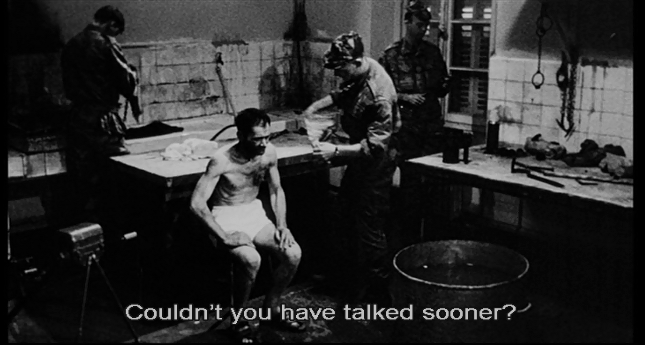
Pontecorvo’s Battle for Algiers is a rightly-celebrated classic, and it’s opening shot confirms the director’s claim to show compassion for both sides:

That’s an unexpected question from torturer to the victim he has just “broken”, and speaks volumes about the director’s intent — as does this quote from the french paratroop commander, Col. Mathieu, speaking of Larbi Ben M’Hidi, a leader of the National Liberation Front (FLN) whom he has captured and questioned — and who in “RL” was in fact murdered, though his death was reported at the time as a suicide:

Pour ma part, je peux seulement vous dire que j’ai eu la possibilité d’apprécier la force morale, le courage et la fidélité de Ben M’Hidi en ses propres idéaux. Pour cela, sans oublier l’immense danger qu’il représentait, je me sens le devoir de rendre hommage à sa mémoire.

For my own part, I can only tell you that I had the opportunity to appreciate Ben M’Hidi’s moral strength, his courage and his loyalty to his own ideas. On that account, and without overlooking the immense danger he represented, I feel obliged to salute his memory.

That reads to me as the respect of courage for courage.

The Pentagon, FWIW, held a screening of Battle for Algiers in September 2003, issuing a flyer indicating their reason to be interested in the film:

How to win a battle against terrorism and lose the war of ideas. Children shoot soldiers at point-blank range. Women plant bombs in cafes. Soon the entire Arab population builds to a mad fervor. Sound familiar? The French have a plan. It succeeds tactically, but fails strategically. To understand why, come to a rare showing of this film.

Yes indeed, it does sound a tad familiar.

**

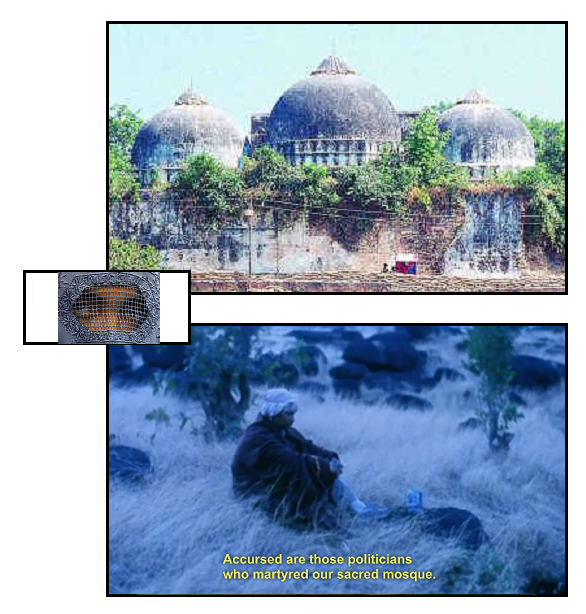
I’ll represent Kashyap’s Black Friday visually with a pair of images, the top one showing the Babri Mosque in Ayodhya / Oudh, which was leveled in December 1992 by an angry Hindu mob who claimed it had been built on the birthplace of Lord Rama, the avatar of Vishnu whose story is told in the Mahabharata

while the lower one represents Muslim rage at that event, making use of voice-over and that remarkable phrase, “martyred our sacred mosque”, to good effect.

Kashyap, then, can understand the feelings behind the horrific series of terrorist bombings that shook Bombay — as well as those of the bombed and terrorized population of that city. As Oorvazi Irani explains in her commentary on the film, Kashyap’s own views are expressed in the voice of DCP Rakesh Maria in the “chapter” on the interrogation of Badshah Khan:

Badshah Khan very proudly takes credit for the bombings and says Muslims have taken the revenge for the atrocities done to their Muslim brothers. That’s when Kay Kay Menon who plays the cop says and speaks in the voice of the director “…Allah was not on your side, on your side was Tiger Memon. He saw your rage and manipulated you. He was gone before the first bomb was even planted. ..he fucked you over. you know why? Because you were begging for it. All in the name of religion. You are a fucking idiot. You are an idiot and so is every Hindu, who murders one of you. Everyone who has nothing better to do … but to fight in the name of religion is a fucking idiot.”

**

Can there be a right side and a wrong side in a game? There can certainly be a winning side and a losing side — but a right side and a wrong side?

I ask, because the connection between wars and games is an ancient one. Can there be a right side and a wrong side in war? Looking at World War II, which was almost certainly the war that Elie Weisel was thinking of, the answer is pretty obviously yes. But what about the reasons given for “our side” being the right side?

Is our cause just because God is on our side? Because might makes right, and the big battalions are on our side? Or simply because it is our side — my country, right or wrong?

And then there is civil war to consider — for all wars are civil wars, when seen within the context of that greater “nationality”, the human race.

Abraham Lincoln, from his Second Inaugural:

Both parties deprecated war, but one of them would make war rather than let the nation survive, and the other would accept war rather than let it perish, and the war came. … Neither party expected for the war the magnitude or the duration which it has already attained. Neither anticipated that the cause of the conflict might cease with or even before the conflict itself should cease. Each looked for an easier triumph, and a result less fundamental and astounding. Both read the same Bible and pray to the same God, and each invokes His aid against the other. … The prayers of both could not be answered. That of neither has been answered fully. The Almighty has His own purposes…

The whole issue of the just war — or of jihad, its Islamic approximate equivalent — revolves around the question of whether there can be a wrong side in war.

**

If there can be a wrong side, it may be shredded. As Mark Twain once prayed:

O Lord our Father, our young patriots, idols of our hearts, go forth to battle — be Thou near them! With them — in spirit — we also go forth from the sweet peace of our beloved firesides to smite the foe. O Lord our God, help us to tear their soldiers to bloody shreds with our shells; help us to cover their smiling fields with the pale forms of their patriot dead; help us to drown the thunder of the guns with the shrieks of their wounded, writhing in pain; help us to lay waste their humble homes with a hurricane of fire; help us to wring the hearts of their unoffending widows with unavailing grief; help us to turn them out roofless with little children to wander unfriended the wastes of their desolated land in rags and hunger and thirst, sports of the sun flames of summer and the icy winds of winter, broken in spirit, worn with travail, imploring Thee for the refuge of the grave and denied it — for our sakes who adore Thee, Lord, blast their hopes, blight their lives, protract their bitter pilgrimage, make heavy their steps, water their way with their tears, stain the white snow with the blood of their wounded feet! We ask it, in the spirit of love, of Him Who is the Source of Love, and Who is the ever-faithful refuge and friend of all that are sore beset and seek His aid with humble and contrite hearts. Amen.

**

There are things to be said for being on the winning side of a conflict: you get to write history. There may be things to be said for being on the losing side: you gain the sympathy that accrues to the underdog. There are things to be said for supporting neither side, for being on the sidelines to pick up the pieces.

Then again, as Buddha observed in the Dhammapada, there are disadvantages to being on either side —

Victory breeds hatred. The defeated live in pain. Happily the peaceful live giving up victory and defeat.

while Christ muddies the simplicity of the whole business with a further contrarian note:

love your enemies.

Peace is not a bad side to be on, but perhaps love is more nuanced.

**

To bring us full circle, here’s another statement of the Elie Weisel position, this time in the words of Dietrich Bonhoeffer, the Lutheran pastor and theologian involved in the plot to assassinate Hitler and executed in one of the concentration camps — together with a response to the question I’ve been posing for myself here which may perhaps providinge some measure of reconciliation, this one from a contemporary Zen Buddhist, someone for whom the appreciation of koans is a way of life:

Form is insight: the funnel, part 1

Thursday, October 11th, 2012

[ by Charles Cameron — a post in my importance of form in intelligence series — Afghanistan, the complexity — also a Blackfoot Tale from Grinnell ]
.

Funnel image credit: Oxsite

.

One of my favorite tales of all time is the Blackfoot legend of The Bull Band, which begins thus in Grinnell‘s telling:

The people had built a great pis’kun, very high and strong, so that no buffalo could escape; but somehow the buffalo would not jump over the cliff. When driven toward it, they would run nearly to the edge, and then, swerving to the right or left, they would go down the sloping hills and cross the valley in safety. So the people were hungry, and began to starve.

Somehow I’d come by a sense that the pis’kun was a sort of funnel – perhaps from Joseph Campbell, whom I once heard tell this tale in his own words – and today I looked around my foolscap-sized screen and discovered that John Canfield Ewers reports what he calls a “buffalo fall” pretty much how I’d imagined the thing, in his Indian Life on the Upper Missouri:

The Piegan band called Never Laughs was camped on the Teton River a few miles north of the present town of Choteau. Their chief announced, “Now we are going to make a buffalo fall.” They built a corral below the cliff and piled rocks in a great V-shape on the slope above the fall. Then they chose a man to lead the buffalo to the fall. But each time he lured them in between the lines of rocks they broke away before they reached the cliff edge. After this had happened three times, young Many Tail Feathers became angry…

So that’s the shape I’m thinking of here: “a great V shape” – let’s call it a funnel.

**

I want to use the funnel to illustrate a movement in time, an imperative in intelligence, and a loss in nuance.

First, some background.

**

We are in a tricky situation here, because our minds would like to grasp a problematic reality (which resembles a landscape) by means of a thought (which resembles a road sign).

What’s up in Afghanistan?

Drought, and a huge humanitarian catastrophe, say those whose eyes are focused on human beings as fellow creatures in need of food, water and shelter. Preparations for getting the oil in Khazakstan to market, say those who focus on geology, resources, economics. The start of a strategic corridor that also includes Tibet and Kashmir, contested by India and Pakistan, the nuclear locals, and Russia and China, the nuclear regionals, in a four-sided tug of war. Islam itself, the religion of God, or a perverse and puritanical variant thereof. Or one man, Osama bin Laden.

Clearly a complex landscape – and we would like, depending which road sign we follow, to bomb the shit out of them, bring in truckloads of food and medicines, establish a stable government with which to ink a pipeline deal, export their Wahabi brand of Islam to the world — or discreetly support the US in its mission to extirpate the terrorists of Al-Qaida without rousing the more fundamentalist and simplistic of our citizens to topple the government and institute a radical Islamist state.

So much depends on whether we are in Peshawar or the Pentagon, in poverty or power. So much depends on our perspective, and the parallax it brings with it.

Because no matter what point of view we choose to consider the landscape from, some parts of the terrain will seem so close together as to be indistinguishable which we can understand to be worlds apart if we can only view them from another angle, in a different perspective.

I am not arguing for moral relativism. I am arguing for a recognition of complexity, and for an admission that sound bites and white papers cannot handle this style of problem. I have painted a highly impressionistic portrait of the complexities at work here, where China touches the tip of the eastwards panhandle of Afghanistan, where Kandahar can stand proxy for Jerusalem, where the national sport is a sort of polo with a goat’s head for a ball, and the tea served in thin, curved glasses is green and sweet.

**

I have checked Google and Dogpile, and as far as I can tell from poor memory, my sense of my own style, and the absence of the same text in the search engines, the above is my own work — the text of the bulk of which I found somewhat haphazardly on my hard drive while working on Part 2 of this post. If anyone else claims copyright, count me an admirer and let me know. I believe it’s “mine” for whatever that concept may be worth, I’m skeptical about solo creativity in any case, myself.

In part 2 of this post, which is definitely almost all borrowed from bright other beings, I’ll try to illustrate the funnel as it applies to America, Afghanistan, Obama and Osama, in a series of “zeroing in” quotes illustrating the complexity of the situation and analysis as contrasted with the “yes” of a kill-decision…

Of miraculous births and abominations

Friday, September 28th, 2012

[ by Charles Cameron — magical religion, the amnesia of the rationalists, a brief mention of poetry and a touch of Tillich ]
.

As you know, I’m interested in the clashing of worldviews. Yesterday, Teju Cole posted a tweet with a quick mention of apocalypse that caught my eye:

There’s a whole lot going on here, and it takes a neat combo of crabwise and linear thinking to get at it all.

But first, a brief and hopefully unnecessary note to our gentle readers:

Take a look at the tweet above, and if you don’t want to peer more deeply into the murky tabloid worlds of strange births, miracles and abominations that it touches on, don’t read the rest. This post may be gross enough in parts, or so absurd-sounding that you want to drop the whole thing and read something else.

As I see it, it’s also interesting and informative — fascinating even — besides being potentially quease-making. But seriously, if you’d rather skip that kind of thing, please don’t leave right away, just go to the very last section and read the two quotes from Paul Tillich. Thanks.

**

Still with me? Good…

For starters, we can compare these two stories, located about two weeks apart, and described as happening in two Nigerian states: Edo and Jigawa:
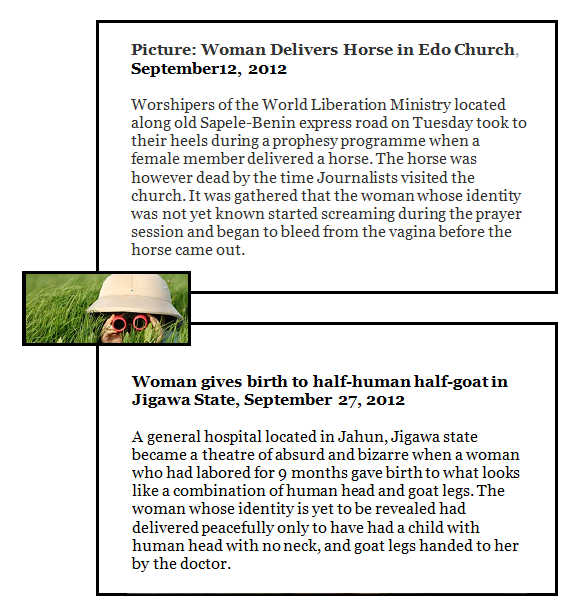
It would be easy to dismiss them both as Weekly World News style fabrications, like WWN’s Werewolf Sues Airline Over Flight Delay — but that would miss the point: they’re believed.

**

Restricting ourselves from the moment to half-goat, half-human combos, we can then compare a human birth narrative with a narrative of a goat birth:

The same story? A completely different event? Or human memory, playing its strange tricks?

Note that the two tales are now three years apart, and while one is reportedly from Nigeria, the other is from Zimbabwe.

**

In that last telling, we saw one local explanation for strange — dare I call them paranormal — events of this kind: a curse.

Let’s explore that idea a bit further. The same report quoted above went on to say:

A belief in ghosts is still alive and well in the region and the creature was taken as a sign of evil – perhaps even witchcraft. But local Governor Jason Machaya (56) is sure, that it was a half-man, half-goat hybrid which was the result of bestiality: “A grown man was responsible for this.”

So there’s another possibility. The next paragraph offers yet another:

Doctors, however say that it would be a biological impossibility.

Score one for the scientific worldview.

**

It may be a gossip and conspiracy mag invention, or an old wives’ tale, or the result of a curse, or witchcraft — which could include the local medical tradition — or, as with the horse birth, a miracle — what else?

It could be archetypal…

It could be Pan, the erotic satyr-god of Greek myth and James Stephens‘ delightful tale, The Crock of Gold, or the hideous demon of the occultist Eliphas Levi — the god of the old cult becoming a demon in the new, as they so often do —

— in this case also giving us the portmanteau word pandemonium

**

But there’s one final possibility, and it’s the one that Teju Cole presented us with the first nine of his 140 characters:

end times

I want to give that one time to settle in, because almost all end times predictions involve “signs of the times” that show the world going to hell in a hand-basket, with (eg) family values upended, the sacred profaned, lies usurping truth, and so forth.

I don’t believe this is by any means limited to Islam, but I’ll give an Islamic example as it comes to hand. One of the major signs of the coming of the Qiyama (Last Day, Day of Judgment, Day of Resurrection) is as follows:

After the night of three nights, the following morning the sun will rise in the west. People’s repentance will not be accepted after this incident.

Compare this, from the Christian New Testament, Matthew 24.29:

Immediately after the tribulation of those days shall the sun be darkened, and the moon shall not give her light, and the stars shall fall from heaven, and the powers of the heavens shall be shaken.

**

Women in church giving birth to horses, goats or women giving birth to half-human, half-goats… The story crops up again in Turkey as reported on January 14th, 2010:

A sheep gave birth to a dead lamb with a human-like face. The lamb was born in a village not far from the city of Izmir, Turkey. Erhan Elibol, a vet, performed a caesarean on the animal to take the lamb out, but was horrified to see that the features of the lamb’s snout bore a striking resemblance to a human face. “I’ve seen mutations with cows and sheep before. I’ve seen a one-eyed calf, a two-headed calf, a five-legged calf. But when I saw this youngster I could not believe my eyes. His mother could not deliver him so I had to help the animal,” the 29-year-old veterinary said.

And again with the religious language — the picture accompanying the article carries the caption:

An Abomination of Nature or a Mutation Caused by Blind Industrialization?

Abomination, a word for the utterly unnatural, is another term found in connection with end times thinking. And industrialization? Perhaps that’s one version of the modernist end times…

**

A few things to note here in closing:

Indigenous religious beliefs and practices in many parts of the world include magical aspects that may seem shocking, absurd or distasteful to rational modern western sensibilities. Some of these beliefs and practices are deeply ingrained, and missionary churches have not infrequently carried some of them into their own structures, there being no clear dividing line between “culture” and “religion”. Churches which place an emphasis on miraculous healings as proofs of renewal in the Spirit are particularly prone to this kind of seepage.

The “rational modern western” sensibility I mentioned above, however, is so utterly out of touch with such matters that it treats them as jokes, lampoons them in the tabloids, and otherwise tends to ignore them.

Strongly held beliefs – what I referred to in Waco in Pakistan using Tillich’s term as “ultimate concerns” – are “facts on the ground” that we ignore at our peril.

Poetry — not flabby cherubic verses in greetings cards but the dedicated study of poetic tradition — contains an antidote.

**

Man, like every living being, is concerned about many things, above all about those which condition his very existence, such as food and shelter. But man, in contrast to other living beings, has spiritual concerns – cognitive, aesthetic, social, political. Some of them are urgent, often extremely urgent, and each of them as well as the vital concerns can claim ultimacy for a human life or the life of a group. If it claims ultimacy it demands the total surrender of him who accepts this claim, and it promises total fulfillment even if all other claims have to be subjected to it or rejected in its name.

and again:

It transcends both the drives of the nonrational unconsciousness and the structures of the rational conscious

Both quotes are from chapter 1, What Faith Is, of Paul Tillich‘s Dynamics of Faith.

Warlords Revisited

Monday, July 23rd, 2012

“The horror! The horror!

Charles Cameron sparked a discussion with his doublequotes post on two colonels, the late strategist John Boyd and the fictional monster,  Walter Kurtz from Francis Ford Coppola’s classic Vietnam War film homage to Joseph Conrad Apocalypse Now.  Kurtz is a disturbing figure, one who is recurrent in literature and history going back to Homer’s Iliad. A superlative warrior who excels above all others who nonetheless sheds all trace of civilization in his descent into barbarism. While the fall of a heroic individual can take many narrative forms, Kurtz is of a particular and dreaded kind of fallen man, the warlord.

Warlords are fascinating and repellent figures who seem to thrive best when the normal order of a society is breaking down, permitting the strong and ruthless to carve out their reputations in blood and infamy. As I have written previously:

Kent’s Imperative had a post up that would have been worthy of Coming Anarchy:

Enigmatic biographies of the damned 

“….Via the Economist this week, we learn of the death of an adversary whose kind has nearly been forgotten. Khun Sa was a warlord who amassed a private army and smuggling operation which dominated Asian heroin trafficking from remotest Burma over the course of nearly two decades. In the end, despite indictment in US courts, the politics of a failed state permitted him to retire as an investor and business figure, and to die peacefully in his own bed.

The stories of men such as these however shaped more than a region. They are the defining features of the flow of events in a world of dark globalization. Yet these are not the biographies that are taught in international relations academia, nor even in their counterpart intelligence studies classrooms. The psychology of such men, and the personal and organizational decision-making processes of the non-state groups which amassed power to rival a princeling of Renaissance Europe, are equally as worthy of study both for historical reasons as well as for the lessons they teach about the nature of empowered individuals.

….There are no shortage of warlords for such a study. Among the living we have Walid Jumblatt, the crafty chief of the Druze during the 1980’s civil war in Lebanon, the egomaniacal and democidal Charles Taylor of Liberia, Gulbuddin Hekmatyar the Islamist mujahedin commander and a large assortment of Somali, Colombian, Indonesian and El Salvadoran militiamen and paramilitaries. The history of the twentieth century alone offers up such colorful characters as “The Dogmeat General“, the ghoulishly brutal Ta Mok of the Khmer Rouge, “The Mad Baron” Ungern von SternbergCaptain Hermann Ehrhardt and Pancho Villa among many others.

What would such a historical/cross-cultural/psychological “warlord study” reveal ? Primarily the type of man that the German journalist Konrad Heiden termed “armed bohemians”. Men who are ill-suited to achieving success in an orderly society but are acutely sensitive to minute shifts that they can exploit during times of uncertainty, coupled with an amoral sociopathology to do so ruthlessly. Paranoid and vindictive, they also frequently possess a recklessness akin to bravery and a dramatic sentimentality that charms followers and naive observers alike. Some warlords can manifest a manic energy or regularly display great administrative talents while a minority are little better than half-mad gangsters getting by, for a time, on easy violence, low cunning and lady luck.

Every society, no matter how civilized or polite on the surface, harbors many such men within it. They are like ancient seeds waiting for the drought-breaking rains.

There are occasionally positive portrayals of warlords. Ahmed Shah Massoud, “the Lion of Panjshir” who fought tenaciously first against the Soviets, then later against the murderous Gulbuddin Hekmatyar’s army of thugs and the Taliban’s fanatics, providing a modicum of civilized governance to ordinary Afghans wherever his power ran, until his assassination by al Qaida. The cagey and mercurial Walid Jumblatt, made the transition from Druze warlord in the 1980’s to Lebanese politician and something of an elder statesman.

In literature, Xenophon was the de facto strategos of the retreating Greek mercenaries in The Anabasis of Cyrus, cut a noble example, but like Massoud, this is a rarity. In recent fiction, Stephen Pressfield created as an antagonist in The Profession, General James Salter, a totemic and caesarian figure who takes on the great powers with his PMC forces with impressive ruthlessness. In the popular fantasy series of George R.R. Martin that began with The Game of Thrones, the notable warlord is the outlandish, cruel and somewhat demented Vargo Hoat, who leads a freebooting company of misfit brigands “The Brave Companions“, whose nonstop atrocities and ludicrous pretensions lead all the other characters to call them “the Bloody Mummers“.

Given the world’s recent experiences with the Lord’s Resistance Army, General Butt Naked and the uprisings in Syria and Libya, I think Martin and Coppola have captured warlordism in it’s most frequent incarnation.


Switch to our mobile site