zenpundit.com » myth

Archive for the ‘myth’ Category

The door of Resurrection pried open

Monday, July 2nd, 2012

[ by Charles Cameron — Ansar al-Din destruction of shrines in Timbuktu expands to include elimination of mosque door and haram eschatological belief ]
.

***

Various positions can be taken, with significantly different emphases, concerning the destruction of the shrines and mausoleums of Timbuctu.

There is the military assessment:

The international community fears the vast desert area will become a new haven for terrorist activity and the Islamists have threatened any country that joins a possible military intervention force in Mali.

The legal opinion:

International Criminal Court prosecutor Fatou Bensouda on Sunday warned that the destruction could amount to a war crime. “My message to those involved in these criminal acts is clear: stop the destruction of the religious buildings now,” Bensouda told AFP in an interview in Dakar. “This is a war crime which my office has authority to fully investigate.”

The attacks come just days after UNESCO declared Timbuktu an endangered world heritage site, so there is the cultural preservation argument:

United Nations chief Ban Ki-moon deplored the destruction of tombs, with his spokesman Martin Nesirky quoting him as saying: “Such attacks against cultural heritage sites are totally unjustified.”

There is the condemnation from much of the Islamic world:

The Organisation of Islamic Cooperation condemned the destruction, saying in a statement the sites were “part of the rich Islamic heritage of Mali and should not be allowed to be destroyed by … bigoted extremist elements.”

and:

Algeria condemned the destruction of tombs which “constitute a homage and a recognition by the local people to the saints and scholars who contributed to the flourishing of Islam in the region and to the spread of the values of tolerance and spirituality.”

And then there is the reason given by the Ansar al-Din themselves:

“God is unique. All of this is haram (forbidden in Islam). We are all Muslims. UNESCO is what?” spokesman Sanda Ould Boumama said on Saturday. He said the group was acting in the name of God and would “destroy every mausoleum in the city. All of them, without exception”.

***

Here’s how the locals saw the destruction of one specific door into the Mosque of Sidi Yahia in Timbuktu:

Islamist militants in northern Mali on Monday destroyed the ‘sacred’ door of one of Timbuktu’s three ancient mosques after smashing seven tombs of muslim saints over the weekend, witnesses said. “The Islamists have just destroyed the door to the entrance of the Sidi Yahya mosque… they tore the sacred door off which we never open,” said a resident of the town. A former tour guide in the once-popular tourist destination said: “They came with pick-axes, they cried ‘Allah’ and broke the door. It is very serious. Some of the people watching began crying.”

Another man, a relative of a local imam (religious leader), said he had spoken to Islamist group Ansar Dine (Defenders of Faith) who have gone on a rampage destroying cultural treasures after occupying the town for three months. “Some said that the day this door is opened it will be the end of the world and they wanted to show that it is not the end of the world.” The door on the south end of the mosque has been closed for centuries due to local beliefs that to open it will bring misfortune.

All quotes above from various versions of Serge Daniel’s AFP reporting, see eg: Islamists smash Timbuktu relics, plant mines in north Mali.

***

Did you catch that?

Some said that the day this door is opened it will be the end of the world and they wanted to show that it is not the end of the world.

There’s irony for you: the Ansar destroyed the ancient door to demonstrate that it wouldn’t bring on the Yawm al-Qiyamah, the Day of Judgment and Resurrection — they’re demythologizing the legend that has it that it will open only on the Day — in the stilted translation offered by Google:

The Abu Turab; who is a member of Ansar al-Din, he emphasized that what happened is the kind of “Aspects of the elimination of superstition and heresy, and the excuse they may reach a trap,” adding: “We have heard our ears that there is a door in the courtyard of the Mosque of Sidi Yahia old if open The Resurrection, and verified what we learned from it that he canceled the door in the courtyard of the mosque is the door has been canceled accumulation Vtm filled soil on it.

Indeed, the photo in the tweet at the head of this post — which is subtitled The process of opening the door of the Holy Sepulchre in Tinbactu — actually downloads under the title “bab alqyama” — door of the Day of Resurrection.

***

Belief in the Last Day, the Yawm al-Qiyamah, is mandatory of Muslims in accordance with the revelation of Qur’an 4.136:

O ye who believe! Believe in Allah and His Messenger, and the scripture which He hath sent to His Messenger and the scripture which He sent to those before (him). Any who denieth Allah, His angels, His Books, His Messengers, and the Day of Judgment, hath gone far, far astray.

***

Here’s an image of one of the beautiful doors from the same mosque:

photo credit: Jean-Luc Dighaye, EurAstro visit to Mali

I am not clear whether this is a photo of the same door which was destroyed, however, and would appreciate any further info.

***

You might like to drink a cool glass of water at this point, to cleanse your palate…

***

Here’s my preferred quote on opening doors into sacred space:

When you have grown still on purpose while everything around you is asking for chaos, you will find the doors between every room of the interior castle thrown open, the path home to your true love unobstructed after all.

St. Teresa of Avila

h/t kathe izzo, who tweeted this today for reasons unconnected with Timbuctu as far as i can tell…
Carlos Fuentes (1928 – 2012)

Wednesday, May 16th, 2012

[ by Charles Cameron — in memory of Carlos Fuentes, requiescat in pace ]
.


.

Carlos Fuentes‘ great novel, Terra Nostra, opens with these words:

Incredible the first animal that dreamed of another animal.

It’s a sentence to stop you in your tracks, a sentence to give pause to time itself, circling back on itself like the serpent that eats its own tail, a dream of a sentence, a dream sentence.

Fuentes continues:

Monstrous the first vertebrate that succeeded in standing on two feet and thus spread terror among the beasts still normally and happily crawling close to the ground through the slime of creation. Astounding the first telephone call, the first boiling water, the first song, the first loincloth.

How does a mind move so agilely among these many and diverse firsts — the sleeping, the archeo-anthropological, the technical, the musical, the shameful or sinful or perhaps decorative, even erotic? In a single paragraph — the first in a book that will run 890 pages and not tire?

And Fuentes continues:

About four o’clock in the morning one fourteenth of July, Pollo Phoibee, asleep in his high garret room, door and windows flung wide, dreamed these things, and prepared to answer them himself.

Pollo Phoibee dreamed these things, Carlos Fuentes dreamed Pollo Phoibee…

And we are in Paris, Paris of the artists, of the garret, and yet a Paris where the Seine is boiling, where the Louvre has become crystalline, the black eyes of the gargoyles of Notre Dame see “a much vaster panorama”…

*

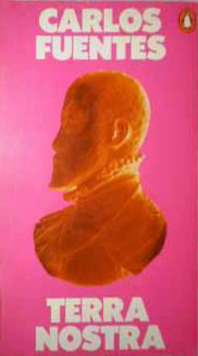
Carlos Fuentes died today, and I am saddened — remembering him signing my short, fat British Penguin paperback of Terra Nostra (its fondly remembered cover image above) and commenting that it was his preferred English edition, since one could slip it into one’s pocket…

And Terra Nostra was special to me, both as a great and tumultuous fiction, and as a fiction that quoted Norman Cohn‘s In Pursuit of the Millenniun, the book that back in my Oxford days introduced me to the history of apocalyptic thought… a fiction also familiar with Frances Yates, another scholar I greatly admire, and her writings on the Memory Theater

Carlos Fuentes, the imagination that conceived Terra Nostra, is no longer with us.

*

He had been a diplomat, this great imagination. Born into a diplo family, he had served as Mexican ambassador to Paris — Paris of the diplomatic banquets, but also of the artist’s garret, of this New World imagination spanning continents and centuries as though they were a playground, the playground of a single, multiple, cosmopolitan and erudite mind.

The poet Paul Claudel, French ambassador to Japan, was reproved by the Surrealists in 1925 with the words:

One cannot be both ambassador for France and poet!

The poet Saint-John Perse was secretary to the French Embassy in Peking, and later General Secretary of the French Foreign Office. The poet Giorgos Seferis was Royal Greek Ambassador to the United Kingdom. The poet Pablo Neruda was Chilean ambassador to France… The poet Octavio Paz, Mexico’s ambassador to India.

Among novelists, it was Lawrence Durrell — an Englishman born in India with what he described as “a Tibetan mentality” — one who found life in England itself “like an autopsy … so, so dreary” — who was British press attaché in Alexandria, Egypt, during World War II, where as they say:

Ostensibly working, Durrell was in reality closely observing the assortment of sights, sensations, and people that wartime Alexandria, a crossroads of the East and West, had to offer.

The result was his masterpiece, The Alexandria Quartet.

*

Fuentes is heir to many lineages: of Mexico, of the world, of literature, of diplomacy, of the imagination.

In honoring him today, my researches turned up this apposite quote from Aldo Matteucci at the Reflections on Diplomacy blog:

To survive, a diplomat needs poetry. Filed amidst the many layers of the brief, the short poem will refresh the bleary mind. Poetry brings distance – hence perspective and insight. Poetry reminds the diplomat that the best professional is the amateur.

Most deeply – poetry is truth.

Carlos Fuentes survives us all.

Sanctity, vision, science, ecology and the creativity of diagrams

Saturday, May 12th, 2012

[ by Charles Cameron — of [almost] no military or intelligence interest, this is a post for computer scientists, historians, scientists, artists, contemplatives and other creatives ]
.

I’ve been on a bit of a binge about medieval and renaissance diagrams recently, putting together an anthology of early “semantic networks” for the Sembl game site – but also thinking about the alternate track of art history which would focus on diagrams rather than paintings (I’m thinking of two dimensions here, hence no mention of sculpture) – an alternate history which may have something to teach our richly diagrammatic and data-visual times.

My interest in all this tracks back at least to my early encounter with an essay by the computer scientist Margaret Masterman in Theoria to Theory (1967).

*

Yesterday brought me a post from Jason Wells, a scientist and bright all-rounder I follow on Google+, in which he posted an image of the cosmos from the Ptolemaic (pre-Copernical) point of view, which I’ve put at the head of this post.

Jason commented on this diagram:

As pretty as this is, this is not how your universe works.

That is all.

The diagram Jason posted purports to be mathematically and astronomically based: it is, if you like, a quantitative diagram. I don’t happen to think it’s pretty, although the two creatures (angels, goddesses?) up towards the top of the circle may be, and the serpent eating its tail around it is nicely done -– I think it has a rather austere beauty to be honest, but I’m likely to concede to Jason that it isn’t “true” in the sense of being an accurate representation of the (abstract) laws of celestial motion.

But then I also think there’s more to truth than accuracy, useful though that may be – there’s also a qualitative element to truth, and perhaps “beauty” is (among other things) a name for it.

*

Yesterday also brought me a news bulletin that ties into that same interest in medieval and renaissance diagrams. From the Vatican Information Service (via Chant Cafe) , we learn that Hildegarde of Bingen (1098 – 1179) is now a saint of the Catholic Church with universal cultus:

Vatican City, 10 May 2012 (VIS) – The Holy Father today received in audience Cardinal Angelo Amato S.D.B., prefect of the Congregation for the Causes of Saints. During the audience he extended the liturgical cult of St. Hildegard of Bingen (1089-1179) to the universal Church, inscribing her in the catalogue of saints.

Consider, then, in contrast to Jason’s mechanistic Ptolemaic diagram, this diagram which today’s fresh-minted saint produced in the late 1140s or early 1150s to illustrate her visionary intuitions of the universe in the first of three books, Scivias:

and these two, from Liber divinorum operum:

and:

These, I take it, are purely qualitative images in contrast to the Ptolemaic diagram — making no propositional claims as to physical or mathematical accuracy, but portraying Hildegarde’s sense of cosmic order. And just as we would not argue whether it is Van Gogh or El Greco who is “right” about the skies in their respective paintings, so I don’t think Hildegarde is worried about which of her diagrams is “right” in its portrayal of the world she lived and prayed in – each one illustrates some aspect of her vision of the world, and one does not necessarily contradict another.

*

Here are two descriptions of Hildegarde’s world, which may give us some insight into the diagrams above. For the top one:

For Hildegard of Bingen, twelfth century German Benedictine abbess, the universe is like an egg in the womb of God. Her view of the universe, conditioned as it is by her times and her education, represents her visionary understanding of God’s motherhood of this sphere that we call the universe. Hers is a view that is organic and holistic, coloured neither by Greek philosophy nor Enlightenment rationalism, refreshing and strikingly “true” in its perceptions around the source of created life.

Jean Evans, RSM, Viriditas and Veritas: The Ecological Prophets Hildegard of Bingen and Miriam Therese MacGillis, OP

And for the third:

God created the world out of the four elements, to glorify His name. He strengthened the world with the wind. He connected the world to the stars. And he filled the world with all kinds of creatures. He then put human beings throughout the world, giving them great power as stewards of all Creation. Human beings cannot live without the rest of nature, they must care for all natural things.

von Bingen, Physica, 755, quoted in Stephanie Roth, The Cosmic Vision of Hildegard of Bingen,” The Ecologist 30, no. 1 (2000).

It’s probably worth mentioning that three of the “four elements” of the ancients are still known to us, though we call them “states” rather than “elements” at this point — the solid, liquid and gaseous states correspond with what the ancients called “earth”, “water” and “air”, respectively — and it has even been suggested that their “fire” corresponds to the fourth state we now term “plasmas” — not my line of business, however, so who knows?

*

Hildegarde picked up the word “viriditas” from Gregory the Great and made it peculiarly her own. It means greeness, literally, and freshness by extension — but for Hildegarde’s integral view of all that is, it also carries a theological dimension, Christ being the greening of the world for her:

For Hildegard, viriditas was an attribute of the Divine nature, a reflection of God’s goodness and beauty. It stood for vitality, fertility, fruitfulness and growth; in fact all the things that we now associate with the “greenness” of nature. For us today “greenness” is a sign that the Earth is healthy and flourishing. Similarly, for Hildegard, viriditas was synonymous with physical and spiritual health, with the continuing vivifying force of the Holy Spirit.
.
Dr Carmel Bendon Davis, Hildegard of Bingen: Eco-warrior and Superwoman

This greening or freshening is not, for Hildegarde, just a matter of earth and water, of river and forest, it is also infused with fire and air:

I am likewise the fiery life of the substance of divinity. I flame over the beauty of the fields and sparkle in the waters, and I burn in sun, moon, and stars. And with an airy wind that sustains all things with invisible life, I raise them up vitally. For air lives in greenness and flowers, waters flow as if alive, the sun, too, lives in his light, and when the moon comes to her decline she is kindled by his light, as it were to live again… Thus I, the fiery force, am hidden in [the winds], and they take fire from me, just as breath continually moves a man, and as a windy flame exists in fire. All of these live in their essence and are not found in death, because I am life.

Nor is it “merely” natural, it can also be found in the soul:

Understanding in the soul is like the Veriditas of the branches and the leaves of the tree

It is, in fact, neither exclusively natural nor supernatural, but non-dual.

*

Dylan Thomas, being a Welshman and a poet, thus has an insight that bears a family resemblance to Hildegarde’s, but phrases it in a way that leaves the “force” neither personified nor otherwise… and thus with no necessary doctrinal implication:

The force that through the green fuse drives the flower
Drives my green age; that blasts the roots of trees
Is my destroyer.
And I am dumb to tell the crooked rose
My youth is bent by the same wintry fever.

Due to the idiocy of copyright, you’ll have to go elsewhere to read the whole, fine poem.

For Hildegarde, this “force” is also Christ — for he himself is the “the fiery life of the substance of divinity” — and his coming to earth a greening and freshening of a world until then barren of the love he brought.

*

Hildegarde was the abbess in charge of a small flotilla of nuns — but also a mystic, a visionary, philosopher, poet, painter and songstress…

Her song of creation, O Viriditas, bears comparison in spirit with St FrancisCanticle of the Sun. She writes to her “green” Christ and his “green” planet:

O greenness of God’s finger
with which God built a vineyard
that shines in heaven
as an established pillar:
You are glorious in God’s preparation.
And o height of the mountain
that will never be dispersed
in the judgment of God,
you nevertheless stand from afar as an exile,
but it is not in the power
of the armed man
to seize you.
You are glorious in God’s preparation.
Glory be to the Father and to the Son
and to the Holy Spirit.
You are glorious in God’s preparation.

And she sets her words to the music of the times:

Indeed, her music is sung even today…

How’s that for a twelfth century statement of what we’d these days call “ecology”?

*

But all this risks getting far too ethereal, I have wandered far along my own epicycles from Jason Wells’ point, and methinks I should bring us back down to earth.

Dennis The Constitutional Peasant, in Monty Python and the Holy Grail, meets King Arthur and complains, “What I object to is you automatically treatin’ me like an inferior.” It’s understandable — but so, perhaps, is king Arthur’s response: “Well, I am king.”

Two worldviews clash here — and in the ensuing debate, Arthurian myth meets contemporary politics:

Dennis’ Mother: Well how’d you become king, then?
Arthur: The Lady of the Lake,… [Angel chorus begins singing in background] her arm clad in the purest shimmering samite, held aloft Excalibur from the bosom of the water signifying by Divine Providence that I, Arthur, was to carry Excalibur. [Angel chorus ends] That is why I am your king!
Dennis: Listen. Strange women lying in ponds distributing swords is no basis for a system of government. Supreme executive power derives from a mandate from the masses, not from some farcical aquatic ceremony.
Arthur: Be quiet!
Dennis: You can’t expect to wield supreme power just ’cause some watery tart threw a sword at you!
Arthur: Shut up!
Dennis: I mean, if I went ’round saying I was an emperor just because some moistened bint had lobbed a scimitar at me, they’d put me away!

Or if some bint told me the universe was a cosmic egg in the womb of God, for that matter — even if Benedict XVI did just add her to the calendar of saints.

*

Here you go, courtesy of YouTube:

*

Frankly I appreciate both modes of thinking — the mythic and the scientific — and believe we’re in the sort of territory here that Nils Bohr was thinking of when he said:

The opposite of a true statement is a false statement. But the opposite of a profound truth may be another profound truth.

For more on the story of diagrammatic and pictorial imagery in western civilization, see Ioan Couliano, Eros and Magic in the Renaissance (University of Chicago, 1987). And for more diagrams from the renaissance, there’s nothing I know of better than SK Heninger, The Cosmographical Glass: Renaissance Diagrams Of The Universe (Huntington Library, 1977).

The Taliban who turned himself in

Wednesday, April 18th, 2012

[ by Charles Cameron — a possible cultural parallel, also an entry for the pattern language of creativity, ourobouros ]

.

.

You’ve read about it in the news already:

U.S. officials couldn’t believe their luck last week when a suspected Taliban commander who heard there was a $100 reward for his whereabouts turned himself into authorities.

Perhaps misunderstanding the meaning of ‘wanted’, Mohammad Ashan sauntered up to police in Sar Howza, Paktika province, with a poster bearing his own face – and demanded the finder’s fee.

There are two things to note here — a parallel, and a pattern.

1.

The parallel is with an incident I mentioned earlier on Zenpundit:

I was also struck by an anecdote Tom Ricks told Fareed Zakariah on the latter’s show recently. He recounted a story first told by John Masters in his book “Bugles and a Tiger”, the memoir of a British officer serving with the Gurkhas in Waziristan in the 1930s. At the end of the war, so the story goes, some Afghans approach the British soldier and ask, “Where are our medals?” “You were the enemy,” he replies. And here’s the punchline, the Afghan respose to that: “No, no. You gave medals to the Pashtuns on your side. We want our medals, too. You couldn’t have had a good war without us.”

Tom Ricks comments, “This is very much the Afghan attitude. This is a kind of sporting event for them in many ways.”

Food for thought.

2.

The pattern is self-reference. Again,it’s something I’ve touched on here before, because it’s always of interest when it crops up:

there’s a special place in my analytic thinking for those representables which are self-referential – the category that gave rise to Douglas Hofstadter’s celebrated book, Gödel, Escher, Bach.

Indeed, I have a special glyph that I use in my games to notate ideas that are self-referential:

We don’t learn anything new about the particular instance of the Taliban walking in to claim his award for identifying himself by noting that it’s self-referential — but it intrigues us because it is, and that’s actually a sign that paradoxes of self-reference are significant at an unconscious level: that they’re a pattern worth watching for, and one that will play a role in the generation of aha! moments — whether they be analytic insights, creative breakthroughs, or (as in this case) just strange and amusing.

Kekulé von Stradonitz‘s basic insight into the structure of the benzene molecule was that it might be a serpent eating its own tail. That’s self-referential paradox at it’s finest — and a key aha! moment in the history of Chemistry.

It is also an archetypal image — the self-devouring serpent (ouroboros) crops up in alchemy (see image above) and in the Norse myth of Jörmungandr, the serpent who encircles Yggdrasil, the world tree.

Such images are important to the care and feeding of the creative mind.

Crucifixion and Resurrection, ancient and modern

Wednesday, April 18th, 2012

[ by Charles Cameron — religious resonances of the Tupac video, from the Drachenloch cave bears to today ]
.

1.

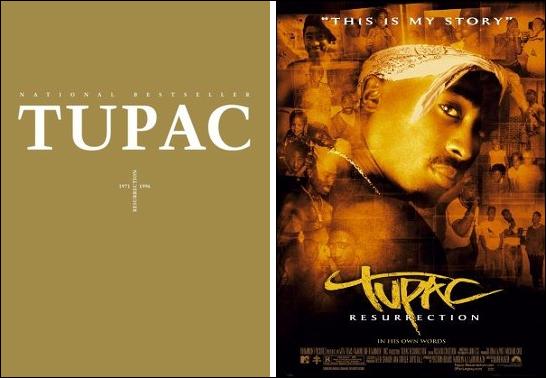
As the 2006 book and DVD covers above suggest, the themes of crucifixion and resurrection have been associated with Tupac Shakur for a while.

R.N. Bradley blogs at Red Clay Scholar and is a doctoral candidate in African American Literature and Culture at Florida State University. She makes the same connection clear in a post titled Smilin’ Serpent: the Violent Passion of Tupac Shakur on September 13, 2010:

Projects revealed Shakur’s pseudo-schizophrenic obsession with death and resurrection. These tropes manifested in videos like “I Ain’t Mad Atcha” or the collabo featuring Scarface “Smile,” and the coverart of The Don Illuminati: the 7 Day Theory(1996).

2.

Death comes before resurrection: Tupac Shakur died of gunshot wounds in 1996, after completing his final album, Makaveli — which was posthumously released:

3.

What may be more surprising is that he was brought back to something approximating life — in a holographic performance that included a duet with a decidedly non-holographic Snoop Dogg— just this week…

4.

But then, that’s religion.

Time-bound, mortal and frankly disintegrating as we are, we’d like there to be more to the story after death, and that yearning is something that religion addresses.

Perhaps to get the point across in an interesting way you’ll allow me to quote from a move in a game I played some years back:

Exploring the Drachenloch cave in Switzerland, Emil Bachler found cave bear skulls arranged in wall niches in one part of the cave, and stone tombs in another chamber containing cave bear skulls and bones. Ursus spelaeus, the cave bear, has now been extinct 10,000 years, while the Neanderthal inhabitants of the caves appear to have ceased as a species themselves about 40,000 years ago.

In Shepard and Sanders’ book, The Sacred Paw, which deals with both the natural history of the bear and its appearances in myth and ritual, Bachler surmises that his finds provide “the first evidence in man of an already awakened higher spiritual life.”

But why the bear in particular? What could we learn from the bear that we couldn’t learn anywhere else? Shepard and Sanders’ answer is that the bear seemed able to teach us how to survive bodily death. Hibernation isn’t just a “natural” phenomenon — it’s also a “spiritual” revelation… I’ll let them explain in their own words:

The bear, more than any other teacher, gave an answer to the ultimate question… an astonishing, astounding, improbable answer, enacted rather than revealed. Its passage into the earth, winter’s death, and burial under the snow was like a punctuation in the round of life that would begin again with its emergence in the spring…

The miracle was double, for the bear burst out with young — birth and rebirth. Somehow the bear knew when to reenter the world again, emerging just ahead of the snowmelt, as though its very heat set the new year in motion… Clearly the bear was master of renewal and the wheel of the seasons.

The bear ‘knows’ about death and how to survive it… She is therefore seen by traditional peoples as a guide to the movement between worlds.

So the bear is not only the first shaman, s/he’s also the first dying and rising God, and the first divine “Mother and Child” — teaching us two things that are still at the heart of religion 40,000 years later: nativity and resurrection!

5.

Death and resurrection certainly date back quite a ways. Attis, Osiris and Odin are only a few of those thought to have died and been resurrected — and indeed the early Christian writer Justin Martyr confirms (In his First Apologia XXI), the similarities between Christian and pagan teachings when he writes:

In saying that the Word, who is the first offspring of God, was born for us without sexual union, as Jesus Christ our Teacher, and that he was crucified and died and after rising again ascended into heaven we introduce nothing new beyond those whom you call sons of Zeus. You know how many sons of Zeus the writers whom you honor speak of — Hermes, the hermeneutic Word and teacher of all; Asclepius, who was also a healer and after being struck by lightning ascended into heaven –as did Dionysus who was torn in pieces; Heracles, who to escape his torments threw himself into the fire; the Dioscuri born of Leda and Perseus of Danae; and Bellerophon…

6.

Here’s the video:

7.

Max Eddy, blogging at The Geeoksystem today, not only describes the technology used to bring Tupac back to artificial life, but gives us a feel for the event:

The Tupac Hologram put on an eerie performance. When it appeared, the crowd became noticeably quiet while the show continued so achingly aware of its strangeness. The CG simulacrum even declared “I’m a ghost” during a rendition of “Hail Mary.” The ghostly, semi-transparent image went on to do two more numbers – one opposite a likely perturbed Snoop Dogg – before, no kidding, dissolving into triangles in a blaze of otherworldly light.

He also gives us an overview of the endurance of the resurrection motif within the music biz. He writes:

While I must confess ignorance to the life and body of work of Tupac, the resurrection obsession is part and parcel of the music industry. We can get specific: Back in 1995, the surviving Beatles recorded two new tracks along with unreleased demos recorded by John Lennon in 1977. Lennon had been dead since 1980. For his 75th birthday in 2010, Elvis Presley netted $60 million despite having been dead since 1977. Deceased in 2004, Ol’ Dirty Bastard still managed to appear on 2009?s “Blackroc,” a rap album put together by the Black Keys.

Though resurrections are a phenomenon that is particularly common in the music industry, it’s notable that CG recreations of dead actors haven’t broken into mainstream film. Perhaps it’s because fooling the ear is easier than fooling the eye.

Posthumous musical careers are clearly not unique to Tupac, but Shakur’s has been particularly lively. Since his death, seven albums have been released under the rapper’s name. For Forbes’ 2002 edition of the magazine’s annual list of top-earning dead celebrities, Shakur came in at number ten. A 2003 documentary about Shakur’s life, titled Tupac: Resurrection, was narrated entirely by Shakur. From 1997 on, Shakur has made 49 guest “appearances” on the tracks of other recording artists.

All of this is not to mention the rumors held by some ardent fans that Shakur is, in fact, still alive and in hiding somewhere.

8.

I don’t know whether this image is taken from an early archaeological report on the Drachenloch caves, or is just a reconstruction of what those first bear-altars with their carefully arrange skulls and bones might have looked like. I don’t really know if the dying-and-rising-god meme has been overblown or not — or the circumpolar bear cult for that matter.

But bears hibernating and coming back to life, Attis and Adonis, Christ, Arthur, the Once and Future King, more recently, Elvis sightings — and now Tupac coming back, as a hologram — it makes me wonder.

9.

I’ll give Max Eddy the final word:

When a singer is on stage, he or she is mostly their celebrity, with their humanity tucked safely away for later. At home, they are someone else, but on stage they fill a role assigned to them by their fans and perhaps by themselves. Some take it to an extreme – Ozzy bit the head off a bat. For others, it’s subtle – Roy Orbison’s dark glasses, for instance.

Unlike them, the Tupac Hologram has no humanity; it is only celebrity. The Tupac Hologram will not go home and read Shakespeare, as Shakur did. The Tupac Hologram will not make controversial political statements. The Tupac Hologram will not visit Tupac’s mother, Afeni Shakur Davis. The Tupac Hologram is empty, and we made it.

[ … ]

When we look into the Tupac Hologram, we see ourselves reflected brightly on a thin Mylar screen.

_________________________________________________________________________________________________________
A hat tip to Doug Breitbart, for suggesting I check out the Tupac video and nudging me along the way. The details of Crucifixion and Resurrection are from the superlative Isenheim Altarpiece by Matthias Grunewald (ca. 1510).


Switch to our mobile site