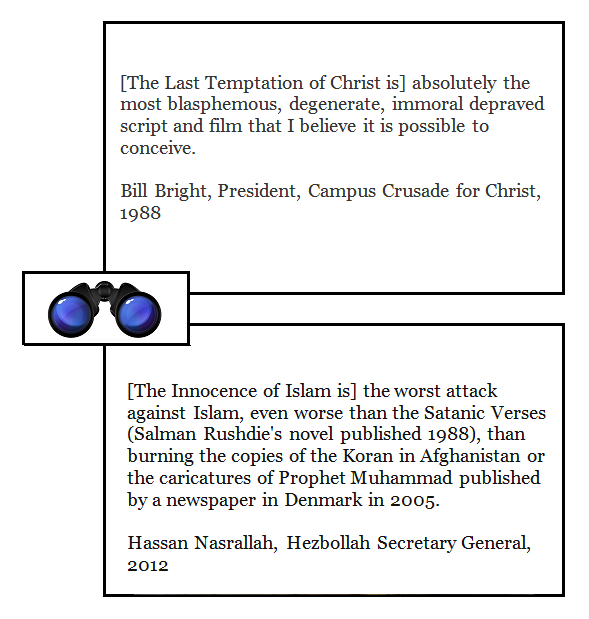
At Play in the Fields of the Lord
Monday, October 8th, 2012[ by Charles Cameron — two ways of playing football, two faiths ]
.
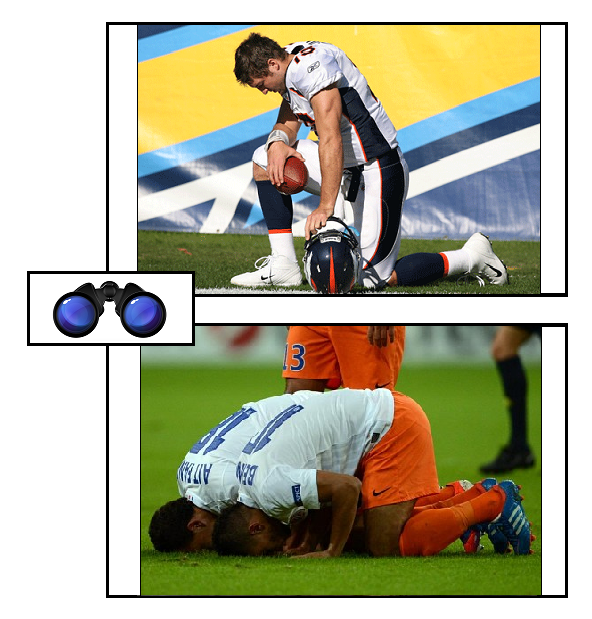
Image sources:
Tim Tebow: Urban Faith
Karim Ait-Fana and Younes Belhanda: Al Arabiya
[ by Charles Cameron — two ways of playing football, two faiths ]
.
Image sources:
Tim Tebow: Urban Faith
Karim Ait-Fana and Younes Belhanda: Al Arabiya
[ by Charles Cameron — more food for thought on religious and irreligious outrage — and Paris again, too ]
.

Michel Mourre (in friar's habit) and Serge Berna reviewing "The Declaration of Mourre"
It will not have escaped the eagle-eyed readers of Zenpundit that three of the incidents we have been discussing recently — the Pussy Riot affair, the Innocence of Muslims video and the Charlie Hebdo cartoons — all revolve around issues of blasphemy and free speech.
I’m indebted to whoever it was pointed me to Colin Jager‘s Pussy Riot’s punk prayer, posted on the SSSR’s Imanent Frame blog ten days ago as a comment on the punk grrls incident:
Perhaps its most obvious precursor is the intervention staged by several young lettrist poets at Notre Dame Cathedral, on Easter Sunday, 1950. In the middle of the service Michel Mourre, dressed as a Dominican monk, climbed into a pulpit and began to read a sermon/poem that condemned the Catholic Church for “infecting the world with its funeral morality,” and announced that God was dead “so that Man may live at last.” As Greil Marcus details in Lipstick Traces, the response was dramatic: the Cathedral’s guards attacked the four with their swords, and the crowd chased them out of the Cathedral and down to the Seine, where they were apprehended by the police.
**
That’s the sort of hint I like to follow up on, so I found my way to Greil Marcus‘ book, and to this paragraph for starters:
At 11:10 A.M. on 9 April 1950, four young men — one got up from head to foot as a Dominican monk — entered Notre-Dame in Paris. Easter high mass was in progress; there were ten thousand people from all over the world in the cathedral. “The false dominican,” as the press called him — Michel Mourre, twenty-two — took advantage of a pause after the credo and mounted the altar. He began to read a sermon written by one of his co-conspirators, Serge Berna, twenty-five.
Let me say right away that there is at least one pointer here suggesting that Marcus may not be the best observer of religious detail. Marcus says Mourre “took advantage of a pause after the credo and mounted the altar” before reading his sermon — Mourre’s own account has him “mounting the pulpit”. Curiously enough, the writer of the Immanent Frame piece makes a similar error in describing Pussy Riot:
Singing “Mother of God, Chase Putin Out!,” and clad in brightly colored dresses, leggings, and balaclavas, the women danced, kneeled, and crossed themselves in front of the Cathedral’s high altar.
Only in a stretched sense can the Pussy Rioters be described as performing their act “in front of the Cathedral’s high altar.” They were in front of the great doors of the ikonostasis, which when opened, lead to the altar. But the ikonostasis itself is no more an altar than a pulpit is.
Sacred architecture, gentle readers: these are differences here that do make a difference.
**
Marcus then gives the text of the sermon, which can be found on Wikipedia and concludes with the line:
We proclaim the death of the Christ-god, so that Man may live at last.
Compare the Pussy Riot prayer, the Guardian’s translation of which can be found here, and which includes the lines:
Fight for rights, forget the rite – Join our protest, Holy Virgin.
**
Moving along, Greil next allows us to glimpse the response, which included the drawing of swords and the threat of lynching:
The cataclysm that followed went beyond anything expected by Mourre and his fellows, who first planned merely to let loose a few red balloons. The organist, warned that a disruption might take place, drowned out Mourre just after he pronounced the magic words “God is dead.” The rest of the speech was never delivered: swords drawn, the cathedral’s Swiss Guards rushed the conspirators and attempted to kill them. Mourre’s comrades took to the altar to shield him — one, Jean Rullier, twenty-five, had his face slashed open. The blasphemers escaped — his habit streaked with Rullier’s blood, Mourre gaily blessed the worshippers as he made for the exit — and were captured, rather rescued, by the police: having chased the four to the Seine, the crowd was on the verge of lynching them.
You may recall for comparison with this incident that the sum total of weaponry attributed to Christ’s disciples in the Gospels was two swords, worn on just the one evening —
And they said, Lord, behold, here are two swords. And he said unto them, It is enough.
— [Luke 22.38], and that the sum total of wounds inflicted by those swords was the loss of one ear, which was quickly and miraculously replaced by the savior himself —
And one of them smote the servant of the high priest, and cut off his right ear. And Jesus answered and said, Suffer ye thus far. And he touched his ear, and healed him.
— [Luke 22:50-51]
**
Next up, here is Michel Mourre’s own, retrospective account, from his book In Spite of Blasphemy:
It would be absurd to expect that the incident I was organizing with my friends was going to bring about a change in the state of the Church. In the fever of excitement we were in at the time, some of my friends, particularly one who was a former monk, a Spanish Jesuit, really believed it would. But I knew only too well that I had no message to deliver, no reforms to attempt, since I as in a far more wretched moral condition than so many others. I did not believe that God could be found anywhere outside His Church or that God could be an ally of ours against the Catholic Church. In this connection there was the example of all the pseudo-saintly sinners, the pseudo-mystics, the pseudo-illuminaries, both Buddhist and otherwise, who flourished in Saint-Germain-des Pres, and the “hidden knowledge,” the “esoteric intuitions,” the “visions” of the diabolical procession in honor of Satan, the Devil-Lucifer, of which at least one initiate could be found any evening in a Saint-Germain bar ready to describe his “trances.” All these voluntary outcasts from the Church, all these madmen drunk on occult fumes and in search of a substitute God, a substitute Church and Mysteries, discouraged, by the very excess of their nonsense, any attempt to look for God outside the discipline and rules of the Church.
No, I had really no idea of changing anything in the Church! I was trying rather to convince myself that God no longer counted for me, nor did His Church, nor above all did the atmosphere of sacredness that could be felt in the ceremonies of the Church. By this insult to God, by this small sacrifice I was going to make, but not without anxiety or fear, I was trying to make God equal in my eyes with human, transient things which are destined to die and which can be trodden underfoot relentlessly and without regret.
And yet, once I was embarked on the details of our scheme for creating a disturbance during the Easter service at Notre Dame, I began to take it all quite seriously. To my feverish mind the cry of revolt which we decided on at a table in the Mabillon was like a message to the Church, to the world, and I found it quite natural to put on my monk’s habit again before mounting the pulpit. For me the habit of Saint Dominic was an exasperating symbol, an object of reproach. By profaning it I hoped to be rid of it.
Next day, after the Credo of the Easter High Mass in Notre Dame, dressed as a Dominican and wearing a tonsure, I mounted the pulpit and shouted out the old blasphemy: “God is dead!” But the blasphemy is no longer what it was in Nietzsche’s day, the prelude to a hymn of joy; it is only a cry of madness and horribly sad.
**
While the Moscow Cathedral and Notre Dame incidents are similar in some ways, the Notre Dame venue — Paris, 1950 — prefigures both the students at the barricades in 1968 and the Last Temptation troubles that I reported in connection with the Innocence of Muslims video — and Charlie Hebdo, too. The motivations, however, are quite dissimilar, as the quotes from the grrls closing statements, which I’ve excerpted here and which are extensively quoted in the Jager piece, suggest:
Maria Alyokhina, for example, asserted that for the Orthodox Church “[t]he Gospels are no longer understood as revelation, which they have been from the very beginning, but rather as a monolithic chunk that can be disassembled into quotations to be shoved in wherever necessary.” Noting that Jesus himself had been accused of blasphemy, Alyokhina goes on: “I think that religious truth should not be static, that it is essential to understand the instances and paths of spiritual development, the trials of a human being, his duplicity, his splintering. That for one’s self to form it is essential to experience these things.” And she makes the link to contemporary art explicit: “all of these processes—they acquire meaning in art and in philosophy. Including contemporary art. An artistic situation can and, in my opinion, must contain its own internal conflict.”
and:
The radical power of that diagnosis becomes most clear in Yekaterina Samutsevich’s closing statement: “In our performance,” she writes, “we dared, without the Patriarch’s blessing, to unite the visual imagery of Orthodox culture with that of protest culture, thus suggesting that Orthodox culture belongs not only to the Russian Orthodox Church, the Patriarch, and Putin, but that it could also ally itself with civic rebellion and the spirit of protest in Russia.” Most striking here, perhaps, is the language of “uniting” orthodox and protest culture, rather than setting them against each other. This is done, Samutsevich suggests, in the name of a democratic ideal: both orthodox and protest culture are properties of the people rather than of one group or another. The performance, on this analysis, becomes a visual and aural demonstration of what Alyokhina had called “internal conflict,” something posed by all three women as the space in which religious revelation happens. Thus art, religion, and the state are not conceptually separated here but deliberately mixed up, in the name of religious truth.
**
It is worth noting that Michel Mourre, who had been a Dominican friar before the event in Notre Dame, came back into the Church and lived until 1977, writing a number of books including Religions et Philosophies d’Asie, Le Monde à la mort du Christ and L’Histoire vivante des moines, as well as his Dictionnaire d’histoire universelle.
As the world spins, so spins my head.
[ by Charles Cameron — my apologies for an earlier incomplete draft, quickly withdrawn — first of two, on loose cannonry and mirror imagery — second will deal with recent events in Benghazi ]
.
.
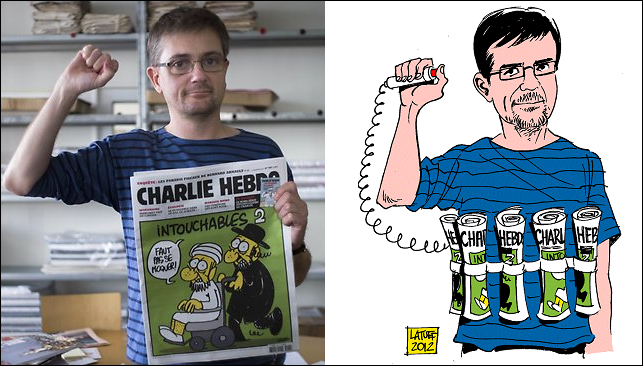
Charlie Hebdo recently published some cartoons featuring the prophet…
Okay, I’m always on about symmetry.
I posted a piece titled Messianic symmetries on ZP a while back, noting that both Ahmadinejad and Netanyahu can be viewed as exercising “leadership that makes decisions out of messianic feelings” — the quote comes from an unimpressed ex-Shin Beth director describing Bibi; Ahmadinejad makes the case for his own Mahdist leabings quite well himself.
Symmetry seems like an important analytic category to me, either because it’s there in the build of the world, or because it’s there in the build of the mind. Either way, I think we should take careful notice of symmetries.
Asymmetries I’ll talk about in my next post.
**
What about the cartoon above, right? It’s clearly based on the photo above, left, which shows Stéphane Charbonnier, the editor of Charlie Hebdo, holding his magazine with its offensive cartoons / vindication of free speech. And the suggestion is clear that he’s some kind of suicide bomber.
But who is he blowing up, exactly? Himself, and perhaps his staff and anyone else who happens to be within a few yards of his office at the time? France, Europe, the western world — the world itself? And how much irony should we read into the cartoon portrait?
They may have learned the technique from the Tamil Tigers, but these days, in the immediate wake of widespread rioting over the video clip and in the context of someone publishing cartoons that satirize the prophet, it’s clearly Islamist suicide bombers who provide the model for the cartoon of the cartoonist above.
Tit for tat? An eye for an eye? You’re just setting yourself up for a fatwa like Salman Rushdie?
**
Incendiary rhetoric on one side leads to incendiary behavior on the other, validating the incendiary rhetoric and making the escalation to incendiary behavior all the more probable.
Some of the incendiary rhetoric has its origin in holy books, which also preach peace.
There are Coptic Christians utterly blindsided by the virulence of the video, attributed to one of their number. There are Libyan Muslims utterly blindsided by the virulence of the attack on the US Embassy, attributed to some of their own.
**
I want to focus not on the specifics of the topic, but on the symmetry.
One writer, observing the partition of India and Pakistan, wrote:
The rioters brought the train to a stop. Those who belonged to the other religion were methodically picked out and slaughtered. After it was all over, those who remained were treated to a feast of milk, custard pies and fresh fruit.
Before the train moved off, the leader of the assassins made a small farewell speech: “Dear brothers and sisters, since we were not sure about the time of your train’s arrival, regretfully we were not able to offer you anything better than this most modest hospitality. We would have liked to have done more.”
Commenting on this paragraph, Ali Sethi wrote recently in the New Yorker:
That is all there is: murder—methodical and quick—followed by a feast and an ingratiating speech. Note the withholding of tags: we don’t know the location of the massacre or the religion of the killers. All we have is a spurt of base instincts.
The point here is that whenever you see a symmetry of opposites, it’s worth considering that symmetry in the abstract, as well as weighing the particular issues that drive your own side or the other.
That, I’d suggest, is one of the implications of that Paul van Riper remark I’m fond of quoting:
What we tend to do is look toward the enemy. We’re only looking one way: from us to them. But the good commanders take two other views. They mentally move forward and look back to themselves. They look from the enemy back to the friendly, and they try to imagine how the enemy might attack them. The third is to get a bird’s-eye view, a top-down view, where you take the whole scene in. The amateur looks one way; the professional looks at least three different ways.
**
I am concerned about hatred, simmering here, boiling over there. I am concerned about what sparks hatred, and what fans it. What I want to draw your attention to here, though, is the process by which one hatred fuels abother, the process of mirror imaging.
Mark Juergensmeyer, a terrific scholar of religion who has published on topics ranging from Gandhi‘s nonviolence to the violence of religionists who consider themselves sanctioned by the scriptures of various religions, makes the point in a recent Religion Dispatches post thus:
The US-based Islamophobes behind the insulting and amateurish video “The Innocence of Muslims,” and those behind the violent protests it allegedly caused around the Muslim world, are kindred hatemongers. Both are extremists with a political agenda, and both want to use this incident to discredit the legitimacy of the moderate governments in power in their respective countries. There is a symbiotic relationship between the strident protesters and the bigoted filmmakers; each needs the other.
We are in a hall of incendiary mirrors, with plenty of kindling: in my view, we should avoid playing with matches.
**
Thank God, there are also asymmetries.
In a companion post, I’ll take a look at recent, very promising events in Benghazi (h/t to Pundita for a pointer to this particular article), the not particularly unsurprising but unwelcome attitude of a Pakistani minister, and the imbalances that go along with the dangerous balances I’ve discussed in this post.
**
Oh, and let me digress…
I won the Divinity essay prize back in my schooldays at Wellington College, and received my chosen prize book, the Liber Usualis with its glorious collection of Gregorian Chants, from the then Minister of Defence, John Profumo, MP. Not long thereafter, it was discovered that he pillow talked with one Christine Keeler, a night lady of class, who also pillow talked with the Russian defence attaché. And the story was broken, week by glorious week, by the British satirical magazine, Private Eye.
Which I consequently have an affection for, after all these years. And I tell you this, because Charlie Hebdo, or Weekly Chuck as we might call it over here is, I’d suggest, a plausible latter-day French rough equivalent of Private Eye.
I don’t really like our guys posting inflammatory materials, you see, but I also have an affection for freedom of speech — and for magazines with a satirical bite, too…
So sue me, I contain multitudes.
[ by Charles Cameron — The Last Temptation of Christ troubles, an early warning re the upcoming Jesus of Nazareth movie — the blood libel and more ]
.
American and European Christians, too, can react violently to films they perceive as blasphemous, and this too we should remember as we weigh our own responses to the rioting in Cairo and elsewhere.
Martin Scorsese‘s Last Temptation of Christ gives us a sense of how modern American and European Christians can react to perceived blasphemy, while the forthcoming Paul Verhoeven movie of his own book Jesus of Nazareth will test the degree to which we’ve learned the lessons of a quarter century ago — and of this last week.

.
**
Martin Scorsese’s The Last Temptation of Christ: stirred strong feelings when it opened. I was in LA at the time, and was following the controversy fairly closely having attended an early screening, and having both literary and theological interests.
The short video clip below is a little choppy, it doesn’t make it particularly clear that the clips you see are from the film Martin Scorsese made of a novel — written by the Nobel laureate Nikos Kazantzakis — which makes no attempt nor pretense to be a historical or religiously orthodox portrayal of Christ. IMO, it is worth watching for the glimpse it gives of just how strong the undercurrents of emotion aroused by Scorsese’s film were at the time:
**
I’m bringing this subject up and attending to it in some detail because NBC World News mentioned Martin Scorsese’s movie on the 13th of this month, in an explanation as to Why films and cartoons of Muhammad spark violence, but without gwetting the picture quite right:
Director Martin Scorsese’s adaptation of a book by the same name showed Jesus struggling with lust, depression and doubt, and engaging in sex — in his imaginings — before snapping back to reality and dying on the cross. That movie was seen as blasphemy by some Christians, who — though not violent — were vocal enough to prevent the film from being shown in many parts of the United States.
There may have been no violence done to humans in the US — but there as certainly damage to property, and some vicious threats made, as The Encyclopedia of Religion and Film records:
At the Cineplex Odeon Showcase Theater in New York City, vandals slashed seats and spray-painted threats aimed at the chairman of MCA: “Lew Wasserman: If you release ‘The Last Temptation of Christ,’ we will wait years and decimate all Universal property. This message is for your insurance company.”
In parts of Europe, the violence was more intense:
Overseas, at the September 28 opening in Paris, demonstrators who had gathered for a prayer vigil threw tear gas canisters at the theater’s entrance. Catholic clergy led rock-throwing and fire-bombing assaults on theaters in many French municipalities. A thousand rioters in Athens trashed the Opera cinema, ripping apart the screen and destroying the projection equipment.
In Paris, specifically, the violence severely injured some human targets. From Wikipedia (with their footnotes removed — you can track the various quotes from the original page):
On October 22, 1988, a French Christian fundamentalist group launched Molotov cocktails inside the Parisian Saint Michel movie theater while it was showing the film. This attack injured thirteen people, four of whom were severely burned. The Saint Michel theater was heavily damaged, and reopened 3 years later after restoration. Following the attack, a representative of the film’s distributor, United International Pictures, said, “The opponents of the film have largely won. They have massacred the film’s success, and they have scared the public.” Jack Lang, France’s Minister of Culture, went to the St.-Michel theater after the fire, and said, “Freedom of speech is threatened, and we must not be intimidated by such acts.”
The Catholic response — from the Cardinal Archbishop of Paris among others — reproved both the blasphemy and the rioting:
The Archbishop of Paris, Jean-Marie Cardinal Lustiger, said “One doesn’t have the right to shock the sensibilities of millions of people for whom Jesus is more important than their father or mother.” After the fire he condemned the attack, saying, “You don’t behave as Christians but as enemies of Christ. From the Christian point of view, one doesn’t defend Christ with arms. Christ himself forbade it.” The leader of Christian Solidarity, a Roman Catholic group that had promised to stop the film from being shown, said, “We will not hesitate to go to prison if it is necessary.”
There was apparently a connection with French far-right politics, too:
The attack was subsequently blamed on a Christian fundamentalist group linked to Bernard Antony, a representative of the far-right National Front to the European Parliament in Strasbourg, and the excommunicated followers of Archbishop Marcel Lefebvre. Lefebvre had been excommunicated from the Catholic Church on July 2, 1988. Similar attacks against theatres included graffiti, setting off tear-gas canisters and stink bombs, and assaulting filmgoers.
There were legal proceedings following the Saint Michel incident, and it’s notable that Fr. Gérard Calvet OSB, founder and Prior of the Benedictine Abbaye Sainte-Madeleine du Barroux, testified at the tribunal on behalf of the convicted youths, describing their motives if not their mode of expression as “noble”. Would that term be equally applicable to protesters of blasphemies against other faiths? We now live in a dense-packed world where such comparisons are easily made.
Let’s pause for a minute over the twinned remarks of the late (and widely respected) Cardinal Lustiger concerning Last Temptation —
Jean-Marie Cardinal Lustiger, said “One doesn’t have the right to shock the sensibilities of millions of people for whom Jesus is more important than their father or mother.” After the fire he condemned the attack, saying, “You don’t behave as Christians but as enemies of Christ. From the Christian point of view, one doesn’t defend Christ with arms. Christ himself forbade it.”
and compare the remarks of a similarly authoritative religious figure in Libya to the Innocence of Muslims video:
Libya’s Grand Mufti, Sheikh Sadeq Al-Ghariani, has issued a fatwa condemning Tuesday’s killing of US Ambassador Chris Stevens along with three other American diplomatic staff and a number of Libya security guards. He said those involved were criminals who were damned by their action.
He also condemned the production of any film, picture or article insulting the Prophet Mohammad or any of the prophets by “extreme fanatics” in the US or elsewhere. The Prophet Muhammad, Ghariani said, had specifically forbidden the killing of ambassadors and envoys.
**
Almost a quarter century has passed since Scorsese’s movie opened, but as I said above, we will soon have an opportunity to show what we have learned from those lamentable events in Paris and the more recent tragedies in Benghazi, Cairo and elsewhere.
Paul Verhoeven — the director of such blockbusters as RoboCop, the original Total Recall, and Basic Instinct — has raised the financing for his upcoming movie Jesus of Nazareth, based on his book of the same name, and scripted by Roger Avary, who shared an Oscar with Quentin Tarrentino for their Pulp Fiction screenplay.
Verhoeven, be it noted, is not only a writer and movie director, but also a member of the Jesus Seminar — a group of scholars which, as Wikipedia nicely puts it, “treats the canonical gospels as historical sources that represent Jesus’ actual words and deeds as well as elaborations of the early Christian community and of the gospel authors” and prepares color-coded editions of the gospels suggesting which sayings of Jesus should be considered original, and which are better understood as later additions.
Here, to give you an idea of what may be on the horizon, is an excerpt from a quick and informal take on the upcoming movie by an admirer of Verhoeven:
Deadline reports that the legendary Paul Verhoeven — a guy who, amazingly, only directed three movies in the past fifteen years — has received financing to adapt his own book, Jesus of Nazareth, which discounts every mythical story surrounding Christ and, instead, opts to present him as a simple human figure with a message powerful enough to radiate throughout time. Roger Avary (Tarantino‘s story partner on Pulp Fiction) will write the film, while Muse Productions are doing the proper backing.
Almost any work going against the long-held Biblical grain will get groups up in arms — no, I don’t even need to provide examples — but the claims of Nazareth are, even in this context, still mighty contentious. Most notable is the idea that Jesus is not the son of God, but was actually the product of Mary being raped by a Roman soldier; so, right off the bat, you’re discounting the entire foundation of his story.
I am pointing this out because right now would be a good time for the various churches to begin a general conversation about the film-maker’s right to hold an opinion, write a book and make a movie, the hurt that may be felt by believers, and the importance of responding without hatred or violence when offended.
**
In our concern with matters of Christian and Muslim issues, let us not lose sight of the fact that Jews too have movies made about them that may not only hurt feelings but also represent real threats against them, reminiscent of Nazi and earlier Russian antisemitic propaganda fabrications.
From the copious “blood libel” entry in Wikipedia:
In 2003 a private Syrian film company created a 29-part television series Ash-Shatat (“The Diaspora”). This series originally aired in Lebanon in late 2003 and was broadcast by Al-Manar, a satellite television network owned by Hezbollah. This TV series, based on the antisemitic forgery The Protocols of the Learned Elders of Zion, shows the Jewish people as engaging in a conspiracy to rule the world, and presents Jews as people who murder Christian children, drain their blood and use this blood to bake matzah.
MEMRI has a report with further details, and a MEMRI clip of the scene in which a Christian child is killed by Jews has been posted on YouTube, with the comment:
Al-Shatat: Jews Murder A Christian Child and Use His Blood for Passover Matzos. anti Semite Arab propaganda against Jews, Judaism and Israel.
The following is a scene from the Syrian-produced TV series Al-Shatat. Al-Shatat was first aired on Hizbullah’s Al-Manar TV during the month of Ramadan 2003, and then on two Iranian channels during Ramadan 2004. Al-Mamnou’ TV, a new Jordanian channel, is airing Al-Shatat during Ramadan 2005.
It is worth recalling, too, that Mel Gibson‘s film, The Passion of the Christ, was perceived by many Jews, Christians and others as anti-Semitic — and that nonetheless the Orthodox Jew and conservative movie critic Michael Medved wrote:
The possibility of anti-Jewish violence in response to the film has been irresponsibly emphasized and has become, self-fulfilling prophecy. In parts of Europe and the Islamic world, anti-Semitic vandalism and violence occur daily, and hardly need a film by a Hollywood superstar to encourage them. In this context, Jewish denunciations of the movie only increase the likelihood that those who hate us will seize on the movie as an excuse for more of hatred.
**
I trust it is not too late to wish our Jewish readers l’shana tova: may your apples be dipped in honey and all our days bathed in peace.
[ by Charles Cameron — in memory of Carlos Fuentes, requiescat in pace ]
.
.
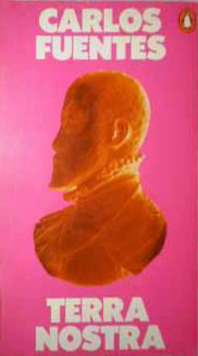
Carlos Fuentes‘ great novel, Terra Nostra, opens with these words:
Incredible the first animal that dreamed of another animal.
It’s a sentence to stop you in your tracks, a sentence to give pause to time itself, circling back on itself like the serpent that eats its own tail, a dream of a sentence, a dream sentence.
Fuentes continues:
Monstrous the first vertebrate that succeeded in standing on two feet and thus spread terror among the beasts still normally and happily crawling close to the ground through the slime of creation. Astounding the first telephone call, the first boiling water, the first song, the first loincloth.
How does a mind move so agilely among these many and diverse firsts — the sleeping, the archeo-anthropological, the technical, the musical, the shameful or sinful or perhaps decorative, even erotic? In a single paragraph — the first in a book that will run 890 pages and not tire?
And Fuentes continues:
About four o’clock in the morning one fourteenth of July, Pollo Phoibee, asleep in his high garret room, door and windows flung wide, dreamed these things, and prepared to answer them himself.
Pollo Phoibee dreamed these things, Carlos Fuentes dreamed Pollo Phoibee…
And we are in Paris, Paris of the artists, of the garret, and yet a Paris where the Seine is boiling, where the Louvre has become crystalline, the black eyes of the gargoyles of Notre Dame see “a much vaster panorama”…
*
Carlos Fuentes died today, and I am saddened — remembering him signing my short, fat British Penguin paperback of Terra Nostra (its fondly remembered cover image above) and commenting that it was his preferred English edition, since one could slip it into one’s pocket…
And Terra Nostra was special to me, both as a great and tumultuous fiction, and as a fiction that quoted Norman Cohn‘s In Pursuit of the Millenniun, the book that back in my Oxford days introduced me to the history of apocalyptic thought… a fiction also familiar with Frances Yates, another scholar I greatly admire, and her writings on the Memory Theater…
Carlos Fuentes, the imagination that conceived Terra Nostra, is no longer with us.
*
He had been a diplomat, this great imagination. Born into a diplo family, he had served as Mexican ambassador to Paris — Paris of the diplomatic banquets, but also of the artist’s garret, of this New World imagination spanning continents and centuries as though they were a playground, the playground of a single, multiple, cosmopolitan and erudite mind.
The poet Paul Claudel, French ambassador to Japan, was reproved by the Surrealists in 1925 with the words:
One cannot be both ambassador for France and poet!
The poet Saint-John Perse was secretary to the French Embassy in Peking, and later General Secretary of the French Foreign Office. The poet Giorgos Seferis was Royal Greek Ambassador to the United Kingdom. The poet Pablo Neruda was Chilean ambassador to France… The poet Octavio Paz, Mexico’s ambassador to India.
Among novelists, it was Lawrence Durrell — an Englishman born in India with what he described as “a Tibetan mentality” — one who found life in England itself “like an autopsy … so, so dreary” — who was British press attaché in Alexandria, Egypt, during World War II, where as they say:
Ostensibly working, Durrell was in reality closely observing the assortment of sights, sensations, and people that wartime Alexandria, a crossroads of the East and West, had to offer.
The result was his masterpiece, The Alexandria Quartet.
*
Fuentes is heir to many lineages: of Mexico, of the world, of literature, of diplomacy, of the imagination.
In honoring him today, my researches turned up this apposite quote from Aldo Matteucci at the Reflections on Diplomacy blog:
To survive, a diplomat needs poetry. Filed amidst the many layers of the brief, the short poem will refresh the bleary mind. Poetry brings distance – hence perspective and insight. Poetry reminds the diplomat that the best professional is the amateur.
Most deeply – poetry is truth.
Carlos Fuentes survives us all.

Zenpundit is a blog dedicated to exploring the intersections of foreign policy, history, military theory, national security,strategic thinking, futurism, cognition and a number of other esoteric pursuits.
Customized Web Site & Blog Design