zenpundit.com » Afghanistan

Archive for the ‘Afghanistan’ Category

Great question!

Tuesday, May 21st, 2013

[ by Charles Cameron — from Paradise Regained: Overcoming Terrorism in Star Trek Into Darkness ]
.


.

Matt Ford, guest-blogging at Grand Blog Tarkin [includes spoilers] asks:

How many young Americans learned Arabic and Pashto or studied counterterrorism and international relations because nineteen men flew three planes into a building and one into the ground, killing thousands?

Great question!

And how many in the UK after 9/11? — and after 7/7?

**

Also worth reading [and also includes spoilers]:

Amy Davidson, Is “Star Trek into Darkness” a drone allegory?

Are Insurgencies “Antifragile”?

Thursday, May 16th, 2013

I have been reading Nassim Nicholas Taleb’s latest book,  Antifragile . It’s a highly intriguing book and I will give it a full review soon, but Taleb’s core concept of antifragility is important  and lends itself to wide application. Here’s Taleb on what constitutes “antifragility” – things that gain or improve with disorder – which he was careful to distinguish not just from “fragility” but also from “robustness” and “resilience”:

Almost all people answer that the opposite of “fragile” is “robust”, “resilient” , “solid”, or something of the sort. But the resilient, robust (and company) are items that neither break nor
improve, so you would not need to write anything on them – have you ever seen a package with
“robust” stamped on it? Logically, the exact opposite of a “fragile” parcel would be a package on which one has written “please mishandle” or “please handle carelessly”. It’s contents would not just be unbreakable, but would benefit from shocks and a wide array of trauma. The fragile is the package that would be at best unharmed, the robust would at best and at worst unharmed. And the opposite of fragile is therefore what is at worst unharmed. [31]

Italics in original.

Taleb uses a number of metaphors – the Phoenix, the Hydra – as well as examples to get across the point that an antifragile entity overcompensates in reaction to stress/damage/disorder by becoming better, growing stronger, more powerful, adaptively improving itself. Think of the effects of weight training in building muscle or a wildfire spurring bountiful growth in an ecosystem. There’s more to Antifragile than this but the gist is sufficient for now.

Which brings me to the question, “Are insurgencies antifragile?”

The study of insurgency, terrorism and revolution, while important and useful tend to suffer from several drawbacks. One is compartmentalization and academic specialization. As Robert Bunker pointed out in Narcos Over the Border,  a problem like “criminal-insurgency” attracts very different reactions from Law enforcement, intelligence analysts, the military, counter-terrorism officials and other experts (to say nothing of politicians) which makes consensus over a common analytic framework very difficult. Sometimes even defining the problem across domains is frustrating. As a result, many studies are too narrow and the few admirably ambitiously broad ones are deeply stamped in the political lens of the era in which they were researched and written – i.e. imperialist Small Wars, the Cold War, the War on Terror, Pop-centric COIN of Iraq and Afghanistan wars etc.  It is a subject that requires both more (and more intellectually creative) scholarship and a greater degree of synthesis.

In the meantime, I’d like to offer some speculation in an effort to answer the question:

  • The characteristics of “antifragility” in terms of at least some kinds of insurgency bears a striking resemblance to that of “wicked problems“, which has also been used to categorize some enduring irregular conflicts. Particularly in the sense of not having natural stopping points , manifesting complex interdependencies and resistance to simple, silver bullet solutions that could destroy it.
  • Moreover, most successful insurgencies are not, contrary to Maoist theory, autochthonous  – they draw many resources from external sources – black globalization, foreign patrons, legitimate trade, fundraising – and from the very state waging counterinsurgency warfare against them. The Afghan Taliban would be a much poorer military force without the vast amount of American aid passing through the hands of Pakistan and the Karzai regime
  • An insurgency’s claim to being “antifragile” may rest as much or more upon the general political and socioeconomic environment being relatively chaotic than on the nature of the insurgent organization itself.  The Chinese, Russian and Lebanese civil wars, Mexico’s narco-insurgency, West Africa and Afghanistan in the 1990’s, the Congo basinand Iraq in the 2000’s all had polycentric and disorderly environments that allowed  irregular groups to rapidly rise and fall on a local and regional basis. By contrast, “bilateral” insurgency vs. state dynamics can stabilize conflict for decades
  • An insurgent organization may lose antifragility as it restructures itself over time to become either more robust (ex. –Hezbollah) subnational entity or to accept greater fragility in order to acquire state-like hierarchical advantages ( political discipline and specialization). Note that “fragile” does not mean “weak”, it means “vulnerable”. States can be very strong and concentrating massive amounts of resources and coercive force, yet be strangely vulnerable to internal coups, popular uprisings, economic collapse, strategic myopia or even natural disasters. One of the great dangers today are complex systems that combine epic power with extreme fragility – small disruptions by irregulars yield huge ROIs.
  • States might be able to seek a strategic advantage over insurgencies by improving their robustness and smother the relatively ineffectual kinetic attacks of guerrillas or terrorists with inertia, refusing to “feed” the growth of an antifragile insurgent opponent, starving them of material resources and political oxygen. India has trucked along with something like seventeen ongoing insurgencies and episodic acts of major terrorism for decades without the Indian state remotely being in jeopardy of being overthrown by, say, the Naxalites, Sikh extremists or Kashmiri Islamists. Compare that with the rapid collapse or retreat of the state in places like Somalia, Yemen, Libya, Mali, Syria and so on.
  • The effects of globalization and information technology, the ability to have  John Robb’sopen source” decentralized, fast-evolving, insurgencies, give an an impetus to insurgencies becoming antifragile. At a minimum, it improves the odds.
Comments welcomed

Sisyphus on the treadmill of memes

Thursday, May 9th, 2013

[ by Charles Cameron — Khorasan, black banners, the Ghazwa-e-Hind — when will the updating ever stop? ]
.

**

It looks as though I first realized that “the black banners of Khorasan” was a meme I should be “eyes out” for was in July 2007, when John Robb pointed us to a piece by Syed Saleem Shahzad on events at the Red Mosque

For the al-Qaeda leadership sitting in the tribal areas, the situation is fast evolving into the promised battle of Khorasan. This includes parts of Iran, Pakistan, Afghanistan and Tajikistan from where the Prophet Mohammed promised the “end of time” battle would start.

That reference to Khorasan in turn led me back to a slightly earlier Washington Post piece where the Khorasan / black banners motif was clearly set forth, along with a pointed comment from Andrew Black, co-founder of Thistle Intelligence Group:

The battles today, like those against the Soviet occupiers, are also fought with religious verve. The Taliban and al-Qaida fight under a black flag connoting the participation of Islam’s prophet in their battle for Khorasan, the ancient name for the region centered around Afghanistan.

Khorasan increasingly features in the militants’ videos and the name was taped to the leg of a suicide bomber who killed 24 people in Pakistan’s Northwest Province this spring.

“One should not underestimate the theological importance of Khorasan to aspiring mujahedeen; particularly those who are only able to initially view the conflict through the Internet,” said Black.

Hamid Gul was in Shahzad’s piece too, talking about the Red Mosque and the Red Fort — and here, too, I likely made my first acquaintance with the motif of the Ghazwa-e-Hind, symbolized by the wish to plant Pakistan’s flag on Delhi’s Red Fort:

It is a pity that our army was preparing youths to seize Lal Qala [the Red Fort of Delhi] and they ended up seizing the Lal Masjid,” Gul said.

Both these memes have been around longer than I have, but back then they didn’t seem to be attracting much attention in the west.

Now they’re cropping up all over — and I’m (to switch metaphors in mid-stream) paddling hard to keep up.

**

The black flags are alive and well this week, as shown in this video of the graduation of a new batch of the Free Army fighters in Syria:

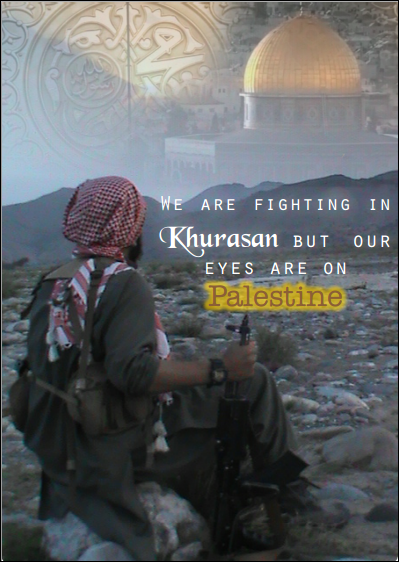
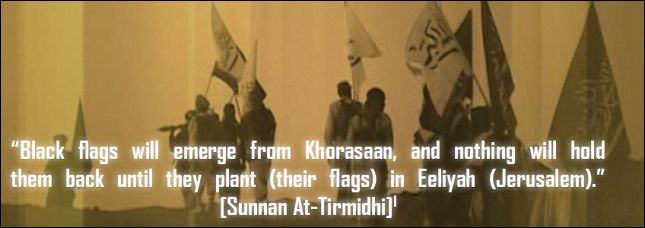
Khorasan too, as seen in the image from the new magazine Azan at the top of this post — but where does Azan itself come from?

B Raman writes:

It is not yet clear who has started “Azan”. One suspect is the Tehrik-e-Taliban Pakistan (TTP), which is the Pakistani Taliban. The other suspect is Al Qaeda headquarters in the South Waziristan area of Pakistan.

I’m interested in this question, because Azan had an overview of the various fronts of contemporary jihad, and an image that invokes both Khorasan and Jerusalem isn’t exactly “local” in focus. And that brings me to that other meme of interest here — the Ghazwa-e-Hind — which as I pointed out recently ius also mentioned in Azan, though not a huge focus there.

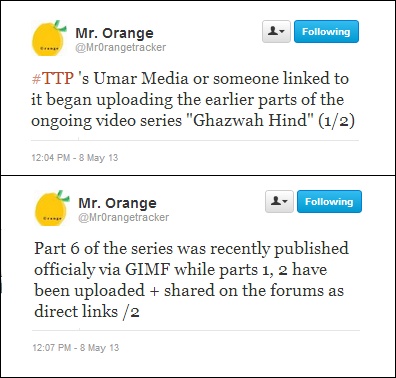
But if Azan is indeed a TTP product, then this info from Mr Orange:

would indicate they find the Ghazwa of more than passing interest…

Early notes on the first issue of the jihadist magazine, Azan

Tuesday, May 7th, 2013

[ by Charles Cameron — more of some familiar ZP themes, now in a new container ]
.

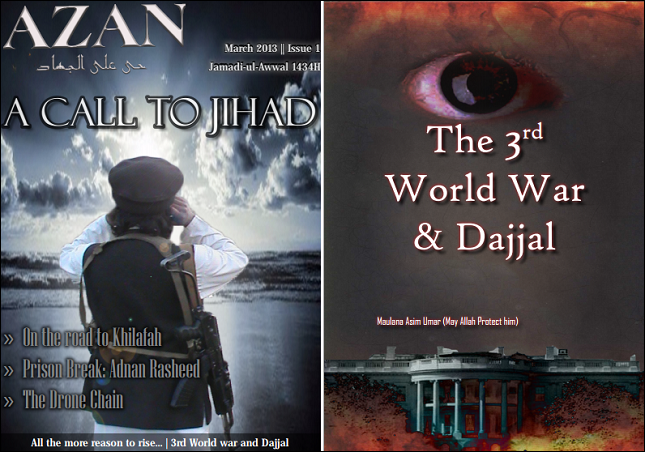
There are several matters of special interest to me that I’d like to draw your attention to in the new magazine, Azan, just issued from the Afghanistan / Pakistan region:

.

**

First, Azan has a major article devoted to the Dajjal [pp. 38 ff.], the end times figure in Islam equivalent to the Christian antichrist. Here’s the introduction:

The world today stands nearer to the Day of Judgment than ever. 1434 years after the migration of the last Prophet (May Allah’s Blessings be upon him), the conflict between the satan and the human being is nearing its final stage. It is therefore crucial that the world events that are unfolding themselves in quick succession be viewed by the and analyzed by the Muslims in the light of the Divine Shariah. Of the Islamic scholars who have dedicated themselves to this pristine cause is Maulana ‘Asim Umer (May Allah Protect him) whose books regarding Islamic eschatology have proved invaluable in guiding the Ummah through these troubled times. In addition, the Maulana (HA) is, by his self, part of the global Jihad caravan that is seeking to implement the Khilafah on Allah’s Earth. This article is about the state of the world before the advent of Dajjal, the false Messiah (Antichrist in the Biblical Tradition). It carries an eerie resemblance to the world we live in today.

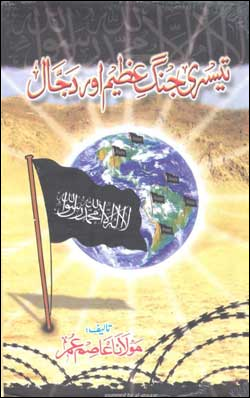
It looks as though this excerpt comes from “Third World War and Dajjal: Maulana ‘Asim ‘Umar Page 111-114 8th Edition” [p. 41].

Sadly, I lack Urdu — along with Bangla, Arabic and most everything else.

**

Second, the “sign of the times” that’s emphasized in the article — the “fitna of the Dajjal” — is one that would appeal to those who already mistrust world leaders and the press…

The truth would be indistinguishable from falsehood and the callers to misguidance would be plentiful. The propaganda during his time would be so ghastly that the truth would be presented as falsehood and the falsehood would be presented as the truth. And this twisted reality would be broadcast to the entire world. The enemies of humanity would be shown as saviors while the real saviors of humanity would be shown as “terrorists.”

That is why the Prophet Muhammad explained the Fitnah of Dajjal in great detail.

**

Third, there’s a sidebar to that article from al-Awlaki [p.41], titled Shaykh Anwar Al-Awlaki (RA) on the Final Battle. He suggests we are nearing the end times:

So the upcoming battle will be either lose it all or win it all and that is part of al-Malhama. It will be the final battle between Kufr and Iman; it will be a battle that will give victory to this Muslim Ummah. It’s not the end of it all as you still have Dajjal, Ya’juj and Ma’juj; but that battle will be the battle that will establish the Islamic Khilafah on a global scale.

So this is an indication that we are getting close to those times. Now, if we are getting close to those times, you really don’t want to be sitting on the sidelines and lose out on all of this reward in this Golden Era; because it is a Golden Era. Upon reading these ahadith, people would wish they were there; and here we are living in those times sitting on the sidelines just as Shaykh ‘Abdullah Yusuf ‘Azzam (rahimahullah) said, “The Jihad was a market that opened, people made a lot of money, and then the market closed.” It’s not going to last forever; if you sit behind, if you hesitate, if you are reluctant, then you will miss out because the chance only comes once.

**

Fourth, in a round-up of jihadist fronts from around the world, there are a few paragraphs devoted to the Ghazwah e-Hind, termed here “the Jihad of Hind” [pp. 15-16]:

As for the Jihad of Hind (present-day India, Pakistan and Bangladesh), it comes in a Hadith:

Abu Huraira (RA) narrates that, “The Prophet Muhammad promised us the Jihad of Hind. If I get a chance to be part of that then I would spend my whole wealth and life in that. Then if I’m martyred, I’ll become the best of martyrs and if I return alive, then I will be a free-from-hell Abu Huraira.” [Sunnan Al-Nisai]

“Thauban (RA) narrates in a Marfoo’ Hadith that the Messenger of Allah said that there are two Jama’ahs (groups) in my Ummah for whom Allah Has Decreed salvation from Hell. One of these Jama’ahs is the one that will wage Jihad in Hind and the second Jama’ah is the one that will wage Jihad with Isa (AS) after he descends during the last days.” [Tibrani Shareef]

With such glad tidings from the Messenger of Allah [saw], the Mujahideen of Pakistan have their firm sights on freeing both India and Pakistan from the rule of the disbelieving rulers and to establish Shariah in all these lands once more. May Allah Grant victory to them! Ameen!

**

And finally, there’s mention of the obligatory black banners of Khorasan [pp. 13-15]:

Black flags were unfurled from Khorasaan just as the Prophet Muhammad [saw] had foretold:

“Black flags will emerge from Khorasaan, and nothing will hold them back until they plant (their flags) in Eeliyah (Jerusalem).” [Sunnan At- Tirmidhi]

So, if indeed these Taliban are the flag bearers mentioned in the Hadith, then they shall inshAllah march forth to and conquer Jerusalem. And this is a note to the “powers” of today. In fact, the Shariah of the Taliban gained such acceptance with Allah The Exalted, that He Made the land of Afghanistan the base for the start of the global Jihad movement.

The black flags of Khorasaan became being unfurled all around and the sacred call to Tawheed (monotheism) was renewed.

**

There is plenty more, of course, and I’ve cherry-picked the bits that bear on specific themes I have been exploring here at ZP that have end times relevance.

Aaron Zelin has made a .pdf of the magazine available via Jihadology. Bahukutumbi Raman discusses it from an Indian intelligence perspective on his blog. Reuters looks at what the magazine has to say about drones. And no doubt others will be providing analysis from various other perspectives in the coming days.

Furnish on Pew findings re: Islam

Thursday, May 2nd, 2013

[ Charles Cameron presenting guest-blogger Timothy Furnish ]
.

.

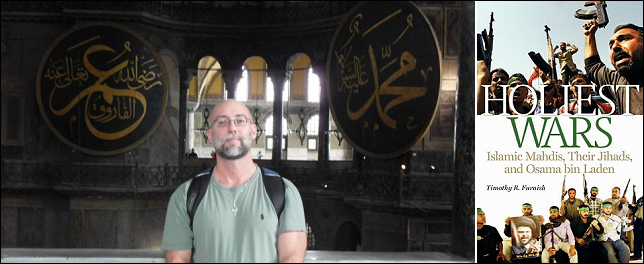
I’m delighted to welcome Dr Timothy Furnish as a guest-blogger here on Zenpundit. Dr Furnish has served as an Arabic linguist with the 101st Airborne and as an Army chaplain, holds a PhD in Islamic history from Ohio State, is the author of Holiest Wars: Islamic Mahdis, Their Jihads, and Osama bin Laden (2005), and blogs at MahdiWatch. His extended piece for the History News Network, The Ideology Behind the Boston Marathon Bombing, recently received “top billing” in Zen’s Recommended Reading of April 24th.

**

Does This Paint It Black, or Am I A Fool to Cry? Breaking Down the New Pew Study of Muslims
by Timothy R. Furnish, PhD
.

Pew has released another massive installment of data from its research, 2008-2012, into Muslim attitudes, entitled “The World’s Muslims: Religion, Politics and Society.” Over 38,000 Muslims in almost 40 countries were surveyed, thus constituting a survey both statistically sound and geographically expansive. Herewith is an analysis of that information and what seem to be its major ramifications.

The first section deals with shari`a, usually rendered simply as “Islamic law” but more accurately defined as “the rules of correct practice” which “cover every possible human contingency, social and individual, from birth to death” and based upon the Qur’an and hadiths (sayings and practices attributed to Muhammad) as interpreted by Islamic religious scholars (Marshal G.S. Hodgson, The Venture of Islam, Vol 1: The Classical Age of Islam, p. 74). Asked “should sharia [as Pew anglicizes it] be the law of the land,” 57% of Muslims across 38 countries answered “yes” — including, most problematically for the US: 99% of Afghans, 91% of Iraqis, 89% of Palestinians, 84% of Pakistanis and even 74% of Egyptians. Should sharia apply to non-Muslims as well as Muslims? Across 21 countries surveyed on this question, 40% answered affirmatively — with the highest positive response coming from Egypt (its 74% exceeding even Afghanistan’s 61%). And on the question whether sharia punishments — such as whippings and cutting off of thieves’ hands — should be enacted, the 20-country average was 52%, led by Pakistan (88%), Afghanistan (81%), the Palestinian Territories [PT] (76%) and Egypt (70-%). On the specific penalty of stoning for adultery, the 20-country average was 51% — with, again, Pakistan (89%), Afghanistan (85%), the PT (84%) and Egypt (71%) highest in approval. Finally, 38% of Muslims, across those same 20 nations, support the death penalty for those leaving Islam for another religion.

Huge majorities of Muslims across most of these surveyed nations say that “it’s good others can practice their faith” — but Pew’s imprecise terminology on this topic makes possible that this simply mean many Muslims are willing to grant non-Muslims the tolerated, but second-class, ancient status of the dhimmi. Majorities, too, in most countries say that “democracy is better than a powerful leader;” however, the latter was actually preferred by most surveyed in Russia, Bosnia-Hercegovina, Kyrgyzstan, Afghanistan and Pakistan, as well as by 42% of Iraqis, 40% of Palestinians and 36% of Egyptians. Most Afghans, Egyptians and Tunisians (and even 1/3 of Turks) believe that “Islamic political parties” are better than other ones, although 53% of Indonesians and 45% of Iraqis are also worried about “Muslim extremists.” (Curiously, 31% of Malaysians are, on the other hand, worried about “Christian extremists” — although evidence of such existing in that country is practically non-existent.) There is good news on the question of suicide bombing, however: across 20 countries, only 13.5% think it is ever justified — although the support is much higher in the PT (40%), Afghanistan (39%) and Egypt (29%).

In terms of morality, large majorities in most Muslim countries (especially outside Sub-Saharan Africa) think drinking alcohol is morally repugnant, notably in Malaysia (93%), Pakistan and Indonesia (both 91%). Most Muslims in most countries surveyed consider abortion wrong, as well as pre- and extra-marital sex and, almost needless to say, homosexuality. (Although one wishes Pew had asked about mu`tah, or “temporary marriage” — a practice originally Twelver Shi`i which has increasingly become used by Sunnis.) Yet, simultaneously — following Qur’anic rubrics — some 30% of Muslims in 21 countries support polygamy, including almost half of Palestinians, 46% of Iraqis and 41% of Egyptians. There is also significant support for honor killings in not just Afghanistan and Iraq but also Egypt and the PT. Over ¾ of Muslims across 23 countries says that “wives must always obey their husbands:” an average of 77%. And Pew notes that there is a statistically very significant correlation between sharia-support and believing women have few(er) rights.

Asked whether they believed they were “following Muhammad’s example,” 75% of Afghans and 55% of Iraqis answered affirmatively — although most Muslims were not nearly so confident. On the question “are Sunni-Shi`i tensions a problem,” 38% of Lebanese, 34% of Pakistanis, 23% of Iraqis and 20% of Afghans said “yes.”

It is no surprise that huge majorities of Muslims in most surveyed countries believe that Islam is the only path to salvation, nor that most also say “it’s a duty to convert others” to Islam. It is somewhat counterintuitive, however, that many Muslims say they “know little about Christianity” — even in places with large Christian minorities, such as Egypt. Muslims in Sub-Saharan Africa are the most likely to agree that “Islam and Christianity have a lot in common,” and so are 42% of Palestianians, as well as some 1/3 of Lebanese and Egyptians. But only 10% of Pakistanis agree. Asked whether they ever engaged in “interfaith meetings,” many Muslims in Sub-Saharan Africa said that they did (with Christians), and a majority of Thais said likewise (albeit with Buddhists). But only 8% of Palestinians, 5% of Iraqis, and 4% of Egyptians said they ever do so—despite substantial Christian populations in each of those areas.

Regarding the question “are religion and science in conflict,” most Muslims said “no” — with the exceptions of Lebanon, Bangladesh, Tunisia and Turkey where over 40% in each country (and, actually, a majority in Lebanon) said that they were at loggerheads. Most Muslims also say they have no problems with believing in Allah and evolution — the exceptions being the majority of Afghans and Indonesians. Regarding popular culture, clear majorities of Muslims in many countries say they like Western music, TV and movies—but, at the same time, similar majorities say that such things undermine morality (although Bollywood less so than Hollywood).

Observations:

1) The high degree of support for sharia is the red flag here. Contra media and adminstration (both Obama and Bush) assurances that most Muslims are “moderate,” empirical data now exists that clearly shows most Muslims, in point of fact, support not just sharia in general but its brutal punishments. Perhaps just as disturbing, almost four in ten Muslims are in favor of killing those who choose to follow another religion. And countries in which the US is heavily involved either diplomatically or militarily (or both) are the very ones where such sentiments run most high: Pakistan, Afghanistan, Egypt, the Palestinian Territories. So are the “extremists” these very Muslims who want to follow, literally, the Qur’an and hadiths? Messers Brennan, Holder and Obama have some explaining to do.

2) Afghanistan would appear to be a lost cause. Afghans are at the top of almost every list in support for not just sharia, suicide bombing, honor killing and — ironically (or perhaps not) — confidence that they are emulating Islam’s founder, as well as dislike for democracy. In light of this clear data, two points about Afghanistan become clear: tactically, ostensible American befuddlement as to the causes of “green on blue” attacks and the continuing popularity of the Taliban in Afghanistan appears as willful ignorance; strategically, the US decision to stay there after taking out the al-Qa`ida [AQ] staging, post-9/11, and attempt to modernize Afghanistan was a huge, neo-Wilsonian mistake. 2014 cannot come soon enough.

3) In some ways Islam in Southeastern Europe, and to a lesser extent in Central Asia, seems to be a more tolerant brand of the faith than the Middle Eastern variety. For example, the SE European and Central Asian Muslims are the least likely to support the death penalty for “apostasy,” and the most supportive of letting women decide for themselves whether to veil. And Muslims in Sub-Saharan Africa are the most likely to know about Christianity, and to interact with Christians. On the other hand, African Muslims are among the most enamored of sharia, and Central Asian ones fond of letting qadis (Islamic judges) decide family and property disputes. So there does not seem to be a direct link between Westernization and moderation; in fact, the influence of Sufism — Islamic mysticism — in the regard needs to be correlated and studied (beyond what Pew did on the topic in last year’s analysis).

4) One bit of prognostication based on this data: Malaysia may be the next breeding ground of Islamic terrorism. It’s home to some 17 million Muslims (61% of its 28 million people), who hold a congeries of unsettling views: 86% want sharia the law of the land; 67% favor the death penalty for apostasy; 66% like sharia-compliant corporal punishments; 60% support stoning for adultery; and 18% think suicide bombing is justified. PACOM, SOCOM and the intelligence agencies need to ramp up hiring of Malay linguists and analysts.

5) Finally, some words for those — like FNC’s Megyn Kelly and Julie Roginsky (on the former’s show “American Live,” 4/30/13) — who pose a sociopolitical and moral equivalence between Muslim support for sharia and Evangelical Protestant Christian support for wives’ obedience to husbands: that’s a bit too much sympathy for the devil. Yes, Evangelical Christian pastors hold some pretty conservative views of the family, as per a 2011 Pew study of them; for example, 55% of them do agree that “a wife must always obey her husband” (compared to 77% of Muslims). And, ironically, many such Evangelicals agree in large measure with Muslims on issues such as the immorality of alcohol, abortion and homosexuality. However, one searches in vain for any Evangelical (or other) Christian support for whippings, stonings, amputation of thieves’ limbs, polygamy or suicide bombing.

Islam is the world’s second-largest religion, numbering some 1.6 billion humans (behind only Christianity’s 2.2 billion). There is, thus, enormous diversity of opinion on many issues of doctrine and practice, and essentializing Islam as either “peaceful” or “violent” is fraught with peril. Nonetheless, this latest Pew study provides empirical evidence that many — far too many — Muslims cling to a literalist, supremacist and indeed brutal view of their religion. Insha’allah, this will change eventually — but time is not necessarily on our side.

Switch to our mobile site