zenpundit.com » games

Archive for the ‘games’ Category

Terror Is Glamour as War is Game

Friday, March 18th, 2016

[ by Charles Cameron — on the necessary simultaneity of temporal and eternal perspectives ]
.
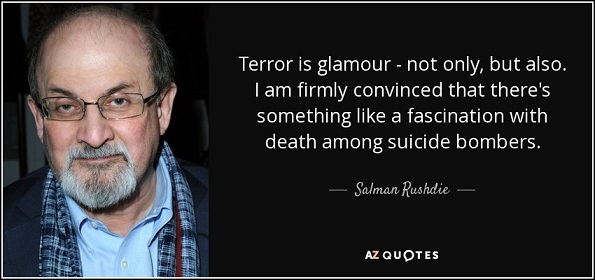
quote-terror-is-glamour-salman-rushdie

**

First as to glamour -– it may help to reflect that glamour, our word, comes not from Vogue but from the same origins as grammar (referring to languages) and grimoire (a book of spells, spelling also being a matter of language), and means something along the lines of “luminous illusion”. If we say terror is glamour, then, we mean that it “casts a spell” — and thus creates an appealing, indeed compelling, mirage. It lies, then, in the realm of magic, image, imagination, so ably delineated by Ioan Couliano in his great book, Eros and Magic in the Renaissance.

The best of contemporary advertising draws on precisely the same Renaissance principles of persuasion — principles of extraordinary power which we nowadays tend to dismiss as “magical thinking”.

**

Thus Virginia Postrel, in Terror Is Glamour:

Glamour can sell religious devotion or military glory as surely as it can pitch lipstick or island vacations. All promise a way to transcend our everyday circumstances, to experience more and become better than ordinary life allows. All invite us to imagine escape and transformation.

Postrel continues:

From Achilles and Alexander to “national greatness,” the glamour of battle is remarkably persistent. So is the glamour of martyrdom, as any trip through a Western museum or perusal of a Lives of the Saints (or its Protestant equivalent) will demonstrate. Nor is martyrdom’s appeal to Christians merely historical, as Eliza Griswold reported in this 2007 TNR piece.

Glamour appeals to our desires, whatever they may be, and Jihadi glamour offers something for everyone: from historical importance to union with God, not to mention riches and beautiful women.

Postrel then quotes Egyptian cleric Hazem Sallah Abu Isma’il, indicating that the “beautiful women” in question are “black-eyed virgins” from a world conceptually above our own:

If one of these virgins were to descend to this world, her light would extinguish the light of the sun and the moon. That’s how beautiful she is.

Yet as Postrel comments, “glamour proves perishable”:

As Rushdie suggests, of course, glamour always leaves something out, in this case the literally gory details of the act .. Either aspirations change, entropy and boredom set in, or the audience learns too much, destroying the mystery and grace on which glamour’s beautiful illusion depends.

She concludes with a significant question and preliminary response:

How do we puncture the glamour of Jihadi terrorism? The first step is recognizing that such glamour exists.

That may seem like CVE 101, but the deeper our understanding of magic, imagination, image — and hence the power of glamour — the deeper our understanding of the deep problem that CVE presents will become.

**

Next we turn to Richard Fernandez, writing in A Bellyful of War, picking up the themes of war’s attraction, and the carnage its glamour omits from mention, and tying both to the notions of war as game and war as brutal reality:

William Tecumseh Sherman understood what many modern theorists have forgotten: war can be attractive to young men for as long as long as it remains a game. War in small doses is supremely thrilling, even glamorous. It is peace which can be routine and boring.

And so it goes until war stops being a game and the going gets really rough. “Its glory is all moonshine,” said Sherman. “It is only those who have never heard a shot, never heard the shriek and groans of the wounded and lacerated … that cry aloud for more blood, more vengeance, more desolation.” To Sherman a “bellyful of war” was ironically the psychological foundation of generational peace.

Not only is that last sentence a profound statement worthy of the contemplation of all who love peace – it is also far more subtly convincing than the old Strategic Air Command motto, Peace is Our Profession, which sounds more like one of Rochefoucauld’s tributes that vice pays to virtue than anything, and yet is presumably intended to convey the same insight.

**

Finally we have Plotinus, for whom – in a manner richly echoed by Shakespeare — life itself is a dream, a play, a sport, a game:

Murders, death in all its guises, the reduction and sacking of cities, all must be to us just such a spectacle as the changing scenes of a play; all is but the varied incident of a plot, costume on and off, acted grief and lament. For on earth, in all the succession of life, it is not the Soul within but the Shadow outside of the authentic man, that grieves and complains and acts out the plot on this world stage which men have dotted with stages of their own constructing. All this is the doing of man knowing no more than to live the lower and outer life, and never perceiving that, in his weeping and in his graver doings alike, he is but at play; to handle austere matters austerely is reserved for the thoughtful: the other kind of man is himself a futility. Those incapable of thinking gravely read gravity into frivolities which correspond to their own frivolous Nature. Anyone that joins in their trifling and so comes to look on life with their eyes must understand that by lending himself to such idleness he has laid aside his own character. If Socrates himself takes part in the trifling, he trifles in the outer Socrates.

Plotinus is correct, I would suggest, sub specie aeternitatis, just as is Sherman sub specie incarnationis — and it is the role of the artist to hold both visions, trivial and eternal, as Koestler suggests.

**

I am again grateful to David Foster for his ChicagoBoyz post The Romance of Terrorism and War which triggered this exploration and the one on Getting Deeper into Koestler which preceded it.

Carambolages, huzzah!

Monday, March 14th, 2016

[ by Charles Cameron — a brilliant new exhibition breaks the usual museum rules to provoke prodigious & repeated leaps of imagination ]
.

Carambolages Dominos

**

Cath Styles, whose Sembl games are closely related to my own HipBone variants on Hermann Hesse‘s Glass Bead Game, recently pointed me to an exhibition called Carambolages that opened recently at the Grand Palais, Galleries Nationales, 3, avenue du General Eisenhower, Paris.

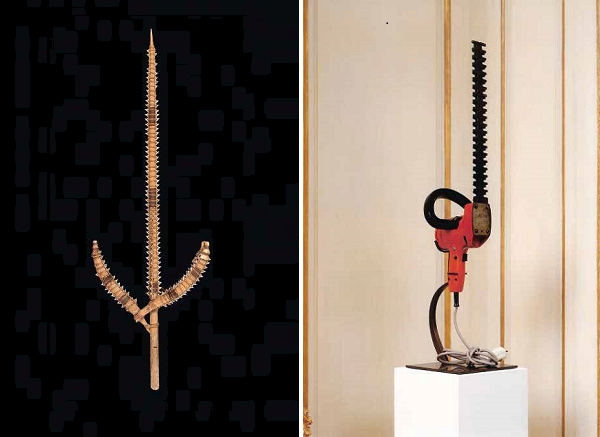
Strolling their website, I was struck by this double image, which in HipBone terms would be called a DoubleQuote, or a Sembl in Cath’s Sembl game:

Carambolages
(left) Sword, Kiribati, Micronesia Islands, Oceania, sd, Paris, Musée du Quai Branly
(right) Bertrand Lavier, Black & Decker, 1998 collection Giuliana and Tommaso Setari

It appears, indeed, that the exhibit in question features a Domino game of Sembls or DoubleQuotes —

Fascinating — and definitely a notable step in the expanding history of bead game variants — which I view, among other things, as an art movement that has yet to be written up as such.

Congratulations, Jean-Hubert Martin! The catalogue will no doubt be as close as I can get physically, but I’m all the way with you in spirit…

Bonne idée, bon chance!

Contrapuntal video, fugal braiding

Friday, March 11th, 2016

[ by Charles Cameron — from Trumpery to Altman’s Nashville ]
.


Tufte’s illustration of the Kathasaritsagara or Ocean of the Streams of Story

**

Wired had a piece titled Never Mind Trump. The Internet Wants to Watch What’s Behind Him a couple of days ago, and it contained a sentence that caught my attention:

Like a Bach fugue, the counterpoint rivaled, and then overtook, the original melody.

**

I’m always interested in non-musical forms of counterpoint, whether we’re talking Glenn Gould‘s radio dramas, Claude Levi-Strauss‘s structure for his Mytholoogiques, Tufte‘s Rushdie‘s Kathasaritsagara, or the various attempts to make Hermann Hesse‘s Glass Bead Game playable. Hesse himself invokes both fugue and counterpoint in the passage in which he describes actual moves in his game about as clearly as anywhere:

A Game, for example, might start from a given astronomical configuration, or from the actual theme of a Bach fugue, or from a sentence out of Leibniz or the Upanishads, and from this theme, depending on the intentions and talents of the player, it could either further explore and elaborate the initial motif or else enrich its expressiveness by allusions to kindred concepts. Beginners learned how to establish parallels, by means of the Game’s symbols, between a piece of classical music and the formula for some law of nature. Experts and Masters of the Game freely wove the initial theme into unlimited combinations. For a long time one school of players favored the technique of stating ide by side, developing in counterpoint, and finally harmoniously ombining two hostile themes or ideas, such as law and freedom, individual and community. In such a Game the goal was to develop both themes or theses with complete equality and impartiality, to
evolve out of thesis and antithesis the purest possible synthesis.

**

I was accordingly interested to read this paragraph, ending as it does with the sentence I quoted above:

The Christie videos were just the latest installment in what might be the defining video format of this election. Call it marginal media, in which background activity overwhelms the intended subject. Most candidates have found themselves inadvertently sidelined at some point. Hillary Clinton was overshadowed by the surreal stylings of “Sticker Kid,” who mugged, jerked, and danced throughout her stump speech. Another short video treated Bernie Sanders’ endorsement of marijuana decriminalization as a preamble to an audience member’s startled reaction. Another Trump rally was undercut when a member of the crowd behind the lectern began reading a copy of Claudia Rankine’s Citizen. The drama unfolded over the course of Trump’s speech, as the reader’s neighbors began to argue with her, then brought their neighbors into the fray. Soon, the tension made it impossible to pay attention to Trump at all. Like a Bach fugue, the counterpoint rivaled, and then overtook, the original melody.

**

We need, it seems to me, to get used to thinking contrapuntally — and accordingly it is instructive to see just how many of the great artists of recent times have employed some measure of contrapuntal thinking in their work. From the same Wired piece:

The frames of Robert Altman’s Nashville are packed with overlapping dialogue and activity—it’s often hard to determine which storyline should dominate—granting his aspiring losers the same weight as the country-music superstars they idolize. Tom Stoppard applied the same lens to Hamlet when he made two lackeys — whose off-stage death was barely remarked upon in Shakespeare’s play — the heroes of his fan-fic spin-off, Rosencrantz and Guildenstern Are Dead.

Okay, I’m off to see Nashville if I can find it..

In case you missed it, as I did: Trump!

Thursday, February 25th, 2016

[ by Charles Cameron — a game with renewed relevance today — though no doubt in need of updated hotel and casino prices ]
.

**

That was 1989 — and hey, the game was popular enough to merit a second edition in 2000:

Trump The Game

Here, for your edification, are some prices from that second edition:

Trump Game Cards

**

Oscar Wilde defined a cynic in his play Lady Windermere’s Fan as “a man who knows the price of everything and the value of nothing.”

I certainly know nothing of the prices of hotels and casinos these or any other days..

Through a glass bead game, darkly

Thursday, February 18th, 2016

[ by Charles Cameron — Hesse and Hitchcock, two good to pass up ]
.

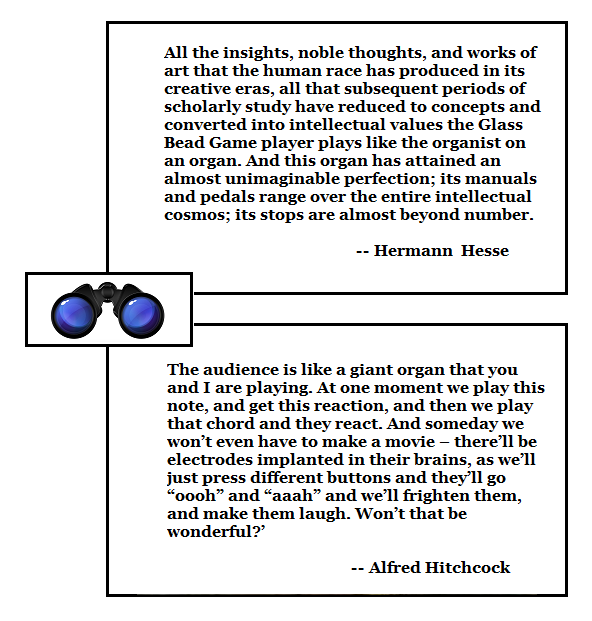
SPEC-Hesse Hitchcock organs


Hitch
was discussing his movie North by Northwest.


Switch to our mobile site