[ by Charles Cameron — who believes that detours are the spice of life ]
.
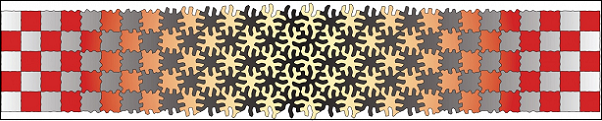
Craig Kaplan:
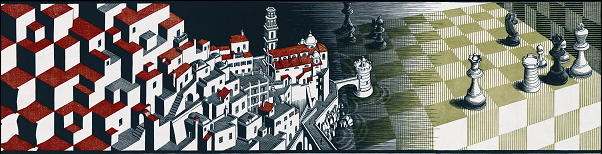
Maurits Escher:
**
There’s a fasacinating article about Craig Kaplan and his work with tiling that I came across today, Crazy paving: the twisted world of parquet deformations — I highly recommend it to anyone interested in pattern — and I highly recommend anyone uninterested in pattern to get interested!
Kaplan himself is no stranger to Escher’s work, obviously enough — he’s even written a paper, Metamorphosis in Escher’s Art — the abstract reads:
M.C. Escher returned often to the themes of metamorphosis and deformation in his art, using a small set of pictorial devices to express this theme. I classify Escher’s various approaches to metamorphosis, and relate them to the works in which they appear. I also discuss the mathematical challenges that arise in attempting to formalize one of these devices so that it can be applied reliably.
Comparing one with the other, I am reminded of the differences between quantitative and qualitative approaches to understanding, of SIGINT and HUMINT in terms of the types of intelligence collected — and at the philosophical limit, of the very notions of quantity and quality.
[ by Charles Cameron — counterintuitive insights are like eddies in group mind ]
.
**
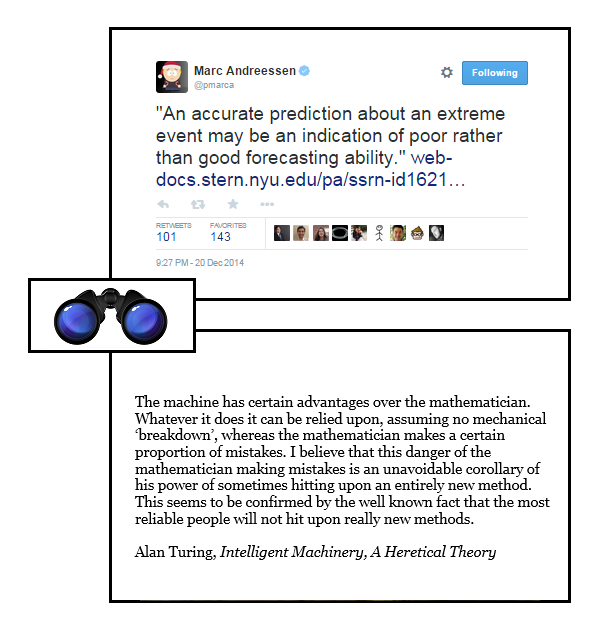
Adam Elkus said a while back that he wondered “if @pmarca and @hipbonegamer could team up for a double quote post.”
Well, I’m @hipbonegamer, and @pmarca is Marc Andreessen — and while we haven’t teamed up as such, the DoubleQuote above consists of a tweet from Marc two or three days ago, and a paragraph I ran across yesterday which seemed to echo Marc’s tweet from one of Alan Turing‘s posthumously published essays, and which is juxtaposed with Marc’s tweet as my response. Effectively, Marc made the first move on this two panel board, and I responded with the second — and that’s how this most basic form of my HipBone Games is played.
The degree of kinship between Marc’s tweet and Turing’s para is even stronger if you look up the link Marc offered in his tweet, which goes to a pre-pub paper by Jerker Denrell and Christina Fang titled Predicting the Next Big Thing: Success as a Signal of Poor Judgment, in which they suggest:
The explanation is that because extreme outcomes are very rare, managers who take into account all the available information are less likely to make such extreme predictions, whereas those who rely on heuristics and intuition are more likely to make extreme predictions. As such, if the outcome was in fact extreme, an individual who predicts accurately an extreme event is likely to be someone who relies on intuition, rather than someone who takes into account all available information. She is likely to be someone who raves about any new idea or product. However, such heuristics are unlikely to produce consistent success over a wide range of forecasts. Therefore, accurate predictions of an extreme event are likely to be an indication of poor overall forecasting ability, when judgment or forecasting ability is defined as the average level of forecast accuracy over a wide range of forecasts.
— and then goes on to demonstrate it:
Consistent with our model, both the experimental and field results demonstrate that in a dataset containing all predictions, an accurate prediction is an indication of good forecasting ability (i.e., high accuracy on all predictions). However, if we only consider extreme predictions, then an accurate prediction is in fact associated with poor forecasting ability.
**
The counterintuitive nature of this prediction is delighful in its own right — there’s a sense in which “going against the tide” of what appears obvious is part of a wider pattern that includes knots in a plank and eddies in a stream, close cousins to von Kármán’s vortex streets. And I suspect it’s that built-in paradox that we perceive as “counterintuitive” that caught the eye and attention of Turing, Denrell and Fang, Marc Andreessen and myself. Once again, form, ie pattern, is the indicator of interest.
So this DQ is for Marc and Adam, raising a toast to Alan Turing, in playful spirit and with season’s greetings.
[ by Charles Cameron — image and Sotheby’s cataloguing via Michael Robinson ]
.
Carl Jung told his friend Sir Laurens van der Post:
One of the most striking testimonies to the quality of the English spirit is the English love of sport and games in a classical sense and their genius for inventing games.
Shepard, E.H.
“FOR A LONG TIME THEY LOOKED AT THE RIVER BENEATH THEM…”
Illustration for Chapter six of ‘The House at Pooh Corner,’ the episode “in which Pooh invents a new game and Eeyore joins in.” The game is ‘Poohsticks.’ Sold this morning: £314,500 (US$492,727)
Shepard, Ernest H. (10 December 1879 – 24 March 1976)
188 by 148mm, original ink drawing,
signed “EHShepard” lower left.
**
For those who don’t know the game, here’s the relevant excerpt from The House at Pooh Corner:
Pooh had just come to the bridge; and not looking where he was going, he tripped over something, and the fir-cone jerked out of his paw into the river. ‘Bother,’ said Pooh, as it floated slowly under the bridge, and he went back to get another fir-cone which had a rhyme to it. But then he thought that he would just look at the river instead, because it was a peaceful sort of day, so he lay down and looked at it, and it slipped slowly away beneath him, and suddenly, there was his fir-cone slipping away too.
‘That’s funny,’ said Pooh. ‘I dropped it on the other side,’ said Pooh, ‘and it came out on this side! I wonder if it would do it again?’ And he went back for some more fir-cones. It did. It kept on doing it. Then he dropped two in at once, and leant over the bridge to see which of them would come out first; and one of them did; but as they were both the same size, he didn’t know if it was the one which he wanted to win, or the other one. So the next time he dropped one big one and one little one, and the big one came out first, which was what he had said it would do, and the little one came out last, which was what he had said it would do, so he had won twice … and when he went home for tea, he had won thirty-six and lost twenty-eight, which meant that he was – that he had – well, you take twenty-eight from thirty-six, and that’s what he was. Instead of the other way round.
And that was the beginning of the game called Poohsticks, which Pooh invented, and which he and his friends used to play on the edge of the Forest. But they played with sticks instead of fir-cones, because they were easier to mark.’
It is a moment to seek out new voices and ideas from artists who can range much farther out into the future. Artists are adept at making sense of disorder while also having the ability to introduce a compelling chaos into the status quo. In other words, they are ideally suited to exploring the future of warfare. Writers, directors and producers and other artists bring to bear observations derived from wholly different experiences in the creative world. They can ask different kinds of questions that will challenge assumptions and conventional ways of tackling some of today’s toughest national security problems. Importantly, they can also help forge connections with some of most creative people in the public and private sectors who otherwise struggle to find avenues for their best ideas.
That’s excellent, and as a poet and game designer with a keen interest in war and peace, I hope to contribute.
**
Funny, though, their first challenge looks, to my eyes, just a little bit back to the future:
The Art of Future Warfare project’s first challenge seeks journalistic written accounts akin to a front-page news story describing the outbreak of a future great-power conflict.
Why would we want to produce something “akin to a front-page news story” at a time when news stories are already more web-page than front-page, and perhaps even tweet before they’re breaking news?
In any case, the good people at Art of Future War offered some clues to those who might want to take up their challenge, and I took their encouragement seriously —
The historical creative cues included below are intended to inspire, not bound, creativity.
**
Their first clue did indeed inspire me, though not to write anything akin to a front-page news story, “between 1,500 and 2,500 words long”. The clue they gave was the Washington Times lede I’ve reproduced in the upper panel below —
while the lower panel contains the quote their clue led me to, by an associative leap of the kind artists are prone to — drawing on the vivid imagery of Peter Brook‘s play, The Mahabharata, which I had the good fortune to see in Los Angeles, a decade or three ago.
**
My own leap backwards — to an ancient and indeed originally oral epic, the Mahabharata, rather than to century-old newsprint — won’t win me the challenge, since it doesn’t answer to the rules, nor will it provide useful hints as to what war will look like a decade from now.
The sage Vyasa, who wrote the Mahabharata at the dictation of the god Ganesh, might have been able to predict the future of war — I certainly cannot.
What I can do, and hope to have done, is to suggest that the whole of human culture has a bearing on war and how we understand it.
[ by Charles Cameron — like father, like son — Gilbert & Sullivan, Shakespeare and the video game Mass Effect ]
.
Some of our readers will no doubt recognize the “model of a modern Major-General” from Gilbert & Sullivan‘s “Savoy Opera” The Pirates of Penzance. He’s definitively British, and it’s a sign of the strength of the “special relationship” between the US and UK that the G&S operas have now won a place in many American hearts.
For those of you who don’t know your G&S, or do and would like to be reminded, here’s a Joseph Papp presentation of Pirates, with George Rose playing the Major-General, Kevin Kline as the Pirate King, and Linda Ronstadt as Mabel, from NYC’s Delacorte Theater in Central Park [available on DVD]:
And here for your convenience, since the words fly past at quite a lick, are the lyrics —
I am the very model of a modern Major-General,
I’ve information vegetable, animal, and mineral,
I know the kings of England, and I quote the fights historical
From Marathon to Waterloo, in order categorical;a
I’m very well acquainted, too, with matters mathematical,
I understand equations, both the simple and quadratical,
About binomial theorem I’m teeming with a lot o’ news, (bothered for a rhyme)
With many cheerful facts about the square of the hypotenuse.
I’m very good at integral and differential calculus;
I know the scientific names of beings animalculous:
In short, in matters vegetable, animal, and mineral,
I am the very model of a modern Major-General.
I know our mythic history, King Arthur’s and Sir Caradoc’s;
I answer hard acrostics, I’ve a pretty taste for paradox,
I quote in elegiacs all the crimes of Heliogabalus,
In conics I can floor peculiarities parabolous;
I can tell undoubted Raphaels from Gerard Dows and Zoffanies,
I know the croaking chorus from The Frogs of Aristophanes!
Then I can hum a fugue of which I’ve heard the music’s din afore, (bothered for a rhyme)
And whistle all the airs from that infernal nonsense Pinafore.
Then I can write a washing bill in Babylonic cuneiform,
And tell you ev’ry detail of Caractacus’s uniform:c
In short, in matters vegetable, animal, and mineral,
I am the very model of a modern Major-General.
In fact, when I know what is meant by “mamelon” and “ravelin”,
When I can tell at sight a Mauser rifle from a Javelin,d
When such affairs as sorties and surprises I’m more wary at,
And when I know precisely what is meant by “commissariat”,
When I have learnt what progress has been made in modern gunnery,
When I know more of tactics than a novice in a nunnery –
In short, when I’ve a smattering of elemental strategy – (bothered for a rhyme)
You’ll say a better Major-General has never sat a gee.e
For my military knowledge, though I’m plucky and adventury,
Has only been brought down to the beginning of the century;
But still, in matters vegetable, animal, and mineral,
I am the very model of a modern Major-General.
**
Now for the fun part.
My son David, who had never heard of the “modern Major-General”, was visiting me yesterday, and very proudly played me the ring-tone on his cell-phone.
It turns out he’d taken it from a video game called Mass Effact 2, which is his current favorite — and when I asked, he showed me a video of the game character called Mordin singing it:
Zing! His favorite game has a character who sings a variant on the G&S song! Like father, like son!
Here are the (revised) lyrics:
I am the very model of a scientist Salarian!
I’ve studied species, Turian, Asari, and Batarian.
I’m quite good at genetics (as a subset of biology),
because I am an expert (which I know is a tautology).
My xenoscience studies range from urban to agrarian –
I am the very model of a scientist Salarian!
Too cool!
**
So we got to talking about games, and Shakespeare — David has been studying Romeo and Juliet — and it turns out that although David feels Shakespeare is very skillful with words, and brings the human emotions out very directly in his plays, he’s more deeply gripped by Mass Effect 2 than by Romeo and Juliet, because it felt more “natural” to him, at least partly because he could navigate it at his own pace.
So this issue wasn’t that Shakespeare was boring or old, but that some games have developed new ways in which narrative can be enjoyed that can take one deeper into the story.
As an admirer of my friend Bryan Alexander‘s work on new narrative forms in his book, The New Digital Storytelling, this gave me a refreshing new perspective on games: that the pacing and interactivity themselves potentially take the narrative experience to a new level.
David made another observation: that he can learn from the little details of a game as much as he learns from the same game’s major plot points — and he used the Scientist Salarian song as his example. When it’s sung, standing alone in Mass effect 2, it’s a minor incident in the game. And whereas in Romeo and Juliet, each speech is intended, word for Shakespearean word, to create a powerful impact, Mordin’s song in Mass Effect 2 is like many other aspects of the game, there only to build a slow familiarity with a character.
It is not until Mass Effect 3, in fact, that the full impact of Mordin’s song hits home.
**
In Mass Effect 3, the character Mordin decides to sacrifice his own life to end the genophage sterility plague which has been aflicting the Krogan, one of the other races in the game. We know he is sad to relinquish his life in this way, because he had earlier expressed a desire to retire to a beach somewhere and “perform tests on sea shells.”
Explaining why he is going to sacrifice his life — and his dreams of retirement — in this way, he says:
My project. My work. My cure. My responsibility.
Sadly — terrified yet proud, then — having made his decision, he sings again the “Scientist Salarian” song:
That, says David, is why I have invested so much time in playing this series of games.
Mordin singing this song in each of two separate scenes doesn’t mean much until we have seen both in sequence. And although the lyrics of the song he’s singing doen’t directly tell us what he’s feeling, experiencing the entire story with him across two games reveals that he is in fact terrified — and reveals it in a disturbingly more intimate way than if he had simply stated it as a fact: it’s his intonation as he sings the song that second time that shows us his terror and his determination.
The second time around, because players have grown to know Mordin through dozens of hours of gameplay, his decision and death scene are truly heart-wrenching.
As I watch that second song for the third time, I see what David means.
Zenpundit is a blog dedicated to exploring the intersections of foreign policy, history, military theory, national security,strategic thinking, futurism, cognition and a number of other esoteric pursuits.