[by Charles Cameron — for the UK, US and others, a day to remember ]
.
.
.
The Great War ended on this date a little short of a century ago, November 11th, 1918. My grandfather, Sir Henry Clayton Darlington, commanded troops at the Hellespont, so for me that war — and the Armistice which ended it — is but one degree of separation from personal memory.
Common British, Canadian, South African, and ANZAC traditions include two minutes of silence at the eleventh hour of the eleventh day of the eleventh month (11:00 am, 11 November), as that marks the time (in the United Kingdom) when armistice became effective.
The poppy pressed between the pages of St Luke’s gospel (image, above) was picked by one Les Forryan, who served with the UK’s Army Service Corps in France and Belgium during the Great War, and the book itself was a “Soldier’s Pocket Testament”, given to him in 1915. The field of poppies and crosses (image, below) was photographed by Brandanno1 in Cardiff, Wales, in 2007. The image of HM Queen Elizabeth II (image, inset) is from a Daily Mail report in 2008.
[ by Charles Cameron — east, west, music, espionage, pacifism, war, the Resistance, the Nazis, Dachau, and exceptional gallantry ]
.
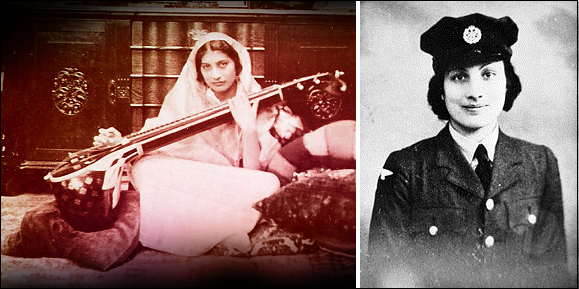
A Muslim woman — born in Moscow of princely Indian paternal descent, her mother an American from Albuquerque, her father a great North Indian classical musician and Sufi master of pacifist leanings…
.
.
Noor Inayat Khan was a student of Western classical music in pre-War Paris under the great Nadia Boulanger, escaped the oncoming Nazis and made it across the channel to England, where she told a British officer during a recruitment interview that she would indeed support Indian independence from Britain after the war — but that defeating Hitler took precedence and she would gladly fight for the British…
She thus became the first female radio operator sent by the British Special Operations Executive into Nazi-occupied France, where she worked courageously as a vital link between the French Resistance and Churchill‘s London until she was finally betrayed, imprisoned, and finally executed by firing squad in Dachau.
After the war, the British awarded her the highest civilian award for bravery, the George Cross, and France the Croix de Guerre.
**
Yesterday’s Guardian reports:
On Thursday afternoon, in a corner of Bloomsbury, Princess Anne unveiled Britain’s first memorial to an Asian woman. The bust is of Noor Inayat Khan, a woman who was a pioneer in so many things: an Indian princess who was also a gifted harpist; a Sufi who wrote Buddhist fables for children; an anti-imperialist who spied for the British empire – and the first female radio operator sent into Nazi-occupied France.
[ by Charles Cameron — second take on the paradox, this time featuring wolves, poetry, lions, honey, and Bach ]
.
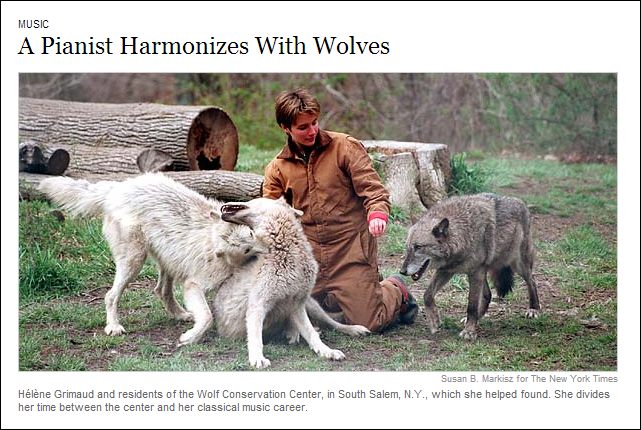
eye-catching headline & image from the New York Times, 2008
.
I’m always trying to see war and peace — violence and gentleness, if you like — in counterpoint rather than in opposition. The distinction is a subtle one, I know, but that’s the task. I tackled it from one angle a few days ago in this earlier post, and imagine I’ll return to it again from time to time.
**
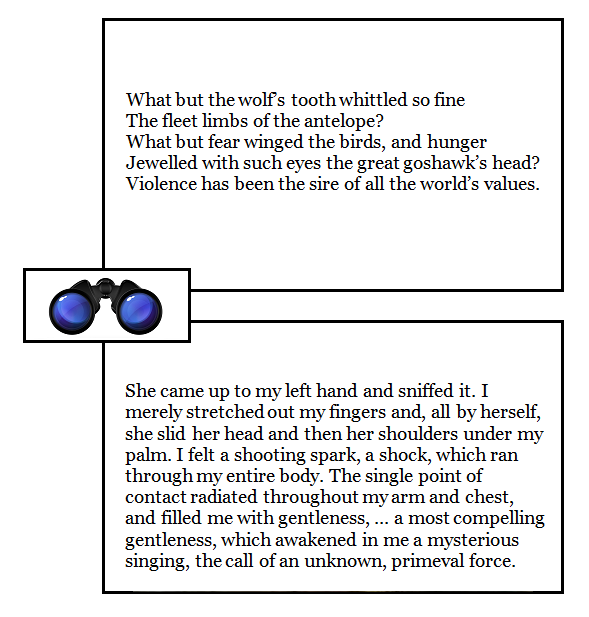
I was fascinated to run across two very different artists talking about wolves these last few days. Robinson Jeffers, in his great poem The Bloody Sire, sees the wolf’s violence (upper panel) as bringing speed and grace to the antelope:
while the extraordinary pianist Hélène Grimaud describes her first encounter with a wolf (lower panel) in terms of gentleness.
After that striking first encounter with a wolf, Grimaud went on to found the Wolf Conservation Center in upstate New York (see NYT article by clinking on image at top of this post).
**
There’s a longish and fairly erotically, religiously and violently charged story in chapter 14 of the book of Judges. Samson, so the story goes, took a liking to a woman of the Philistines, and despite his parent’s urgings went down to see her because, as he delicately put it, “she pleaseth me well.” Along the way he meet a young lion, and “rent him” — tore him apart with his bare hands — “as he would have rent a kid” — here meaning a young goat. Samson continued to like the look of the women of the Philistines, we are told, and on his next visit down to see her, “he turned aside to see the carcase of the lion: and, behold, there was a swarm of bees and honey in the carcase of the lion. And he took thereof in his hands, and went on eating, and came to his father and mother, and he gave them, and they did eat…”
Samson, it seems, was a gambling man, and he soon proposed a bet and a riddle to his bride’s companions — for somewhere around that time they had married, a fact that the story teller omits to tell us in so many words — giving them seven days to solve it:
Out of the eater came forth meat, and out of the strong came forth sweetness.
The companions, of course, could not solve the riddle, since they had not seen the lion, nor its carcase with its swarm of bees and honey… but they pleaded with his new wife so piteously that she pleaded with her new husband so piteously that he revealed the secret to her, and on the seventh day her Philistine companions won the bet and answered Samson’s riddle:
What is sweeter than honey? And what is stronger than a lion?
To which poor Samson replied:
If ye had not plowed with my heifer, ye had not found out my riddle.
The marriage didn’t last — and, we are told, “his anger was kindled…”
**
I certainly heard this story intoned in chapel at one school or another, but recognized neither the eroticism nor the violence nor the significance of the religious enmity between monotheistic Jew and pagan Philistine…
But my mother did make us pancakes on rare and wonderful occasions, and on them I lavished farm butter and Tate and Lyle‘s glorious Golden Syrup, with its image of Samson’s lion and the honey bees:
and the Tate and Lyle motto: Out of the strong came forth sweetness.
It’s that sweetness — that image of the lion and those bees more than the Biblical story itself — that I remember…
**
I am grateful to Steve Engel for bringing Robinson Jeffers’ poem to my attention this last week, and to J Scott Shipman of this blog for introducing me to Hélène Grimaud’s playing of the Bach Chaconne on YouTube:
[ by Charles Cameron — comparative images, Russian and British, with videos of Sunday’s Occupy-related protest during Evensong at St Paul’s in London ]
.
By way of contrast with the bright balaclavas of the Pussy Riot grrls, the British protesters wore white, and chained themselves to the pulpit steps during the Sunday service of Evensong.
**
Here’s a short video featuring the way St Paul’s integrates their protest into a ceremonial procession, so that it’s just a little odd in about the same way that Elton John playing piano during a service in the same cathedral is just a little odd.
Or let’s just say, eccentric… British.
Here’s the 30-minute official St Paul’s version, including the sermon, some muffled protester voices, and some blasts from the great cathedral organ…
.
**
Essentially, the protesters get co-opted by the clerics — with an offer of a little chat, probably over a cuppa tea, to follow…
I was going to comment on the death of the famed historian who was the Soviet Union’s most venerable and shameless apologist, but I was beaten to it in a brilliant piece by British blogger and fellow Chicago Boyz member, Helen Szamuely:
On my way to and from Manchester yesterday and today I read Anne Applebaum’s latest book Iron Curtain about the subjugation of Eastern Europe between 1944 and 1956. Ms Applebaum’s knowledge and understanding of the European Union is not quite what it ought to be, given that she usually appears in the guise of one of our leading political commentators but she does know the history of Communism and what it did to the countries and peoples who, for various reasons, found themselves under its rule. The first few chapters describe in some detail the brutality, violence, whole scale looting and widespread rapine that marked the Red Army’s route across Eastern and Central Europe, regardless of whether they were in enemy or friendly countries, with soldiers or civilians, men or women, adults or children, friend or foe. And then came the NKVD and the organized violence and looting. How many people know, for instance, that several of the Nazi camps, Auschwitz and Buchenwald included, were reopened by the Soviets for their own purposes? Not a few of the people they imprisoned there had been liberated only a few weeks previously.
As I was reading this horrible tale I got a text message from somebody who saw on the news that Professor Eric Hobsbawm, the best known apologist for Stalin and denier of Communist crimes, has died. We are entering a period of unrestrained mourning for this man who has on various occasions been described as the greatest living historian and one of the most influential ones. Sadly, the last part of it is true. He has been influential.
While Holocaust deniers are rightly excoriated Professor Hobsbawm has been treated in life and will be in death with the greatest adulation. Channel 4 lists some of the misguided souls who are pronouncing sorrowfully on the demise of this supposedly great man and asks rather disingenuously whether he was an apologist for tyranny.
Zenpundit is a blog dedicated to exploring the intersections of foreign policy, history, military theory, national security,strategic thinking, futurism, cognition and a number of other esoteric pursuits.
 .
.