zenpundit.com » Strategy and War

Archive for the ‘Strategy and War’ Category

Bomb Syria?

Thursday, August 29th, 2013


[by Mark Safranski a.k.a. “zen“]

There is much ado about a prospective Western (i.e. American) aerial campaign to bomb the Iranian allied Alawite-Baathist dictatorship Syria over use of chemical weapons against primarily al Qaida allied Sunni Islamist extremist rebels.

To what end or how that end will be brought about by a surgical use of American air power, aided by token French and British contributions, well, no one is quite sure.

The driving insider force behind this astrategic call to arms are Susan Rice, Samantha Power and Anne-Marie Slaughter, the three Furies of R2P.  Slaughter writes on military intervention in Syria with her usual combination of moral certainty and operational magical thinking here. Rice angrily pontificates here while an unusually muted UN Ambassador Samantha Power just tweeted about it while on vacation from the emergency UN Security Council meeting on, uh, Syria.

The strategic argument about Syria is not about the normative qualities of the Assad regime, which is anti-American, brutal, terrorist supporting and fascistic. Or that the regime is committing atrocities. It is. It is about what political objective, if any, the use of military force against Syria can accomplish at what cost and with what probable outcomes. At a grand strategic level, there are also questions about how military intervention in Syria will impact great power relations and the shaping of international law.

I suspect many R2P advocates like Slaughter, Rice and Power are attracted to the idea of bombing Syria partly to garner a precedent to support doing similar things in the future, whether or not it has any positive effect on the Syrian civil war. That however, if true, is an extremely poor reason for military intervention anywhere. If bombing had some hope of changing the behavior of the Syrian regime or replacing it with something better, I would warm to the prospect but where is the evidence that is a likely outcome? Consider:

The Syrian rebels include armed groups as violent, lawless and squalid as the Assad regime. You know, the Beheading community of the third jihad international, with fringe support from the occasional cannibal commandos. If these Islamist lunatics come to power in Damascus they will cheerfully engage in ghastly pogroms of mass murder and torture that will make Assad’s goons look like the British Raj at tea time.

The Assad regime and the Alawite minority from whence it originates have their backs to the wall in a conflict that determines if they continue to rule Syria or are exterminated. Having no margin for maneuver or concession, America bombing them is irrelevant to whether in their calculus they can stop fighting their local enemies. The whole point of combining the threat of force with diplomacy – allegedly the reason given for bombing Syria – is to be able to make Assad an offer that he can’t refuse and not a threat that the Alawites can’t accept. Then, while blustering loudly and ominously we undercut our own bellicose posturing and announce that regime change was off the table. WTF?  Really?

The President should fire this unholy crew of incompetents and intellectual poseurs and hire some real foreign policy advisers with at least an undergraduate level grasp of how diplomacy, strategy and war have worked for the past 2000 years.

Failing that, a few poker players who can bluff without showing the entire table their cards.

War on Speed

Monday, August 26th, 2013

[ by Mark Safranski a.k.a. “zen”]

“When a man is lying in a shell hole, if he just stays there all day, a Boche will get him eventually. The hell with that. My men don’t dig foxholes. Foxholes only slow up an offensive. Keep moving.”

                                                                                                      – General George Patton

“In large-scale strategy, when the enemy starts to collapse, you must pursue him without letting the chance go. If you fail to take advantage of your enemies’ collapse, they may recover.”

“Speed is not part of the true Way of strategy. Speed implies that things seem fast or slow, according to whether or not they are in rhythm. Whatever the Way, the master of strategy does not appear fast”

                                                                                                          – Miyamoto Musashi 

“Two basic principles . . . underlie all strategic planning. . . .The second principle is:  act with the utmost speed”

                                                                                                             – Carl von Clausewitz

Soldiers of the 1st Cavalry Division charge [ Photo credit: U.S. Army photo by Sgt. Travis Zielinski]

SWJ Blog published a link to  2013-14 Key Strategic Issues List put out by the Strategic Studies Institute to US Army War College students and researchers regarding the critical questions that the Chief of Staff believes need to be answered for the US Army to adapt to changing circumstances. It’s a good institutional practice and an interesting document to peruse. My attention was drawn to the subset entitled “Chief of Staff of the Army Special Interest Topics”. General Odierno’s second topic begins with an appropriately broad question:

                                       “How important is speed—both in terms of maneuver and information?”

We should look at the question first in a general sense and then in the light of the U.S. Army and the circumstances in which it is likely to find itself in the next few decades.

Common sense tells us that in any conflict, the ability of a single combatant, an armed group or an army corps to move and fight with speed is generally an advantage. This applies in other forms of conflict aside from warfare; for example, the boxing legend Muhammed Ali was great in his early career not merely because he was a big man and a gifted boxer but because he was also incredibly fast compared to his opponents, running rings around them in a match, taunting and humiliating them. When age removed the edge of speed, a slower Ali was forced to change his tactics and absorb a great deal of punishment that he had formerly escaped. Slow moving armies are like Muhammed Ali past his prime -they make for good targets.

In the history of warfare, many great fighting forces were also fast moving ones. Stonewall Jackson’s Confederates averaged close to fifteen miles per day in the Shenandoah Valley campaign; Roman legions frequently marched twenty miles in five hours while the armies of Alexander the Great and Napoleon Bonaparte drew closer to thirty a day. The fierce and elusive Apache topped them all, reputedly covering an astonishing seventy miles a day on foot in harsh desert terrain. Nor are the advantages of great speed limited to land armies, speed at sea and in the air is a tremendous equalizer for numerically inferior forces. It is good to move fast. The US Army, or at least parts of it, should be able to move fast, but this comes with a few caveats:

  • First, speed is always relative advantage. Being the fastest army in the world is a great thing but it is not quite so great if you are fighting the second fastest army in the world and the difference between the two is marginal.
  • .
  • Secondly, really optimizing speed for an entire army (vice specific units) is likely to come with trade-offs in terms of force structure and operational costs. Fast is fine, but fast with firepower is better, unless you think Operation Market Garden is the model to emulate.
  • .
  • Third, distance is often antagonistic to speed (i.e. imposes greater friction costs).  The ability to sustain a campaign in Afghanistan from the Western hemisphere does not mean it will be cheap to run your strykers and helicopters on imported fuel.  Zipping your panzers across France is not the same as slogging them through the vast and roadless expanse of Russia.
  • .
  • Fourth, speed and agility are not the same thing.  Maneuver in battle depends on other things aside from linear speed; the ability to execute fast transients by rapidly shifting what your force is doing on the fly is unlike simply moving them from point A to point B at a high rate of speed. 
  • .
  • Fifth, moving at one easily predictable speed and operational tempo, even at a high rate, is not as good as purposefully changing up both to throw the enemy off of their game. Sometimes employing a slow or erratic tempo is useful for imposing costs on enemy forces, deceiving them or constraining their freedom of action. 

Speed of information is not at all the same as the speed of material things, in part because the qualitative value of the information determines the utility of receiving it faster. An army that could move information and communicate more effectively – by having mastered writing, messenger systems, secret codes, the telegraph, shortwave radio or the internet – usually has a comparative advantage, but only up to a point. Much like medicine, the right dose of information can cure what ails you but too much or the wrong kind at the wrong time can kill you.

Even valuable information – much like Robert E. Lee’s battle plans for Antietam wrapped around some cigars – is simply unconnected data unless it is received by someone (Observation), who unlike General McClellan, is competent to discern the importance, put the information into context (Orientation), plan (Decide)and take appropriate action (Act).  Knowledge is contextual and actionable ( or it is a prerequisite for effective action) while information is isolated, raw and could easily be irrelevant trivia or distracting “noise”.

Quantity of information and the velocity with which it circulates through an organization can undermine the comparative advantage of having greater informational speed. Communication often expands to fill the bandwith allotted to the detriment of organizational effectiveness.  What is useful intel for a squad leader entering a seemingly abandoned village becomes a drowning sea of minutia for a battalion, brigade or theater commander who can only grasp coup d’oeil by focusing on essential components of operational or strategic problems as they are expressed on the battlefield.

Every transmitted message is a form of transaction requiring time, attention and energy from a commander and his subordinates, taxing their ability to prioritize effectively and inevitably creating “fog” by increasing the ratio of useless, incorrect or irrelevant data to crucial information. Improvement comes both from becoming increasingly effective at distilling knowledge from masses of data and from paring back the traffic in informational garbage and “busywork” and legalistic “CYA” communication. Greater informational speed shows it’s true value when an organization (military, business, political etc) can systematically move critical knowledge to the person who needs it at the moment it is required.

How Should the US Army think about Speed?

The US Army, in my view, faces some probabilities in the next few decades in terms of thinking about speed, force structure, potential conflicts and other questions:

  • Barring a resumption of conscription, austerity and domestic politics will mean a smaller active duty peacetime force that will have to formally shed some of the Cold War legacy missions it is no longer capable of executing  or willing to fund. 
  • .
  • Any major land conflict the US enters is likely to be expeditionary against a much more numerous opponent ( North Korea, Iran, Pakistan,  China or a proxy war – likely in Africa) while our technological edge over near-peer and second to third tier adversaries, while remaining, will be less than in previous decades.
  • .
  • The US may face more than one “small war” at a time with an allied or friendly state requesting FID/COIN help against an insurgency of some kind. 
  • .
  • The US may face an insurgency at home from Mexican narco-cartels that may begin as a law enforcement matter and be escalated by cartels into a serious paramilitary insurrection and terrorism problem before political authorities are willing to acknowledge the gravity of the threat (i.e. American politicians will behave much like their Mexican counterparts did in the 2000’s. Indeed they are already doing so in regard to massive cartel infiltration of American cities)
  • .
  • The US will retain sufficient nuclear deterrent, Naval and strategic air capability to make a conventional or nuclear attack on the American homeland extremely unlikely.

The US Army, even in a reduced size,  will probably retain the role of “mailed fist” land force with a core of  armor, motorized infantry, artillery units along with infantry that could conceivably be scaled up to much larger levels of personnel in a grave crisis. But the reality is the politicians will always try to fight foreign wars with peacetime forces, so to be of real use, the Army must be able to go to war “as is” and win it very quickly.  It is unlikely that a serious opponent like Iran, if it’s leaders believe the US intends regime change, will permit America a leisurely 6-12 month build-up of an invading host in a neighboring state the way that Saddam did [ can you imagine PLA generals sitting on their hands as the US Army put, say, 10-15 divisions of American and coalition troops on their border with Vietnam?]

So if the US Army is to be operationally relevant by virtue of speed, there must be a deep all-services investment in the unsexy air and sealift capacity to move a substantial amount of troops and their heavy equipment in days or weeks instead of months ( most likely combined with even greater efforts at pre-positioning ). Speed and maneuver in operations depends on getting there in the first place.

Assuming we have many divisions or brigades (if we stay “modular’) arriving somewhere, increasing operational speed is partly a work of the Army’s leaders spending years changing  the organizational culture to give subordinates real room to take initiative within their commander’s intent. This will help improve both physical maneuver as well as information flow by reducing the institutional incentives to create paralysis by micromanagement.

Accepting loose reins may mean more American casualties, far more enemy combatant casualties and consequent civilian collateral damage as field grade and junior officers take greater responsibility and the tempo of operations accelerates. ROE will have to be simpler and hew closer to what is permitted under the Laws of War vice what overly complex guidance prevailed at certain times in Afghanistan. This will require ruffling the feathers of international law professors, lefty NGO activists, anti-American journalists and some members of Congress.

On the other hand, we might start winning wars again.

How to Lose a War: A Primer

Sunday, July 28th, 2013

[by Mark Safranski a.k.a. “zen“]

Since Pakistan is now attempting to get its victory over the United States in Afghanistan formally ratified, now seemed to be a good time to reflect on the performance of American statesmen, politicians and senior generals.

It has occurred to me that we have many books and papers outlining how to win wars. Certainly the great classics of The Art of War, The History of the Peloponnesian War and On War are the foremost examples, but there are also other useful classics in the strategic canon, whole libraries of military histories, memoirs of great commanders and an infinite number of PDFs and powerpoint briefs from think tanks and consultants. Strangely, none of these have helped us much. Perhaps it is because before running this war so few of this generation’s “deciders” read them en route to their law degrees and MBAs

We should engage in some counterintuitive thinking:  for our next war, instead of trying to win, let’s try to openly seek defeat. At a minimum, we will be no worse off with that policy than we are now and if we happen to fail, we will actually be moving closer to victory.

HOW TO LOSE A WAR

While one of these principles may not be sufficient cause for losing an armed conflict, following all of them is the surest road to defeat.

1. War is the Continuation of Domestic Politics:

The point of politics is to acquire, hold and enjoy using power. When we lose sight of this fact due to romantic notions of “national interest” or “duty” and spend too much attention prosecuting a war against foreign armies then our real enemies – the political opposition – can take advantage. What good is overseeing a global victory over an epochal tyranny if the result is you get immediately voted out of office like some hapless loser? While on the surface, it might seem wise during a war to staff a government with able statesmen, experienced generals, capable diplomats and other experts, the truth is that if you do so you will have very few plum jobs left with which to reward the cronies, ideologues, campaign consultants, activists, wealthy grafters and partisan hacks who got you into power in the first place. Without their continued support, you will not be long for political office.

The fact is that the nation can survive many lost wars far longer than your career will survive lost elections.  Once you view the war solely through the prism of how any action might impact your fortune in domestic politics, you will have a marvelous clarity that the war is the best pretext upon which to expand your power at the expense of the opposition and the people.

2. Policy is the True Fog of War:

Having a clearly defined, coherently articulated policy based upon vital interests and empirical facts that sets a few realistic objectives in a way that makes possible shared understanding and broad political support is no way to go about losing wars.

Keeping in mind #1, the point of war policy is to generate a set of politically compelling slogans that remain ill-defined enough to serve as an umbrella  under which many contradictory and competing agendas can cohabit until some of them can be opportunistically realized. These agendas may not be realistic – in fact, it is easier to put them forward as attractive fantasies for the public if your administration is unburdened with officials with genuine expertise in warfare, economics, foreign cultures, history and other inconvenient information that the media and the political opposition will only be too happy to seize upon. The more abstractly and arcanely expressed the policy the harder it is for critics to demolish and the  better it is for losing wars. “Unconditional surrender” for example, is bad because it is too concrete and easily evaluated – either an enemy is totally defeated and in your power or he is not. “Make the world safe for Democracy” by contrast,  is better as it is more ill-defined and subjective, permitting a larger range of politically tolerable bad outcomes.  “Responsibility to Protect” and “War on Terror” are even more abstract, being essentially unlimited, open-ended, process goals that do not have any point of “victory” whatsoever and can thus not only potentially bring about losing wars but very long ones.

3.  Strategy is a Constraint to be Avoided:

Strategy is about lining up Ends-Ways-Means to construct a theory of victory. While that might give us hope of prevailing over an enemy in an armed conflict, forging a strategy – any strategy -comes with a severe cost: namely the discipline of the government adhering to a strategy requires choices be made about the use of limited resources rather than keeping “all options open” to react  to transient and trivial political concerns on a moment’s notice. Strategy for the nation equates with diminished political flexibility and mobility for the politician.

In other words, having a strategy might require elected officials expend their precious political capital in order to pursue it without getting anything in return that might expand their powers or further their personal careers.  Doing strategy would mean prioritizing winning the war over other possible objectives and putting key decision-makers in the uncomfortable position of having to say “No” or “Not now” to powerful and influential people or factions. Worse, having a strategy also implies that the results can be quantified and evaluated for success, costs, failure and ultimately, personal accountability for leaders.

Obviously locking ourselves into a strategy is something to be avoided if we wish to stay in power, so “strategy” is only invoked rhetorically to mean a wide and confusing array of other non-strategy things – tactics, goals, operational art, planning,  public relations, nation-building,  diplomacy, policy, routine procedures, withdrawal dates, theories, fantastical pipe dreams and so on.  When “strategy” means anything and everything it ultimately means nothing.

4. All Lost Wars are based on Self-Deception: 

It is not enough to avoid strategy, there must also be a collective political determination to avoid reality enforced from the inception until the bitter end.

Wars have real and physically destructive consequences for the people who fight them, but unless you are engaged in a desperate struggle to repel a foreign invader, chances are the battlefield is far away from your home territory. This gives political leaders wiggle room to manipulate perceptions – most importantly their own – to political advantage by controlling information about the war and shaping the ideological boundaries of acceptable public discourse. This will eventually lead to a vicious cycle of bad decisions as misinformation and deceit corrupts the OODA Loop, but political leaders will maintain their political advantage over their critics, at least until the day of reckoning arrives.

Here we must begin with an insistence of a position of firmly held ignorance regarding the prospective enemy, their military capabilities, economic resources, the geographic characteristics, their cultural attitudes toward conflict and their history as a people. Should such information become widely known, it might result in popular skepticism about the wisdom of the entire enterprise, the difficulties that might be encountered and the prospects for success. If you wish to lose a war ignominiously, the less you know the better.

Likewise, once war has begun, the initial jingoistic overconfidence that greeted the war will quickly fade unless actively sustained by preventing an honest analysis of  events and providing a steady stream of rationalizations for the gullible public. It would be a good idea to ban discussion that accurately characterizes the form of warfare  or the nature of the enemy, though these things alone will not be sufficient. The intelligence process itself should be corrupted when possible to provide the “right” answers and censored or circumvented when it is not; while public assessments should use irrelevant metrics divorced from their  context so that they will not have to be gamed later.  Critics, truth-tellers, whistleblowers and those not towing the party-line should be retired, fired, demonized and punished.

5. Isolate the War and those Fighting it from the People: 

A war forgotten by the folks at home is a war that is much easier to quietly lose.

At the outset of the war, ask no sacrifice of the people because that will give them too much of a stake in a victorious outcome and raise expectations about your own leadership. Neither raise their taxes (at least not for the war at any rate) nor conscript their sons. Do not even issue a national call to the colors for volunteers, instead encourage people to be at ease and go about their business. Supplement your small regular army that increasingly feels itself a caste apart with highly paid mercenaries and foreign paramilitaries while neglecting the needs of your own troops. Speaking of the troops, always lavish the soldiers with superficial public pieties about service, sacrifice and heroism, but cynically break faith when it comes to your obligations to look after their interests.

6.  Complexity= Opacity and Micromanagement= Power

Most things in war are simple, but they are not easy. By deliberately making everything incredibly complicated, war can also become impossible too

While adding superfluous complexity does not help win wars, it does offer a number of immediate benefits for the political class. First, in real life the consequence of increasing complexity in any governmental endeavor (not just war) is that you will have more jobs and contracts to hand out to followers as bureaucracy and regulations require new inspectors, secretaries, managers, clerks, lawyers, advisers and in a military context, also new commands, staff officers, promotions, headquarters, increased budgets and so on. Chances are, most of these new jobs will continue on, if not forever, for a very long time.

Secondly the sheer complexity and number of offices, bureaus, agencies, departments, teams, commands, commissions and committees offer excellent “cover” for carrying out unpopular or illegal actions “under the radar” and with diffusion of responsibility, should these antics come to light.  If everyone is in charge, then no one is.  So if your military, intelligence agencies, diplomats, cultural advisers, aid and development people and senior administration officials talk and behave as if they are all hailing from different planets, you are well on your way to losing the war.

Third, the control of people at the top is reinforced by excessive complexity because the initiative of lower levels is strangled by micromanagement. If every idea from the field ( or even basic actions) requires two, three or more levels of command approval with consultation with lawyers at each step the answer is always going to be “No” or a very delayed “Yes” long past the point of being useful. This, plus making examples of those who exercise initiative and act without orders, teaches everyone in the system to eschew risk, value passivity, play it safe and wait for higher-ups to spoon-feed them instructions. With modern, networked online communications every colonel, brigadier to three-star can play company commander while the President of the United States can ride virtual shotgun on SEAL team raids.

7.  Enormous Tail, Tiny Tooth: the Worse the ROI the Better

When you regularly use hundred million or billion dollar platforms to kill illiterate tribesmen with AK-47s and RPGs and build food courts in the Hindu Kush, something is eventually going to give.

Generally, a reasonably well governed country at war can afford to employ either a massive military force for a short campaign or a small, “light footprint“, force for the long haul. What few nations in history can afford, unless it is Persia under Xerxes, is to field a massive force disproportionately composed of rear echelon support troops and what used to be called “camp followers” and “auxiliaries” for years on end. There are two ways this can bring you to defeat.

First, obviously, fielding an enormous army for too long can lead to bankruptcy as costs of the war exceed tax revenues and the state begins to rely on various forms of credit, foreign bankers and debasing the currency to carry on. This does not guarantee an economic collapse or hyperinflation as war can also greatly stimulate production and other variables are always in play, but the risk of dire negative economic effects is significantly increased.

The second issue is that if you are moving your armed host into a desperately poor region to wage war against an impoverished enemy, the passage and encampment of your own military introduces the economic surplus to the local economy the enemy needs to afford to wage war. You are like a red hot iron in a bucket of ice water. Through bribery, extortion and theft the enemy will siphon from you money, arms and contraband and eventually, corrupt your own officials and officers.

 8. Cultivate Hatred and Contempt:

If you wish to lose a war, be hated but not feared.

While most principles of losing a war  are political, strategic or operational in nature and therefore the province of incompetent politicians and generals, cultivating contempt and hatred in all observers can be done at anytime by anyone regardless of rank, experience or status. Technology has revolutionized this sphere of losing warfare: where once undermining an entire war effort could only be done by an arrogant national blowhard, today any grinning idiot on a battlefield with a smart phone is only a tweet away from an international media firestorm.

It is import in cultivating hatred to remember that mere violence, an inevitable part of all wars, is not sufficient. One can respect and admire an honorable but fierce opponent. Conveying a bullying attitude of casual cruelty to all onlookers by mistreating prisoners and civilians, especially if you humiliate and abuse them is a surefire goad to hatred while also alienating allies and neutrals, especially when doing so contradicts the nation’s deeply held values.  Hatred can also be stirred in less dramatic ways, from posing with Nazi flags to widespread ignorance of and expressions of disdain for local customs and mores. Disrespect has legs.

Contempt by contrast, is earned more by exhibiting moral weakness and truckling appeasement of the enemy and his sympathizers. For example, have your own PA and diplomatic organs in speaking to the media, repeat enemy propaganda against your own soldiers and abuse the military justice system to prosecute soldiers for splitsecond combat decisions in order to appease these critics. Loudly trumpet the “culturally appropriate meals” to the guys you are going to waterboard and appoint enemy sympathizers as “cultural advisers” and “liaisons” to government security and law enforcement agencies. Do nothing as your own heavily infiltrated host nation “ally” repeatedly frags your soldiers.

9. Protect that Which is Most Unimportant:

Organizations signal what they really value not by what they say, but what they spend time and money on.

Make sure that as the war is steadily being lost that top brass and their civilian overseers frantically emphasize politicized trivialities and institutional martinet nonsense. Reflector belt mania, giving everyone and their brother breathalyzer tests, cultural sensitivity training, counterproductive regs for MEDEVAC helicopters, promoting the gender equality of foreign societies and gender-neutrality of our own should bump out boring, old training exercises for future combat deployment in terms of priority. Remember, the military is not really there to win wars – it is a captive social engineering project for things the wackier members of Congress wish they could impose on their constituents were it not for those damned free elections.

10. Level the Playing Field: Paralyze Your Own Tactical Advantages.

While a war is often lost by having a bad strategy or no strategy at all, the power of crapping away your tactical advantages to no purpose ought not be underestimated. There are thousands of ways to do this but if you are cutting the enemy repeated breaks you can’t go wrong.

First and foremost, you wish to avoid bringing all of your combat power to bear on the enemy’s weakest point in a combined arms assault because he very well may break and then where the hell will you be? You can hardly lose a war if the enemy dies or surrenders first.

Treat your combat arms, services and host nation military as separate, autonomous and almost unrelated units, each with their own objectives and set of ROE guidance more restrictive than required by the Laws of War (while mixing in allied and host nation forces of varying levels of capability and different ROE). Make it difficult for fire support, armor and air to work with your infantry commanders dealing with unforseen circumstances, who you should also spread thin over remote operational areas the size of, say, Iowa to maximize their vulnerability. If a battalion is needed, send a company. If a company is called for, send a squad. Allow the enemy to have safe havens in adjacent countries whose military power is dwarfed by your own by many orders of magnitude. Make sure that your intelligence and public diplomacy services are shorthanded on personnel  fluent in the languages used by the enemy, whom you allow to practice perfidy without punishment.

Remember, there are no guarantees in war. No matter how badly you screw up, the enemy might still be more poorly led and less adaptive than are you. That said, if you practice these ten principles you can become a master of the art of defeat.

“Optimizing the Potential of Special Forces”

Sunday, July 14th, 2013

[ by Mark Safranski – a.k.a “zen”]

A remarkably blunt article on SF/SOF (“special forces” is being used as an umbrella term for both) in the context of policy and strategy, from the perspective of an emerging great power by LTG Prakosh Katoch of the Indian Army. The American example of SOCOM in Afghanistan/Iraq/GWOT has obviously had an impact here, as has the negative example of Pakistani use of terrorists as proxy forces and ISI covert operatives for direct action in Indian territory and elsewhere. Quite aside from global conflicts and the bilateral rivalry with Pakistan, India also faces more than a dozen long term irregular conflicts with their own dynamics, such as the NaxaliteMaoist insurgency , which Katoch places in the context of Chinese strategic ambitions against India.

A must read.

Optimizing the Potential of Special Forces

….In India, the lack of strategic culture, more on account of keeping the military out from strategic military decision making, has led the hierarchy to believe that conventional forces coupled with nuclear clout can deter us from irregular threats. Nothing can be farther from the truth. Pakistan, though conventionally inferior, has been successfully playing her ‘thousand cuts policy’ knowing full well that India has failed to develop the required deterrent. It is our inability to find a cure to this Achilles’ heel, that has led China, which was hitherto using Pakistan as proxy to wage irregular war on India, now directly aids and supports insurgent and terrorist outfits inside India.

….Why the US has managed to secure its mainland post 9/11 is not only because of an efficient Homeland Security organisation but because the US Special Forces (USSF) are operating in 200 countries including India. Significantly, USSF have undeclared tasks such as conducting proactive, sustained ‘man-hunts’ and disrupt operations globally; building partner capacity in relevant ground, air and maritime capabilities in scores of countries on a steady – state basis; helping generate persistent ground, air and maritime surveillance and strike coverage over ‘under-governed’ areas and littoral zones and employing unconventional warfare against state-sponsored terrorism and trans-national terrorist groups globally. Before 26/11, Al-Qaeda had planned similar operations against New York but could not because the USSF had infiltrated Al-Qaeda. One cannot guard the house by simply barricading it. You must patrol the streets and the area outside.

Growing inter-dependence and interlinking of terrorist groups regionally and internationally should be a matter of serious concern. It is not the US alone that has deployed its Special Forces abroad. This is the case with most advanced countries including UK, Russia, Israel, China and even Pakistan. Pakistan’s SSG was operating with the Taliban in Afghanistan and has been active in Jammu and Kashmir, Nepal and Bangladesh, primarily training anti-India forces. There is a strong possibility of their presence in the Maldives and Sri Lanka as well, aside from presence within India. The Chinese have been smarter. For all the development projects throughout the globe, including in Myanmar, Nepal, Pakistan-POK, Sri Lanka, Bangladesh and Seychelles, contracts underway by PLA-owned/affiliated companies employ serving and veteran PLA soldiers and disguised Special Forces with assigned tasks, including evacuation of Chinese citizens from that country in case of emergencies. 

Read the rest here.

Book Review at Pragati: The Strategy Bridge by Colin Gray

Friday, July 5th, 2013

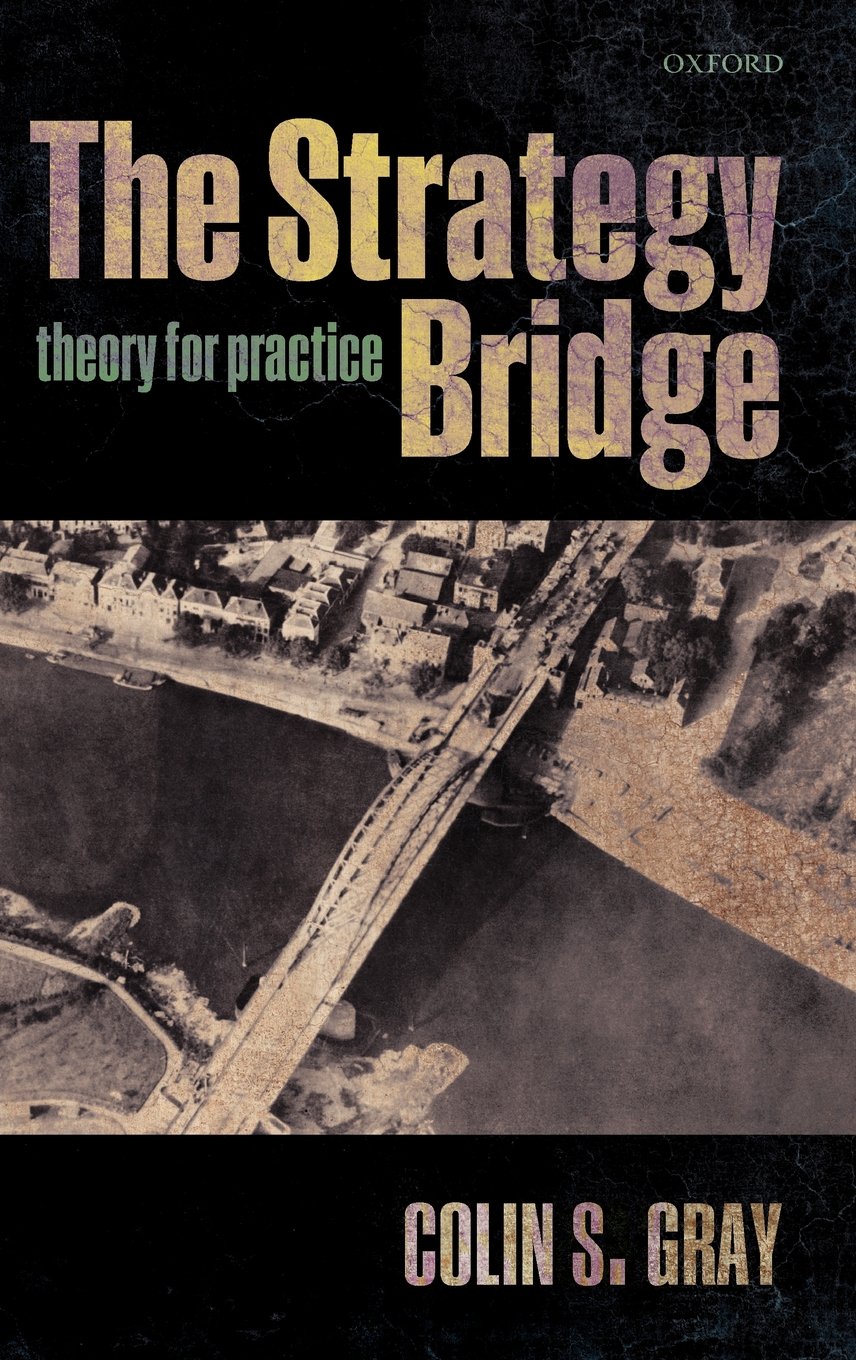
I have a new book review up at Pragati Magazine this morning, The Strategy Bridge:Theory for Practice by Colin S. Gray which is a must read book for any serious student of strategy.

Pragati, which is a national interest and policy magazine for India is starting to turn greater attention towards the subject of strategy and is also running another article in the same issue on strategy and the Maoist insurgency and recently on Indian grand strategy.

A Bridge over Troubled Waters

The title of The Strategy Bridge is also Gray’s operative metaphor, both for the purpose of strategy and the role of the strategist himself that represents the dialectical dynamic of war and strategy-making, the latter being a shared enterprise, save for some extreme historical outliers where strategy was vested in one man, like the regimes of Napoleon and Adolf Hitler. Strategy is the ‘bridge’ that must be built between policy determined by a national leadership and the operational and tactical behaviors of the military and other arms of national power. The strategist “mans the bridge”, orchestrating all of the elements within a master strategic concept and managing the iterative relationship.

Gray writes “The function of the military strategist, his unique raison d’etre, is to ensure that policy and the military instrument are purposefully connected… The strategist must understand the whole nature of a conflict, including war and warfare if antagonism has escalated thus far, because subject to political control, he has the duty of care over the entire competitive performance of the security community… The mission of the military strategist is to decide how the enemy is to be defeated. It is his task to invent a theory of military victory. That theory has to be expressed in and revealed in plans, which are contingent predictions of an extended kind, and must be commanded by generals to whom the strategist delegates some restricted command authority. Whether or not the strategist wishes or is able to function as a general also, must vary with historical circumstances”

….The Strategy Bridge is subtitled “Theory for Practice” because it is intended as a serious work of theory, a framework for understanding enduring principles of strategy so that a practitioner can thoughtfully apply them in making strategies for the specific context in which they find themselves to provide correct guidance for the operational planners and tacticians who will execute it. Consequently, Gray has not written an introductory text for a novice student but an insightful book for the strategic practitioner of journeyman experience – field grade officers, senior intelligence and foreign policy analysts, academic strategists, think tank researchers and national security advisers to senior government officials – who have a store of knowledge of their own. Hence the repeated invocation of “the bridge” metaphor by Gray; his primary audience are the people “doing strategy” and their success or failure “manning the bridge” will help determine the degree to which government purpose remains connected to action or whether the whole business will go off the rails into a quagmire, as it too often does. 

Read the rest here.


Switch to our mobile site