zenpundit.com » Religion

Archive for the ‘Religion’ Category

Manhunt: religion and the director’s eye

Saturday, June 8th, 2013

[ by Charles Cameron — with an assist from Wm Benzon, under-appreciated and brilliant film and literary critic, musician, author of Beethoven’s Anvil ]
.

Screen-time is valuable: movie directors don’t just throw it away.

Here are screen-grabs of two moments in Greg Barker‘s HBO bin Laden documentary, Manhunt, offered for your consideration:

and:

**

As you know from my review of Battle of Algiers (Pontecorvo) and Black Friday (Kashyap), I’m a film buff.

Screen time is the life-time of story: every second counts. And thus it is that if a director uses the same shot with variations at two or more points in a movie, they don’t just follow along, the way the elements in the narrative through-line follow along, one after another — they stack up. They “mean” cumulatively, synchronically…

Putting that in musical terms, they take on the function of rhythm rather than melody — and it is rhythm that can make the body dance, just as it is melody that can make the heart soar.

So, this repetition, this striking parallelism — why?

**

Here’s my friend Bill Benzon, writing about the use of parallelism in Apocalypse Now:

The Assassin and the Surfer

Now for the less obvious parallel: Willard and Lance, the only member of the boat crew to survive. One can’t miss the parallel killings nor Willard’s statement of kinship with Kurtz. This parallelism, on the other hand, is easy to miss. That is to say, it may well elude conscious notice. Unconscious notice, on the other hand … Well, what is that?

Here’s three frame-grabs that point up the parallel. The first is from the opening montage of Willard in Saigon just before he gets his orders:


Montage AN 19 martial arts

The second shot comes much later in the film. Clean has been killed (bullet), then the Chief (spear). Lance is the one who floated the Chief’s body down the river. Now they’re heading upriver toward Kurtz again, with Lance in the bow of the boat:


AN Lance dance1

He’s doing a martial arts dance. Not the same one as Willard did in the opening montage, but a martial arts dance. No one else in the film does such a thing. Clean does some dance moves while listening to the Rolling Stones, but they’re in an entirely different style; faster, jerkier, more angular.

Finally, we have this scene in Kurtz’s compound. Willard’s in the foreground, and Lance is in the background:


AN Lance dance2

One might suggest that this parallel is a mere accident, one might. And perhaps it is. In cases like this, however, my default assumption is that it is not an accident. It may not be there by conscious intent and deliberate plan; but it is not there by accident. The people who made this movie are too skilled to do such things inadvertently.
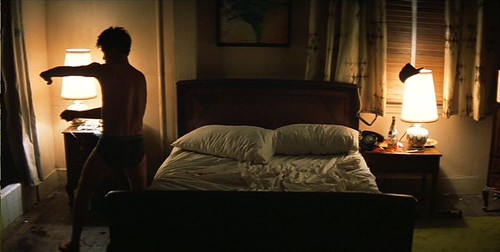
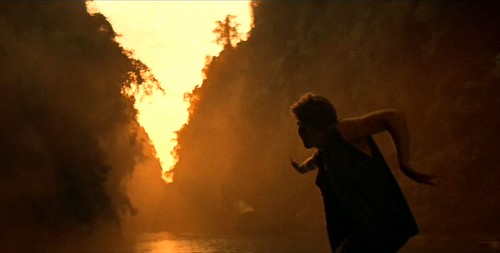
That final remark of Benzon’s makes exactly the point I was hoping to make here, before commenting on those two screen-grabs from Manhunt:

The people who made this movie are too skilled to do such things inadvertently.
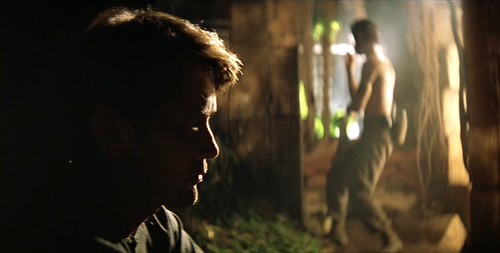
**

There’s actually a third shot in Manhunt with a view of a dangling rear-view-mirror ornament — let’s take a look:

This one’s from the van Peter Bergen and his cameraman, Peter Jouvenal, took in the docu’s re-enactment / flashback to their CNN interview with bin Laden, back in 1997. I don’t think this one is a rosary-like thing though it might be — I think it’s just the sort of tassel decoration you’ll find on saddle-bags, or decorating a camel or a car in Afghanistan.

The other two, however, seem clearly religious, both of them are shots of the cars in which American counter-terrorist folks would have gone to work during their efforts to track down bin Laden — and I find it significant that one features a (Christian) cross while the other very likely shows (Muslim) prayer-beads.

I say “very likely” because the beads could be (secular, Greek) worry-beads — but they look more like a tasbih to me. And why would that be interesting — why would a film-maker be interested in such a parallelism?

Besides the fact that these shots allow voice over and show us the various folk involved going to work, they specifically point up the fact that those working to defeat bin Laden were not all kuffar but included Ali Soufan of the FBI and “Roger” — the fellow described by Greg Miller in this March 2012 piece in WaPo, At CIA, a convert to Islam leads the terrorism hunt.

Am In right? I don’t know. But the subliminal message, if I am, is that the manhunt for bin Laden was indeed not a “Crusaders against Islam” affair.

**
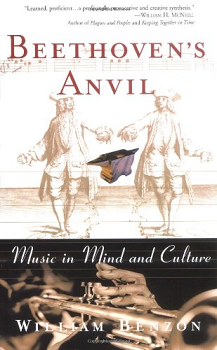
May I recommend Wm. Benzon’s Beethoven’s Anvil to all who read here who have an interest in cognition and / or music?

For more on parallelism in cinema, see David Bordwell, Julie, Julia, & the house that talked, to which Benson also pointed me.

Thinking outside the cocoon…

Thursday, May 16th, 2013

[ by Charles Cameron — on caterpillars, butterflies, psyche and the alephs of Georg Cantor, with a glance at the vertiginous idea it might be “boxes all the way up and down”… ]
.

Let’s get the science — which is quite fascinating — taken care of first. Here’s our best current visualization of how a caterpillar, after crafting its cocoon, prepares to become a butterfly:

**

Words can sometimes tell us some things that images can’t — or explain things to parts of us that simply cannot comprehend them visually — so here for parallel processing is an account of part of the same business from Scientific American:

How does a caterpillar rearrange itself into a butterfly? What happens inside a chrysalis or cocoon?

First, the caterpillar digests itself, releasing enzymes to dissolve all of its tissues. If you were to cut open a cocoon or chrysalis at just the right time, caterpillar soup would ooze out. But the contents of the pupa are not entirely an amorphous mess. Certain highly organized groups of cells known as imaginal discs survive the digestive process. Before hatching, when a caterpillar is still developing inside its egg, it grows an imaginal disc for each of the adult body parts it will need as a mature butterfly or moth—discs for its eyes, for its wings, its legs and so on. In some species, these imaginal discs remain dormant throughout the caterpillar’s life; in other species, the discs begin to take the shape of adult body parts even before the caterpillar forms a chrysalis or cocoon. Some caterpillars walk around with tiny rudimentary wings tucked inside their bodies, though you would never know it by looking at them.

Once a caterpillar has disintegrated all of its tissues except for the imaginal discs, those discs use the protein-rich soup all around them to fuel the rapid cell division required to form the wings, antennae, legs, eyes, genitals and all the other features of an adult butterfly or moth.

**

It’s just possible that the bear’s ability to “die” in the winter and “be reborn” in spring gave use the original cirumpolar bear cult — and more generally, a propensity to believe that resurrection from the dead might be a physical, existential human possibility.

Humans watch animals pretty diligently — my old friend and mentor Wallace Black Elk once told me:

We watch the deer, and when they’re sick they know which plant is their aspirin: they eat that green medicine, and drink water. So we have deer medicine. We don’t need the mass-produced kind.

I don’t have the exact quote, but he also observed somewhat wryly that scouts from pharmaceutical companies used to watch him and see what medicines he used, in much the same way…

And if there’s any natural process that humans have watched with equivalent metaphysical interest to that which they may have shown in observing the bear’s pattern of hibernation and return, it would have been the process of metamorphosis in butterflies — whose name in Greek, psyche, is also the word for soul.

**

WB Yeats had a sense of the butterfly transcending both day-to-day human logic and death itself, when he wrote in his poem Tom O’Roughley:

‘Though logic choppers rule the town,
And every man and maid and boy
Has marked a distant object down,
An aimless joy is a pure joy,’
Or so did Tom O’Roughley say
That saw the surges running by,
‘And wisdom is a butterfly
And not a gloomy bird of prey.

adding just a few lines later:

What’s dying but a second wind?

**

What I’d like to do here is to take us from the plodding science of linear thought to which Yeats was (among other forms of linearity) objecting, towards the science — and poetry — of complexity, of nuance.

And I’d like to do it by skipping a couple of thoughts like a stone across water, inviting you to watch the ripples…

These are the leaps that connect the dots.. the creative leaps. And some leaps, it seems to me, are bigger and more demanding than others.

**

Is the leap from cocoon to butterfly in Hutching‘s quote really quite a huge leap? It certainly keeps some of our best scientists busy uncovering its hidden secrets. And the leap from butterfly to tornado, that Lorenz made? That would appear to me to be a larger leap, requiring a different mode of perception. And skipping from Hutchings to Lorenz, can we skim our stone of thought even further?

Putting two and two together is one thing: imagining “aleph null” for the first time, as Cantor did, that would be something else altogether. From two to four, I’m tempted to say, is a quantitative leap, while the imaginative leap from four, ten, or ten thousand to the alephs is qualitative.

How should we recognize and connect widely separated — yet deeply entangled — dots? What would prove to be the richest and most profound of creative leaps? Is there a move that will take us not just out of this box into the box it came in — but out of a whole matrioshka nest of boxes?

Those are the questions in my sandbox about now.

**

When we next meet, I’ll try to tie them in with this diagram that Adam Elkus recently pointed us to —

and with Hermann Hesse‘s Glass Bead Game for good measure.

Religions 101

Wednesday, May 8th, 2013

[ by Charles Cameron — prone to be wrong himself, for that matter ]
.

The media seems having a hard time of it. Journalists are neither all scholars of religion, nor necessarily religiously inclined, so it’s only too easy for the New York Times to get Easter wrong:

or for AP to manage the same sort of trick with Islam.

**

The New York Times has had time to repent of its sins, and has published a retraction that comes close enough to accuracy for my taste:

An earlier version of this article mischaracterized the Christian holiday of Easter. It is the celebration of Jesus’s resurrection from the dead, not his resurrection into heaven.

The AP needs to make a similar confession. The Hajj is not a pilgrimage directed to Muhammad’s place of birth, but to the Ka’aba — which is indeed in the city where the Prophet was born, but is believed to have been a site of pilgrimage since the time of Abraham, and to have been cleansed of idols by Muhammad and restored to its original purpose as a shrine to the one God.

And BTW, the honorific would be “Hajji” not “Hajii” — FWIW.

**

This is Islam 101, just as the Resurrection is Christianity 101. I’ve forgotten what the numbering system is for remedial classes, but we need them.

Guess I’d best get back to reading Zen Mind, Beginner’s Mind.

Jottings 6: How the network works, it seems

Sunday, May 5th, 2013

[ by Charles Cameron — often puzzled & shocked at the way some algorithms behave in public ]
.

I was on Silobreaker this evening, looking at a page called Dead Terrorist Tamerlan Tsarnaev Channeled Islamic Videos, and what I found curious was this little network diagram, presumably algorithmically-generated from the Silobreaker database:

I have to tell you, I like network diagrams — but what are we supposed to infer from that?

Do you see the same diagram when you visit the site — or is this display just for me, knowing what books I buy, what movies I see, what friends I have — and tailored to sell me something, or get my vote?

A religious footnote to the pro-life / pro-choice issue

Monday, April 29th, 2013

[ by Charles Cameron — with cites from the Qur’an and Bukhari, together with a concerto by Saint-Saëns ]
.


.

Stephen Hough is a classical pianist of note recording on the Hyperion label, the recipient of a MacArthur Fellowship, and one of twenty living polymaths listed as “Pianist, poet, composer, writer on religion” in a 2009 survey by The Economist’s 2009 Intelligent Life blog.

Hough — a Catholic — blogs at The Telegraph, and today he wrote something that caught my eye in his post Why haven’t you written anything about Gosnell?:

I think that without religious faith it is hard to accept a zygote as equivalent in value to a fully formed child. I can understand that a non-religious person is going to see a scale of development in the nine months of pregnancy.

**

To broaden Hough’s discussion a little, I’d like to gently point out that not all religious faiths perceive these matters in the same way. Islam, for instance, has a Qur’anic passage that’s apposite in Sura 20, The Believers, 12-16:

Man We did create from a quintessence (of clay); Then We placed him as (a drop of) sperm in a place of rest, firmly fixed; Then We made the sperm into a clot of congealed blood; then of that clot We made a (foetus) lump; then we made out of that lump bones and clothed the bones with flesh; then we developed out of it another creature. So blessed be Allah, the best to create! After that, at length ye will die Again, on the Day of Judgment, will ye be raised up.

Getting into more detail, we find these ahadith — the first in Bukhari, Chapter 6, The Book of Menstruation, 312:

It is related from Anas ibn Malik that the Prophet, may Allah bless him and grant him peace, said, “Allah the Mighty and Majestic appoints an angel to every womb who says, ‘O Lord! A sperm drop! O Lord A clot! O Lord! A lump of flesh! ‘ Then if He desires to complete His creation, He does so and the angel asks, ‘Is it to be male or female? Wretched or happy? What is its provision? What is its life-span?’ This is all decreed in the mother’s womb.”

and the second in Bukhari Chapter 63, The Book of the Beginning of Creation, 3036:

It is related that ‘Abdullah said, “The Messenger of Allah, may Allah bless him and grant him peace, who is the truthful confirmed one, said, ‘The way that each of you is created is that you are gathered in your mother’s womb for forty days as a sperm-drop and then for a similar length of time as a blood-clot and then for a similar length of time as a lump of flesh. Then an angel is sent and he breathes the spirit into you and is encharged with four commandments: to write down your provision, your life-span, your actions, and whether you will be wretched or happy.

*

My Sources:

  • Qur’an 20, in the Yusuf Ali rendition
  • Bukhari, Book of Menstruation 312 the Aisha Bewley translation
  • Bukhari, Book of the Beginning of Creation, 3036 also in the Bewley translation
  • **

    Here Stephen Hough plays Camille Saint-Saëns‘ Piano Concerto 2 in G minor Op. 22 with the City of Birmingham Symphony Orchestra, Sakari Oramo conducting:

    blockquote>


    Switch to our mobile site

