zenpundit.com » Religion

Archive for the ‘Religion’ Category

The matter of the Black Banners and Benghazi

Wednesday, November 9th, 2011

[ by Charles Cameron — flag of AQ in Iraq, Benghazi, implications for Arab Spring, for AQ, millennarian / Mahdist implications, cautions ]

.

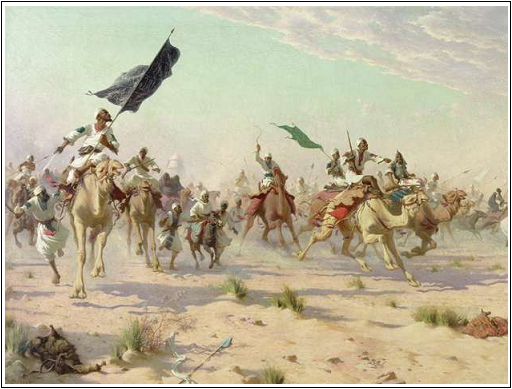
omdurman.png
black banner of the Mahdi at Omdurman 

The question of whether a certain flag flying in Benghazi and elsewhere is in fact an (or teh) Al-Qaida flag has now reached Andrew Sullivan.

Sullivan quotes Will McCants of Jihadica at some length, and also links to the relevant pieces by Aaron Zelin of Jihadology and Adam Serwer, now of Mother Jones. McCants and Zelin are very much the right people to be reading on this topic, and while Serwer’s remit is wider, he’s a bright lad too.

Here’s Sullivan’s money quote from McCants:

[The flag’s] appearance in Benghazi certainly raises questions… Nevertheless, the appearance of the flag in other Arab countries is not necessarily evidence of growing support for al Qaeda or terrorist group’s presence. It could just as easily be youth taking advantage of their newfound freedom to scare their elders, or repressed Salafis using the most shocking symbol possible to voice their anger in public. There is also an element of “Wish You Were Here” photography to many of the photos of the ISI’s flag being unfurled around the Arab world and posted in jihadi forums. This is not to say that the appearance of the flags, particularly in protests, should be ignored. But more corroborating evidence is needed before hitting the panic button.

Okay?

I want to take this a step further.

As McCants very briefly and understatedly indicates in his piece, black flags or banners are associated in Islam not only with the Prophet, but with the Figure at the Far End of Time, the one that’s awaited, the Mahdi. So there are really two questions raised by the presence of these flags:

1:

Are they at some level indicative of Al Qaida?

That’s the question that people seem to be asking, and answering with either an incautious, unqualified “yes yes” or a more cautious and informed “maybe, but let’s not jump to hasty conclusions, there are many shades of influence between vague sympathy and radical participation”.

The “more corroborating evidence” that McCants feels is needed “before hitting the panic button” might include some unobtrusive interviews with the folks waving (or hoisting) those banners, or cheering them on, to see what a bunch of them have to say for themselves… But to me, that’s the less interesting of the two questions.

More interesting, because it deals with the undertow not the height of the tide, how flammable the kindling is, rather than whether it has already been ignited, its potential, not just its currently kinetic energy… is this one:

2:

Are these flags at some level indicative of Mahdist expectation?

Black banners are associated in ahadith with the “end times” expectation that a triumphant army will sweep from Khorasan to Jerusalem.

I have covered this ground repeatedly on ZP, because I believe it is underplayed in most western narratives on the topic of jihad, and most recently I’ve pointed to its significance in Ali Soufan‘s recent book, The Black Banners.  Fwiw, the black flags are also mentioned, and a version of the Khorasan hadith cited, in Syed Saleem Shahzad‘s book, Inside Al-Qaeda and the Taliban, pp 200-01, though there the emphasis is on the ghazwa-e-hind, a topic I’ll be returning to…

Here’s one version of the hadith:

Messenger of Allah said: “If you see the Black Banners coming from Khurasan go to them immediately, even if you must crawl over ice, because indeed amongst them is the Caliph, Al Mahdi.” [Narrated on authority of Ibn Majah, Al-Hakim, Ahmad]

Here’s Ali Soufan’s comment on what he learned as an Arabic speaking FBI interrogator of such AQ figures as KSM and Abu Jandal:

I was to hear that reputed hadith from many al-Qaeda members I interrogated. It was one of al-Qaeda’s favorites. […] It is an indication of how imperfectly we know our enemy that to most people in the West, and even among supposed al-Qaeda experts, the image of the black banners means little…

So – along side the question of what the specific flag in question (with the Shahada and Prophet’s seal) means in terms of support for AQ within parts of the Arab Spring — there’s another question to be quietly and unobtrusively investigated – overlapping to some extent with the AQ question, but separate, distinct, less “obvious” to western minds, and in some ways more significant.

What does the presence of this particular black banner, or any black banner more generally, tell us about the state of apocalyptic expectation?

3:

Use with caution:

Just as the presence of black flags may indicate any number of different shades of interest in or sympathy with AQ, so that presence may indicate any number of different shades of interest in or sympathy with Mahdist expectations.

Here again, “more corroborating evidence” is needed “before hitting the panic button” – and here again, that would presumably require some unobtrusive interviews with the folks waving (or hoisting) those banners, or cheering them on, to see what a bunch of them actually have to say for themselves… about the Mahdi, about the end times and “final war” — and most of all, specifically about the hadith regarding black banners, and the victorious army from Khorasan.

Let me just quote from the opening paragraph of Timothy Furnish‘s book Holiest Wars: Islamic Mahdis, Their Jihads, and Osama bin Laden, and from the closing paragraph of Richard Landes‘ monumental, magisterial overview, Heaven on Earth: the Varieties of the Millennial Experience.

Furnish:

Muslim messianic movements are to fundamentalist uprisings what nuclear weapons are to conventional ones: triggered by the same detonating agents, but far more powerful in scope and effect.

Landes:

I respectfully submit that we will do better in the face of this immense challenge if we understand the varieties and dynamics of the most protean belief in human history: millennialism.

4.

And let me add one further caution:

This one is about the analysis of those unobstrusive — and I do mean, unobtrusive! — interviews, and also about quotes like the ones I’ve just given from Furnish and Landes.

The excitable (Richard Landes calls them “roosters”) will tend to overstate the current of apocalyptic enthusiasm, because it’s exciting — because they will in fact by the very nature of apocalyptic expectation be what Landes terms “semiotically aroused”.  The cautious (Landes calls them “owls”) on the other hand, will understate the current, because it seems jejeune or hysterical (compare, in the west, the way we mock the old guy with tattered coat and “end is nigh” banner).

So our analysis (and our reading of any materials concerning apocalyptic expectation, including my own posts here on ZP) needs to be alert, but not excited.  Neither overstating, nor overlooking, a matter of considerable significance.
Al-Awlaqi and the Rebbetzin?

Thursday, November 3rd, 2011

[ by Charles Cameron — tracking an al-Awlaqi quote through Jewish, Christian, Islamic and Hindu sources ]

.

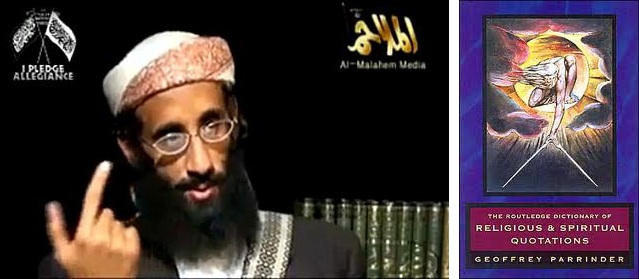
awlaqi.jpg

.
I was reading JM Berger‘s CTC Sentinel piece about al-Awlaqi‘s Constants on the Path of Jihad, which is itself an expansion of al-Uyayri‘s original text, and found myself feeling vaguely uneasy about one of al-Awlaqi’s interpolations.

Berger’s example of how al-Awlaqi frequently “expanded al-‘Uyayri’s citations into living, breathing stories, often at significantly greater length, transforming the legalistic argument into an emotionally and politically loaded discourse” concerns the “People of the Ditch” motif found in the Qur’an and hadith:

In the story, a king is persecuting believers in Allah. He orders them to renounce their religion or be thrown into a flaming ditch or trench to die. All of the believers throw themselves in. One woman, carrying her baby, hesitates, and Allah inspires the baby to speak to her, saying “Oh Mother! You are following al-Haqq [the truth]! So be firm!” As a result, she carries him into the fire and succeeds in achieving martyrdom.

Al-Uyayri makes a brief mention of this story; Al-Awlaqi expands on it, transforming (in Berger’s words) “al-‘Uyayri’s perfunctory citation into an emotional journey that engages the listener and broadens the original point to emphasize the importance of taking even one step toward jihad.” He does this by commenting:

This woman, because she took the first step, and that is the willingness to jump in the trench, when she was about to retreat, Allah helped her. So if you take that first step towards Allah, Allah will make many steps towards you. If you walk towards Allah, Allah will run towards you.

*

So far so good. But isn’t al-Awlaqi quoting someone here?  I had an itch in the back of my head…

I thought I should check, and what I found frankly surprised me. I mean, was he really quoting the Rebbetzin Esther Jungreis?

We have a promise from HaShem that if we take just one step toward Him, He will take two steps toward us.

Not likely.

Perhaps it was a Christian source he had in mind…

A common saying in my church and in many Christian circles is the following: “Take One Step Toward God and He Takes Two Steps Toward You”

Nope.  Surely, it must have been a Hadith:

Allah (swt) says: “Take one step towards me, I will take ten steps towards you. Walk towards me, I will run towards you.”

After all, he can hardly have been quoting the Hare Krishna devotees, can he?

in 1972 In Denver, I remember hearing all the time from the temple devotees to encourage me as a new bhakta… “you take one step towards Krsna and He’ll take 10 steps towards you”.

And no, that particular phrase doesn’t seem to be in the Routledge Dictionary of Religious and Spiritual Quotations — perhaps because it’s hard to know quite where to put it…

*

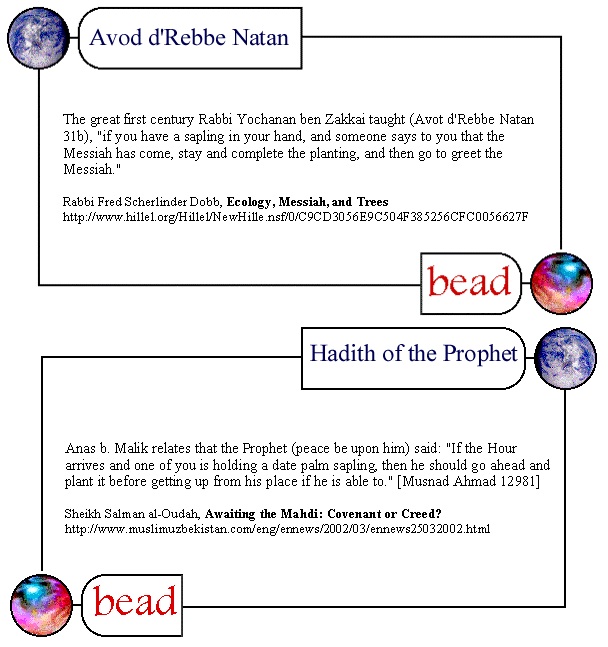
My own favorite among cross-religious commonalities of this sort, fwiw, is this one:

dyad_planting.jpg

*

BTW, nice to see both Berger and Chris Anzalone in the Sentinel — and the Flagg Miller cover-piece on early bin Laden tapes is interesting, too.

Is Mammon having a “secularism” crisis?

Friday, October 21st, 2011

[ by Charles Cameron — Robb’s analysis, capitalism as religion metaphor, irony, warning ]
.

church-for-sale-sm.jpg

image source — btw, contact jonesharris [at] btinternet.com if interested

.
Okay. The Church of England‘s own website, whose banner reads A Christian presence in every community, now hosts a list of, well,

closed-churches.jpg

which seems a rather unfortunate way to phrase things — but the point is, something called “secularism” is gnawing away at belief and church attendance, and I’m wondering if it may not be gnawing away at belief and bank attendance, too…

And since Mammon is the theological term for riches or material wealth personified, I’m asking, metaphorically speaking, whether Mammon is now facing its own “secularism” crisis…

Well, to be honest, I’m not the one doing the wondering, really — I’m borrowing the whole idea from the imperturbable John Robb, fighter pilot, entrepreneur and author of Brave New War, and spicing it up a bit with nice pictures of a church conversion to drive the irony of the whole thing home.

From two of Robb’s recent posts on his Global Guerrillas blog:

1.

Oct 5 JOURNAL: The Pope of the Church of Capitalism

The Chairman of the Federal Reserve is part:

Religious figure. The Pope of the Church of Capitalism. The leader of the Church. Final arbiter on the meaning of scripture (arcane economic indicators and economic papers). Is trained in ancient mysteries (economics). Has a council of Cardinals (the Fed board). He also issues indulgences (bailouts and free loans) to banks that he likes.

2.

Oct 7 OCCUPY (Insert Your City Here): Protesting Capitalism’s Crisis

What Occupy is Really About The real reason we are seeing this movement right now is because

Capitalism, the last great ideological system, is in crisis.

This isn’t merely a crisis of outcomes (economic depression, financial panic, etc.), it’s a crisis of BELIEF. While people generally believe in the idea of capitalism, a critical mass of people now think that the global capitalist system we currently have is so badly run, so corrupt, so terrible at delivering results that it needs either a) a complete overhaul or b) we need to build something new.

In short, in its tiny way, this protest may be the start of a reformation of the church of capitalism.

A splintering that may change everything…. For better or worse depending on how well you did in the old, corrupt system.

3.

So, anyway — is it time for capitalism to rid itself of the sale of indulgences?

The religious metaphor is, of course, what fascinates me.

But there’s a warning here, too, about the dangers of radically polarized populations and mobs and their heated passions, as Robb quietly implies with his “for better or worse” — are we ready to go through another (networked, and no doubt accelerated) Thirty Years War?

That is something I devoutly hope we can avoid.

Quoting Joseph Smith on “the Al-Koran or the sword”

Tuesday, October 18th, 2011

[ by Charles Cameron — Christopher Hitchens, Muhammad, Jack Chick, and Joseph Smith ]

.

I get so tired of people not doing their homework, left and right.

Or perhaps that should read, Left and Right.

1.

I don’t know quite how you’d classify Christopher Hitchens, but in a Slate article today titled Romney’s Mormon Problem: Mitt Romney and the weird and sinister beliefs of Mormonism, he asserts:

On his later forays into the chartless wilderness, there to play the role of Moses to his followers (who were permitted and even encouraged in plural marriage, so as to go forth and mass-produce little Mormons), Smith also announced that he wanted to be known as the Prophet Muhammad of North America, with the fearsome slogan: “Either al-Koran or the Sword.”

Juicy, eh?

Luckily, Hitchens has linked the phrase “Either al-Koran or the Sword” – so we can source the quote in, let’s see, Christopher Hitchens, in his book God is Not Great, as excerpted in Slate again:

The Church of Jesus Christ of Latter-day Saints-hereafter known as the Mormons-was founded by a gifted opportunist who, despite couching his text in openly plagiarized Christian terms, announced that “I shall be to this generation a new Muhammad” and adopted as his fighting slogan the words, which he thought he had learned from Islam, “Either the Al-Koran or the sword.”

Sadly, there’s no link this time, no further sourcing of the quote.

2.

Hugh Nibley is my go-to man for Mormon scholarship (orthodox), and it doesn’t surprise me that there’s an essay of his on the web comparing Islam and Mormonism [.pdf].

Nibley accepts that “in fact, early Mormon leaders saw no reason why Mohammed should not be considered a true prophet, for there have been many prophets, great and small, in the past whose words are not in the Bible.” But that impression didn’t long survive a second observation:

[T]he striking resemblance turns almost at once into an equally striking contrast when the Moslems announce that Mohammed is the last of the prophets and that there can be no prophet after him. “When a doctrine is sealed,” writes an eminent Moslem scholar, “it is complete, and there can be no further addition. The holy Prophet Mohammed closed the long line of Apostles. … there has been and will be no prophet after Mohammed.”

Nibley’s six-page essay has no quotation in which Joseph Smith speaks of “Al-Koran or the sword”.

Neither, in fact, does Todd Harris in his 162-page 2007 BYU Master’s thesis A Comparison of Muhammad and Joseph Smith in the Prophetic Pattern [.pdf].

3.

Jack Chick to the rescue.

As you may know, Jack Chick publishes some appallingly poorly illustrated Christian booklets that are almost as small as large postage stamps, and almost as much fun to collect.

Chick’s larger-than-usual publication The Enchanter, whose cover graces the top of this post, includes the following garishly interesting graphic:

But – poor taste in art aside – Chick is more thoroughgoing than Hitchens, and is kind enough to supply us with references for the statements he makes. In a commentary on his own pamphlet, he writes:

On October 14, 1838, Joseph Smith called himself a “second Muhammad” as he was concluding a speech in the public square at Far West, Missouri. Those words have been verified by affidavits from Thomas B. Marsh, Orson Hyde (from Joseph’s Quorum of the Twelve), George M. Hinkle, John Corrill, W.W. Phelps (a major leader in the Mormon church), Samson Avard (founder of the Danites), and Reed Peck.

To Marsh’s statement, he footnotes thus:

For the full affidavit of Thomas B. Marsh, see The Rocky Mountain Saints by T. B. H. Stenhouse (New York: D. Appleton and Company, 1873), pp. 89-90.

and points out that we can read the relevant pages ourselves on Google Books.

4.

There’s an article titled From the Archives: Joseph Smith or the Sword!? at the Juvenile Instructor blog, commenting on the Jack Chick publication, which handily quotes the various 1838 testimonies in which associates and one-time associates attest that Smith compared himself with the Prophet of Islam – that of Thomas Marsh being the only one of which actually offers us the phrase that Hitchens — remember Hitchens? – was (almost) quoting.

Marsh’s statement reads:

I have heard the prophet say that he should yet tread down his enemies, and walk over their dead bodies; that if he was not let alone he would be a second Mahomet to this generation, and that he would make it one gore of blood from the Rocky Mountains to the Atlantic Ocean; that like Mahomet, whose motto, in treating for peace, was “the Alcoran or the Sword,” so should it be eventually with us, “Joseph Smith or the Sword.”

And so — with the exceptions that the original has “Mohammed” where the Juvenile Instructor has “Mahomet” and that the original has single quotes where the Juvenile Instructor has double — Marsh’s testimony as published in Stenhouse’s book does indeed read.

5.

So that’s the closest thing we have to a source for Joseph Smith having made the statement that Hitchens says Smith “adopted as his fighting slogan” – when even that one source has Smith uttering it with the conditional “if he was not left alone” and the future-oriented “so should it be eventually with us”…

For what it may be worth — no more and no less, and I shall not be the judge of that — the third volume of BH RobertsHistory of the Church of Jesus Christ of Latter-day Saints contains the following, which I take to be placed in the mouth of Smith himself, but drawn from his diaries and other contemporary papers:

Thomas B. Marsh, formerly president of the Twelve, having apostatized, repaired to Richmond and made affidavit before Henry Jacobs, justice of the peace, to all the vilest slanders, aspersions, lies and calumnies towards myself and the Church, that his wicked heart could invent. He had been lifted up in pride by his exaltation to office and the revelations of heaven concerning him, until he was ready to be overthrown by the first adverse wind that should cross his track, and now he has fallen, lied and sworn falsely, and is ready to take the lives of his best friends. Let all men take warning by him, and learn that he who exalteth himself, God will abase.

This at least gives us a sense of the tension between the two men…

And consider this:

The disaffected and the apostate are in particular informants whose evidence has to be used with circumspection. The apostate is generally in need of self-justification. He seeks to reconstruct his own past, to excuse his former affiliations, and to blame those who were formerly his closest associates. Not uncommonly the apostate learns to rehearse an ‘atrocity story’ to explain how, by manipulation, trickery, coercion, or deceit, he was induced to join or to remain within an organization that he now forswears and condemns.

That’s from Bryan Wilson, Fellow of All Souls College, Oxford, and author of The Social Dimensions of Sectarianism: Sects and New Religious Movements in Contemporary Society.

6.

Homework, Hitchens, homework!

I shouldn’t say stuff like that – I’m sure I’ve missed a few points myself.

7.

At least Hitchens is wittier than Limbaugh.

The Limbaugh Rush to Erroneous Judgment

Saturday, October 15th, 2011

[ by Charles Cameron — Limbaugh, “Christianity” of the Lord’s Resistance Army, Uganda, sectarianism, RJ Rushdoony ]

.

flag_of_lords_resistance_army.jpg

flag of the Lord’s Resistance Army — Wikipedia

Matt Yglesias trumpets “Rush Limbaugh Endorses The Lord’s Resistance Army” on ThinkProgress today, and goes on to say:

I don’t have a really strong view on whether or not it’s advisable to dispatch a small number of US combat troops to help fight the Lord’s Resistance Army. My instinct is to be skeptical. I want to see less military intervention, not more. But Rush Limbaugh’s instinct is to embrace brutal murderers…

That last sentence is an over the top ad hominem attack, if you ask me. But Limbaugh himself is so far over the top he’s almost reached the bottom.

Limbaugh may not be embracing or endorsing Joseph Kony‘s Lord’s Resistance Army, but this is some of what a transcript of his show has to say about them:

Lord’s Resistance Army are Christians. They are fighting the Muslims in Sudan. And Obama has sent troops, United States troops to remove them from the battlefield, which means kill them.

The transcript shows that Rush draws at least some of his knowledge of the subject from a report by Jacob Tapper of ABC News, which is mentioned in Limbaugh’s second sentence with a link provided at the end of his transcript.

1.

The Limbaugh transcript ends after a caller has apparently updated Limbaugh on some of the facts:

Is that right? The Lord’s Resistance Army is being accused of really bad stuff? Child kidnapping, torture, murder, that kind of stuff? Well, we just found out about this today. We’re gonna do, of course, our due diligence research on it. But nevertheless we got a hundred troops being sent over there to fight these guys — and they claim to be Christians.

Due diligence? Isn’t that something you do before you blurt?

If Limbaugh had continued to the end of the 12 paragraph ABC report he referenced, he’d have read this quote from the 2010 Statement by the President on the Signing of the Lord’s Resistance Army Disarmament and Northern Uganda Recovery Act of 2009:

The Lord’s Resistance Army preys on civilians – killing, raping, and mutilating the people of central Africa; stealing and brutalizing their children; and displacing hundreds of thousands of people. Its leadership, indicted by the International Criminal Court for crimes against humanity, has no agenda and no purpose other than its own survival. It fills its ranks of fighters with the young boys and girls it abducts. By any measure, its actions are an affront to human dignity.

Is Limbaugh in need of an intern to do some fact-checking, perhaps?

2.

Here’s Limbaugh again:

Now, up until today, most Americans have never heard of the combat Lord’s Resistance Army. And here we are at war with them. Have you ever heard of Lord’s Resistance Army, Dawn? How about you, Brian? Snerdley, have you? You never heard of Lord’s Resistance Army? Well, proves my contention, most Americans have never heard of it, and here we are at war with them.

I know I’ve been tracking them for quite a while myself, because I quoted the estimable Helena Cobban‘s JustWorldNews piece announcing a “second-stage peace accord” between the Ugandan government and LRA in May 2007 — but I also have a 2002 article from the UK’s Department for International Development (DFID) magazine Developments, buried in among the files I brought over from an older computer, which contains one striking piece of evidence that I’d love to follow up on.

In this article, no longer available at the DFID site, but which can now be retrieved from the Internet Archive — DFID Media Fellow Maya Deighton reports as though it’s common knowledge that Kony at one point converted to Islam:

The rebels’ leader is a religious fanatic called Joseph Kony, who hides out for most of the time in southern Sudan.

Kony manages to combine a heady blend of occultism, born-again Christianity, and most recently, a much-proclaimed conversion to Islam, with his campaign of terror and child abduction.

3.

Muslim, Christian, spiritualist, shamanic, syncretistic, tribal, or merely incoherent in belief, the LRA has long been known for its brutality. Deighton continues:

Known as the Lord’s Resistance Army (LRA), the force of 10,000 recruits is a rag-tag one. It is made up of highly powerful commanders, who roam in the vast, wild bushlands of northern Uganda and southern Sudan, with bands of abducted children, forcing them to take part in brutal raids on their own communities.

The commanders instruct the children to take part in arcane rituals, including smearing their bodies with shea nut oil, which they claim will magically protect them from enemy bullets.

In sprees of frenzied violence, the children burn and loot whole villages, raping women, abducting more children of both sexes and killing men, as they rampage through.

During the attacks, the rebels leave their unmistakable trademark by cutting off their victims lips, ears and even legs.

If Limbaugh is so far over the top as to be close to bottoming out, Kony is crazed enough for me to forgo my usual scruples and apply the nauseating term, batshit.

4.

And hey – even JR Rushdoony‘s Chalcedon Foundation has known about this for ages. Their magazine featured an interview by Lee Duignon with Uganda’s Ambassador to the US, Edith Ssempala, in May 2005, titled Uganda’s War with ‘the Devil’. I don’t think Rush Limbaugh or his people had read that piece, either.

It begins by setting the time-frame – and remember, this was published in 2005:

“We need your prayers” to bring an end to “a spiritual war” that has ravaged northern Uganda for 19 years, Uganda’s Ambassador to the United States appealed to American Christians.

It’s not every day you see the “spiritual warfare” meme more readily associated with C Peter Wagner and the NAR cropping up in a Rushdoony publication…

In an exclusive interview with Chalcedon, Ambassador Edith Ssempala discussed her country’s war against the Lord’s Resistance Army – a terrorist organization that has, in the name of God, murdered tens of thousands, driven more than a million people from their homes, and abducted many thousands of children to be slaves or “soldiers.”

“I prefer to call it the Devil’s Resistance Army,” the ambassador said. “It’s blasphemous to call it ‘the Lord’s.’ All those atrocities in the name of God.”

[ … ]

Self-proclaimed “General” Joseph Kony, who claims he has supernatural powers conferred on him by the Holy Spirit, created the LRA and still leads it. The government has tried many times to negotiate with him, Ms. Ssempala said – but it’s impossible to negotiate with a madman.

“Those who’ve met with him say they can’t make any agreement with him,” the ambassador said. “He always says he needs to consult the spirits.”

5.

Okay, here’s another interesting bit:

Publicly, Kony says his mission is to impose the Ten Commandments on Uganda as law. Uganda’s Christians, of course, already believe in the Ten Commandments.

“He says he wants to establish the Ten Commandments as the nation’s law, and he violates every one of them,” Ms. Ssempala said. “Nobody knows what he really wants. He’s motivated by pure evil. He maims, he murders, he rapes. He makes children do these things as their initiation into his army. It’s demonic.”

Also of interest is the LRA’s statement of intent, which Limbaugh quotes approvingly:

Lord’s Resistance Army objectives. I have them here. “To remove dictatorship and stop the oppression of our people.” Now, again Lord’s Resistance Army is who Obama sent troops to help nations wipe out. The objectives of the Lord’s Resistance Army, what they’re trying to accomplish with their military action in these countries is the following: “To remove dictatorship and stop the oppression of our people; to fight for the immediate restoration of the competitive multiparty democracy in Uganda; to see an end to gross violation of human rights and dignity of Ugandans; to ensure the restoration of peace and security in Uganda, to ensure unity, sovereignty, and economic prosperity beneficial to all Ugandans, and to bring to an end the repressive policy of deliberate marginalization of groups of people who may not agree with the LRA ideology.” Those are the objectives of the group that we are fighting, or who are being fought and we are joining in the effort to remove them from the battlefield.

Nothing much to argue with there.

But hey, Rushdoony must have felt a little confused by these guys.  His massive Institutes of Biblical Law is dedicated to the proposition that now and for ever, Old Testament law should be the foundation of civil law – on page 18 he writes that “one God, one law” propounded in Deuteronomy 6.4 (the Shema Yisroel) is “the declaration of an absolute moral order to which man must conform”.  Joseph Kony as quoted above seems to be pretty much in agreement with that.

6.

But then in the LRA’s own official presentation, A Case for National Reconcilation, Peace, Democracy and Economic Prosperity for All Ugandans, we find:

3.4. Propaganda by the Museveni regime and the media that the LRA is a group of Christian fundamentalists with bizarre beliefs whose aim is to topple the Museveni regime and replace it with governance based on the Bible’s ten commandments are despicable and must be rejected with all the contempt it deserves.

Hunh?

Then again, we’re talking about Uganda here, which also gave us the Movement for the Restoration of the Ten Commandments of God – the Catholic splinter group which set fire to its church with four or five hundred adherents locked inside on March 17, 2000 – after their December 31st 1999 end of days had been postponed in a vision by the Virgin Mary.

So perhaps it’s understandable if Kony’s emisary seeks to distance himself from the associations brought up by mention of the “Ten Commandments” in a Ugandan context, and sets forth a list of LRA objectives that sounds passable enough that Limbaugh can quote them with approval.

7.

And Rush, we’re still waiting for that overdue diligence


Switch to our mobile site