zenpundit.com » anglosphere

Archive for the ‘anglosphere’ Category

An end-timely reminder

Saturday, May 14th, 2011

[ by Charles Cameron ]

.

I spend a fair amount of effort as you know, trying to monitor the various forms of end-times religion manifesting in the Abrahamic faiths, so it came as a shock to me to find a seam of material on Sunni Mahdism that I hadn’t previously run across, now a year old, from over on my old side of the pond of all places…

Look what happens to London:

london.jpg

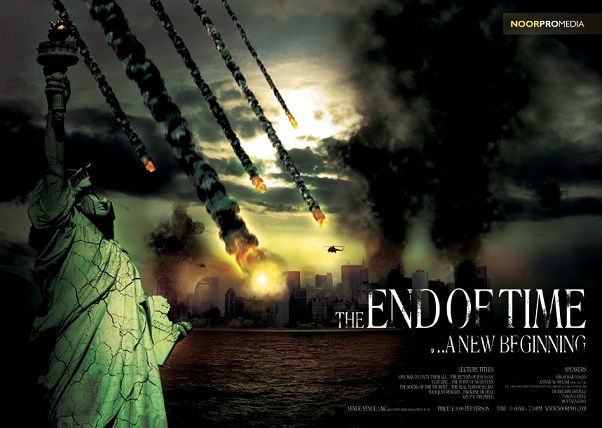
And if that isn’t graphic enough for you — and it really isn’t very graphic — look at what happens to New York

nyc.jpg

The End of Time… A New Beginning…

*

The first image comes from a poster for a tour of Ireland in October of last year — though why the good people of Ireland should be so worried if London is consumed in sulphurous fog and flame is a little hard for me to understand — while the second graphic advertises a conference in London — though why the good people of London should be so concerned if the city of New York… no, I won’t go there, there’s the Special Relationship, isn’t there?  Is there?

I missed both events, alas, living quietly here in the United States, or I might have heard, in Ireland:

a clear description about life in the grave, the trials of the last day, the major and minor signs leading to the last hour and the day of resurrection including Imam Mahdi, The Dajjal and many more.

I could have taken notes, and published them here on Zenpundit. After all, as the advertisements advertised:

On the Day of Judgment those who pass the test will be rewarded with Paradise.

Cliff’s Notes for Judgement Day — a sure best seller!

*

Not to worry, I can still study up on the January 2009 London conference, at which Anwar al-Awlaki reportedly hosted a live video question-and-answer session, presumably beaming in from Yemen — even though tickets are no longer available

If I can just get hold of the DVDs…

end-of-time-awlaki-dvds.jpg\

Sadly, though, they’re out of stock

*

Okay seriously now — three points:

This is associated with al-Awlaki.  This has slick PR, intercontinental video feeds, and DVDs.  And this is Sunni Mahdism.

Check?

Grand Strategy Board II, UK Edition

Tuesday, May 10th, 2011


Aaron Ellis at Egremont, the blog of the Tory Reform Group, has taken a liking to my previous post, Time for a Grand Strategy Board? and decided that the time might be right for Britain:

Should the UK institutionalise its Wise Men?

Ever since the end of the Cold War, this country has found it hard to think strategically. A parliamentary report last year stated, “We have simply fallen out of the habit”. It has also befallen the United States and both our foreign policies have suffered from similar problems. The ‘Big Picture’ is being obscured as policies such as humanitarian intervention and promotion of democracy take the place of grand strategy.

Governments have also found it hard to implement their chosen policies because of the lack of proper strategy – the sort that links ends, ways and means. This has been the case for military action, as we are witnessing in Libya.

The lack of any overarching ideas about our role and our interests has led to an incoherent foreign policy, as competing departments pursue contradictory policies even within the same country.

The problem is partly institutional. Jim Scopes, a former director of strategy at HM Revenue & Customs, has written that current reward and promotion mechanisms in the Civil Service “favour reactive (problem-solving) behaviour rather than proactive (strategic) approaches.” The Public Administration Committee has found that “the ability of the military and the Civil Service to identify those people who are able to operate and think at the strategic level is poor.” As I wrote last month, the makeup of government institutions is not the only factor in making strategies but it is an important one. The world is so unstable right now that it is essential for policymakers to understand the global environment if they are to form a sensible foreign policy – yet the structure of governments influences how they see the world.

If governments are filled with officials more comfortable with solving immediate problems then foreign policy will be reactive and short-termist. We need people to take the longer view…

Read the rest here.

There’s an interesting symmetry here, in the effort to improve the strategic capacity of respectively the United States and the United Kingdom, that derive from the differences in their Constitutional arrangements and national security cultures.

Britain has operated for centuries with an unwritten Constitution and Cabinet government. While these phrases are much more historically complex than meets the eye, the power relationships of Monarch, Houses of Parliament, electorate, peerage, bureaucracy and Party having evolved considerably over time, we can simplify things by stating that the cardinal virtue of the British system was flexibility, to adapt to circumstances. In a crisis, power could rapidly flow to the minister best suited to deal with the trouble at hand and the lack of institutional structures helped ensure that once the crisis had ebbed, concentrated power would just as rapidly dissipate.

The United States, by contrast, has a written Constitution and a Federal government, which while also undergoing historical evolution, is characterized by restraint. Friction is engineered into the American system to thwart or deter concentrations of power and circumscribe it’s exercise within defined parameters . Except in rare instances of overwhelming national consensus, new activities by the US government require the Congress to establish formal institutions that will then fall within the natural gridlock of checks and balances that is the American system.

Ironically, in remediating the lack of strategic vision on both sides of the Atlantic, a Grand Strategy Board would represent an institutionalization of strategy by the British, whose flexible system is in need of a long term, disciplined, focus and a strategic advisory lobby for the Americans, whose more rigid political system periodically requires blue ribbon commissions, panels, study groups and boards to break our habitual political deadlocks.

Ghosts of Pakistan

Saturday, January 8th, 2011

[ by Charles Cameron – cross-posted at ChicagoBoyz ]

Links: PunditaAfPak Channel

As Long as I am on an Anglospheric Strategy Kick…..

Wednesday, November 10th, 2010


Here’s two from the other side of the pond:

Offshore BalancerLecture Notes: Grand Strategy

….Bottom line up front: Grand strategy is a vision, not a plan. We tend to think of it nowadays as something institutionalised and  grandiose, written down in solemn declaratory documents, thrashed out by committees, created by new layers of bureaucracy. The word is rampant in public life. But just because we institutionalise and declare strategy, doesn’t mean we do it. Grand strategy is not necessarily the product of grand structures.

In fact, it might not be that at all. Systematic attempts to codify strategy often don’t work. The Princeton Project, for instance, which gathered a gang of experts on foreign policy, came up with an elaborate world view that was not very strategic, because in all the political gravitas and seriousness they forget to do the most important thing: prioritise, balance power and interests, give us an idea to organise around, and note how and where our power is limited. Committees and structures can be the enemies of strategic thought. They take ideas and disfigure them beyond all recognition. Just ask George Kennan, whose idea of containment – non-universal, pragmatic, selective – was in his own words ambiguous and lent itself to misinterpretation. It become militarised, universal and crusading.

So instead of thinking about the institutional home of strategy – the National Security Council, or the NSS – I want to return to the core of this discipline, of strategy not as a system but as a sensibility. t is a set of basic ideas and instincts about relationship between power and goals, strong enough to give us a sense of pattern in the chaos, but elastic enough to respond to crisis….

This is actually a very long post. I particularly like the last paragraph in the excerpt by Dr. Porter – the pragmatic sense of strategy there reminds me of the Greek classics, particularly Xenophon. Vision and aspiration without magical thinking.

Kings of WarIs politics the enemy of strategy?

The Faceless Bureaucrat writes…

….It is therefore interesting to wonder, as Gordon Goldstein does in his book Lessons in Disaster (references to which figure in Bob Woodward’s recent Obama’s Wars), if politics isn’t the enemy of strategy.  Because of the need to compromise, and the need to worry about mid-term elections, optics, spin, and implications, doesn’t politics just cloud what should be crystal clear?  Wouldn’t military action just be better if it were protected from the fog of politics? 

Clausewitz, of course, would disagree.  But let’s see if we can address this issue without referring to the Prussian. 

Politics has to deal with the real world, which can be larger and more complex than the battlefield.  Sometimes (a key word here) the battlefield, for all its dangers and pitfalls, can be deceptive.  Ideas like ‘clear and hold’, or ‘feed ‘em, don’t bleed ‘em’ make sense, if looked at narrowly, without reference to the need for resources, or the need to maintain support from allies, voters, and political opponents.  Sometimes military action is affected by what we might call political ‘externalities’-things that occur outside of a particular frame of reference, but which have enormous power to change the way things are viewed inside that frame of reference.  For instance, what military planner looking at a sand model of Helmand would have thought that American domestic spending patterns would factor into his or her strategy?  But, as Richard Haas and Roger Altman point out, ignoring this issue is not longer an option.  As Bill Clinton famously (and successfully) declared, ‘It’s the economy, stupid.’….

I look forward to reading seydlitz89′s reaction.

Britain and Future Conflict

Tuesday, November 9th, 2010

From the auspices of The Warlord, an interesting paper:

UK Ministry of DefenceThe Future Character of Conflict (PDF)

Deductions from Themes in Future Conflict

  • Future conflict will not be a precise science: it will remain an unpredictable and uniquely human activity. Adversaries (state, state-proxies and non-state) and threats (conventional and unconventional) will blur. The range of threats will spread, with increased proliferation of Weapons of Mass Destruction (WMD), cyberspace, and other novel and irregular threats.
  • Even during wars of national survival or the destruction of WMD, conflict will remain focused on influencing people. The battle of the narratives will be key, and the UK must conduct protracted influence activity, coordinated centrally and executed locally.
  • Maintaining public support will be essential for success on operations. Critical to this will be legitimacy and effective levels of force protection.
  • Qualitative advantage may no longer be assumed in the future. Some adversaries may be able to procure adequate quality as well as afford greater quantity, whereas we will be unable to mass sufficient quality or quantity everywhere that it is needed.

I have a great fondness for the British.

They are culturally our close cousins and are a greater people than their recent governments would imply ( the same can largely be said of Americans as well). The current and former administrations have not nurtured the “special relationship” as they should have.

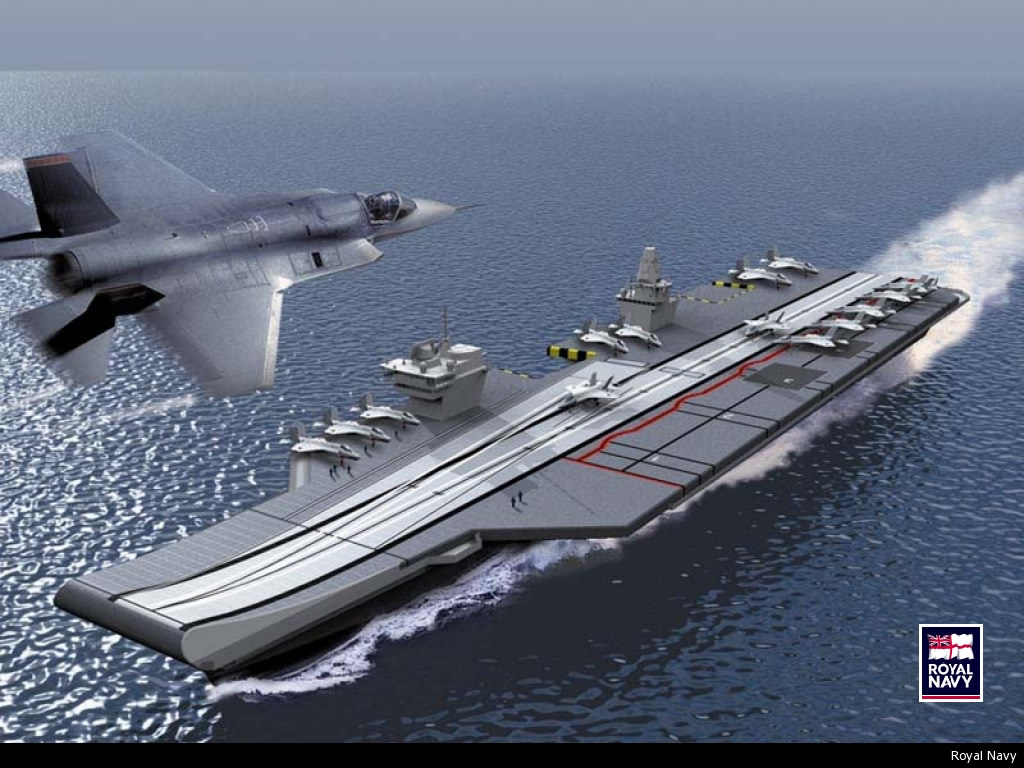
This is of course, an gross understatement: the Obama administration has been at special pains to kick British Prime Ministers in the groin in public ever since they came in to office in 2009. Now, in a fit of ill-considered budgetary niggardliness,  the British are merging part of their military power projection capability with that of France, in order to form something that will be, in case of “future conflict”, completely undeployable. Great.

Just wait, by 2012-2014, the cry in American politics will be ” Who Lost Britain?”

Perhaps we will be too consumed with Mexican narco-insurgency in Texas, Arizona and California  by then to care.


Switch to our mobile site