zenpundit.com » India

Archive for the ‘India’ Category

Of the sacred, III: saliva redux

Friday, July 6th, 2012

[ by Charles Cameron — yet another angle on religious violence ]
.

Religion can be a lot stranger than one might think.
.

Wrathful deity, Tibet


Here, I’m going to tie in my recent post about Iranian clerics claiming Khamenei‘s saliva could cure diseases with the notions of religious danger and religious violence.

Bear with me, this will give us a richer understanding of how religious violence may work with people who are naturally rule-averse — and I’m thinking here of criminals who get into a mix of religion and violence, including criminals who get involved in jihad, but also the cultic side of cartel violence in Mexico.

My aim is not to explicate either of these phenomena specifically, nor to claim they necessarily resemble each other or the punk or Hindu practices I’ll reference, but simply to suggest again, from another angle, how astonishingly diverse, powerful — and frankly surprising, disgusting and on occasion dangerous — religious expressions can be.

**

In my post about Iranian clerics’ claims of virtue for the Ayatollah’s saliva, I drew on other examples in Islamic, Hindu and Christian traditions where the saliva of saints was considered capable of conferring blessings. Marcus Ranum replied with a hilarious, down to earth comment about Chuck Norris‘ saliva, and Derek Robinson then chimed in with a link to a story about punk rockers and spit:

It was the glorious contemptuousness of spitting, of course, that lay behind its enthusiastic adoption by rock stars and others attempting an instant badge of streetwise chic. Spittle’s finest hour came when the activity was adopted as a collective pastime by fans of punk in the 70s, although, according to Jon Savage, the author of England’s Dreaming, a history of the period, the affection for flob may initially have been accidental. “There are various theories as to how it all started but it seems to have originated, with Johnny Rotten blowing his nose on stage when he had a bronchial problem. He may have started the whole thing, unconsciously.” What probably gave the habit legs, he says, was the penchant of the Damned to go to other bands’ gigs and spit at them from the mosh pit as a sign of disapproval.

“The interesting thing about punk spitting was that it was supposed to be friendly, a gesture of solidarity. It was a clever inversion by the punk audience: if you call us disgusting, we’ll show you that we can be disgusting. Bands at the period routinely complained about having to come offstage because they couldn’t play with their hands slipping all over their guitars, however, and if you look at footage of the period – there is some of the Clash in 77 – they are operating in a hail of spit. Completely disgusting.” The power of sputum in punk reached its zenith when Joe Strummer, the band’s lead singer, caught hepatitis after accidentally catching a blob of goo on stage.

What’s clear from this quote, I think, is that the idea behind all this spitting is what some scholars call “transgressive” — there’s a delight here in going beyond accepted boundaries? — and I think FWIW that that’s very much part of what some tantra is about.

**

So we’re in the realm where excitement is generated by doing what’s against the code — moral, legal, social, whether written or unwritten. There’s a frisson of excitement there, in crossing the line, and in religion the technical term for religious practices that explore the crossing of lines and breaking of taboos is “antinomian”.

There are plenty of examples of antinomian behavior in religion. They often crop up when new religious movements are born in defiance of an existing order perceived as unjust, corrupt or hypocritical — as when some medieval heresies held that stealing from wealthy bishops to share food with the poor was more in line with Christ‘s teaching than paying tithes to support the bishop in his splendor.

Perhaps the most interesting example in Christian history is that of the agapetae or subintroductae, who in the early church made the experiment of sleeping together as couples without sex, as if to demonstrate by deed that their love in Christ (agape) was stronger than the love of sexual desire (eros). As Charles Williams noted, the experiment often failed, and the Church Fathers accordingly shut it down.

It’s instructive, I think, that Mahatma Gandhi attempted the same experiment, inviting his 19-year-old grand-niece Manu to share his bed without sexual relations. As Stanley Wolpert put it in Gandhi’s Passion: The Life and Legacy of Mahatma Gandhi (OUP, 2002):

Gandhi was testing the “truth” of his faith in the fire of “experience.” His had always been a practical philosophy, an activist faith. He appears to have hoped that sleeping naked with Manu, without arousing in himself the slightest sexual desire, might help him to douse raging fires of communal hatred in the ocean of India, and so strengthen his body as to allow him to live to 125 in continued service to the world.

I have an extensive set of notes on both the subintroductae and Gandhi’s prayog, prepared as a briefing for a scholar friend’s use in legal proceedings, available on my Forensic Theology blog for further reading. Here, I’d simply note that the breaking of codes and taboos regarding purity, cleanliness and sexuality forms part of the approach to spiritual liberation known as tantra, in which all the energies of human desire, including those normally repressed, may be brought into play under focused, conscious spiritual direction, in the effort to achieve transcendance.

**

Some Tantric practices are not transgressive of any boundaries — forms of meditation focusing on the energy of breath (pranayama) within the seated body, for instance. But some are, as we can see from Loriliai Biernacki‘s book, Renowned Goddess of Desire: Women, Sex, and Speech in Tantra (Oxford UP):

What do we mean when we talk about the “transgressive” in Tantra? The idea of the transgressive gets neatly encapsulated within the Tantric tradition in a simple and pervasive list of words all beginning with the letter m. The “Five Ms,” a list of five substances, including, for instance, liquor and sex, become incorporated within ritual worship of the goddess. The five elements are meat (mamsa), fish (matsya), alcohol (madya), parched grain (mudra), and illicit sexual relations (maithunam). The transgressive ritual that incorporates these substances is designated as “left-handed,” following a nomenclature also prevalent in the West where the right hand is the auspicious and normatively socially acceptable hand and the left represents that which must be repressed and expelled.

The “Five Ms” have elicited a concatenation of emotional Western and Indian appraisals of Tantra ranging from a Victorian repulsion and embarrassed dismissal to ecstatic embrace by contemporary popular culture in the West.

Another aspect of the same tantric strategy consists in arousing and transmuting the energies of disgust by meditating in charnel grounds — the location favored by Lord Siva himself. Mark Taylor has a fascinating and thought-provoking commentary on the cross-cultural role of bones, skulls and skeletons in religious practice in his Cabinet article, Sacred Bones.

**

Now let’s get back to the our starting point: saliva.

Alf Hiltebeitel in his book Criminal Gods and Demon Devotees: Essays on the Guardians of Popular Hinduism (SUNY Press) describes how the god Shiva (Siva) pulled a devotee of his who was a hunter “completely out of the web of conventions that make up the communal life of hunters”. I think you can get the gist even if you don’t know all the technical terms in these paragraphs, but “apna” is love or devotion, and a “linga” is the god Shiva worshiped in the form of a symbolic, stone penis, and the Agamas are scriptures:

When Tinnanar decided to clean his Lord up and to feed him, he did so in complete ignorance of the Agamas and acted as an infatuated Untouchable hunter would. He brought to the linga pig’s meat that he chewed in order to find the tastiest morsels, water that he carried in his mouth, and flowers that he stuck in his hair. He then performed puja in ways that the Agamas rank as defiling. He brushed the linga off with the sandal on his foot, he bathed it by spitting water over it, he dropped the flowers from his head onto Siva’s, and he fed him the saliva-drenched pork. He did this for six days.

In the meantime, Kalattiyappa explained to a Brahman who served the linga while Tinnanar was away hunting why he enjoyed Tinnanar’s abominable ritual, a lengthy explanation summed up by one example: “The water The water that he spits on us from his mouth, because it flows from the vessel made of love called his body, is more pure to us than even the Ganges and all auspicious tlrthas. Anpu is the normal experience we have when our feeling, thinking, and speaking are unified in an attentiveness to another that we call infatuation, but infatuation for Siva may carry one far beyond normal moral boundaries.

**

Humans come in all shapes and sizes, qualities and kinds — and it appears that at least in this Indian example, the divine is prepared to bless the human “where the human is at” — in a manner according with his own nature.

If we can understand this, perhaps we can understand also the curious paradox by which the book Wild at Heart by the Colorado Springs evangelist John Eldredge, becomes part of the “Bible” of La Familia, the Mexican narco-terror group, how the deceased Mexican bandit, now a folk-saint, Jesus Malverde, receives prayers like “Lord Malverde, give your voluntary help to my people in the name of God. Defend me from justice and the jails of those powerful ones” — and how more generally, terror groups with a strong religious ideology can easily number petty criminals and the like among their enthusiastic members, without ceasing to draw on religious motivation.

*****

ADDENDUM regarding the illustration at the top of this post:

A wrathful deity is characteristically wrathful in the sense of Malachi 3.2:

And who can stand when He appears? For He is like a refiner’s fire…

Speaking generally, the purpose of the wrath is purification. It may be helpful to bear this in mind as you contemplate the full image of that wrathful Tibetan deity which heads this post:
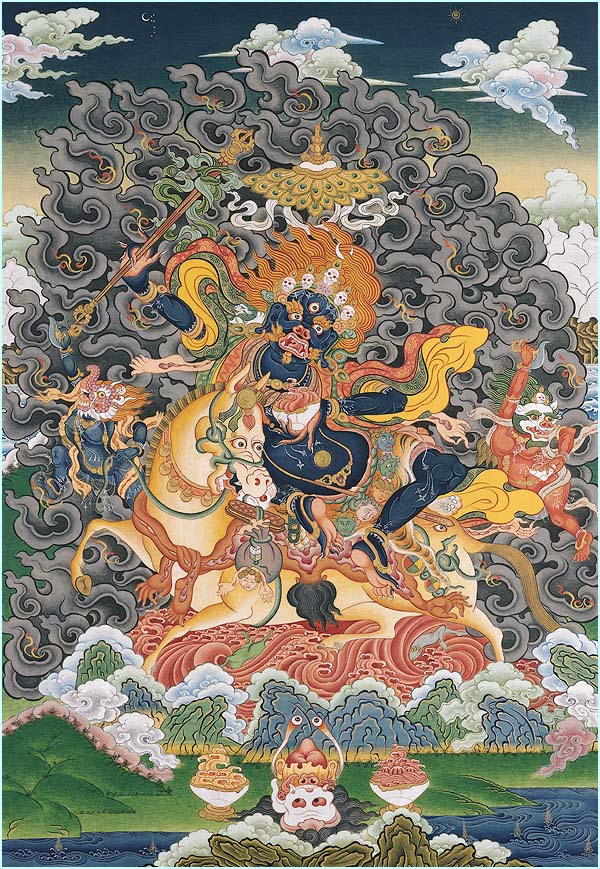
Full image of Tibetan wrathful deity seen above
Of the sacred, II: trees

Wednesday, July 4th, 2012

[ by Charles Cameron — more on magical worldviews: following hot on the heels of the curative power of saliva, a breathtakingly beautiful tale a wise man told me ]
.

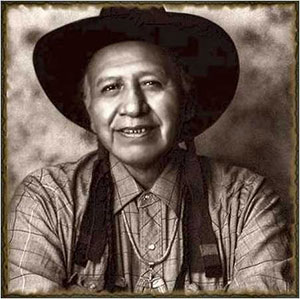
Wallace Black Elk


Look, you may detest saliva, saintly or otherwise, and I’d prefer not to leave you feeling queasy — so let’s follow the saintly saliva trail just a little further, and I think you’ll find it leads to something quite beautiful.

Susan Bayly continues:

Tamil Sufi texts often assert that the founding pir of a particular cult shrine identified his heir and successor by bequeathing him the twig which he used for tooth-cleaning. Such an object would naturally be impregnated with the saint’s saliva and would therefore serve to pass on the pir’s endowment of power and sanctity without involving him in an act of procreation.“ Fakiruddin is portrayed as having received a tooth-brushing twig as a token of spiritual succession from his murshid or preceptor, the Trichy pir Nathar Wali. According to the texts, it is this twig which grew up into the miraculous staff of the Nandi episode. The wooden staff also becomes imbued with the miraculous transforming barakat of the pir. …

Let’s forget saliva, let’s even forget neem-sticks, the organic Indian equivalent of the toothbrush — and consider the miraculous thorn tree that grows at Glastonbury:

After the crucifixion of Jesus lore has it that Joseph of Arimathea (who according to the Bible donated his own tomb for Christ’s interment after the Crucifixion) came to Britain, bearing the Holy Grail — the cup used by Christ at the Last Supper and later by Joseph to catch his blood at the crucifixion.

When Joseph landed on the island of Avalon, he set foot on Wearyall Hill — just below the Tor. Exhausted, he thrust his staff into the ground, and rested. By morning, his staff had taken root — leaving a strange oriental thorn bush – the sacred Glastonbury Thorn.

Lore has it that the thorn would bloom once a year, at Christmas.

**

But virtuous trees, like saintly saliva, can be found in more than one tradition. I had the privilege some while ago of spending a good deal of time in the company of the Lakota shaman, Wallace Black Elk, and would like to offer you one of his stories which I noted down pretty close to his own words.

I should perhaps preface this account by telling you that Wallace once told me he had twelve grandfathers — so the words grandpa and grandma don’t imply lineal descent here as they do in common usage, but function more as a term of respect for one’s elders:

I remember my grandfather, Black Elk. One time when I was very young, he came with my
grandfather Eagle Man to visit my grandmas in the tipi. My mother and my aunt were both young, so they let the old people visit together. “We’re good at cooking, so you just sit down and rest, and visit. We’ll look after the cooking.” And my father went off to take care of the horses, and to haul and chop wood, and left the old people to visit with each other.

That was the way it was. Everybody would eat a big meal, and some of those evenings my grandfathers would sit around telling ghost stories, spirit stories, and I’d listen. And while they were talking, they had a pipe. They would smoke the pipe and talk. So I was maybe seven years old, and I was sitting in the middle between grandma and grandpa, I used to sit there and listen, and watch them smoke the pipe.

My grandpa took the pipe-stem and planted it in the ground. He took a piece of charcoal and lit the fire, sprinkled some tobacco on it, and just puffed a little of that smoke. And that pipe-stem, you know, blossomed. Branches bloomed out of it, leaves bloomed out, and there’s a big red plum there. Red.

So my grandpa took the plum and gave it to his brother, and he ate it, and said: “Washtay, that’s really good.” And then he took the pipe and planted the pipe-stem, did the same thing, and put some tobacco over it, and that pipe-stem…that tree just bloomed, leaves just cropped out all over it, and there was a black cherry hanging there, it was a choke cherry. So my grandpa gave that choke cherry to his brother, and he ate it and blew the pit onto the ground. “Aah, very good.”

My grandmas were watching all this, and one of my grandmas picked up her moccasin and said, “Aaah, want some cherries, do you?” as if my grandpas were doing this to show their powers, and she was telling them, don’t do that! She threw her moccasin on the ground and an owl came up. It hopped around and flew in front of them, and started hooting whu whuwhuu, whu whuu.

My grandfathers looked at one another and said: “Hey, almost like our powers!” And they both started laughing, and that owl jumped down, and puffed itself up, and started hooting. So then my other grandma took her cane, she cried “Heeeeeee!” and threw it on the ground and it came out a rattlesnake. And it wasn’t just kind of a rattlesnake almost: boy, it really was a rattlesnake, and it coiled around the place. Boy, we bailed out.

Then my grandma reached over and took hold of that snake, and she took that cane and grabbed a hold of that owl by the neck, and pulled it back to her, and when it flopped down, when it landed, it was her sister’s moccasin, and she gave her sister her moccasin and put away her cane.

So that was my grandmas and grandpas. They had those powers, they knew that power was there. So I learned then there was a power in that pipe we hold, that the pipe could feed us. And he has been feeding us. There is no starvation, and we needn’t fear. That pipe represents the whole universe, and she can continue to multiply trees and plums and cherries.

That power of the Great Spirit is there, and those creatures can come from that pipe. Grandpa Great Spirit can do these things. From out of nowhere, he can do anything. I realized that.

A white man might think it was a bit of hocus pocus. Like a white man’s magician pulls a poor rabbit out of a hat, or a pigeon. But this is real. A tree comes up, and then it blooms, then it flowers, then it bears fruit. It’s a tree. And we are part of that tree. We absorb that fruit in our system, and we bear children, we bear fruit.

So that is an interpretation of the vision of the Tree of Life. That way my grandpa taught me.

**

Which reminds me (Exodus 7)…

And the LORD spake unto Moses and unto Aaron, saying, When Pharaoh shall speak unto you, saying, Shew a miracle for you: then thou shalt say unto Aaron, Take thy rod, and cast it before Pharaoh, and it shall become a serpent. And Moses and Aaron went in unto Pharaoh, and they did so as the LORD had commanded: and Aaron cast down his rod before Pharaoh, and before his servants, and it became a serpent. Then Pharaoh also called the wise men and the sorcerers: now the magicians of Egypt, they also did in like manner with their enchantments. For they cast down every man his rod, and they became serpents: but Aaron’s rod swallowed up their rods. And he hardened Pharaoh’s heart, that he hearkened not unto them; as the LORD had said.

Of the sacred, I: saliva

Wednesday, July 4th, 2012

[ by Charles Cameron — more on magical worldviews: first the curative power of saliva, Iran, India — then in the follow up, a breathtakingly beautiful tale a wise man told me ]
.

First off, a hat-tip to Shoshank Joshi, because were it not for his tweet, I might not have noticed Muhammad Sahimi’s post, stirred old memories, and written what follows.

The tweet:

Frankly, it was the mention of saliva in a religious context that caught my attentiont.

**

Sahimi’s post only mentions the Ayatollah Khamenei‘s saliva in passing, and is worth reading in its own right:

Some of the praise heaped on Khamenei is borderline blasphemy. But as the Prophet Muhammad said, “A ruler and his rule can survive blasphemy, but not injustice.” And terrible injustice is being done to a great nation and its people on a daily basis by Khamenei’s supporters. As far as the fate of the nation is concerned, the critical question is, Given that Khamenei is surrounded by minions, flatterers, and cronies who compete with each other to praise him lavishly, how realistic a view does he have of what is going on, either domestically or internationally? When his own chief of staff exaggerates and even lies about him, what type of information can he expect to receive? Mohammad Reza Shah Pahlavi was surrounded by the same sort of coterie, and by the time he realized the gravity of the state’s situation in the fall of 1978, it was too late to reform his regime and put it on a democratic path.

**

So, Charles, saliva. WTF?

**

TF is this. Sahimi begins his article, in which mention is made of the sacred qualities attributed to Khamenei’s saliva, with the following observation:

Praising national leaders and elevating them to mythic levels is as old as human civilization. Iran is no exception; indeed, the phenomenon has a very long history in the country, as manifested by the many tales of kings’ bravery, vision, kindness, and generosity that one finds in the Persian literature. This practice continues — the difference is that it is now entering uncharted territory and reaching absurd heights.

**

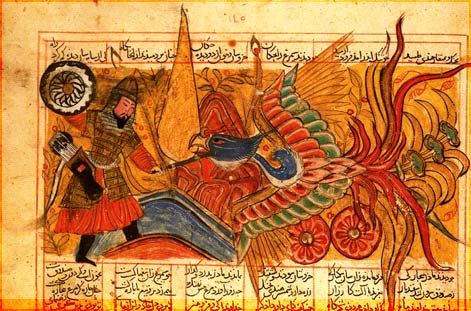
Okay, okay, the Shahnameh.

**

But then Sahimi gives us these two paragraphs:

In addition to producing reactionary clerics to serve Khamenei and his power, Mesbah — as he is commonly known — has been the Supreme Leader’s exaggerator-in-chief. Here are a few examples:

“Ayatollah Khamenei’s saliva can cure diseases.” According to dogma, only a saint can possibly perform such “miracles.”

And I’m sorry — that absolutely isn’t “uncharted waters” — it’s definitely charted.

**

As Sahimi says, in fact, it’s dogma — or, I’d prefer to think, an archetypal feature of pre-scientific religious thought.

Consider this, from Susan Bayly, Saints, Goddesses and Kings: Muslims and Christians in South Indian Society, 1700-1900, (Cambridge South Asian Studies), p. 127:

The explanation for this is that throughout India bodily secretions, especially blood, semen, saliva and human wastes, are thought of as being charged with a form of power and energy which may be both menacing and protective. The god manifests his awesome potency with a great flow of blood; the individual’s wastes and secretions are a source of danger and pollution to others. Lesser beings accept saliva-impregnated leavings from their superiors, and so the Hindu devotee and so the Hindu devotee takes the divine ‘leavings’ or prasatam of the god as a token of fealty and a source of protective and transforming sacred energy.

In south India the pir’s devotees also perceive their lord’s saliva as a medium which carries and transmits his barakat. Here too the disciple seeks out contact with a transforming substance which would otherwise be conceived of as unclean and defiling…

So that’s the sacredness of a saint’s saliva attested to in both Hindu and Sufi traditions — but it was apparently also a part of Christian tradition, as this by turns charming and arresting quotation from the description of Saint Columban in Sean Kelly and Rosemary RogersSaints Preserve Us!: Everything You Need to Know About Every Saint You’ll Ever Need p. 67 attests:

He was known to everyone, and cut a distinctive figure — he shaved the front of his shoulder-length hair into a half-tonsure, squirrels nested in his cowl, and he wandered around brandishing his staff and downing oak trees with his fist While in France, Columban and his monks followed the Irish tradition, often criticized by many as being too severe: a monk who cut his finger badly while reaping had the wound cleaned by Our Saint’s saliva and was ordered back to work.

**

But wait — there’s more… and it’s beautiful.

Messy Wars, Navigating Wicked Problems, and the Soul of American Foreign Policy

Monday, June 18th, 2012

Michael Few is a retired military officer and former editor of the Small Wars Journal: we are honored to offer our readers this guest post by a good friend of this blog.
.

This fall, I’m hoping to begin teaching high school social studies as well as an elective on Global Issues or Wicked Problems (WPs). WPs are those messy, seemingly intractable problems that seem to evade solutions from conventional planning and decision making methods — terrorism, poverty, water rights, etc… These types of courses are already being taught in the school system where I live, and my hope is that I will be able to become a force multiplier given my experience and background.

Eventually, if this elective course takes off, then I would like the final project to be a collection of TEDx talks, where the students describe a problem, discuss past failed efforts to tame the problem, and offer coping strategies or new solutions.

As I am doing my initial reconnaissance of the student demographics, the first striking data point is their age. The incoming freshman class would have been born in 1998, and the senior class born in 1995. A second surprise that I received is the socio-ethnic backgrounds. Along with the expected mix of white, black and Hispanic children, my school district has a significant first generation Indian population, whose parents teach or work in the Research Triangle Park or surrounding universities. Moreover, there is a minority of Burmese refugees who have found a safe home after fleeing a repressive regime.

How do they see and understand the world?

The attacks of 9/11 were but a faint memory; the Cold War is ancient history. Their childhoods were formed with the Iraq and Afghanistan wars in the background, and their pop-culture heroes are Navy Seal Team Six and Call to Duty video games. Drone strikes and the intervention in Libya are normal for them.

It is the way things are. We fight terrorists in other countries in order to protect our way of life. But what is a terrorist or an insurgent? Is it simply someone that disagrees with you?

These students have much bigger problems to solve than simply pacifying villages in the remote areas of modernity. By 2040, when these students are in the prime of their lives, the world population is expected to be nearing nine billion with increased competition for basic resources as the world passes through peak oil and peak fresh water.

If the United States is to remain strong, then these children are our hope. They will be tasked with leading the nation, finding new solutions to coming crisis, and developing innovation in technology, science, governance, and medicine.

As I am developing my teaching philosophy, I am using the same process that served me well as a commander in the military. My purpose is to help develop, mentor, and coach: 1. leaders of character, 2.involved citizens in the nation who understand that rights must be complimented by responsibilities, and 3. the individual self-confidence to pursue a good life respecting themselves and others.

Initially, I want to challenge them to rethink what they’ve been taught or think they know. I want my students to think for themselves and determine what right should look like.

First, I began studying Reinhold Niebuhr. Now, I’m spending some time reading Saint Augustine’s “City of God” and rethinking Just War Theory. If we zoom up from just drone strikes and look at our continued military action across the globe, do we still have the moral high ground? I don’t know. As Saint Augustine wrote,

Whoever gives even moderate attention to human affairs and to our common nature, will recognize that if there is no man who does not wish to be joyful, neither is there anyone who does not wish to have peace. For even they who make war desire nothing but victory — desire, that is to say, to attain to peace with glory. For what else is victory than the conquest of those who resist us? And when this is done there is peace. It is therefore with the desire for peace that wars are waged, even by those who take pleasure in exercising their warlike nature in command and battle. And hence it is obvious that peace is the end sought for by war.

When I quoted Saint Augustine in a comment here, Mark Safranski, the Zen of Zen, replied,

The high ground is in the eye of the beholder. Some people cheered 9/11, including a few American radicals. With multiple-audiences watching 24/7, some will disapprove of our merely existing and bitterly resent and deny the legitimacy of our fighting back because they prefer us defeated and dead. Other audiences are more fair-minded and these are a good barometer – if we are winning them over, securing their admiration and isolating our opponents, our moral behavior in the big picture is apt to be reasonably on track. If we are repelling them, isolating ourselves, driving others to the side of our enemies, then chances are fairly good that we are going astray.

Zen’s point is well-taken, but I disagree. Following a moral life is not based on how others feel about you. It is through living a life that subscribes to your believed philosophy, spiritual norms, and values and beliefs particularly when you have to make an unpopular decision.

John Arquilla, in his most recent “Cool War,” said it best,

’It is well that war is so terrible,’ Confederate General Robert E. Lee once said, ‘lest we should grow too fond of it.’ For him, and generations of military leaders before and since, the carnage and other costs of war have driven a sense of reluctance to start a conflict, or even to join one already in progress.

Caution about going to war has formed a central aspect of the American public character. George Washington worried about being drawn into foreign wars through what Thomas Jefferson later called ‘entangling alliances.’ John Quincy Adams admonished Americans not to ‘go abroad in search of monsters to destroy.’ Their advice has generally been followed. Even when it came to helping thwart the adventurer-conquerors who started the twentieth century’s world wars, the United States stayed out of both from the outset, entering only when dragged into them.

Today, war has become too easy and not too terrible. With our global hegemony in military strength, we can force our will at any time and any place.

But, what is the right thing to do?

What is the moral high ground?

These are some of the questions that my students will eventually have to answer.

Carlos Fuentes (1928 – 2012)

Wednesday, May 16th, 2012

[ by Charles Cameron — in memory of Carlos Fuentes, requiescat in pace ]
.


.

Carlos Fuentes‘ great novel, Terra Nostra, opens with these words:

Incredible the first animal that dreamed of another animal.

It’s a sentence to stop you in your tracks, a sentence to give pause to time itself, circling back on itself like the serpent that eats its own tail, a dream of a sentence, a dream sentence.

Fuentes continues:

Monstrous the first vertebrate that succeeded in standing on two feet and thus spread terror among the beasts still normally and happily crawling close to the ground through the slime of creation. Astounding the first telephone call, the first boiling water, the first song, the first loincloth.

How does a mind move so agilely among these many and diverse firsts — the sleeping, the archeo-anthropological, the technical, the musical, the shameful or sinful or perhaps decorative, even erotic? In a single paragraph — the first in a book that will run 890 pages and not tire?

And Fuentes continues:

About four o’clock in the morning one fourteenth of July, Pollo Phoibee, asleep in his high garret room, door and windows flung wide, dreamed these things, and prepared to answer them himself.

Pollo Phoibee dreamed these things, Carlos Fuentes dreamed Pollo Phoibee…

And we are in Paris, Paris of the artists, of the garret, and yet a Paris where the Seine is boiling, where the Louvre has become crystalline, the black eyes of the gargoyles of Notre Dame see “a much vaster panorama”…

*

Carlos Fuentes died today, and I am saddened — remembering him signing my short, fat British Penguin paperback of Terra Nostra (its fondly remembered cover image above) and commenting that it was his preferred English edition, since one could slip it into one’s pocket…

And Terra Nostra was special to me, both as a great and tumultuous fiction, and as a fiction that quoted Norman Cohn‘s In Pursuit of the Millenniun, the book that back in my Oxford days introduced me to the history of apocalyptic thought… a fiction also familiar with Frances Yates, another scholar I greatly admire, and her writings on the Memory Theater

Carlos Fuentes, the imagination that conceived Terra Nostra, is no longer with us.

*

He had been a diplomat, this great imagination. Born into a diplo family, he had served as Mexican ambassador to Paris — Paris of the diplomatic banquets, but also of the artist’s garret, of this New World imagination spanning continents and centuries as though they were a playground, the playground of a single, multiple, cosmopolitan and erudite mind.

The poet Paul Claudel, French ambassador to Japan, was reproved by the Surrealists in 1925 with the words:

One cannot be both ambassador for France and poet!

The poet Saint-John Perse was secretary to the French Embassy in Peking, and later General Secretary of the French Foreign Office. The poet Giorgos Seferis was Royal Greek Ambassador to the United Kingdom. The poet Pablo Neruda was Chilean ambassador to France… The poet Octavio Paz, Mexico’s ambassador to India.

Among novelists, it was Lawrence Durrell — an Englishman born in India with what he described as “a Tibetan mentality” — one who found life in England itself “like an autopsy … so, so dreary” — who was British press attaché in Alexandria, Egypt, during World War II, where as they say:

Ostensibly working, Durrell was in reality closely observing the assortment of sights, sensations, and people that wartime Alexandria, a crossroads of the East and West, had to offer.

The result was his masterpiece, The Alexandria Quartet.

*

Fuentes is heir to many lineages: of Mexico, of the world, of literature, of diplomacy, of the imagination.

In honoring him today, my researches turned up this apposite quote from Aldo Matteucci at the Reflections on Diplomacy blog:

To survive, a diplomat needs poetry. Filed amidst the many layers of the brief, the short poem will refresh the bleary mind. Poetry brings distance – hence perspective and insight. Poetry reminds the diplomat that the best professional is the amateur.

Most deeply – poetry is truth.

Carlos Fuentes survives us all.


Switch to our mobile site