zenpundit.com » India

Archive for the ‘India’ Category

Quake in Nepal as Act of God

Monday, April 27th, 2015

[ by Charles Cameron — before the Pat Robertsons get a word in.. ]
.

DoubleTweeting Indian responses to the quake:

and:

**

Note: Rushdie Explains is a parody account, but the newspaper is genuine.

Ghazwa-e-Hind revisited: Husain Haqqani

Sunday, March 29th, 2015

[ by Charles Cameron — a highly recommended article on an often overlooked topic ]
.
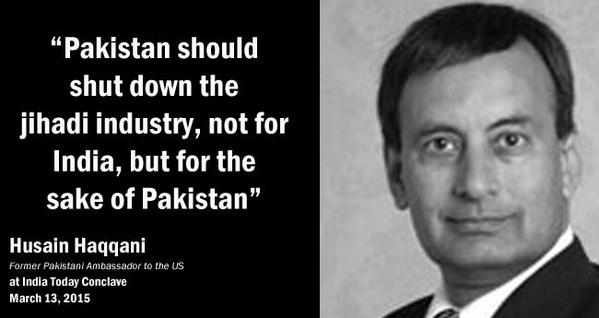
Amb Haqqani

**

Amb. Husain Haqqani has a new piece up on the Hudson Institute site, Prophecy & the Jihad in the Indian Subcontinent, which deals with the Ghazwa-e-Hind. I have quoted Haqqani before on this topic, since he is an eminently credible witness, unlike the propagandist Zaid Hamid.

Key intro para:

Radical Islamists invoke the Hadith (the oral traditions attributed to the Prophet Muhammad) to prophesize a great battle in India between true believers and unbelievers before the end-times. These references in the Hadith to the Ghazwa-e-Hind (Battle of India) infuse South Asia with importance as a battleground in the efforts to create an Islamic caliphate resembling the social order that existed at the time of the Prophet Muhammad and the Rightly Guided Caliphs (632-661 AD).

After discussing the Khorasan-to-Jerusalem and Euphrates-gold ahadith (the latter easily and often interpreted to refer to Middle Eastern oil, aka “black gold”), he turns to the Ghazwa traditions:

In one version of the Hadith, attributed to Thawban, a freed slave of the Prophet Muhammad, “[t]he Messenger of Allah said: ‘there are two groups of my Ummah whom Allah will free from the Fire: The group that invades India, and the group that will be with Isa bin Maryam, peace be upon him.’”4 Isa bin Maryam is the Quranic name of Jesus, whose return to earth alongside the Mahdi is held in Islamic tradition to be a seminal event of the end of time.

In another version, narrated by Abu Hurairah, “[t]he Messenger of Allah promised us that we would invade India. If I live to see that, I will sacrifice myself and my wealth. If I am killed, I will be one of the best of the martyrs, and if I come back, I will be Abu Hurairah Al-Muharrar.” Al-Muharrar translates as “the one freed from the fire of hell.”

We hear relatively little about the Ghazwa-e-Hind narrative in the west, so Haqqani then offers some recent historical context:

Just as the prophecies of Khurasan became popular during the wars in Afghanistan, the Ghazwa-e-Hind divinations became a staple of the Islamist discourse after the launch of jihad in Indian-controlled parts of Kashmir in 1989. Throughout the 1990s, Pakistani official media also encouraged discussion of the Ghazwa-e-Hind Hadith to motivate jihadists. In fact, every major Pakistan-based jihadi group that launched terrorist attacks across the border claimed that their operations were part of the Battle for India promised by the Prophet. For these Pakistani groups, supported by Pakistan’s Inter-Services Intelligence agency, the target of jihad should be the modern state of India and its “occupation” of Kashmir.

**

This next para gave me pause and insight, quoting as it does a Deobandi source:

According to Maulana Waris Mazhari of the Darul Uloom Deoband seminary in Uttar Pradesh, India, the conflict between India and Pakistan over Kashmir was not jihad; the dream of establishing “Muslim hegemony throughout the entire world” was fanciful. “The term ghalba-e Islam, the establishment of the supremacy of Islam, used in the context of the Quran and the sayings of the Prophet (Hadith), refers not to any political project of Muslim domination,” Mazhari wrote, “but, rather, to the establishment of the superiority of Islam’s ideological and spiritual message.”

Haqqani then goes into considerably more detail on Mazhari‘s views, saying for instance:

Mazhari saw the Ghazwa-e-Hind Hadith as an instrument of propaganda in “the proxy war engaged in by Kashmir by powerful forces in Pakistan in the guise of a so-called Jihad,” which he and other Ulema consider “nothing but deceit.”

**

Haqqani next turns to the various contemporary jihadist interpretations of the Ghazwa, starting with the shifts occasioned by the defeat of the Taliban and the death of Osama bin Laden:

The defeat of the Taliban and the arrival of NATO forces in Afghanistan in 2001 shifted al-Qaeda’s major operations to Iraq and Yemen even though Osama bin Laden continued to hide in Pakistan. For some time, discussion of the epic battle for India diminished in the jihadi discourse while grand strategies for the expulsion of Western influence from the Middle East took center stage. The death of Osama bin Laden and the rise of ISIS, however, have revived global jihadist interest in Ghazwa-e-Hind.

and:

The recent revival of interest in the Ghazwa-e-Hind prophecy reflects rivalry between competing jihadi groups. Al-Qaeda, now led by Ayman al-Zawahiri, faces the prospect of extinction as its Arab cadres defect to ISIS, led by Baghdadi. Zawahiri has worked to build alliances with Pakistani jihadi groups and make inroads in India’s Muslim population because it helps him remain relevant in the face of ISIS.

As to that rivalry between AQ and IS, Haqqani concludes his piece:

Al-Qaeda appears to be attempting to maintain support among radical Islamists in the subcontinent by directing its ire at India. Its leaders have been active in Afghanistan and Pakistan since the 1980s anti-Soviet jihad and maintain close ties to the Pakistani-supported Afghan Taliban and Kashmiri jihadi groups. By focusing on India, al-Qaeda hopes to retain the support of Pakistan-backed groups, which interpret the Ghazwa-e-Hind Hadith to mean re-conquest of Hindu India without hitting Muslim Pakistan. Even in Zawahiri’s statement about AQIS, Pakistan was mentioned only as a country that needed to be brought under full Sharia rule while Hindu India was portrayed as the enemy of Islam.

ISIS, on the other hand, has accepted the allegiance of groups that are violently opposed to both the Republic of India and the Islamic Republic of Pakistan. ISIS affiliates appear to have opted for the alternative interpretation of Ghazwa-e-Hind, offered by groups such as the TTP, to pursue jihad in all parts of historic Hind. Indeed, in an ominous declaration, one South Asian ISIS member proclaimed, “[o]ur struggle is ongoing and Insha’Allah after defeating Pakistan Army, we won’t just stop in Pakistan rather we shall continue our advance into Kashmir and India until the laws of Allah are implemented globally and the whole world comes under the rule of one Muslim Khalifah.”

All in all, this is a fascinating and timely article, and I highly recommended it as a counterpoise to our usual concern with westward-facing jihad.

Cologne and Thiruvananthapuram, no contest

Friday, February 20th, 2015

[ by Charles Cameron — more from my endless fascination with the varieties of religious behavior ]
.

SPEC DQ billions no contest

Take the news of the diocese of Cologne‘s $3.8bn fortune by itself, and it’s a shock. Compare it with Sri Padmanabha temple in Thiruvananthapuram’s estimated $22bn trove, and it suddenly seems a much less staggering amount.

**

A couple of interesting points from the two articles in question. In Cologne:

Some 2.4 billion euros were invested in stocks, funds and company holdings. A further 646 million euros were held in tangible assets, mostly property. Cash reserves and outstanding loans amounted to about 287 million euros. [ .. ]

Pope Francis has stressed the need for the church to show humility and emphasize its work for the poor.

The Cologne archdiocese published its accounts on Ash Wednesday, which marks the start of Lent, the period of reflection and repentance leading up to Easter week.

and in Thiruvananthapuram:

The loot includes about 1,000 kilograms (2,205 pounds) of gold coins – some dating back 400 years – ropes of gold, sacks of diamonds, and a gold statue of the Hindu god Vishnu studded with precious gems, as well as an 18-foot solid gold ornament weighing 35 kilograms (77 pounds) and rare silver and brass platters.

So far the find is worth nearly double India’s 2011-2012 education budget ($11.61 billion) – and there’s still another vault to be unlocked. The 16th century Sri Padmanabha temple, in the capital of the southern coastal state of Kerala, is now considered to be the richest of India’s temples.

**

Sources:

  • US News, Cologne
  • Christian Science Monitor, Thiruvananthapuram
  • Contextualizing the beheading of Coptic Christians in Libya

    Monday, February 16th, 2015

    [ by Charles Cameron — in real estate it’s location, location, location — in thought space it’s context, context, context ]
    .

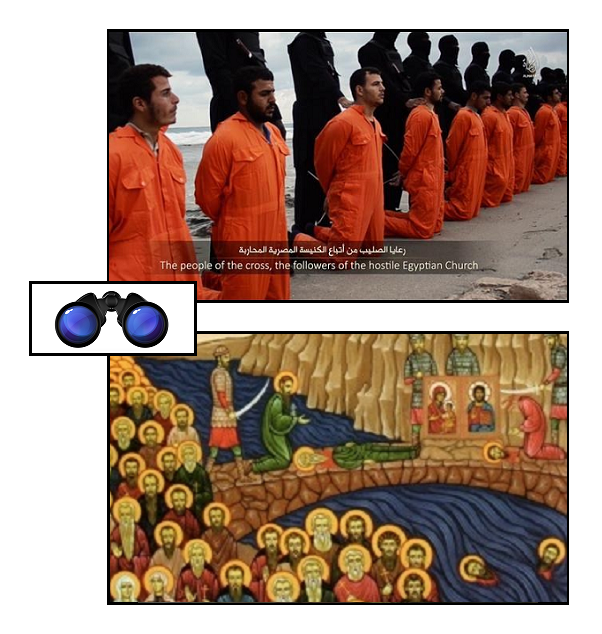
    Timothy Furnish offers us context for the newly released video of Islamic State beheadings of 21 Egyptian Coptic Christians (screencap in upper panel, below) with two striking images of precedents, one of which I have reproduced in part (lower panel), illustrating how the Ottomans beheaded tens of thousands of Georgian Christians:

    SPEC DQ christians beheaded

    Furnish’s post is titled ISIS Beheadings: Hotwiring the Apocalypse One Christian Martyr At A Time.

    **

    I am saddened to say that this is indeed part of the history of Islamic relations with Christianity.

    I am happy to add, however, that it is not the whole story. In the upper panel, below, you see Muslim and Christian at a very different form of battle, as found in the Book of Games, Chess, dice and boards, 1282, in the library of the monastery of San Lorenzo del Escorial:

    SPEC DQ chess and krishna

    Religious tolerance in Islam is illustrated as found today in India, in this picture of a Muslim mother in full niqab taking her son, dressed as the Hindu deity Krishna, to a festival — very probably the Janmashtami or birthday celebration of the child-god (lower panel, above).

    **

    It will be interesting to see how President Sisi repsonds to this murderous IS attack on Egyptian citizens.

    Of morale, angels and Spartans

    Saturday, January 17th, 2015

    [ by Charles Cameron — how sky differs from heaven, and what that means for morale and jihad ]
    .

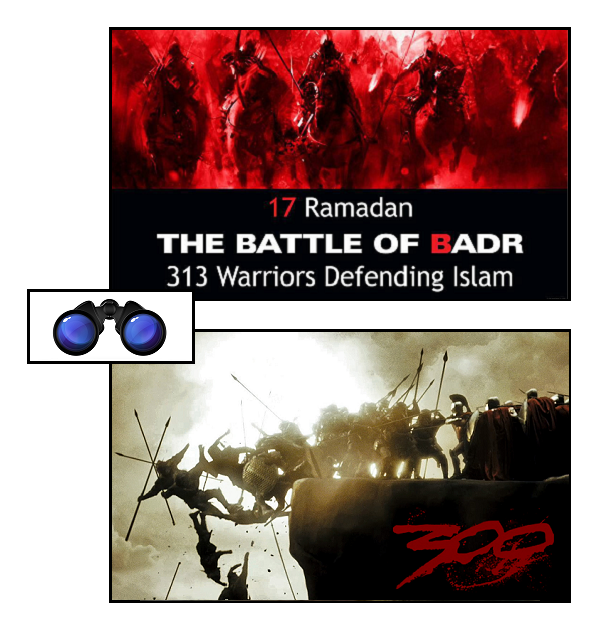
    SPEC Badr & Spartans

    **

    Okay, that Spartans / Battle of Badr DoubleQuote above is just a teaser, locating us in the general zone of morale..

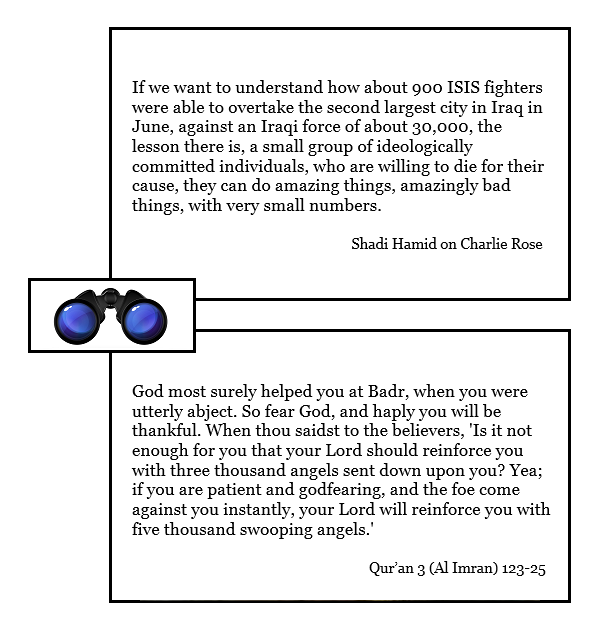
    What I’d really like to offer you here is another Badr-related DoubleQuote, of which the first part comes from Shadi Hamid, speaking about half way through the Charlie Rose show, A conversation about Islam and politics with Reza Aslan, Will McCants, Michael Hanna and Shadi Hamid, which aired on the 14th of this month (full video at the bottom of this post). He said:

    We have to take religion seriously, but I worry sometimes, if we focus too much on religion we forget that there’s a political context. That if we want to understand the rise of Isis we can’t understand that without looking at the political vacuum that emerged in Syria. That didn’t happen by itself; there’s a series of policy decisions from the international community that helped contribute to the rise of ISIS.

    So I guess the interesting question then is, How does religion interact with these political factors. So we have to bring those different variables into focus and I think we lose some of that, we lose that complexity if we’re just saying Islam is the problem. On the other hand, though .. these terrorists and extremists, they believe that what they’re doing, they’re going to be granted direct entry into Paradise, and that inspiration, motivation, is a very powerful thing that we shouldn’t underestimate. And ideology in this sense is a sort of force multiplier on the battlefield.

    All of that seems relevant to me, but it’s his next few phrases I want to DoubleQuote (upper panel, below):

    SPEC DQ Shadi Hamid & Quran

    And whereas Hamid’s explanation, as befits a Brookings Fellow refers to a belief about Paradise, the Qur’an, as befits sacred scripture, treats the world as though it is thronged not with beliefs but with angels..

    **

    The comparison and contrast between our conntemporary, post-Enlightenment view of “the sky” (in which birds, planes, helicopters, missiles and drones may be found, but no angels, jinn, apsarases or faeries) and that of the world’s various scriptural and mythological “heavens” (in which helicopters and parachutes are generally absent, though angels, demons, gandharvas, apsarases and the rest abound) is one that has long fascinated me — but the two are usually kept distinct. Albrecht Durer will show you angels and demons just above the rural countryside in “heaven” — but you won’t find them in military aviations journals..

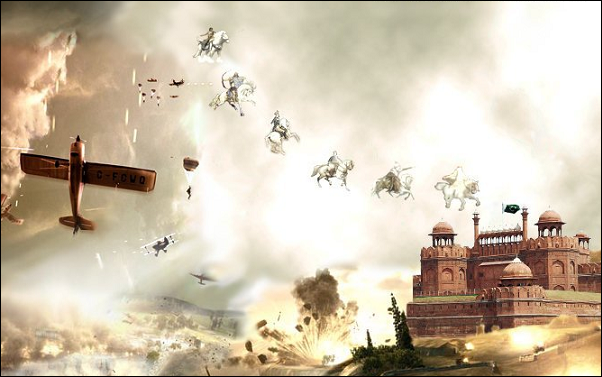
    It is against that background that I find this piece of artwork about the Ghazwa e-Hind so interesting — it appears to envision both “sky” with its various planes and parachutist (most of the planes a little dated, alas), and “heaven” with its celestial cavalry, occupying the same visual space:

    Great Ghazwa Sky meets Heaven

    **

    All this leads me to the question — which would seem to become ever more urgent as we move from textual to visually enhanced modes of communication —

    How does one graphically depict morale or esprit de corps?

    That’s my question for the day.

    ** ** **

    Here, for those who would like to view it in its entirety, is the Charlie Rose show from which Shadi Hamid’s quote above was taken:


    Switch to our mobile site