zenpundit.com » Mexico

Archive for the ‘Mexico’ Category

Destructive Witnesses: JW, IS, Saudis, Brits, Byzantines

Thursday, June 30th, 2016

[ by Charles Cameron — religions taking other religions apart, stone by stone, image by image, song by song ]
.

Some recently converted Jehovah’s Witnesses appear to have destroyed the altars of indigenous Otomi people in Mexico, an anthopologist has stated:

Assailants have damaged an ancient Otomi Indian religious site in Mexico, toppling stone structures used as altars, breaking carved stones and scattering offerings of flowers, fruit and paintings at the remote mountain shrine known as Mayonihka or Mexico Chiquito. [ .. ]

“I don’t know what religion they belong to, but they destroyed several images that were there,” said Daniel Garcia, the municipal secretary of the nearby township of San Bartolo Tutotepec. “The thing is, there are some religions that don’t believe in using idols.”

Luis Perez Lugo, a professor at the University of Chapingo, visited the site in May and talked to residents of a nearby hamlet, El Pinal, whose residents said they had carried out the attack.

“I was there, and the Jehovah’s Witnesses said they had done it,” Perez Lugo said, noting some were recent converts to the religion who used to go to the site for Otomi ceremonies.

See upper panel, below:
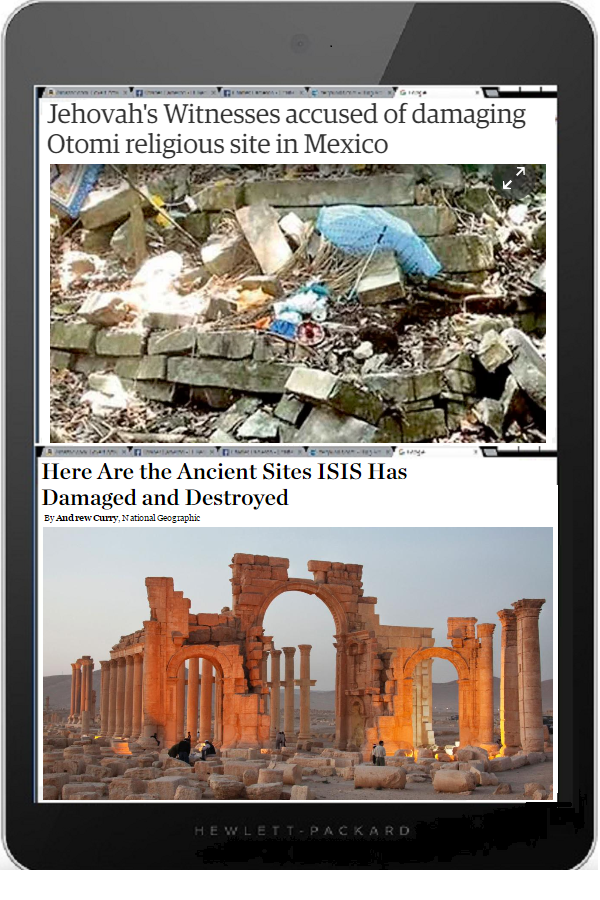
JWs and IS destroy sacred sites

In the lower panel, above, we see a detail from a National Geographic listing of sites attacked by the Islamic State. Three quick notes:

  • the JWs, if they were JWs, were recent converts; converts often have a zeal all their own
  • the IS, like the Taliban at Bamiyan, destroys ancient religious sites even if no longer in use
  • see Saudi Arabia Bulldozes Over Its Heritage for threats to Muhammad‘s birthplace & tomb
  • **

    Why?

    You already know this, but for the record — because Scripture:
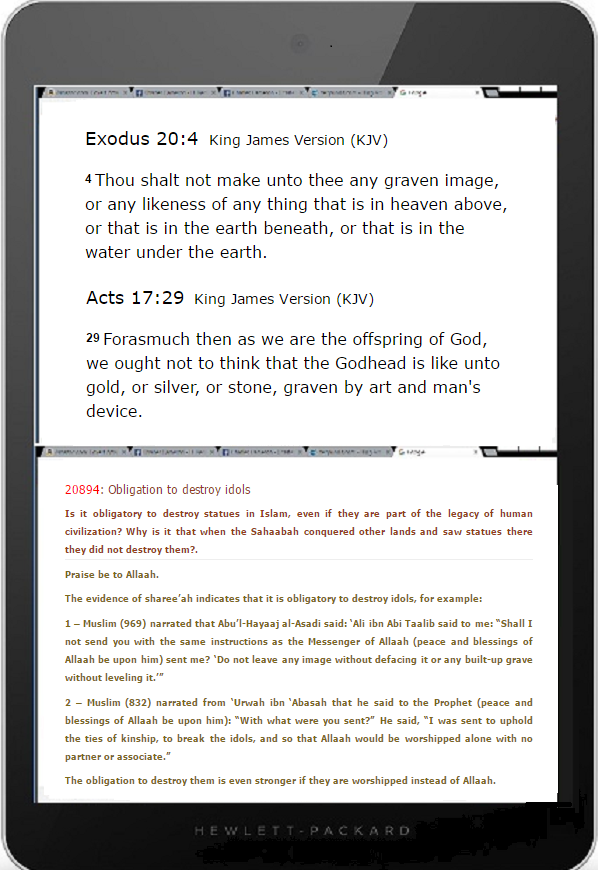
    DQ 600 Graven Images

    In the upper panel, Jewish and Christian scriptures — from the Jewish Ten Commandments in Exodus, and St Paul‘s address to the Athenians, as recounted in the Acts of the Apostles.

    In the lower panel — a hard-line contemporary Islamic commentary, citing two ahadith.

    **

    So it’s Jehovah’s Witnesses and hard-line Muslim literalists who approve of the destruction of monuments to false gods, is that what this means?

    They are not alone. In the upper panel, below, recent news of the Chinese — avowed atheists — continuing their attacks on Tibetan Buddhism, this time by mandating the dismantling of Buddhism’s largest monastic university at Larung Gar:

    DQ 600 Larung Gar Glastonbury

    In the lower panel, above, we see some of what remains of the great Abbey of Glastonbury, torn down during the Dissolution of the Monasteries under King Henry VIII.

    Glastonbury has strong associations with Arthurian and Christian traditions:

    William Blake’s dramatic poem ‘Jerusalem’ familiar nowadays as an inspirational hymn, draws on the myth that Christ himself may have visited Glastonbury with Joseph of Arimathea and ‘walked on England’s mountains green’.

    The Gospels record that Joseph of Arimathea was a wealthy follower of Christ who buried Christ’s body in his own tomb after the Crucifixion.

    In the Middle Ages Joseph became connected with the Arthurian romances of Britain. He first features in Robert de Boron’s Joseph d’Arimathie, written in the twelfth century, as the Keeper of the Holy Grail. He receives the Grail (the cup used by Christ at the Last Supper) from an apparition of Jesus and sends it with his followers to Britain.

    Later Arthurian legends elaborated this story and introduced the idea that Joseph himself travelled to Britain, bringing the Holy Grail with him and then burying it in a secret place, said to have been just below the Tor at the entrance to the underworld. The spring at what is known as Chalice Well is believed to flow from there. In their quests King Arthur and the Knights of the Round Table searched for the Grail.

    Glastonbury retains its place in English hearts to this day, albeit in contemporary guise — it is the Yasgur’s Farm of England’s ongoing Woodstock — mud, sex, drugs, rock and all — the yearly Glastonbury Festival

    It is also — in the form of Blake‘s hymn “And did those feet in ancient time” — a part of such ceremonial events as the Last Night of the Proms — and Royal Weddings:

    But more on Blake’s poem — known as Jerusalem, and taken from his preface to Milton a Poem — in an upcoming post, Creek willing.

    **

    Finally, what an exceptionally lovely early DoubleQUote is this, returning us to the topic of sacred places and images and their destruction:

    Clasm_Chludov

    What we have here is a page from the Chludov Psalter — ask Wikipedia for that what means, I only just ran across it in the course of writing this piece — but it’s a 9th century Byzantine prayer book, illuminated with illustrations attacking the iconoclasts — those Christians who wanted to destroy icons and other Christian images for reasons not dissimilar ton those of the Taliban.

    Wikipedia, Chludov Psalter:

    In the illustration to the right, the miniaturist illustrated the line “They gave me gall to eat; and when I was thirsty they gave me vinegar to drink” with a picture of a soldier offering Christ vinegar on a sponge attached to a pole. Below is a picture of the last Iconoclast Patriarch of Constantinople, John the Grammarian rubbing out a painting of Christ with a similar sponge attached to a pole.

    Let’s take a closer look:
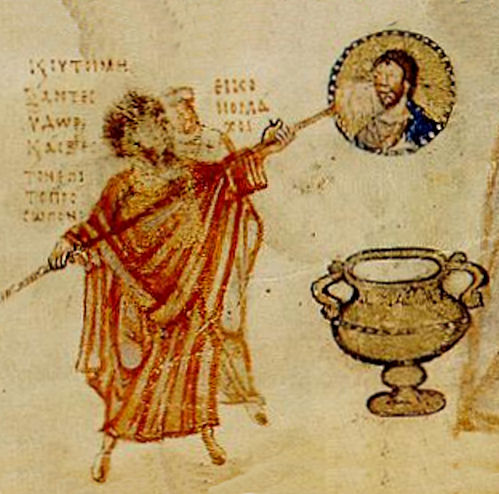
    Clasm_Chludov_detail_9th_century

    Both verbally and visually, then, we have a direct comparison of the Roman soldier mocking the dying Christ, and the icon-hating Patriarch erasing Christ’s image from a wall.. And they call him the Grammarian!

    But let’s proceed:

    John is caricatured, here as on other pages, with untidy straight hair sticking out in all directions, which was considered ridiculous by the elegant Byzantines.

    No punks, apparently, these Byzantines!

    And the coup de grâce? House the sacred book in a state museum..

    Nikodim Kondakov hypothesized that the psalter was created in the famous monastery of St John the Studite in Constantinople. Other scholars believe that the liturgical responses it contains were only used in Hagia Sophia, and that it was therefore a product of the Imperial workshops in Constantinople, soon after the return of the Iconophiles to power in 843.

    It was kept at Mount Athos until 1847, when a Russian scholar brought it to Moscow. The psalter was then acquired by Aleksey Khludov, whose name it bears today. It passed as part of the Khludov bequest to the Nikolsky Old Believer Monastery and then to the State Historical Museum.

    No monks will sing from it there..

    **

    Sources:

  • The Guardian, Jehovah’s Witnesses accused of damaging Otomi religious site in Mexico
  • National Geographic, Here Are the Ancient Sites ISIS Has Damaged and Destroyed
  • The American Muslim, Saudi Destruction of Muslim Historical Sites
  • Islam Question and Answer, Obligation to destroy idols
  • Lion’s Roar, China to displace 5,000 Tibetan Buddhist monastics
  • Orlando Tweets Two

    Tuesday, June 14th, 2016

    [ by Charles Cameron — on a variety of other perspectives ]
    .

    Once again, my point is that there’s a whole lot of going on going on, and it’s worth getting a wide-angle view.. which means multiple perspectives, including those not your own:

    **

    Politicking:

    Joshua Green, Trump seems to regard Omar Mateen as “Afghan” in the same way Judge Curiel was “Mexican”: foreign/un-American, even though both born in US
    Charlene Deveraturda, The Atlantic’s ISIS Expert Graeme Wood Slams Trump For “Hurt[ing] The Fight Against ISIS” With Anti-Muslim Rhetoric

    Both Al-Jazeera‘s and Joshua Green‘s tweets offer us examples of DoubleQuotes thinking.

    **

    Guns:

    Program on extremism, ‘Orlando Shooter Legally Bought Guns Despite Previous Flags by FBI’
    Rob Crilly, Orlando shows arc again. Hate-filled young man with access to guns picks his victims and then selects poisonous ideology to add “meaning”
    Bill Maher, #Orlando Conservatives:”Don’t say it has anything to do with guns!” Liberals:”Don’t say it has anything to do with Islam!”
    Maajid Nawaz, Saying this has nothing to do with Islam (libs) is as ignorant as saying this has nothing to do with guns (cons).Both need reform
    Piers Morgan, Obama’s about to make the same speech he’s made about guns 20 times in his presidency. Just more pointless rhetoric, sadly.
    Steven Crowder, Orlando timeline: Anti-Gay Muslim commits mass terrorism. American gun-owners condemn it. Liberals try to take their guns

    **

    Islamic responses:

    Shadi Hamid, Muslim organizations in the United States unequivocally condemned the Orlando assault
    Usama Hasan, Does #Islam condemn #gays to death?

    and in ISIS perspective:

    Cole Bunzel, ISIS’s A’maq news agency claims Florida attack was “carried out by a soldier of the Islamic State”
    Will McCants, ISIS uses term “fighter” for Orlando attacker rather than “soldier” (Paris/Brussels) or “supporter” (San Bernardino) for whatever it’s worth

    **

    And finally, barely mentioned in the welter of opinions about Orlando — the other shoe:

    JM Berger, We may have narrowly escaped having two very similar massacres on the same day, apparently unconnected
    JM Berger, The fact that one was prevented and one was not is largely a trick of fate. We need robust reporting on LA incident as well

    Patricia, the gathering storm

    Friday, October 23rd, 2015

    [ by Charles Cameron — spiral storming in the atmosphere, spiral vertiginous in the mind, inbound ]
    .

    Visual and verbal expressions of computational cognition:

    SPEC Patricia visual verbal

    Which conveys the most, which is most easily grasped, and how much do the models know?

    Sources:

  • Slatest, Patricia, Strongest Hurricane in History, Nears Mexico Landfall
  • Tribune, Forecasters: Patricia is strongest hurricane ever recorded in Western hemisphere
  • **

    Need to know, and why?

    SPEC Patricia need to know

    The zoom in, from need to know to why, exactly?

    Sources:

  • New York Times, Hurricane Patricia: What You Need to Know
  • New Scientist, Did climate change set the scene for hurricanes like Patricia?
  • **

    Cognitive dissonance:

    SPEC Patricia cog diss

    Cognitive dissonance, the human condition — or counterpoint, as understood by Bach and Glenn Gould?

    Sources:

  • NPR, Why Hurricane Patricia Can’t Be Blamed On Climate Change
  • Wired, Thank El Niño and Climate Change for Huge Hurricane Patricia
  • Review: Blood Meridian by Cormac McCarthy

    Sunday, August 16th, 2015

    [by Mark Safranski, a.k.a. “zen“]

    Blood Meridian: or The Evening Redness in the West by Cormac McCarthy

    Cormac McCarthy and Blood Meridian first came to my attention back in 2000 when noted literary critic, Yale professor Harold Bloom was interviewed on C-Span’s Booknotes regarding his book, How to Read and Why. Bloom, an eccentric character who owns a personal collection of 95,000 books, gave Blood Meridian and McCarthy, of whom at that time I had never heard, a remarkable endorsement:

    ….One book in particular, a very great book and I’m very glad you bring it up, Brian, a book called “Blood Meridian,” which I write about at some length at one point in this book. Many of McCarthy’s novels are remarkable, including “All The Pretty Horses,” the first volume of the Border Trilogy. I–I don’t think the second and third volumes are quite as fine. And some of his earlier novels like “Suttree” are very Faulknerian, somewhat derivative, are still remarkable books. But he has written one masterpiece, which I would say is–I mean, of contemporary American fiction, of fiction written by human beings still alive and among us, I would list Philip Roth’s “Sabbath’s Theater” and “American Pastoral.” I would list Don DeLillo’s “Underworld.” I would certainly list Thomas Pynchon’s “The Crying of Lot 49” and “Gravity’s Rainbow” and his recent and magnificent “Mason and Dixon.”

    But if I had to vote for one novel by a living American, it would be “Blood Meridian,” which is a fearsome story and terrible parable in which I think has a deep, implicit warning for current American society….

    ….But it’s fascinating to me that you ask that, Brian, because the first two times that I read it, I could not read it. And I admit this to my students and I admit that in this book. I broke down–I don’t know what–after 15 or 20 pages the first time and after 70 or 80 pages the second, because the sheer carnage of it, though it is intensely stylized, is nevertheless overwhelming. It’s–it’s–it’s shocking. It’s–it’s horrifying. And it takes a very strong stomach, but if you break through it, if you–if you read your way into the cosmos of the book, then you are rewarded. You get an extraordinary landscape. You get an extraordinary visionary intensity of personality and character. You get a great vision, a frightening vision of what is indeed something very deeply embedded in the American spirit, in the American psyche. And the more you read the book, I find, the more you will be able to read the book. It is–it’s as close, I think, to being the American prose epic as one can find, more perhaps even than Faulkner, though there are individual books by Faulkner like “As I Lay Dying,” which are perhaps of even higher aesthetic quality and originality than “Blood Meridian.” But I think you would have to go back to “Moby Dick” for an American epic that fully compares to “Blood Meridian.” 

    I made a mental note of this despite the fact that Western novels were not my thing. After a while, I read Bloom’s book, which had some interesting, additional insights and then thought no more about the matter until many years later when I watched the film No Country for Old Men, based upon the McCarthy novel. I thought Anton Chigurh was a chilling antagonist, as demonstrated in the scene below:

    The screen depiction of Chigurh caused me to recollect Bloom’s commentary regarding the ominous central character and the antagonist of Blood Meridian, Judge Holden, who may or may not have been a historical person:

    ….And the Glanton gang, an extraordinary group of free booters or filibusters, have with them as their spiritual leader a frightening manifestation, a Melvilleian–a kind of human Moby Dick, Judge Holden, who is a vast albino fellow as round as I am but seven foot tall and who has all languages, all knowledges and who preaches endlessly of the theology of violence and war, and who is still alive and dancing and fiddling and proclaiming that he will never die at the end of the book. And indeed, he has never died. He–he is responsible for those horrible posses we have out there in Idaho. He is responsible for those people who blew up the Federal Building. He is responsible for these mad people who break into schools and shoot children. There is–we–we are a country that has had a kind of perpetual ongoing religious revival since the year 1800, and simultaneously, we have been completely gun crazy for the last two centuries. And in some sense, that’s what McCarthy’s great book is about.

    Blood Meridian was inspired by the exploits of the marauding, scalp-hunting, Glanton Gang in the mid-19th century Southwest and Northern Mexico in the years after the Mexican War. The nameless protagonist, known only as “the Kid” escapes massacre and is saved from  abject poverty and starvation in the desert when he reluctantly joins up with Captain Glanton’s mercenary company of Indian fighters. Glanton’s gang is bound for Mexico with a rich contract from a Mexican governor to kill off and scalp the murderous, hated, dangerous Apaches.  Glanton, the leader of the enterprise, is a laconic, impulsively violent, stone-cold, professional killer whose eyes were “burning centroids of murder”; most of his crew of cut-throat vagabonds, renegade Indians and Texan filibusteros the Kid interacts with are cut from the same, if duller, cloth as Glanton, but a few stand out; Benjamin Tobin the ex-priest, Louis Toadvine the outlaw, Davy Brown, who wears a necklace of human ears and repeatedly spars verbally with Glanton’s eerie second in command, Judge Holden.

    Having been hired to kill marauding Apaches, Glanton’s company proves itself Golem-like, to be a cure worse than the disease. With some good fortune, Glanton’s men improbably prevail in their scalping raid despite being outnumbered 500 to 1 by the Apaches. Their fury, goaded by Glanton and Judge Holden, is anarchic and protean, instigating a kaleidoscopic bloodbath akin to a Biblical plague, consuming Mexicans, settlers, women, children, saloon-keepers, whores, herds of livestock and whole villages perish by their guns and bowie knives. Glanton’s men also perish, yet the company fights and murders and rapes and pillages along its way despite ever diminishing numbers until dirt and blood are caked indistinguishably on skin, clothing and horse. In this, McCarthy has captured something of the reality of war, especially irregular war in frontier spaces in a way that exceeds all contemporary fiction. Only reality will do for comparison and we must search for kindred horrors in places like Mexico, the Congo or Iraq. Glanton’s men would be at home with ISIS (or in fighting them), cutting off Zeta heads in Mexican plazas or tearing up Waziristan country, leaving smoking villages and violated mosques in their wake.

    Judge Holden figures centrally here. Many critics and fans have commented upon the possibly supernatural nature of Judge Holden, a characteristic that increases and becomes more evident as the novel matures. An albino giant of tremendous size and strength, the Judge is nevertheless nimble and cunning, speaking at need all languages and mastering every art to which he cares to put his hand, the Judge can orate like Cicero, fight like a savage and outdance the Devil.  Judge Holden reflects many different literary archetypes – the trickster, Old Scratch, the mysterious Stranger, Woland and so on, but what Holden is more than any of that is a prophet of war without limit, reason or restraint. The Judge is a Clausewitzian death-god, delighting in the unchaining of chaos and murder:

    ….The judge cracked with the back of an axe the shinbone on an antelope and the hot marrow dripped smoking on the stones. They watched him. The subject was war.

    The good book says that he that lives by the sword shall perish by the sword, said the black.

    The judge smiled, his face shining with grease. What right man would have it any other way? he said.

    The good book does count war as an evil, said Irving. Yet there’s many a bloody tale of war inside it.

    It makes no difference what men think of war, said the judge. War endures. As well ask men what they think of stone. War was always here. Before man was, war waited for him. The ultimate trade awaiting its ultimate practitioner. That is the way it was and will be. That way and not some other way

    He turned to Brown, from whom he’d heard some whispered slur or demurrer. Ah, Davy, he said. Its your own trade we honor here. Why not take a small bow. Let each acknowledge each.

    My trade?

    Certainly.

    What is my trade?

    War. War is your trade. Is it not?

    And ain’t it yours?

    Mine too. Very much so.

    What about all them notebooks and bones and stuff?

    All other trades are contained in that of war.

    Is that why war endures?

    No, it endures because young men love it and old men love it in them. Those that fought, those that did not.

    That’s your notion.

    The judge smiled. Men are born for games. Nothing else. Every child knows that play is nobler than work. He knows too that the worth or merit of a game is not inherent in the game itself but rather in the value of that which is put at hazard. Games of chance require a wager to have meaning at all. Games of sport involve the skill and strength of the opponents and the humiliation of defeat and the pride of victory are in themselves sufficient stake because they inhere in the worth of the principals and define them. But the trial of chance or trial of worth all games aspire to the condition of war for here that which is wagered swallows up the game, player, all.

    ….This is the nature of war, whose stake is at once the game and the authority and the justification. Seen so, war is the truest form of divination. It is the testing of one’s will and the will of another within that larger will which because it binds them is therefore forced to select. War is the ultimate game because war is at last a forcing of the unity of existence. War is god.”

    Although he did not see the Clausewitzian absolute war in Holden, Bloom’s analysis comes very close:

    The violence is the book. The Judge is the book, and the Judge is, short of Moby Dick, the most monstrous apparition in all of American literature. The Judge is violence incarnate. The Judge stands for incessant warfare for its own sake.

    Indeed, as the story shifts for imperceptible reasons, Holden perhaps withdraws his apocalyptic benediction from the gang, Glanton is killed and his men dead or scattered by the vengeful Yuma Indians. The Kid senses the judge is no longer the ally he once was but a dangerous enemy and the ex-priest Tobin knows it and desperately fears what is to come. They take their leave but Holden tracks and hunts them in the desert, seemingly to no avail until, decades later, the Kid and the judge cross paths again, last survivors of the Glanton Gang.

    Blood Meridian is a must read book.

    ADDENDUM:

    Actor-director James Franco is a devoted fan of Blood Meridian and has attempted a video sketch/rough cut of one of the book’s more important scenes. The short video does not make it on all accounts. Their Judge Holden is miscast (if good casting is possible) but the Kid and Tobin are well represented and the dialogue and screenplay are true to McCarthy’s intent. It is worth a watch.

    A song of the narco-miraculous

    Friday, May 15th, 2015

    [ by Charles Cameron — on dark spirituality, magic and apocalyptic ]
    .

    I’ve received a review copy of Tony Kail’s Narco-Cults, and by chance when I first opened it, my eye fell on a miracle story.

    **

    Here, in a clip from a narcocorrido video, is an officer of the US Border Patrol vanishing into thin air as the result of a Santeria invocation:

    narco miracle

    Here’s the book’s narrative description of that event:

    Consider the following story. A Cuban Santería priest speaks into a twoway radio as three Hispanic men cross over the border into Arizona. One of the men, who is transporting drugs under his clothes, wears several multicolored Santería necklaces (elekes). The man responds to the priest on the radio as a U.S. Border Patrol agent begins to follow him. As the “coyotes” begin to run from the agent, the agent draws his weapon and aims it at the smugglers. As the priest whispers an incantation into the radio, the agent mysteriously disappears into thin air. The men jump into the agent’s truck and drive away as the priest kneels before the image of Elegua, a Santería deity who is believed to be the owner of fate and the crossroads. mages of drug smugglers bowing in front of statues of saints and figures like Santa Muerte are seen as music begins to play away in the background.

    This is a scene from a popular narco music video called La Clika Del Elegua from Mexican musician El Pelon Avile. The video is a perfect depiction of how spiritual traditions are used by modern-day drug smugglers for protection in the drug war.

    Here’s the video of the narcocorrido in which the miracle is depicted:

    **

    Turning the page, we find:

    The heavy scent of spirituality among the cartels is so prevalent that some members of law enforcement have sought shelter in magical religions for protection. Members of the Mexican police have been documented in the media as undergoing various rituals for protection from the cartels. Some officers have even had tattoos of sacred religious symbols placed on their bodies to give them magical protection. One officer in Tijuana shared that his tattoos gave him protection from bullets that killed his comrades during a gunfight.

    How far is that from, say, this:

    Christian group brushes aside death threat from kidnappers

    Death threats against 13 Christian preachers from their Muslim extremist captors are not a concern as the evangelists are confident God will protect them, a member of the Christian ministry said Thursday.

    The kidnapped head of the Jesus Miracle Crusade, fiery televangelist Wilde Almeda, particularly has special powers that will protect him from bullets, said Robert Chua, a member of the group.

    Or for that matter:

    The Second Battle Of Adobe Walls

    A charismatic medicine man, named Ish-Ta-Ma, claimed he could make the warriors bullet proof and that his bowel movements would provide rifle cartridges. ..

    Emboldened by Ish-Ta-Ma’s prophesies, the combined tribes of Southern Cheyenne, Comanche and Kiowa, near one thousand strong, advanced towards Adobe Walls before daylight in what should have been an easy route. Fate was not in their favor.

    Or:

    Thomas Muentzer

    When the final showdown comes in 1525, the peasants are arrayed against the German princes and their army, and Thomas Muentzer continues to assure them, even at the last moment, that Christ will intervene on their side. This is the apocalyptic moment foretold in the Revelation. They’re singing hymns. They literally are awaiting a glorious triumph. Muentzer assures them that he will catch the cannonballs in his shirthsleeves. Of course, it turned into a slaughter. Five thousand ill-equipped peasants were slaughtered. The Peasants’ Revolt was utterly destroyed. It was one of those incredible explosions of apocalypticism that arise in history.


    Switch to our mobile site